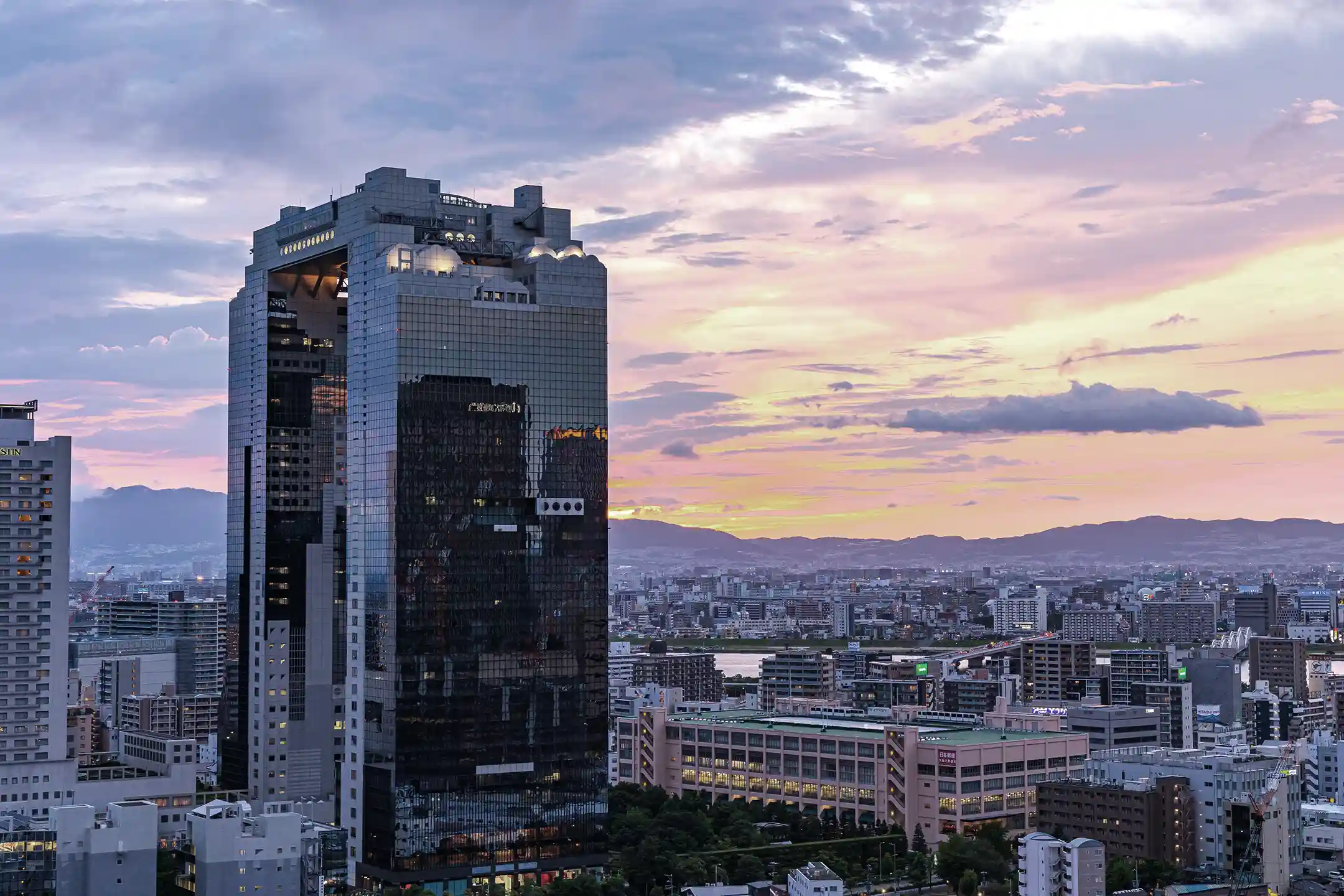
The Umeda Sky Building is the twin-towered skyscraper north of Osaka Station whose two 40-story blocks are joined at the top by a ring-shaped deck, the Kuchu Teien Observatory, or Floating Garden Observatory. Admission is 2,000 yen for adults, the deck is open from 9:30 to 22:30 with last entry at 22:00, and the walk from JR Osaka Station takes about seven minutes. This guide covers the tickets and the route up, how the deck compares with Tokyo's Shibuya Sky, when to go, and the story of a building that was planned with four towers and finished with two.
It also corrects a quotation that an earlier version of this guide attributed to the architect and an unsourced claim about a bridge on the 22nd floor, and it fixes a price comparison with Shibuya Sky that was wrong on both sides.
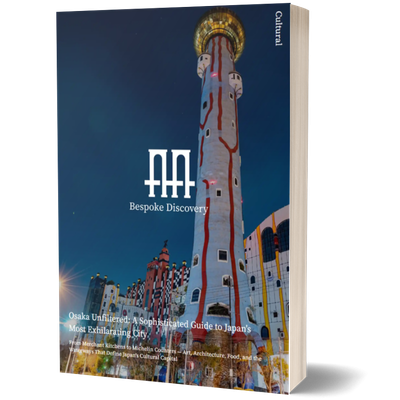
This article is one way into Osaka — a single street in a much larger city. The Osaka Unfiltered Digital Guide gathers its food, its neighborhoods, and the history beneath them into one connected reading.
Umeda Sky Building Tickets, Hours and the Route to the Roof

The operator's hours and tickets page sets admission at 2,000 yen for adults and 500 yen for children from age 4 through elementary school; children under 4 enter free. Visitors with a disability certificate pay half the regular price, and the operator's page extends the same rate to their helpers, up to the same number; the Osaka Convention and Tourism Bureau's accessibility page says one companion. Same-day tickets are sold at the counter on the 39th floor. The official ticket page also lists an advance e-ticket, sold through Asoview at 1,800 yen for adults against the regular 2,000, along with bundles that add a soda float, a bottle of sparkling wine for two, or a heart-shaped padlock, which is sold only with web tickets. The operator's English site adds that holders of the Osaka Amazing Pass enter free from 9:30 to 15:00 and get 10 percent off from 15:00.
The deck is open every day from 9:30 to 22:30, with last entry at 22:00, but the official page lists exceptions in advance. On November 8, 2026, it closes at 19:00 (last entry 18:30) for a facility inspection, and on October 17, 2026, the night of the Naniwa Yodogawa fireworks, the day was split into three sessions. The same page warns that in stormy weather you may not be allowed onto the roof. The warning names the roof; the indoor gallery on the 40th floor has the same 360-degree view behind glass.
The way up is part of what you pay for. The national tourism agency's multilingual description of the observatory traces the route: a departure gate on the 3rd floor whose walls carry quotations about the sky from the Rig Veda, Gulliver's Travels and Kenji Miyazawa's Night on the Galactic Railroad; an elevator to the 35th floor, which nippon.com describes as giving a 360-degree view on the way up, and the cloud-covered Sky Wall waiting there; then a tube-shaped escalator of steel and glass that crosses the open gap between the towers to the 39th-floor sky lobby, with the ground far below. Above it, the 40th floor is a circular indoor gallery with a 360-degree view and cafe SKY 40, and on the roof is the open-air ring called the Sky Walk.
Getting to the Umeda Sky Building From Osaka Station
The building is about a seven-minute walk from JR Osaka Station and about nine minutes from Hankyu Osaka-umeda Station and Osaka Metro Umeda Station, according to the Osaka Convention and Tourism Bureau's accessibility page. The official English directions from JR start at the Renrakubashi ticket gate on the 3rd floor of the station. Head for the Central North Exit, take the escalators down to ground level, pass the south building of Grand Front Osaka, and at the crossing go down into an underground walkway of about 40 meters. Come back up, cross one more street, and you are at the towers. The highway bus terminal run by WILLER sits on the 1st floor of Tower East, which makes the building a practical first or last stop for anyone arriving or leaving by overnight bus.
Wheelchairs, Strollers and Places to Rest
The standard route has one barrier: above the 35th floor there is only the escalator. Wheelchair users take the high-rise elevator from the 1st floor of Tower East straight to the 39th floor, and a separate elevator links the 39th and 40th floors for wheelchairs and strollers. From the Umeda side, the tourism bureau recommends the ground-level route and the underground passage, which has a ramp. One loaner wheelchair is available. Nursing rooms are on the 39th and 40th floors; the 40th-floor restroom has a diaper-changing table, and the 39th-floor restroom has ostomate facilities. If you want to sit with the view, the 40th floor has a glass counter 35 meters long running along the windows. The same page notes guidance in English, Korean and Chinese, and wheelchair parking in the B2 car park.
Umeda Sky vs Shibuya Sky: Which Deck Suits Your Trip

Travelers doing both Tokyo and Osaka often ask which of the two open-air decks to choose. The facts first. Shibuya Sky is on the roof of Shibuya Scramble Square, which opened on November 1, 2019, and its operator's February 2025 release puts the rooftop at 229 meters above ground. Shibuya sells each ticket for a set date and a 20-minute entry window, and the web price for adults rises from 2,700 to 3,400 yen at 15:00. The Umeda Sky Building is 173 meters tall, opened in 1993, and keeps a regular adult price of 2,000 yen at any hour (1,800 yen in advance online). The official pages we checked describe no entry slot of the kind Shibuya Sky uses.
The rules on the roof differ too. On Shibuya's roof, according to Tokyo's official tourism site, GO TOKYO, tripods, selfie sticks and loose hats are not allowed, and bags go into lockers. In Umeda, the operator's notice for the February 2026 sunset season said only that tripod use may be restricted when the deck is crowded, and the hours page lists no item restrictions; that is an absence of published rules, not a promise that anything goes.
The useful way to choose is by what each deck is for. Shibuya Sky's signature view is straight down, onto the Scramble Crossing and a skyline of towers. The Umeda deck was built as the building's own centerpiece, the ring that holds two towers together, so the structure is the first thing you see. Then comes the view: the Yodo River and the mountains beyond it to the north, Osaka Bay to the west at dusk, and the lit streets of southern Osaka after dark, in the Japan Tourism Agency's description. If architecture is part of why you travel, Umeda gives you a building worth the trip in itself. If you want the city's most famous street scene from above, Shibuya does that better. Our Shibuya Sky guide covers the Tokyo side in detail.
Best Time to Visit the Kuchu Teien Observatory: Day, Sunset or Night

Day or night is the most common question, and the answer is the hour that holds both. The deck has been chosen for Japan's 100 Best Sunsets and for a list of 100 night views, nippon.com reports. West of the building there is open sky over Osaka Bay, which is why a visit timed to arrive before sunset covers daylight, dusk and the first city lights on a single ticket. Daytime has its own case: in daylight you can follow the Yodo River north to the hills and pick out the gardens at the building's feet.
The Sunset Over the Akashi Kaikyo Bridge
Twice a year the sunset lines up with something specific. On a few days in February and again in October, the operator says, the sun sets into the middle of the Akashi Kaikyo Bridge, the suspension bridge between Kobe and Awaji Island. The operator publishes a forecast for each season. For 2026 it gave February 19 to 22 in a press release and October 20 to 22 on its official site. The release calls the dates a forecast, notes that weather changes what you see, and warns that tripods may be restricted when the deck is busy. If your trip falls in one of those windows, arrive well before sunset and take a place on the west side.
The other end of the day has its own opening. For the first sunrise of 2026, the official hours page listed a special opening on January 1 from 6:00 to 8:00, with web tickets only. Watching hatsuhinode, the first sunrise of the year, is an old New Year custom in Japan, and the operator's hours page is the place to check whether a special opening is listed for your year.
After Dark on the Sky Walk
The rooftop ring was fully renewed in October 2023 as the Lumi Sky Walk, according to the official ticket page. The design idea behind the open ring, in the agency's words, is the space a spaceship leaves behind after it has flown off, and lighting fixtures around the deck echo that spaceship. The operator sells heart-shaped padlocks with its web tickets, and Wikipedia mentions a "Fence of Vows" on the deck. One floor below the roof, cafe SKY 40 roasts its own coffee and stocks around 50 beers from around the world. On the 39th floor, Sky Lounge Stardust lists about 300 cocktails, and Chinese Restaurant Sangu serves Cantonese dishes. For something seasonal, check the official site before you go. For late 2026 it lists an anime collaboration with My Hero Academia from October 30 to November 30 and a Christmas program from November 13 to December 25.
How the Umeda Sky Building Was Built: Four Towers Planned, Two Built

The building you see is half of a plan. Japan's national tourism organization, on its Hong Kong site, notes that the original idea was four large buildings joined at their rooftops, and that two were completed in 1993, at the end of the bubble years. The English Wikipedia entry, citing a 2016 nippon.com article, adds that the concept, called the "City of Air," dates to 1988, that a third tower was to stand on the ground now occupied by a vegetable garden and a fourth to the east of it, and that the economic damage of the bubble's collapse cut the plan to two. Had the plan been built, the ring you stand on would have been one link among several.
What was built was still new. The City of Osaka's architecture profile of the building, which it lists under the name of its complex, Shin-Umeda City, credits the design to Hiroshi Hara and Atelier Phi and describes two towers standing about 50 meters apart and joined at their 39th and 40th floors as the world's first connected skyscraper. At 173 meters, it was the tallest building in western Japan when it was completed in 1993. The profile's author, the architectural historian Shunsuke Kurakata, adds that taller buildings have since passed it, but that in the height of its ideas it is still among the best in the world, and he counts it among the few skyscrapers in Japan that deserve to be called an architect's work. The same profile says the British newspaper The Times picked it among 20 buildings representing the world; an experience site run with support from the Osaka Convention and Tourism Bureau names a British publisher, Dorling Kindersley, and its "Top 20 Buildings Around the World." The same page traces the idea of joining the towers to Hollywood: Hara, it says, was inspired by the 1974 film The Towering Inferno to connect the top floors of two towers with an observation deck. Kurakata also describes the detailing as a deliberate mix of many different designs that together form a landscape suggesting a village of the future. Nippon.com notes that overseas the building was reportedly called a "triumphal arch of the future." The operator says the facade is clad in about 17,000 half-mirror glass panels, and Kurakata notes that the sky reflected in that glass is what makes the connecting section, named the Floating Garden, appear to float.
The Lift-Up: Building the Floating Garden on the Ground

The ring was not built in the air. It was assembled at ground level and then hoisted into place. Nippon.com describes this as the first use of the lift-up method anywhere and says the deck was fixed between 150 and 173 meters above ground; the agency calls the method unprecedented. According to Wikipedia, the glass escalators and elevators were raised the same way.
The two sources disagree on one number. Nippon.com gives the see-through escalator a length of 45 meters; the agency says it stretches about 40 meters across the space between the towers. Either way, it is the moment most visitors remember.
Reading the Futurism Inside
The building explains itself if you look. On the inner wall of the 40th-floor gallery, panels trace humanity's dream of the sky from the ziggurats and pyramids through the present to space elevators, orbital habitats and, finally, a self-sufficient city in the air. On that timeline, the agency notes, the building's completion in 1993 sits exactly two-thirds of the way along. Read with the four-tower plan in mind, the panel is the most candid object in the building: it places this tower on a road toward a city in the air, and the plan that was to carry it further stopped at two towers. The quotations at the 3rd-floor gate, the cloud wall on the 35th floor and the empty ring a spaceship has left behind on the roof all belong to the same argument. The view is the reward, but the building's subject is the future of cities.
A correction belongs here. An earlier version of this guide credited Hara with a remark about connected towers as a step toward future cities and attributed it to nippon.com's Japanese article; that article does not mention Hara at all. The same version said an emergency bridge links the towers at the 22nd floor, without a source, and we could not find one. Both claims have been removed. The four-tower plan and the futurism panels make the point the quotation was meant to make, with evidence behind them.
The "village of the future" is the thread that ties the building to its architect. Hara died on January 3, 2025, at the age of 88. Casa BRUTUS, reporting his death, introduced him as the designer of the Umeda Sky Building and of Kyoto Station, and as an architect who brought the "lessons of villages" from around the world to fruition in his buildings. Taken together with Kurakata's "village of the future," the Floating Garden looks less like a viewing platform than a village street lifted 170 meters into the air: a shared open space reached by a path, with the city spread around it. If your trip continues to Kyoto, the station you arrive at is Hara's work too, and seeing both in one journey is the easiest way to know an architect who is no longer here to explain them.
The building is still being restaged. In 2016 nippon.com reported that the observatory was setting new visitor records and attributed the rise to its popularity with international travelers. Since then the operator has renewed the rooftop (2023), and in June 2025 Rakuten Travel reported a new photo spot on the 40th floor, round windows framed in lights whose colors change with the season. A deck designed to show a future city is now also being staged for the photograph its visitors take home.
Below the Umeda Sky Building: Takimi Koji and the Gardens

The future is on the roof; the past is in the basement. Takimi Koji, on the B1 and 1st floors, is a restaurant street built as a stage set of old Osaka, with about 20 shops, mostly restaurants, according to GOOD LUCK TRIP, whose listing also notes that opening hours and closing days vary by shop and that the street has coin lockers and restrooms; the operator's English site adds an ATM and a post office there. GOOD LUCK TRIP also lists a hand-pumped well and a round postbox. The operator adds an Inari shrine where you can draw a fortune slip, a Daihatsu Midget three-wheeled truck from Japan's high-growth years and, beside the police box, a statue of Nipper, the dog from the gramophone trademark. The tourism agency's description adds full-size dioramas of an early three-wheeler and a 1950s living room, and restrooms tiled like an old public bathhouse with Mount Fuji painted on the wall.
The official materials do not agree on which decade the street recreates. The operator calls it a Showa-retro shopping street. The agency says it takes as its model the atmosphere of Hozenji Yokocho, the famous back lane near Dotonbori, in the 1920s. The exhibits themselves run from that 1920s mood to the postwar high-growth years. Treat it as a memory of the city assembled from several decades, not as a reconstruction of one, and the mismatch becomes part of the fun. The name helps too: Takimi Koji means "waterfall-viewing lane," and from inside it you can see the larger of the two waterfalls in the garden outside.
That garden, Naka Shizen no Mori, lies southeast of the building and was designed as a natural oasis among the towers, with a small waterfall that runs from bottom to top as well as the larger one. North of the building, Shin-Satoyama is a concept garden planted only with native species, with small plots where local kindergarten and elementary school children grow vegetables and rice. Just northeast, the tourism agency described in 2023 a wall of greenery 78 meters long and 9 meters high designed by Tadao Ando, the Wall of Hope. Across the grounds, the operator says, stand 44 stone statues. Inside the towers, Theatre Umeda shows films on the 3rd and 4th floors of Tower East, and the Koji Kinutani Tenku Art Museum occupies the 27th floor of Tower West. All of these make the building a full afternoon on a day when the roof is closed.
If Takimi Koji leaves you wanting the working version of Osaka's food culture, our guide to Kuromon Market covers the city's best-known market, and for an evening that ends somewhere quieter, our guide to private onsen in Osaka looks at in-room baths in the city. Readers who came for Hara's building may also like our architecture tour of Tokyo.
Stay a little longer in Osaka

Planning Your Umeda Sky Building Visit
Buy the advance e-ticket if you know your day, or pay 2,000 yen at the 39th-floor counter; with an Osaka Amazing Pass, go before 15:00 for free entry. Arrive before sunset to see the city by daylight, at dusk and at night, and if your dates fall in late February or late October, check the operator's forecast for the sun setting into the Akashi Kaikyo Bridge. On a stormy day the roof may close; the 40th-floor gallery has the same 360-degree view behind glass, and Takimi Koji, the gardens and the museum fill the rest of the visit.
Is it worth going up? If you want only a high view, 2,000 yen buys one; the reason to choose this deck is the building itself, so look at the building before you look from it. The ring at the top was meant to be one link of a larger plan that stopped at two towers, and the panel on the 40th floor still marks where 1993 stood on the way to a city in the air.