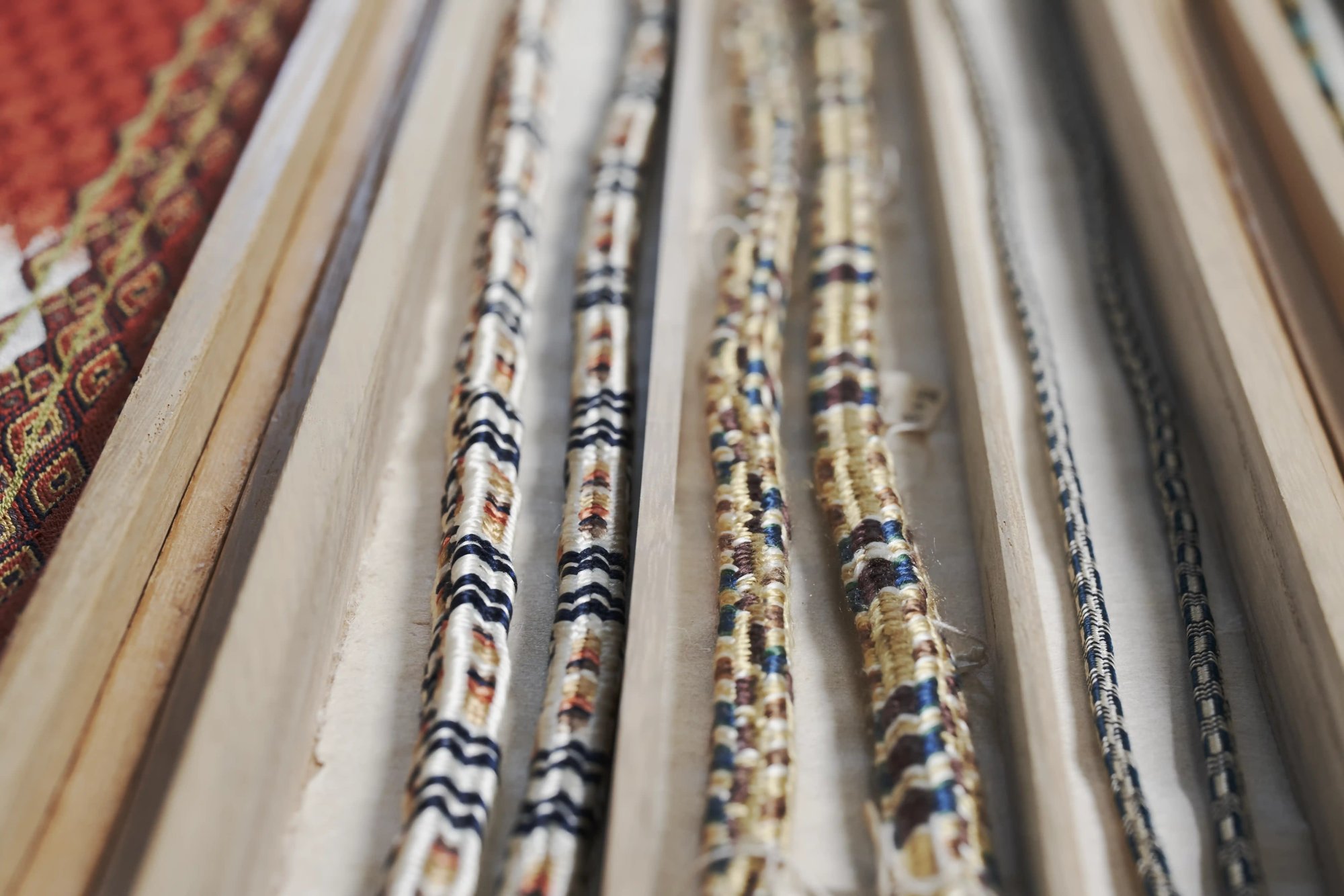
A sageo is the silk cord tied to a katana's scabbard; the tsuka-ito is the cord wrapped around its handle. Both are easy to overlook on a mounted sword, because the eye goes to the guard and the metal fittings. Yet they are two places on a katana where the work is done by a cord rather than by steel, fitted metal or lacquer.
This guide reads the sword from the side of those cords: what each one does, why each is braided rather than twisted like rope, who made them, and how a sword cord became the cord on a kimono sash. It treats Japanese braided cord, kumihimo, as a technology of arms rather than an ornament. The braiding side comes from Kiichiro Domyo, president of the Tokyo braiding house Domyo, whom we interviewed for an Our Masters article published in August 2026, and from the house's own written history; the sword side comes from the polisher Yasumasa Nagaoka and from Japanese museums. Where a fact comes from a museum or the house's history rather than from what either man told us, the text says so.
What Is a Sageo? The Silk Cord That Ties a Katana to Its Wearer
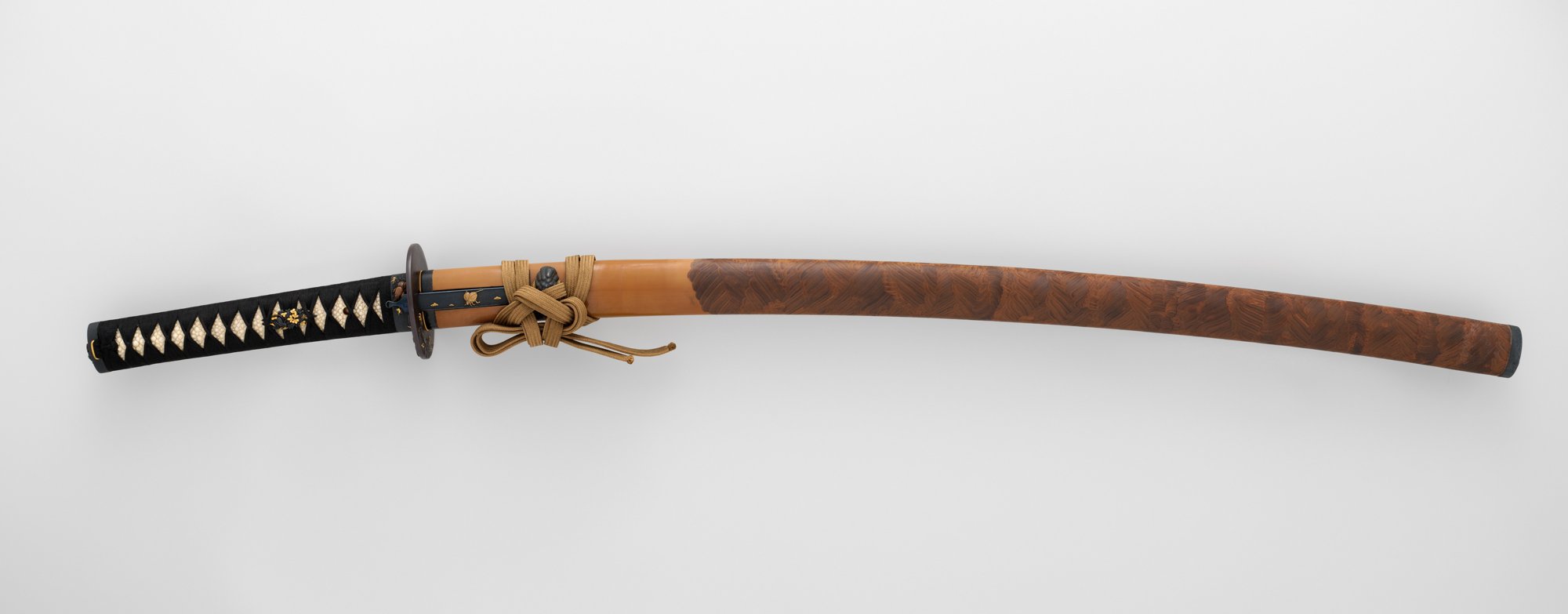
The Fukuoka City Museum writes the word as Sageo, literally a hanging cord. On a katana, the sageo cord runs from the scabbard to the wearer's sash. The museum, in its text for an exhibition of sword and spear fittings from Fukuoka samurai families, describes the two fittings on the scabbard that serve it: the kurikata, through which the cord is passed, and the kaeritsuno, which holds the sageo and cords at the sash. The same text notes that a katana was normally pushed into the sash edge up; the sageo is what joined that scabbard to the person wearing it.
It is a formal part of the mounting. The Japanese Sword Museum, run by the Society for the Preservation of Japanese Art Swords (NBTHK), lists the parts of a katana mounting from the kashira at the end of the hilt through the guard and the scabbard fittings, and ends the list with the kojiri at the scabbard's tip and the sageo. Kiichiro Domyo told us that the sageo "had always been made as Kumihimo", and that thread merchants such as his house supplied it.
The Fukuoka museum also gives a standard for reading the cord on the hilt, though not the sageo. It describes the standard Edo-period pair of swords, the daishō, as a set worn in public and in private, with hilts wrapped in the same or a related colour, guards of similar design, and scabbards in black roiro lacquer.
Sageo, Tachi-o and Hirao: Two Ways of Wearing a Sword, Two Kinds of Cord
Not every sword cord is a sageo. A tachi, the older long sword, was not pushed into the sash but hung from it, edge down; our guide to sword types explains how a tachi was hung edge-down from cords or chains. The Japanese Sword Museum's list for a tachi mounting includes the two ashi-kanamono, hanging fittings on the scabbard, and the obitori, the attachment that takes the sword to the belt. Those parts suspend the sword. The sageo on a katana ties the scabbard to the sash.
The house's history suggests that the cord changed with that change in wearing. According to Domyo's history of kumihimo and of the house (in Japanese), one of the uses of braided cord in the Heian period was the hirao, which nobles used to hang their swords, alongside cords for arms, for sutra scrolls and for amulets worn at the neck. The same page names the sageo as the principal use of kumihimo in the Edo period. Read together, the house's two entries suggest that the sword cord's role moved from hanging a noble's sword to fastening a samurai's scabbard.
Tsuka-ito: The Katana Handle Wrap, Read From the Cord's Side
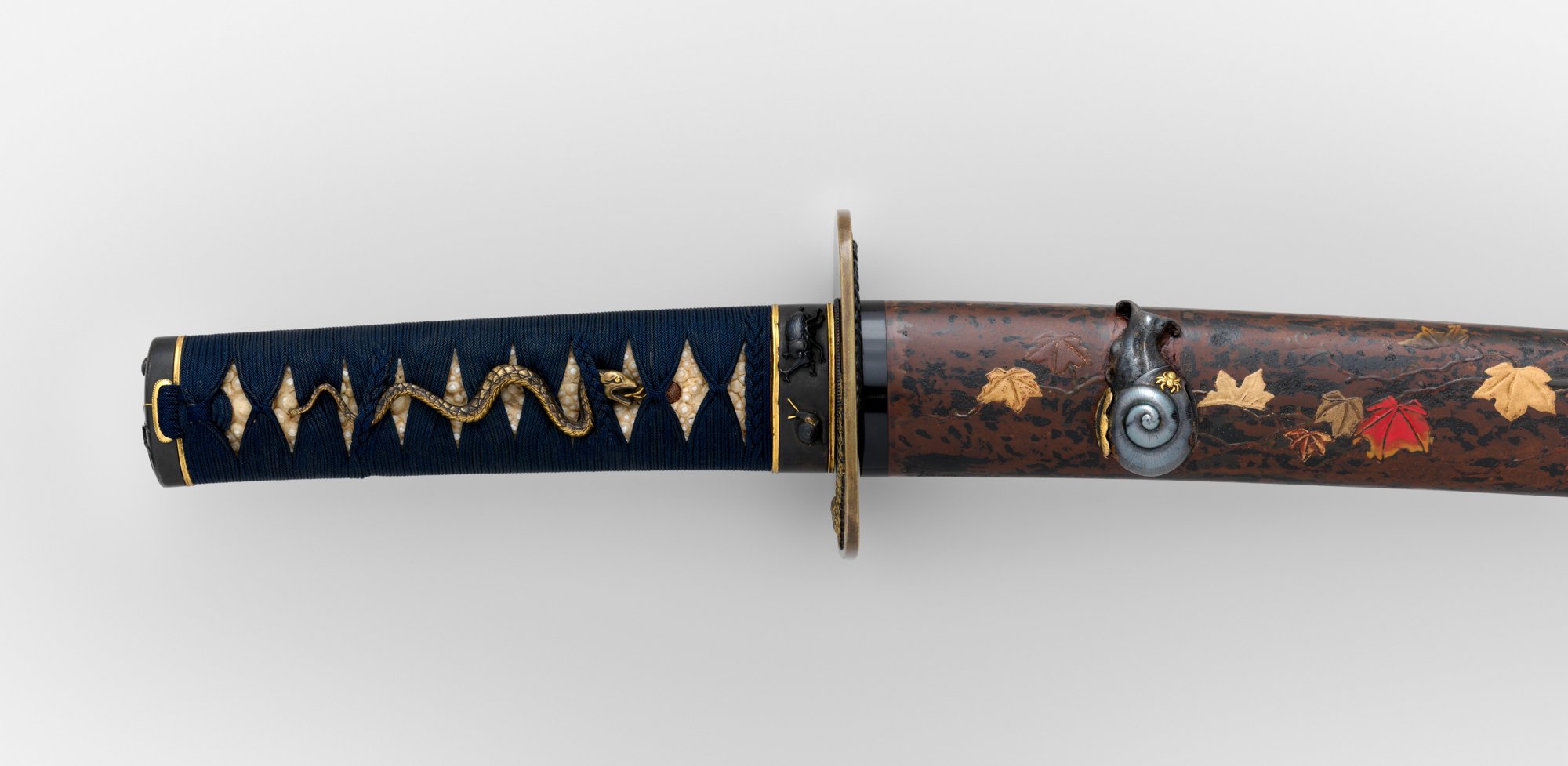
The wrap on a katana handle is called the tsuka-ito (also written tsuka ito), the hilt cord, and the wrapping, or the wrapped grip, is tsukamaki. The handle itself is the tsuka.
The demand for that cord is recorded on the braiding side. Domyo's history page states that in the 18th century kumihimo was in heavy demand as the sageo and the tsuka-ito of samurai swords, and that Edo had a great number of thread merchants to supply them. Kiichiro Domyo did not speak about the hilt cord in our interview; for the tsuka-ito, the house's written history and the museums below are the sources.
Hishi-maki: Why a Katana Handle Wrap Leaves Diamonds of Ray Skin
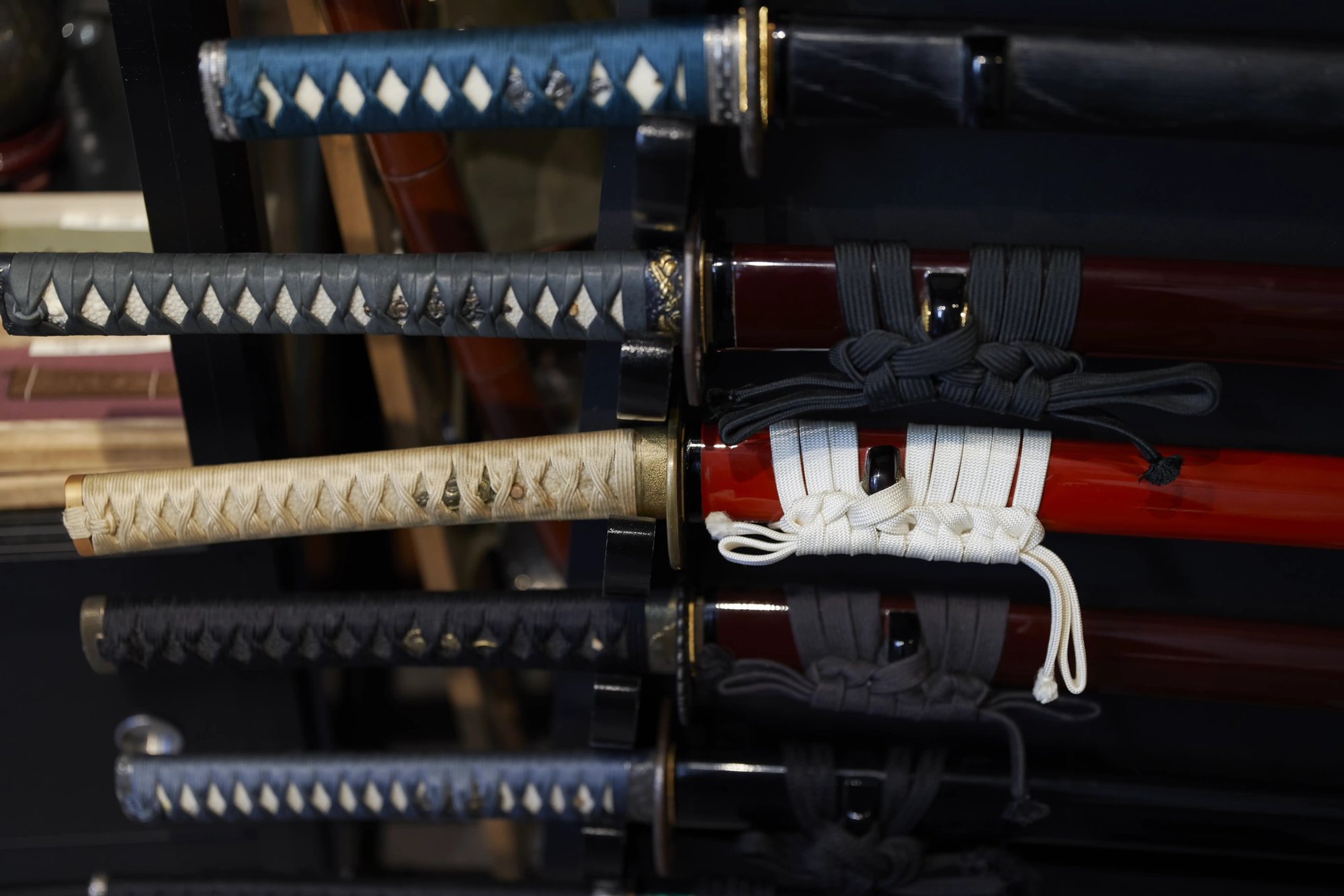
The Japanese Sword Museum describes the hilt from the early modern period on in one sentence. It is a core of hō, Japanese magnolia wood, covered in white ray skin, same, and bound with hishi-ito-maki, a diamond-pattern cord wrap. The same page shortens the term to hishi-maki. In the photographs from our interview with Nagaoka, a hilt wrapped in black cord shows a row of light-coloured diamonds along its length, between the turns of the wrap.
The museum adds that ray skin was frequently lacquered black to withstand rain and dew, so the diamonds are not always white. When you look at a wrapped hilt, read what shows inside the diamonds: pale skin, or black lacquer. The museum's wider point is that the wrap belonged to fighting men. Court and ceremonial swords, it says, had no diamond wrap.
Silk, Leather or Baleen: What a Katana Handle Is Wrapped With
A katana handle was not always wrapped in silk. The Japanese Sword Museum records that leather wrapping and cord wrapping were for warriors in the field, and that around the Warring States period the hilt covered in ray skin and wrapped in cord became the general custom. Hilt wraps, it adds, were made of leather and of flat braided cord, hira-gumi-ito, and also of whale baleen and hemp.
The phrase that matters for this guide is flat braided cord. Kiichiro Domyo, explaining what kumihimo is, divided it into families: "The ways of braiding fall broadly into three kinds: cords round in cross-section, cords square in cross-section, and flat cords called hiragumi." Of his three families, it is the flat one that the museum names among hilt wraps. Domyo did not connect hiragumi to the sword in what he told us; the museum's list of wrapping materials is what makes the connection.
Tsukamaki-shi and the Braider: Two Trades in One Katana Handle
The cord on a hilt passes through two pairs of hands. One braids it. Another, the hilt wrapper, tsukamaki-shi, lays it on the hilt. The Fukuoka City Museum names the hilt wrapper among the craftsmen of sword fittings, with the scabbard maker, the lacquerer and the silversmith. Their precise and creative work, it says, together with the gold, silver and copper available from the middle and late Edo period, turned the mountings of the time into works of art. The museum does not say who braided the cords the hilt wrapper used. Domyo's history page, for its part, says that the cords sold in Edo were made mostly by craftsmen retained by thread merchants.
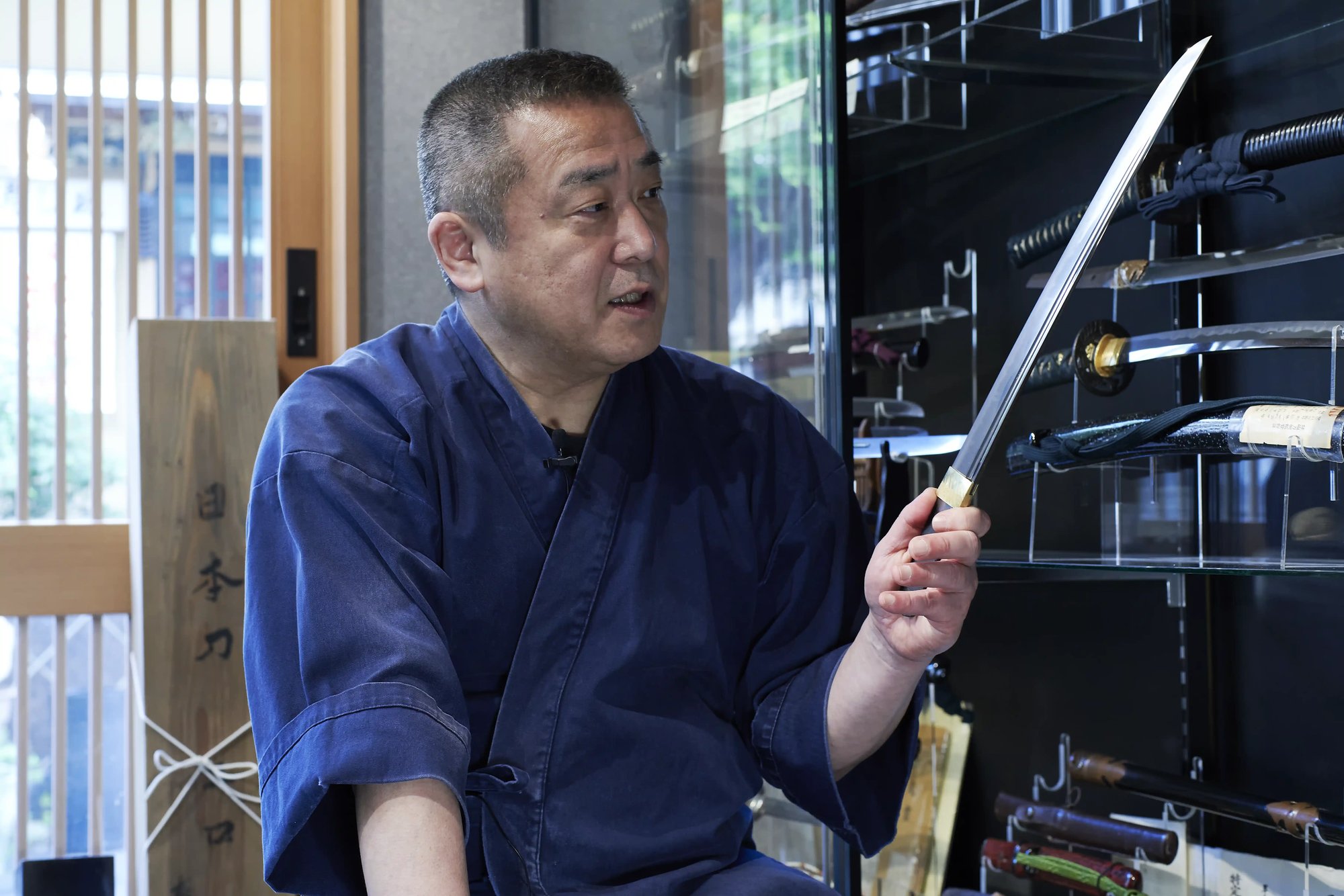
Yasumasa Nagaoka, the polisher we interviewed for "The Sword Polisher Who Chooses Not to Finish", gave a polisher's list of trades. When he listed the specialists a sword still needs, two of the names were "the one who makes the hilt, the one who braids the cord." He did not say which cord he meant, and the list is his, not a register; it is quoted here only to show that a polisher counts cord-braiding as a trade separate from the hilt maker. More on his own work is in our article on what a sword polisher actually does to a blade.
The episode below is the first in our film series with Nagaoka; at around the six-minute mark he names the trades, the braiders of kumihimo among them.
Kumihimo Samurai Cords: Why a Sword Needed a Braid, Not a Rope
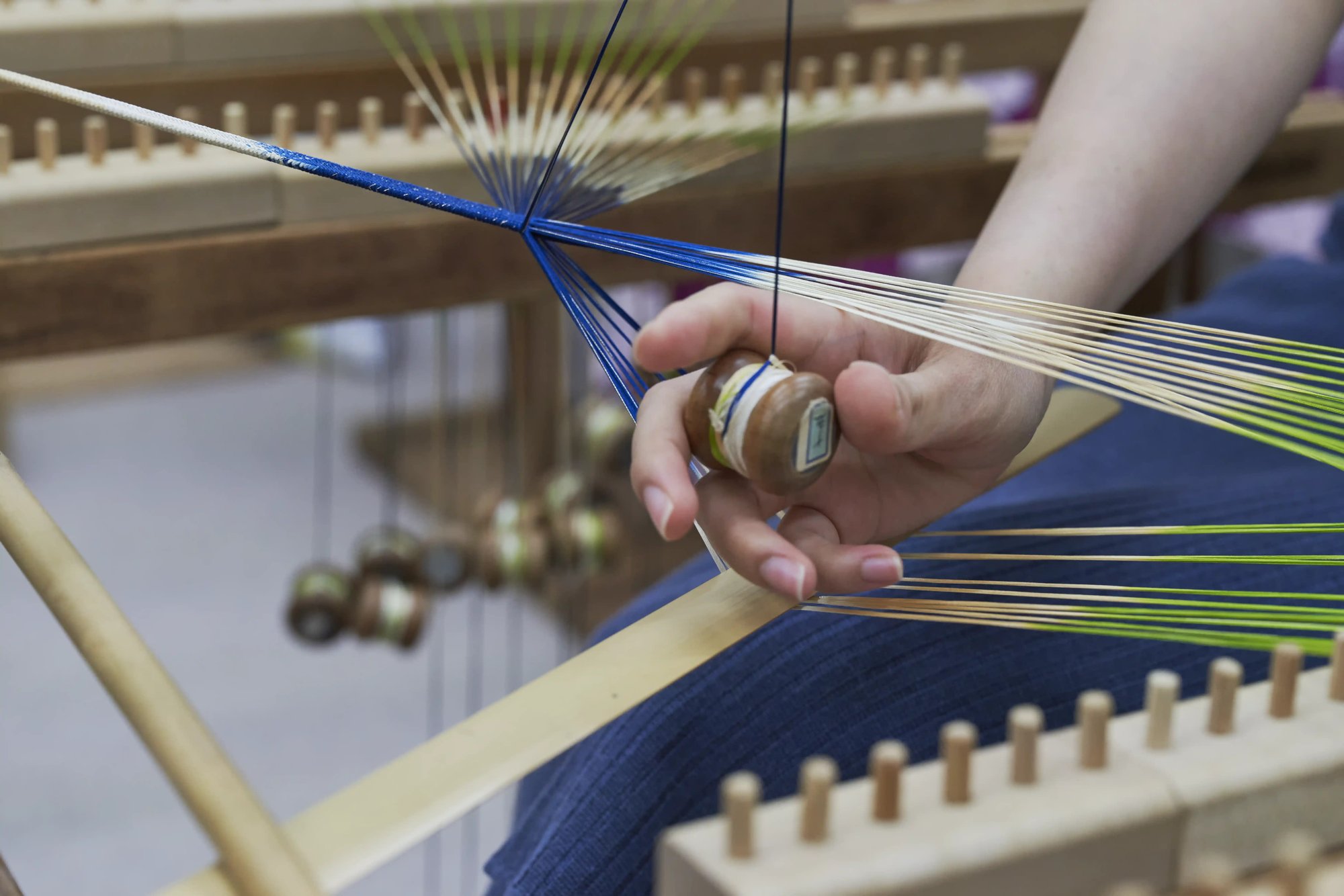
Kumihimo was a craft of the court before it was a craft of the warrior. Kiichiro Domyo traced its uses era by era, from the sashes of Nara-period officials and the garments of the Heian nobility to the samurai: braided cord, he said, was put to use "from the Kamakura, Muromachi, and Edo periods onward, in the arms and armor of the samurai." The general story of the craft is in the history of the silk-braiding craft. The question here is narrower: what did a sword and a suit of armour need from a cord?
Elasticity and a Knot That Holds: What a Braided Sword Cord Does
Domyo's definition of the craft names the property first: "It is a craft in which silk threads are bundled and combined through a fixed sequence to make an elastic cord." When he described what his artisans aim for beyond appearance, he listed functional qualities: a cord that ties easily and does not come undone, that is rich in elasticity and pleasant to the touch. In another answer, comparing hand braiding with machines, he said that a braider working by hand can weaken or strengthen the force partway through, and that this is what gives the braid its elasticity.
Domyo was describing kumihimo, not sword cords. Read against the sword, though, his list sounds like a specification. A sageo is a cord tied at the sash; a hilt wrap is a cord pulled over ray skin and held in the hand. Both are uses in which a cord that ties easily, holds its knot and has some give is worth more than one that only looks well. That is this guide's reading, not Domyo's claim, and it is why the cords on a sword are better read as equipment than as decoration.
Round, Square and Flat: The Three Kumihimo Families on a Katana
Domyo's three families, round, square and flat, sit inside a much larger repertoire: "Even the representative types number around thirty, and including variations and specialized ones, several hundred braiding methods are said to have been devised." On a katana, the flat family is the one the Japanese Sword Museum names, as the flat braided cord of the hilt wrap. For the sageo, the evidence is the house's own record rather than a general rule: Domyo's history page shows a sageo braided with ayadashi, a technique that the page says was born in the Edo period to bring patterns and characters up on the surface of a cord.
Domyo also drew the line between Japan and elsewhere at structure, not ornament: "Abroad, too, Kumihimo developed in the direction of making knots and ornaments, but the structure itself did not advance much."
The sword cord is also not only a thing of the past. The house still lists a sword sageo among its cords today, in sasanami-gumi, a braid it names for a surface like ripples on water. Which braid was used for which sword in a given century is not something this guide can state as a rule; no source consulted here gives one.
Armour Cords and the Kikkō Braid: Kumihimo Beyond the Sword
The sword was one customer among several. Domyo's history page dates the creation of kikkō-gumi, the tortoiseshell braid, to the Kamakura period and says it was widely used for the cords of armour. Elsewhere the house describes the same braid as used for the cords of the tachi and of armour, and dates its completion to the Heian period; the two accounts differ on the period, and both tie the braid to arms.
The house also knows armour cords at first hand. Our interview article records that, for more than a hundred years, the house has examined and reproduced, one by one, the kumihimo attached to Buddhist statues and armour across Japan. For where the real swords and armour can be seen in the city, see where Tokyo's real swords and armor are on show.
How Sageo Changed Hands: From Samurai Kit to the Obi-jime
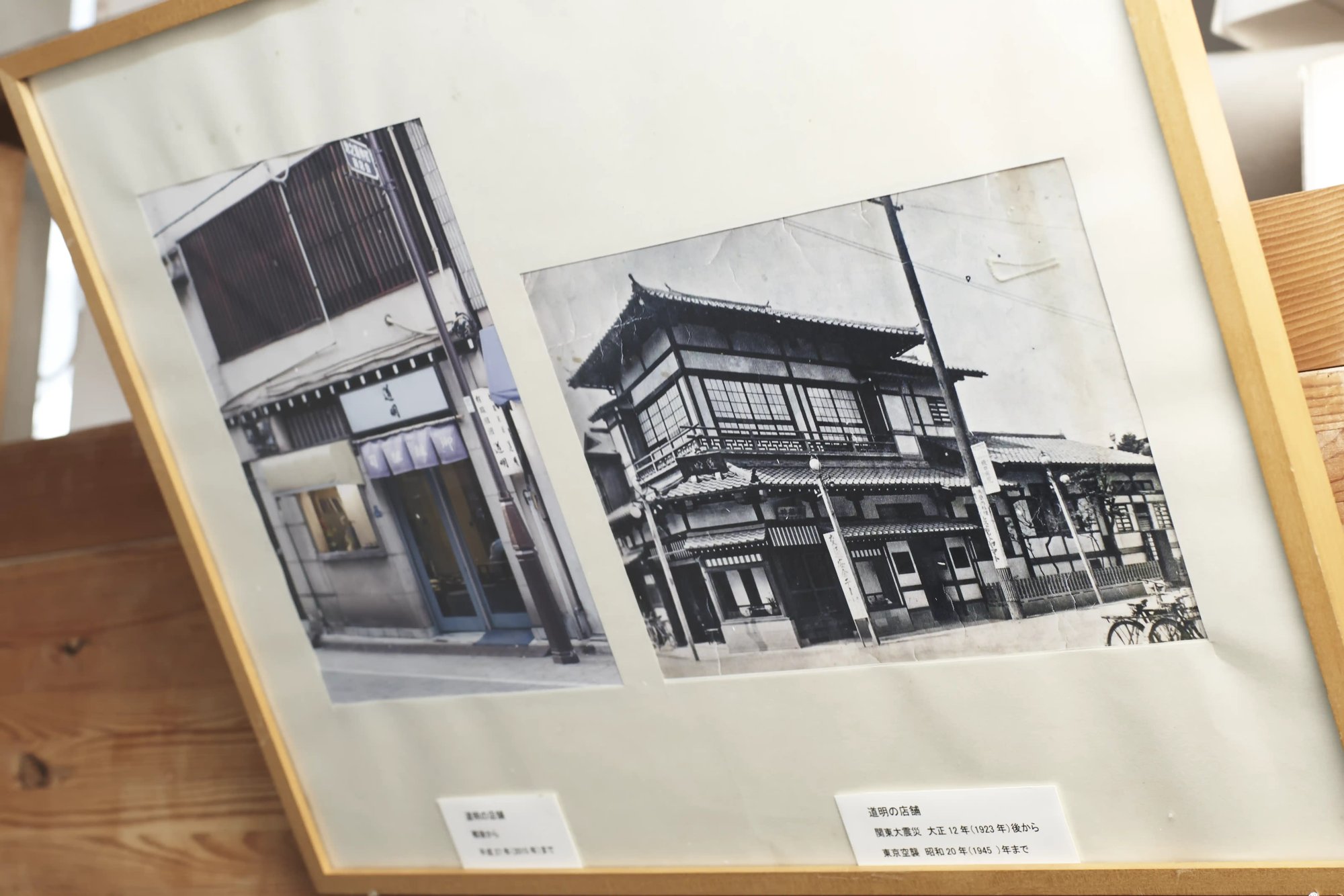
The sword cord changed three times, and each change came from outside the cord. Its makers changed, its purpose changed under a long peace, and a law took away the sword it was made for. The chapters below follow those three in order and end by measuring the same braid twice: once as a sword cord, once as an obi cord.
Edo Samurai Who Braided: Kumihimo as Part of a Warrior's Kit
Asked how kumihimo in Tokyo differed from Kyoto, Kiichiro Domyo placed his house in the Edo line and gave the samurai a part in it: "We are an Edo–Tokyo company, so we developed from the Edo period on; the cords of Edo were something the samurai of the time researched in various ways, and gradually good-quality Kumihimo came to be made in Tokyo as well."
The house's history page fills in that sentence. Domyo dates its founding to 1652 as a thread merchant, and says that in the middle of the 18th century the head of the house took the name Domyo Shinbei, the first of the line. The cords sold in Edo were made mostly by craftsmen retained by thread merchants, but the samurai were among those who researched the technique: a teaching had spread among them that a warrior should make his own arms with his own hands, and braiding cord was counted among a samurai's accomplishments. The page names two written sources for the techniques of the time, a military treatise, the Shika Sūyō, and the Hyakkō Hishō.
The second is a known collection: the Japan Tourism Agency's multilingual database describes the Hyakkō Hishō as a 17th-century collection of craft samples conceived by Maeda Tsunanori, fifth lord of the Kaga domain, in eleven boxes holding over 2,000 items. Its English entry does not mention braided cord; that it records braiding techniques is the house's statement.
The page then turns the story around. From the middle of the Edo period, as townspeople prospered, samurai households grew poor, and braiding was also passed down as paid side work done at home. According to the seventh-generation head, his grandfather, the fifth Domyo Shinbei, went again and again to samurai houses in the last years of the shogunate to press for the finished cords. In this account, the samurai is the supplier and the cord merchant the customer.
Edo Peace: When the Tsuka-ito Turned Many-Coloured
Peace also changed what a sword cord was for. Nagaoka described the Edo period, when swords were worn and not used, as a time when the metalwork, the scabbard lacquer and the hilt cord were no longer only black but many-coloured. His reason: a samurai wearing something he would never use wanted individuality, as with a kimono.
The Japanese Sword Museum describes the same movement in the other fittings: from the middle of the Edo period, chased fittings in coloured metals were made in great numbers, and scabbard lacquer, influenced by townspeople's culture, looked for variety in a long list of special finishes. The museum's account does not single out the hilt cord, but Nagaoka's does. The same Edo period that standardised the matched pair also gave the cord on the hilt room to be seen.
Sageo and Obi-jime: The Same Braid, Measured Twice
Then the sword went. On 28 March 1876, according to the National Archives of Japan's record of the sword-wearing ban, the Council of State prohibited the wearing of swords, except with full court dress and for soldiers, police and officials in uniform. Domyo's history page says that demand for sageo and hilt cord, which until the Edo period had made up most kumihimo products, disappeared abruptly. The cord merchants found a way forward in the obi-jime, the cord that holds a woman's kimono sash in place, which was then becoming the main way of securing it.
The move was possible because the two cords were nearly the same object. Kiichiro Domyo told us:
"Today's women's obi-jime is almost identical to the sword sageo of that same era in length, width, and braiding method; only the coloring grew vivid to suit women's attire."
The house's written history says the same from the Edo side. In the Edo period, it states, the sageo was finished to almost the same dimensions as today's obi-jime, and for that reason older braids of various shapes were converted into forms suited to the sageo, and new braids were created. The comparison is with the sageo of that era. In the Meiji period, the page adds, the main obi-jime was a narrow braid used with metal fittings; only gradually did the wide, thick braids used for sword sageo come into use as obi-jime, and it was between the Meiji and Taishō eras that the obi-jime became the byword for braided cord.
This is the piece of the story to keep. The next time you see an obi-jime tied across a kimono sash, its length, width and braid, in the account of the house that supplied both, are almost those of an Edo-period sword cord. What changed, in Domyo's words, was the colouring.
Where to See Sageo and Tsuka-ito in Tokyo: Museum Koshirae, a Ueno Braiding House, a Polisher's Bench
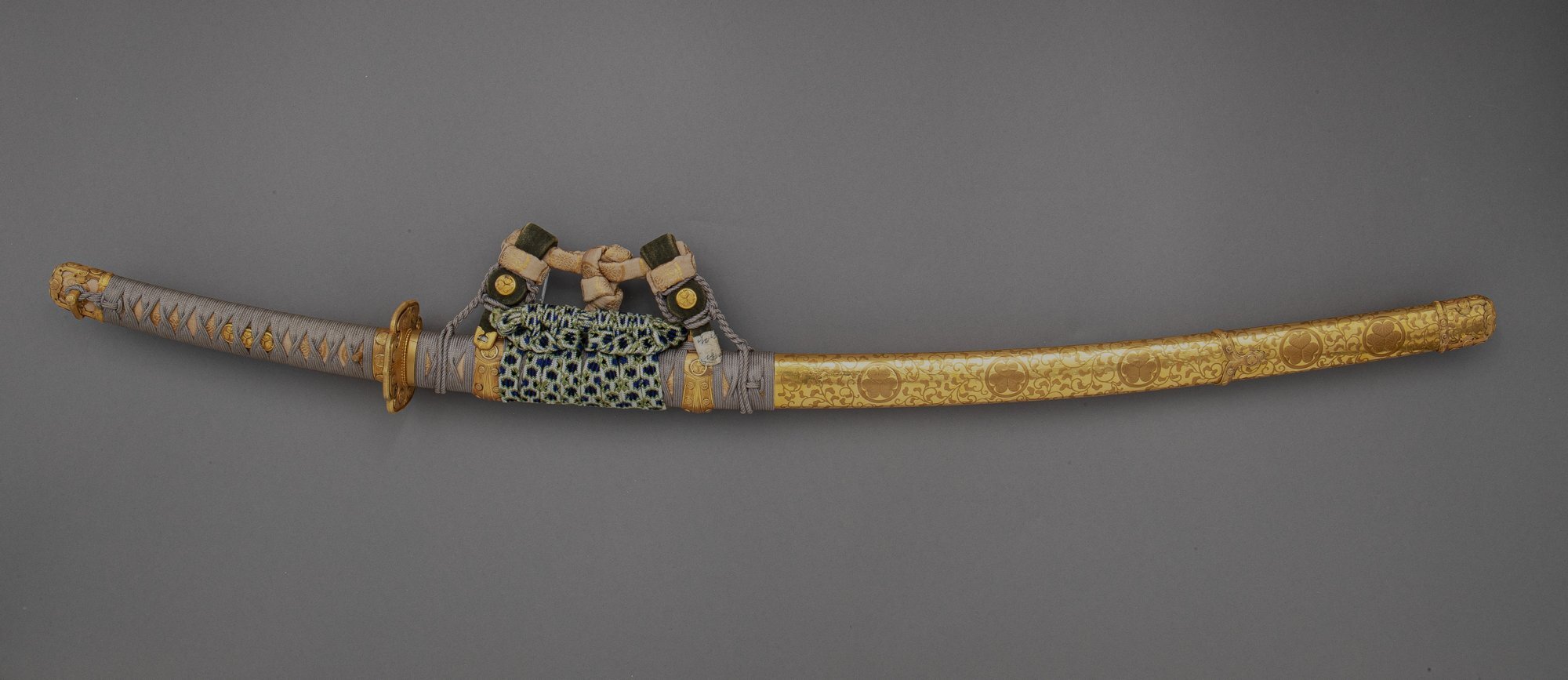
The two cords can be seen at three distances in Tokyo, and each one shows something different.
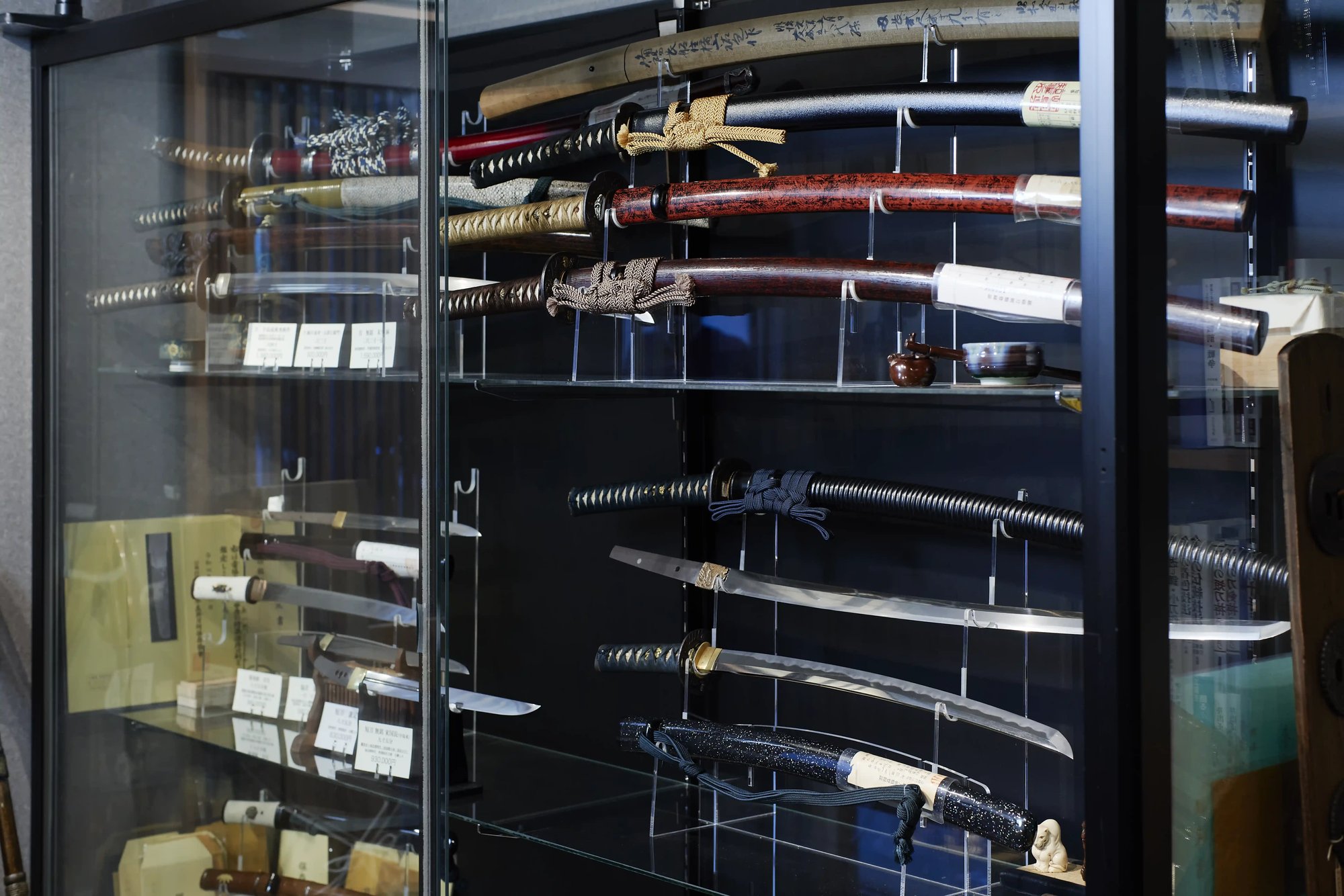
The first is open to anyone: a museum case. The Tokyo National Museum in Ueno holds a mounting that shows how far a cord could go on a sword. It is a 15th-century tachi mounting covered in black leather, with cord wrapping on the handle. As the e-Museum entry describes it, a purple cord is wrapped on the scabbard from its mouth down to the second hanging fitting. The museum rotates its displays, so whether that mounting is out on a given day has to be checked against its current list. The Japanese Sword Museum in Ryōgoku, run by the NBTHK, shows blades and fittings; there too, what is on view changes from exhibition to exhibition. Where a mounted katana is on view, look for a sageo through the kurikata and the diamond wrap on the hilt.
The second is there for those who know where to look: a house that supplied such cords. Domyo's building stands at Ikenohata in Ueno; our interview article notes that the Tokyo National Museum is about a five-minute walk away. A sword cord in a museum case and the braiding stands of a house that supplied such cords in the Edo period and still lists a sword sageo today are in the same district. The full conversation with Kiichiro Domyo is in our interview with the Ueno braiding house.
The third, a working bench rather than a public room, needs an introduction: the polisher's bench. Nagaoka's workshop is in Asakusabashi, and his trade is the blade rather than the cord. As our interview with him records, he holds introductory courses where beginners hold a real sword, and takes groups to the nearby sword museum with someone knowledgeable beside them. In our interview he describes having newcomers take a sword apart, part by part, once they have held it; the photographs from that interview show a hilt, still in its wrap, lying apart from the blade, guard and scabbard.
Sword Cords Today: Who Still Braids for the Katana
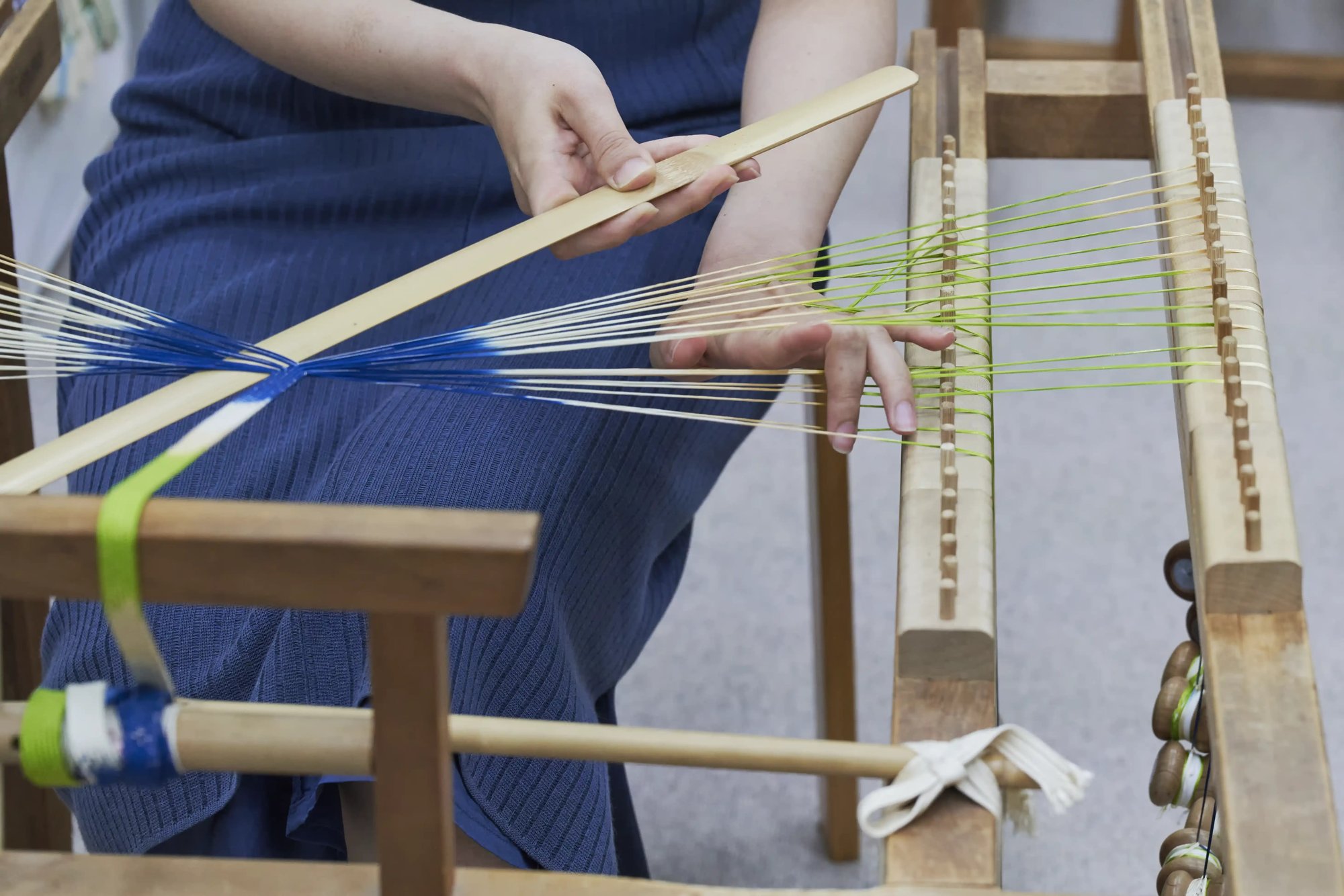
The katana no longer needs a cord to be worn. At Domyo, artisans still train in the history of the craft's uses. Kiichiro Domyo explained what the word Yusoku, in his house's name, means to them: "we hold every technique of the Kumihimo that has a history of well over a thousand years in Japan, and that we bring it to life in present-day making."
Describing how an artisan learns, he said that alongside the braiding itself you learn "what uses the historical masterpieces were put to", as well as how to match colours and how to match kimono with obi-jime. By the house's own history, the sword cord was once the principal use of its craft, and it still lists sword sageo among its cords.
What is changing now is on the sword's side: who comes to look, and how. Nagaoka described a reversal: "In the past it tended to be said that a sword is something you hold only after you have studied. Now it is the reverse — please, just take an interest; whatever you don't understand, ask us." In the first episode of our film series he adds that young collectors have increased markedly, and that he senses more people want to keep a sword at hand as a familiar work of art and craft, without thinking about it as hard as in the past.
That new audience meets the sword as a finished object made by many hands; in Nagaoka's words, it is "still made by a division of labour among specialists." For the cords, the braiding side has its own continuity: the house that supplied sword cords in Edo, and whose history records the demand for both sageo and tsuka-ito, still lists a sword sageo among its cords today.