An obi is the sash worn around the waist of a kimono: a band of fabric several metres long, wrapped around the body and tied at the back into a knot.
Explanations of the obi tend to stop once the sash is tied. This one starts there. A woman's kimono obi is commonly finished by a braided cord, the obijime, passed around it to hold the knot at the back in place, and that cord is the vantage point of everything below. Much of it comes from Domyo, a braided-cord house in Ueno, Tokyo, that dates its founding to 1652, and from what its president told us about how an obijime is made and chosen.
What Is an Obi? The Kimono Sash, Defined
A kimono is the robe and an obi is the sash tied over it: in modern dressing, under-sashes hold the kimono closed, and the obi is wrapped on top and tied into a knot at the back.
The Victoria and Albert Museum set out that structure when its conservators dressed mannequins for the 2019 exhibition Kimono: Kyoto to Catwalk. A kimono, they write, "has no integral fastenings"; padding, under-sashes and ribbons hold it in place first, and then the obi is secured around the waist and tied into a knot, the musubi. In modern dressing, in other words, the obi is not the fastening itself; in the V&A's account it goes on over a kimono already held in place. (Kids Web Japan, describing the obi more generally, still says it holds a kimono in place and keeps the front closed.)
What an Obi Does on a Kimono
That division of labour is the end point of a long change. The Embassy of Japan in Singapore's Japan Creative Centre traces it in a short history of the obi: early obi were cords or thin, ribbon-like sashes that men and women alike used to keep their robes closed. As the sleeves of the kosode, the forerunner of the kimono, grew longer and wider, so did the obi. Over time, the same source says, obi became more ornamental than functional, and other ties were created to keep the front closed instead. The same source notes that obi were originally knotted at the front, and that knotting at the back had become customary by the start of the 20th century.
What a kimono obi does now is carry the knot and carry the occasion. Once it carried more than that. Japan's Ministry of Foreign Affairs magazine niponica describes how, in a society classified by occupation, there was a certain way to knot the obi according to occupation, so that social position, occupation and marital status could be read from it. Those codes belong to the past. What survives of them is the idea that an obi is read, and the reading today runs mainly through two things: which type of obi it is, and how it is tied.
Obi Types and Formality: Maru, Fukuro, Nagoya, Hanhaba
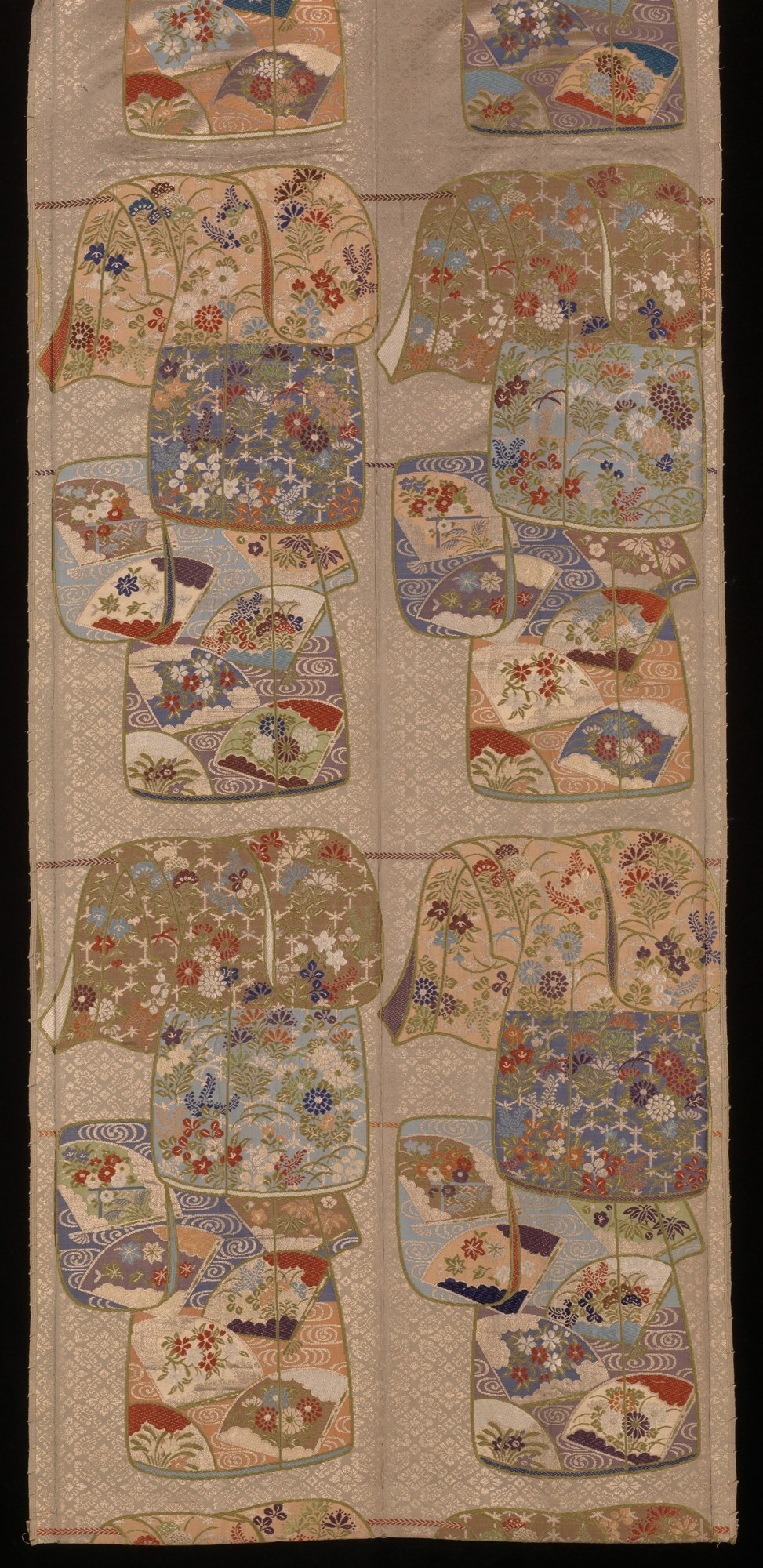
The most formal is the maru-obi. The Japan Creative Centre gives it as worn primarily by brides, geisha and maiko: about 30 centimetres wide and 4 to 4.5 metres long, made of stiff silk brocade, with the same woven design on the face and the reverse. Because of its length and weight, the same source notes, it requires another person's help to put on and knot.
Below it sit the two obi that Kids Web Japan, also published for the Ministry of Foreign Affairs, calls the two most common types. The fukuro-obi has its design on one side only and is about 4.2 metres long. The nagoya-obi is narrower in the middle to make it easier to tie around the body and is about 3.5 metres long. Both are about 30 centimetres wide. A collection record at the University of Michigan Museum of Art adds the order of formality and a date: Nagoya obi were first produced at the end of the Taishō era and are shorter than "the more formal fukuro and maru obi".
At the informal end is the hanhaba-obi, "half width": unlined, about 12 centimetres wide and 3.6 metres long, worn with an informal everyday kimono or a yukata, according to the Japan Creative Centre. The reading order is therefore maru, fukuro, nagoya, hanhaba, and a 12-centimetre sash on a yukata belongs to a different occasion from a 30-centimetre brocade obi.
Obijime, Obiage and the Obi Knot: How an Obi Is Finished
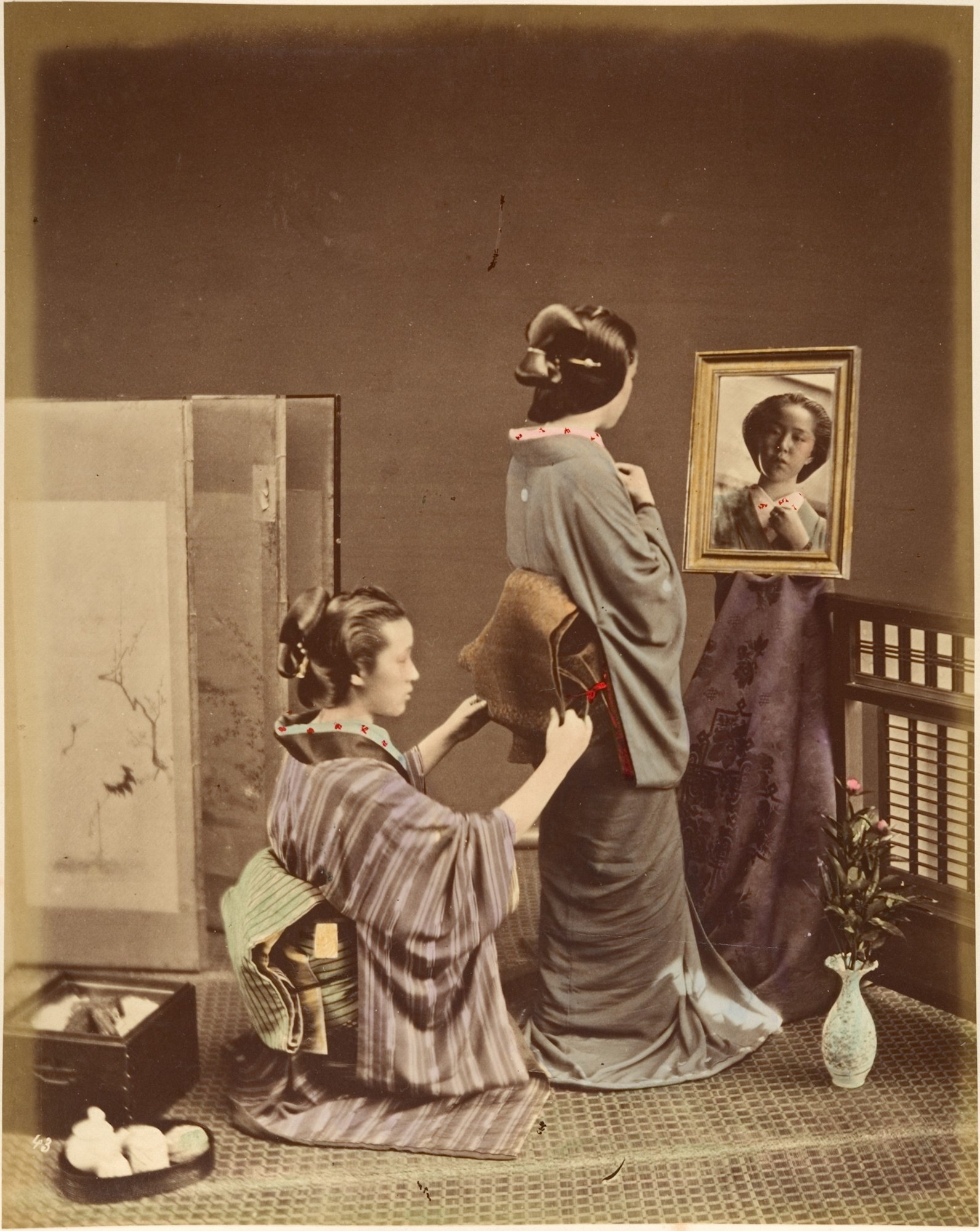
Two small pieces finish the obi. The V&A conservators name them as the accessories that "complete the obi aesthetic": the obiage, a scarf-like length of fabric, and the obijime, a braided cord. Kids Web Japan dates the wearing of an obi with obiage and obijime to the Meiji period (1868–1912). An obi in finished form therefore has three points to read: the obiage, the obijime, and the knot at the back.
Obijime: The Silk Cord That Holds the Obi Knot
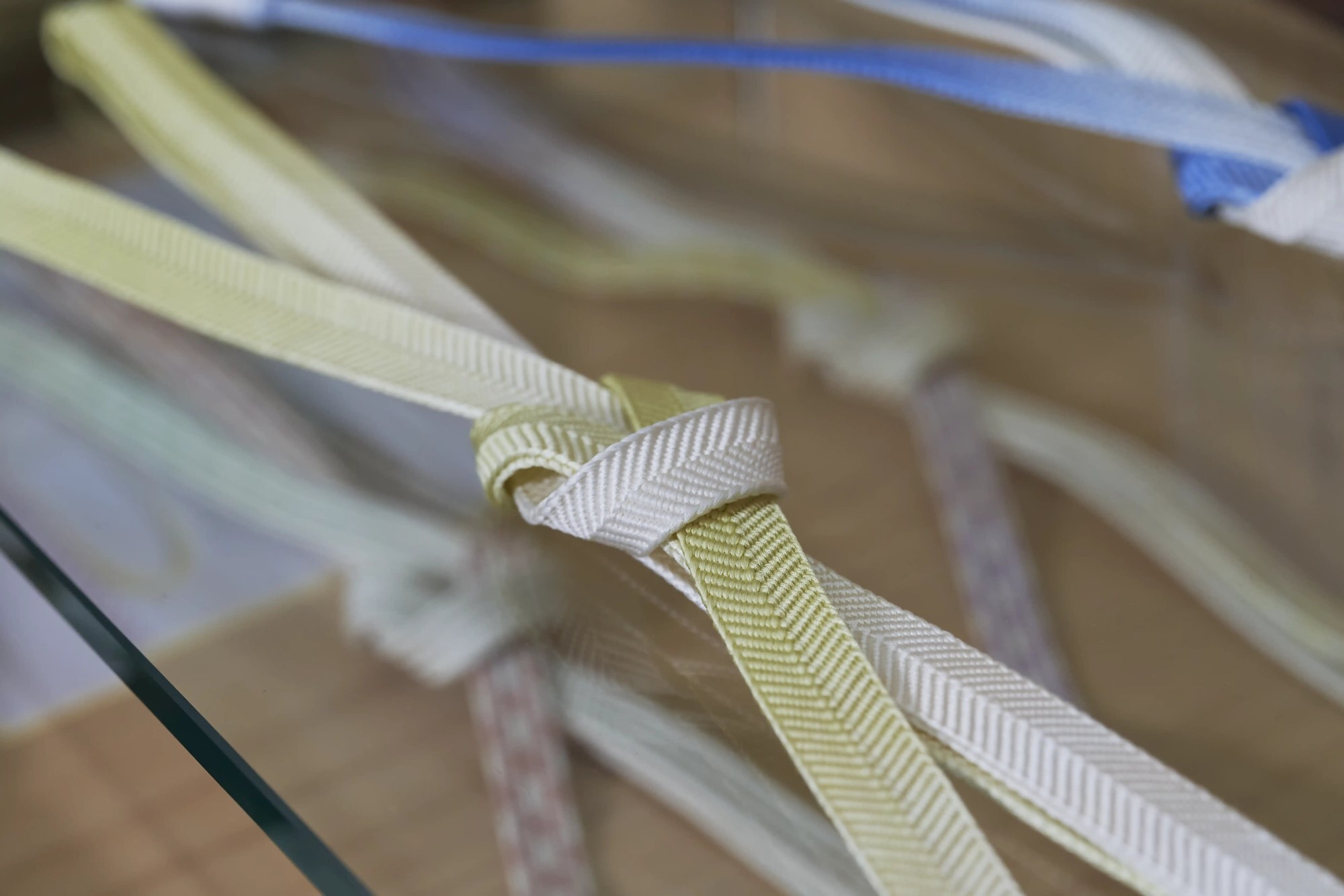
An obijime is a braided cord tied around the obi to hold the obi knot in place. Domyo's formal obijime, as the house lists them, run about 148 to 155 centimetres long and about 1 to 1.6 centimetres wide, in silk.
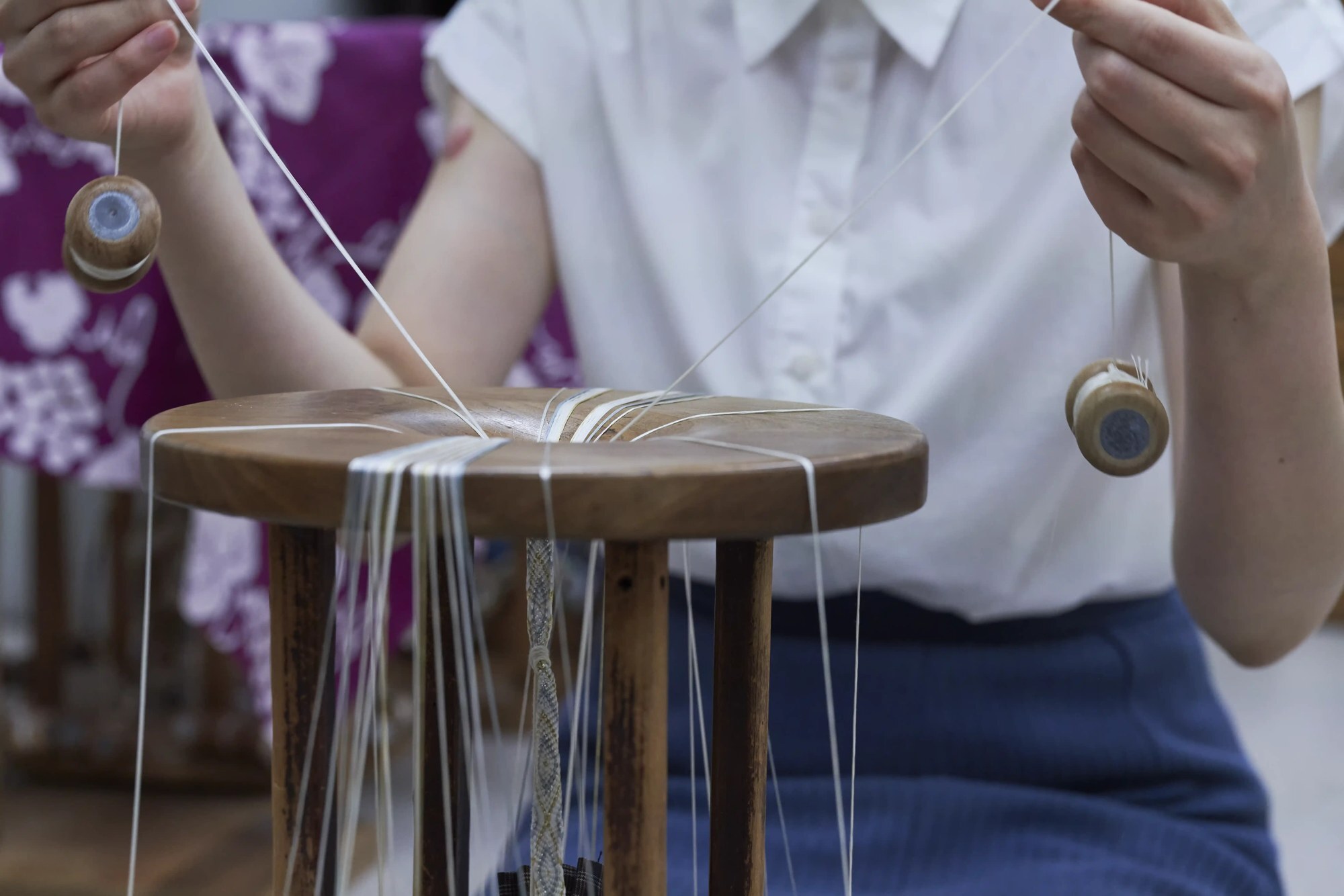
The cord is kumihimo, Japanese braided silk cord, a craft with its own long record that we have traced separately in the history of kumihimo. On the obi, what matters is what the cord has to do. Kiichiro Domyo, President and CEO of Domyo Co., Ltd., described the standard his artisans train toward as functional as much as visual: "how to make a cord that is easy to tie and hard to come undone, rich in elasticity, and pleasant to the touch."
Obiage: The Cloth Above the Obi
The obiage is, in the V&A's words, a scarf-like length of fabric. Kids Web Japan describes it as sandwiched between the kimono and the obi to hide the strings of the obimakura, the pad that gives the knot its volume at the back, while adding another touch of colour without spoiling the line of the obi. The V&A describes the same piece as hiding support pads.
The obiage and the obijime are the two small accents on a large surface, and the same Kids Web Japan page notes that wearing them in different colour combinations became a way to show one's sense of style.
Obi Knots: Otaiko and the Knots a Traveller Will Actually See
niponica reports that there are said to be over a hundred ways to tie an obi, the majority of them variants of styles born in the Edo period (1603–1868). A traveller needs to recognise only a few. The one to know first is the otaiko-musubi, the "drum" knot: Kids Web Japan calls it the most popular bow, characterised by the obimakura cushion inserted under the obi to give it volume at the back.
Two others are worth recognising. The bunko-musubi, in niponica's description, can be tied tightly and does not unravel easily, and its modest, dignified look was associated with women of samurai families. The fukura-suzume evolved from the tateya-no-ji-musubi and is, niponica notes, still commonly used when young women wear kimono. Alongside its note on the Coming of Age ceremonies held each January, the magazine shows modern-day arrangements of the tateya-no-ji-musubi and the bunko-musubi in the context of long-sleeved furisode.
Beyond the maru-obi's need for a second pair of hands, the V&A conservators, working with Japanese specialists, describe the whole dressing process as complex, with subtle changes of etiquette for different periods and types of kimono.
Obidome and Sanbu-himo: The Ornament on the Cord
An obidome is a small ornament, Kids Web Japan's "sash clip", worn on its own narrow cord in place of an ordinary obijime. Domyo makes that cord as a sanbu-himo: a silk cord of about 9 millimetres, "three bu" in the old unit, about 126 centimetres long, passed through the clasp on the back of the obidome and then used as the obijime.
The house adds a warning in its description of the sanbu-himo: the clasp on the back of an obidome differs from piece to piece. Obidome made in the Meiji and Taishō eras in particular can have clasps only two bu or two and a half bu wide, roughly 6 to 7.5 millimetres by conversion. An antique ornament, in other words, sets the width of the cord, not the other way round. The obidome sits in the same family of small finishing ornaments as kanzashi, the hair ornaments of kimono dress.
How the Obi Got Its Cord: From Sword Sageo to Obijime
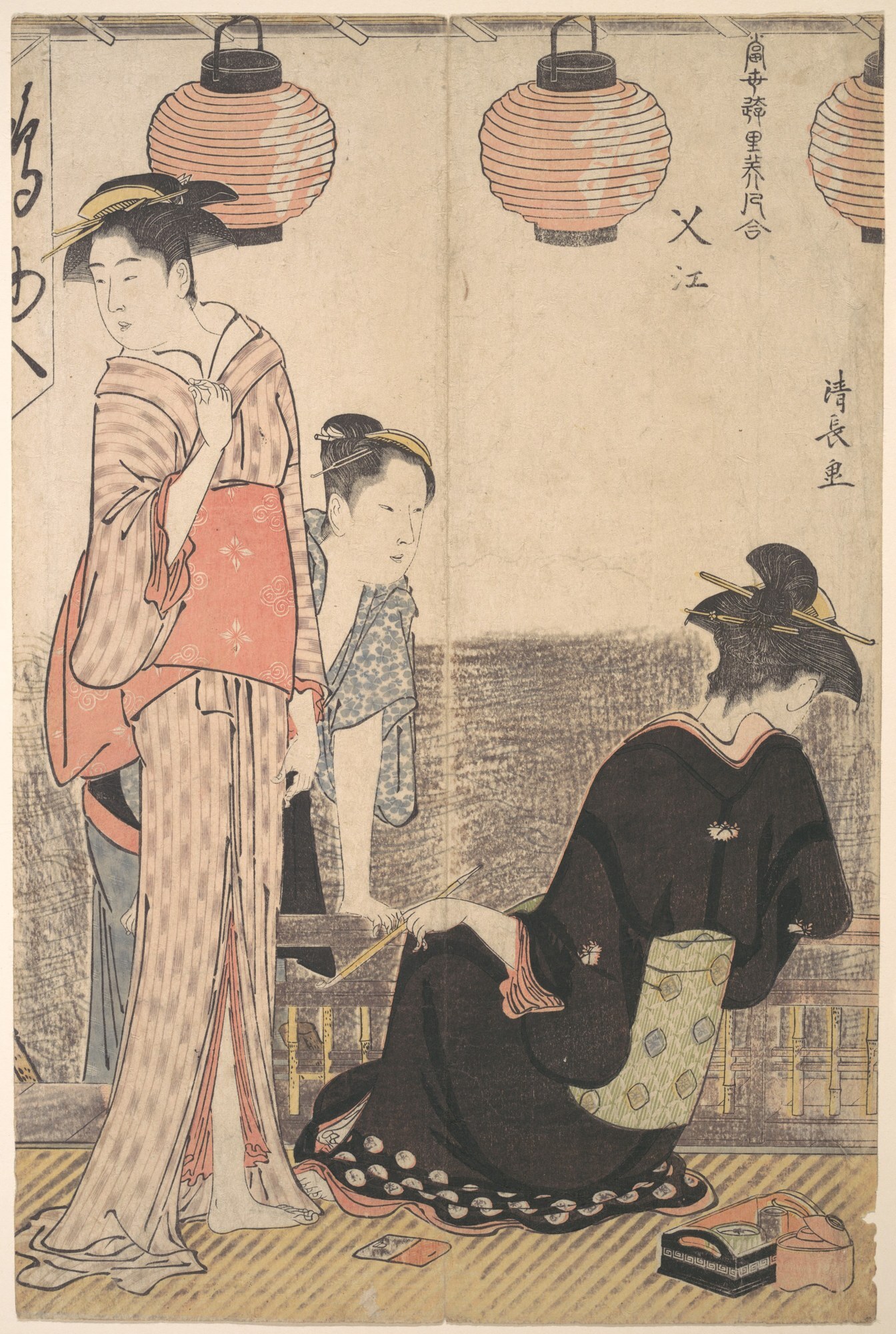
The thick braid of today's obijime came, in Domyo's account, from the sword. Domyo's history of kumihimo and of the house states that up to the Edo period the bulk of braided-cord products were the sageo, the cord fastened to a sword's scabbard, and the wrapping of sword hilts. A new knot that needed a cord, and a law that took the sword away, moved that craft onto the obi.
Otaiko-musubi: The Obi Knot That Needed a Cord
niponica describes the mechanism. The tsunodashi-musubi, a knot of the townspeople, was simplified and "transitioned into having a cord used to secure the obi-musubi, thereby transforming it into the otaiko-musubi". The otaiko is, by construction, a knot held by a cord.
When that happened is told differently by different sources, and the difference is worth keeping rather than smoothing over. Kids Web Japan describes the taiko-musubi together with its obimakura cushion as having "been very popular since the late Edo period", and dates the wearing of obiage and obijime to the Meiji period. Kiichiro Domyo, in our conversation, said that "in the late Edo period a way of tying the kimono sash called otaiko-musubi had become established". The house's own history page says the otaiko knot of women's kimono became established through the Meiji era.
Haitorei, 1876: When Sword Cords Moved to the Obi
On 28 March 1876, according to the National Archives of Japan, the Council of State issued the haitorei, the edict banning the wearing of swords, with exceptions for full court dress and for soldiers, police, officials and others in uniform.
Domyo's history page describes the effect on its trade bluntly: demand for sageo and hilt wrapping, which had made up the bulk of the work, vanished suddenly. Cord merchants who had lost most of their work found a way forward in the obijime, which was then becoming the mainstream means of holding a woman's obi. Kiichiro Domyo's phrase for the same turn is "a new path forward": the braiding techniques built for sword cords were applied to the obi.
The match between the two was closer than the change of use suggests: in Domyo's account, the sword cord of the Edo period was already made to almost the size of a present-day obijime, a comparison set out more fully in the history of kumihimo.
From Metal Clasps to Thick Silk Cords: The Meiji Obijime
In the Meiji era, the obijime was not yet the cord seen today. Domyo's history page records that in the Meiji era the main form of obijime was a narrow braided cord used with metal fittings. Only gradually did the wide, thick braids that had been used for sword sageo come into use as obijime, and it was between the Meiji and Taishō eras that the obijime became, in the page's words, the byword for braided cord.
The same page says the house went on to put its cords into the world as obijime and haori himo, made to its own aesthetic standard, and that obijime drawing on historical cord designs are still on its shop shelves nearly 100 years later. A second pressure came from machinery. Kiichiro Domyo said that from the Meiji era onward Western braiding machines came in and many companies mechanised, and that under the sixth-generation head the house set the opposite policy: "to use no machines at all and to make Kumihimo by handwork alone." Domyo's obijime today are, in this sense, shaped by two outside forces: a law that removed the sword, and a machine that the house decided not to use.
How an Obijime Is Chosen: Colour, Formality and Grip
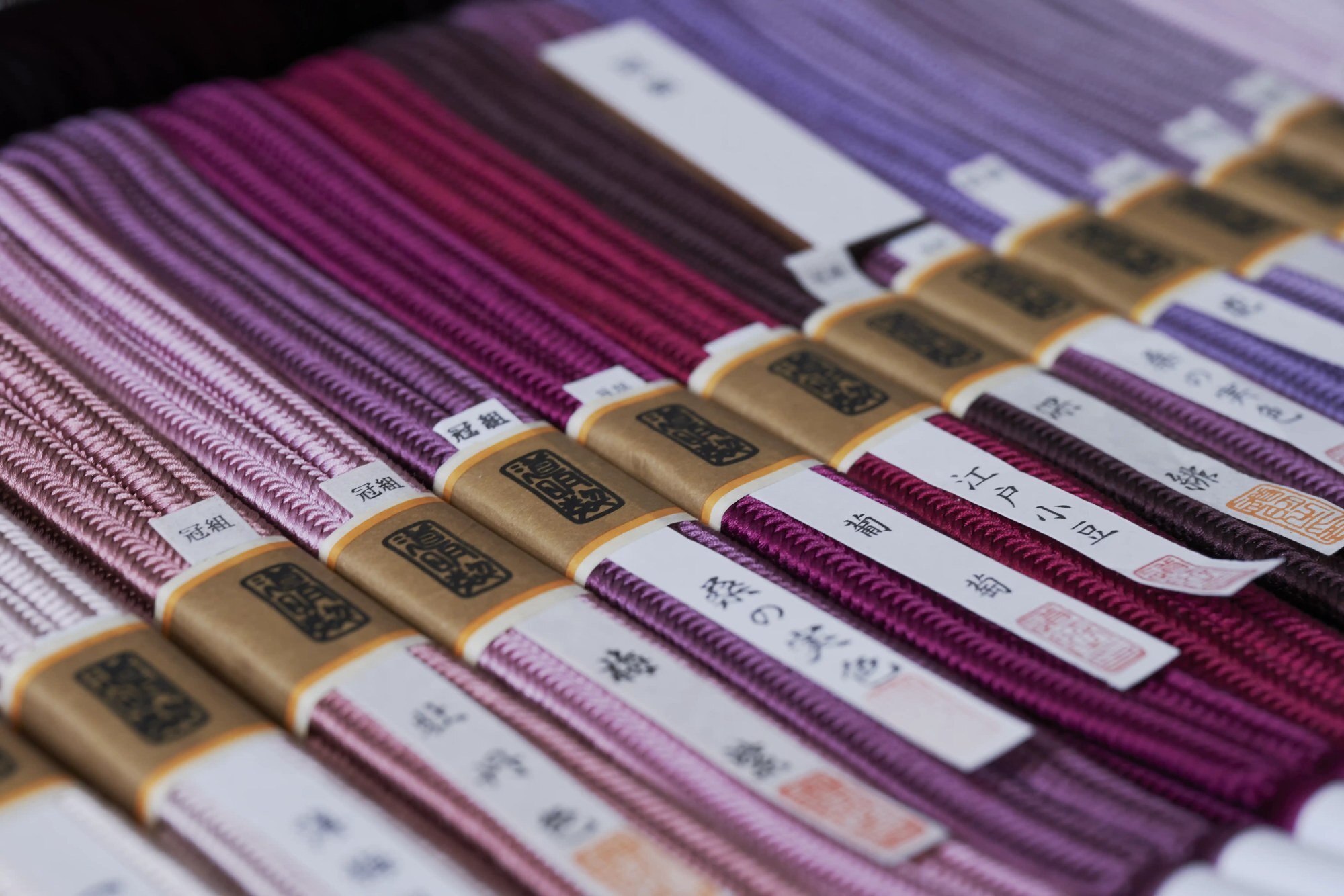
For the maker, choosing is part of the training. Kiichiro Domyo said that alongside the braiding itself, an artisan has to learn "how to match color with color, how to match kimono with obi-jime". From the side of the cord, that choice runs along three lines: the formality the cord declares, the colour it adds, and how it holds once tied.
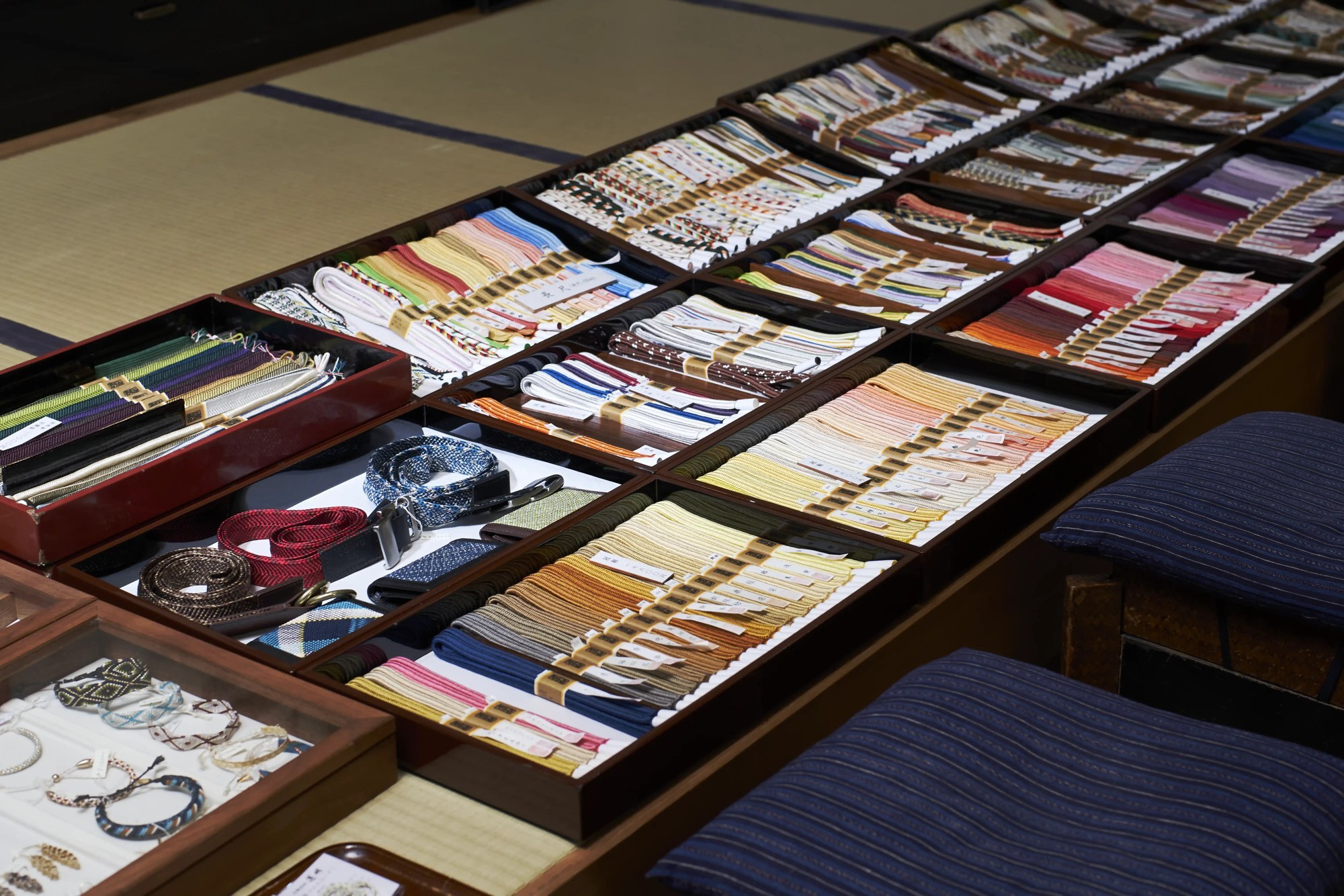
Formal Obijime: White, Gold and Silver Silk
At the time of writing (October 2026), of the twelve cords in Domyo's formal obijime category, eleven are white, white with gold, or white with silver; the twelfth is black. Several are braided with metallic thread. Among their braids are kōrai-gumi, which the house describes as finely braided and very easy to tighten; kara-gumi, a braiding method the house says has survived in Japan since the Asuka period; and kikkō-gumi, the tortoiseshell braid.
The house's note on kikkō-gumi gives the formal cord a pedigree in arms: the braid was used for the cords of the tachi sword and of armour, and its tortoiseshell pattern, tied to wishes for long life, has been prized as among the most auspicious. A white and gold kikkō-gumi on a formal obi carries that pedigree onto the obi.
Obijime Colour: Why the Silk Is Dyed in Small Batches
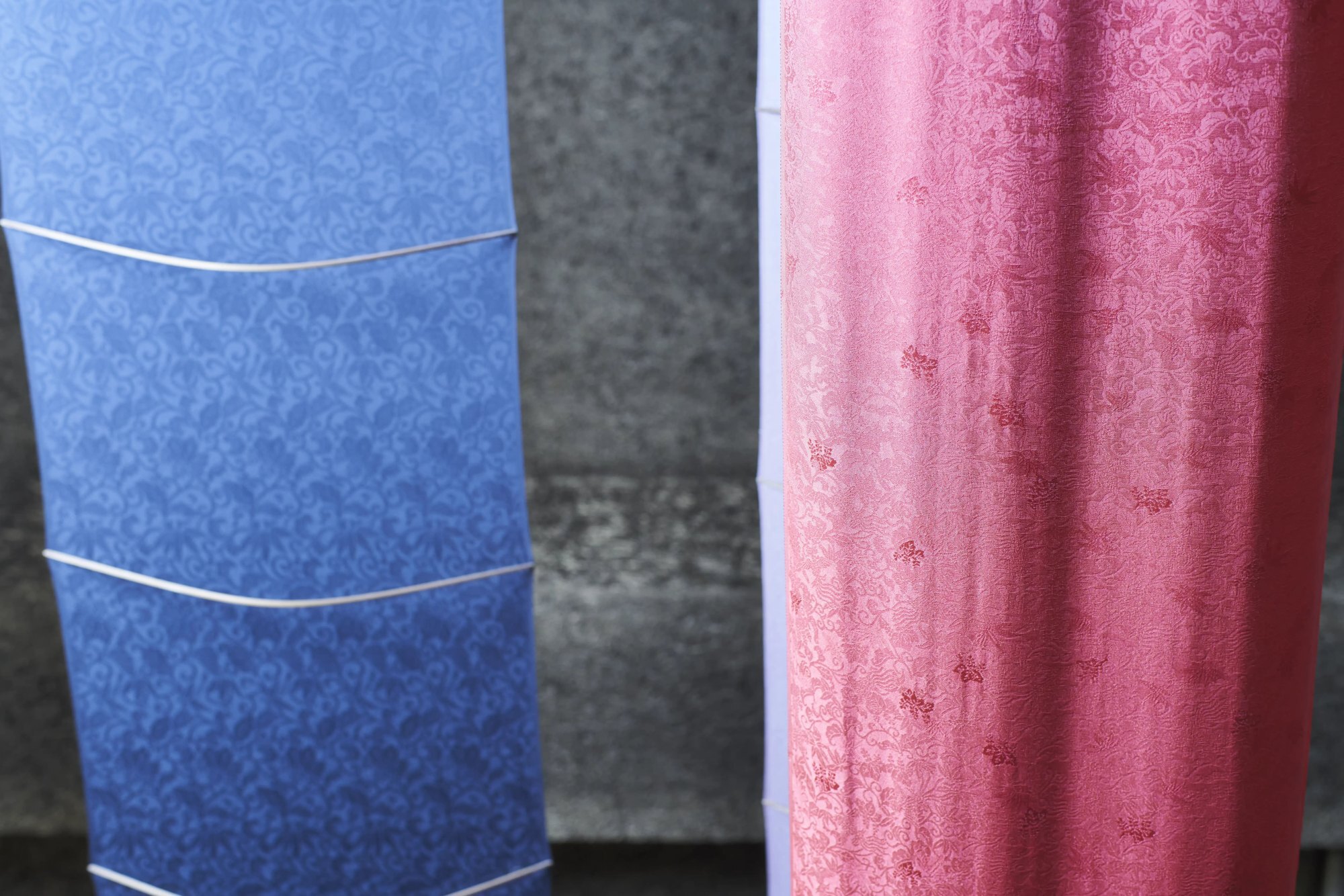
Outside formal dress, colour carries more of the choice, and Domyo addresses it at the dyeing stage. "Because the amount of thread we use for obi-jime is small, by dyeing that small amount into as many colors as possible we can make beautifully colored Kumihimo exactly as intended," Kiichiro Domyo said. "I think we dye three to four thousand colors a year." The comparison he drew was with a large factory, where a great quantity of thread is dyed in one go and no fine adjustment is possible afterward.
Colour has also been regional. Kiichiro Domyo described the Kyoto manner as favouring things a little more showy and soft, "while in Tokyo, for a long stretch of time, more understated things were favored — plain, yet with a depth of color." Of one of the house's signature obijime series, he said: "They are easy to match with many kinds of obi and yet have a presence that does not disappear into them." Where those designs come from is a separate story, told in where kumihimo patterns come from.
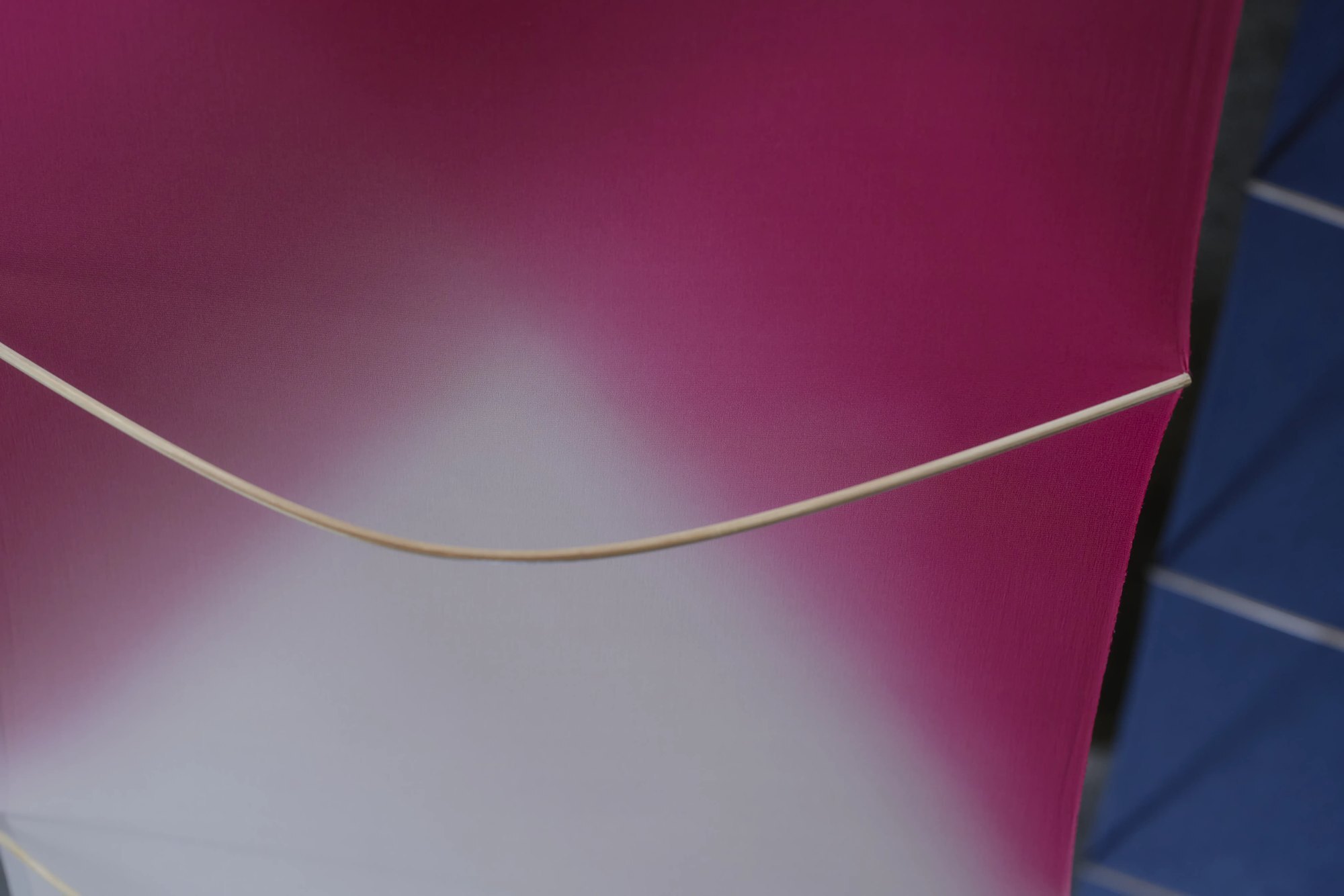
One thing about colour cannot be fixed in the shop. Dan-zome, which Kiichiro Domyo named as a technique only hand work allows, is a technique of dyeing a single strand of thread in varying colours along its length. Domyo's cord descriptions carry a note that for dan-zome or bokashi (shaded) dyeing, the part that shows at the knot varies with the wearer's figure and the thickness of the obi it is worn with. A shaded obijime, in other words, does not have one front colour. What shows at the knot depends on the person and the obi it is tied over.
Hand-Braided Obijime: Elasticity and a Knot That Holds
The third line is grip, and here the difference between hand and machine is physical. "A machine keeps pulling the weights continuously and braids at a uniform tension, so no elasticity emerges," Kiichiro Domyo said, "but in hand-braiding you can weaken or strengthen the force partway through the braiding, so you can make a braid with elasticity and with fūai." Fūai is the tactile character and texture of a braid that emerges through adjustment by hand.
Domyo's descriptions of its kanmuri-gumi cords put the same quality in the wearer's terms: the braid is rich in elasticity and comfortable to tie, and is said to have been used on the crowns of military officials. Hand braiding is also slow: Kiichiro Domyo put the pace of the braiding stage at roughly one cord a day to one cord in two days.
Haori Himo and Men's Obi: The Cord on the Jacket
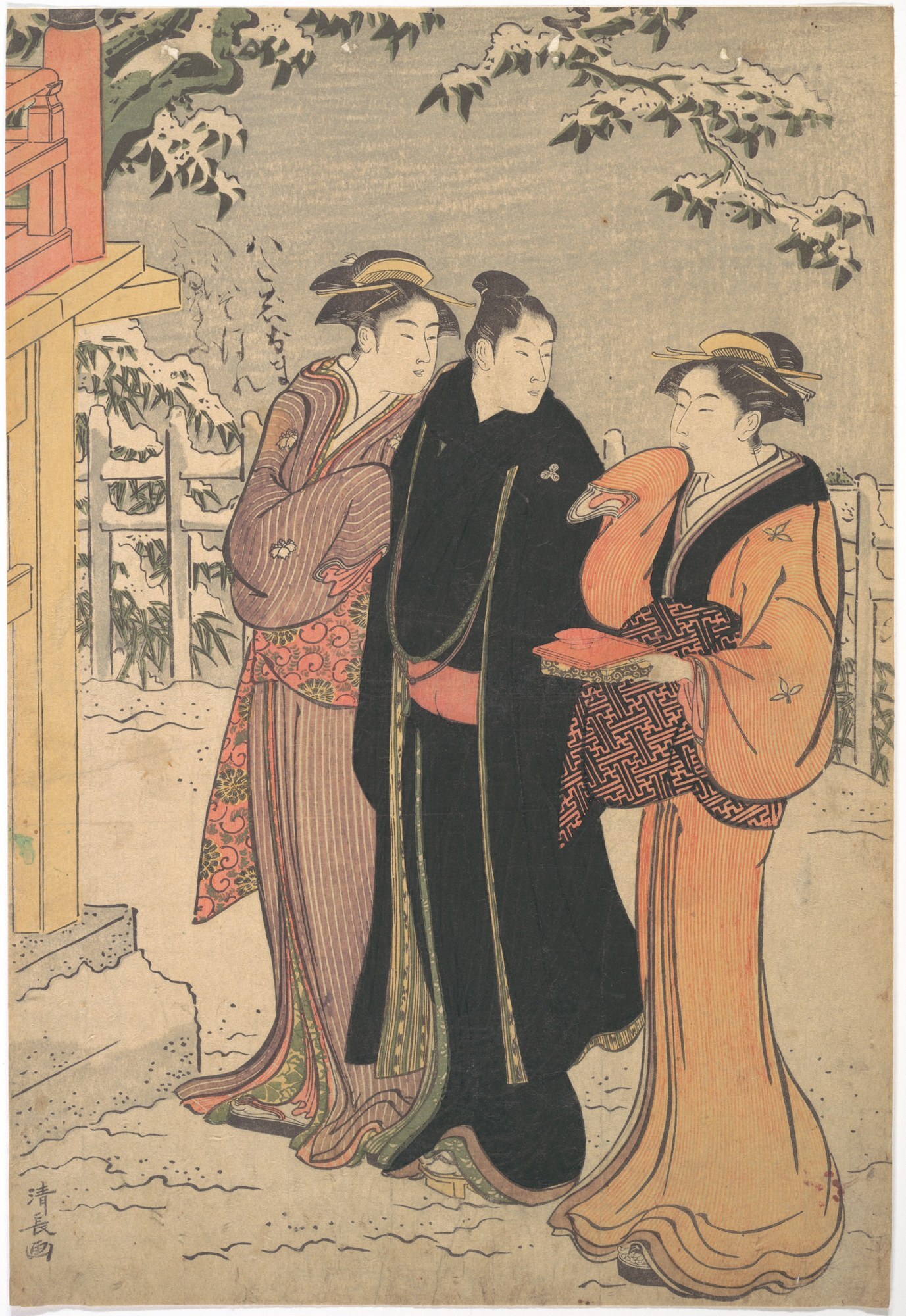
Men wear an obi too, narrower than a woman's full-width sash: the Edo-Tokyo Museum holds a men's kaku obi of 320 by 15.5 centimetres and a men's obi sash of 282.6 by 8.3 centimetres.
On men's dress, though, the braided cord sits higher. It is tied on the haori, the half-coat, which Kids Web Japan lists, with hakama, as what boys wear on Coming-of-Age Day. Domyo's history page names haori himo alongside obijime among the products through which the house put its cords into the world.
Haori Himo: Tied Each Time, With No Metal Showing
Domyo's haori himo are men's cords of about 36 centimetres, in silk, braided as nara-gumi, sasanami-gumi and kanmuri-gumi. Sasanami-gumi takes its name, the house explains, from a braid that looks like ripples on the surface of water.
The house makes them as a direct-attachment type, tied straight onto the haori. Its description states the trade-off plainly: the cord has to be tied every time the haori is put on, but no metal fitting at the join shows, which gives a clean look that only direct attachment can. For a viewer, that is the reading on a man's chest: whether a metal fitting shows at the join or only silk.
Men's Obi: Kaku Obi and Heko Obi
The kaku obi can be seen in the Edo-Tokyo Museum's records in the online Tokyo Museum Collection, where the kaku obi for men is dated to the 19th to 20th century. The same collection also holds a heko obi of 298 by 18.5 centimetres.
The Japan Creative Centre notes that while men's and women's obi began alike, more styles have since developed for women than for men, and that samurai often tied their obi in the kata-basami style, simple and secure, in which swords could be held at the waist.
Where to See Obi and Obijime in Tokyo
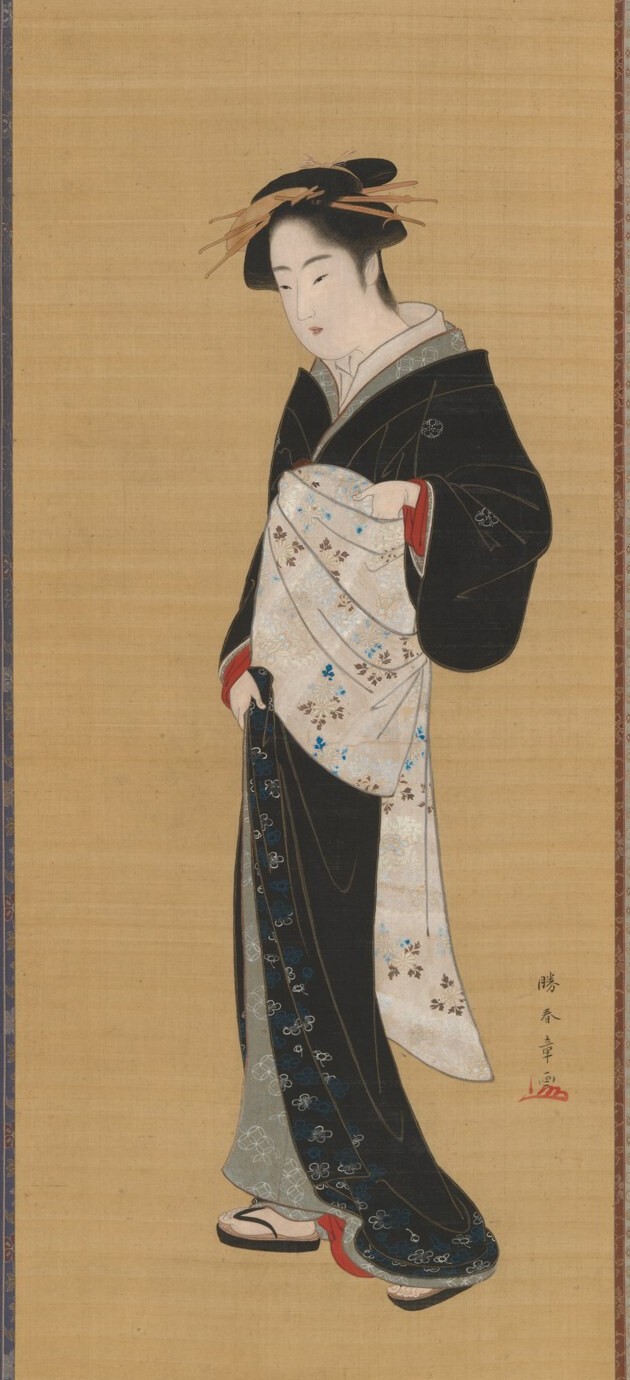
The first layer is open to anyone. The Tokyo National Museum in Ueno has paired ukiyo-e prints with Edo-period clothing in Room 10 of its Japanese Gallery; the clothing rotation from 2 January to 24 February 2019, for example, presented kosode, furisode and uchikake together with obi and hair ornaments as the total fashion of Edo townswomen. Displays change from rotation to rotation, so what is on view now, and in which room, has to be checked against the museum's current list. For men's obi, the Edo-Tokyo Museum's records above can be studied online.
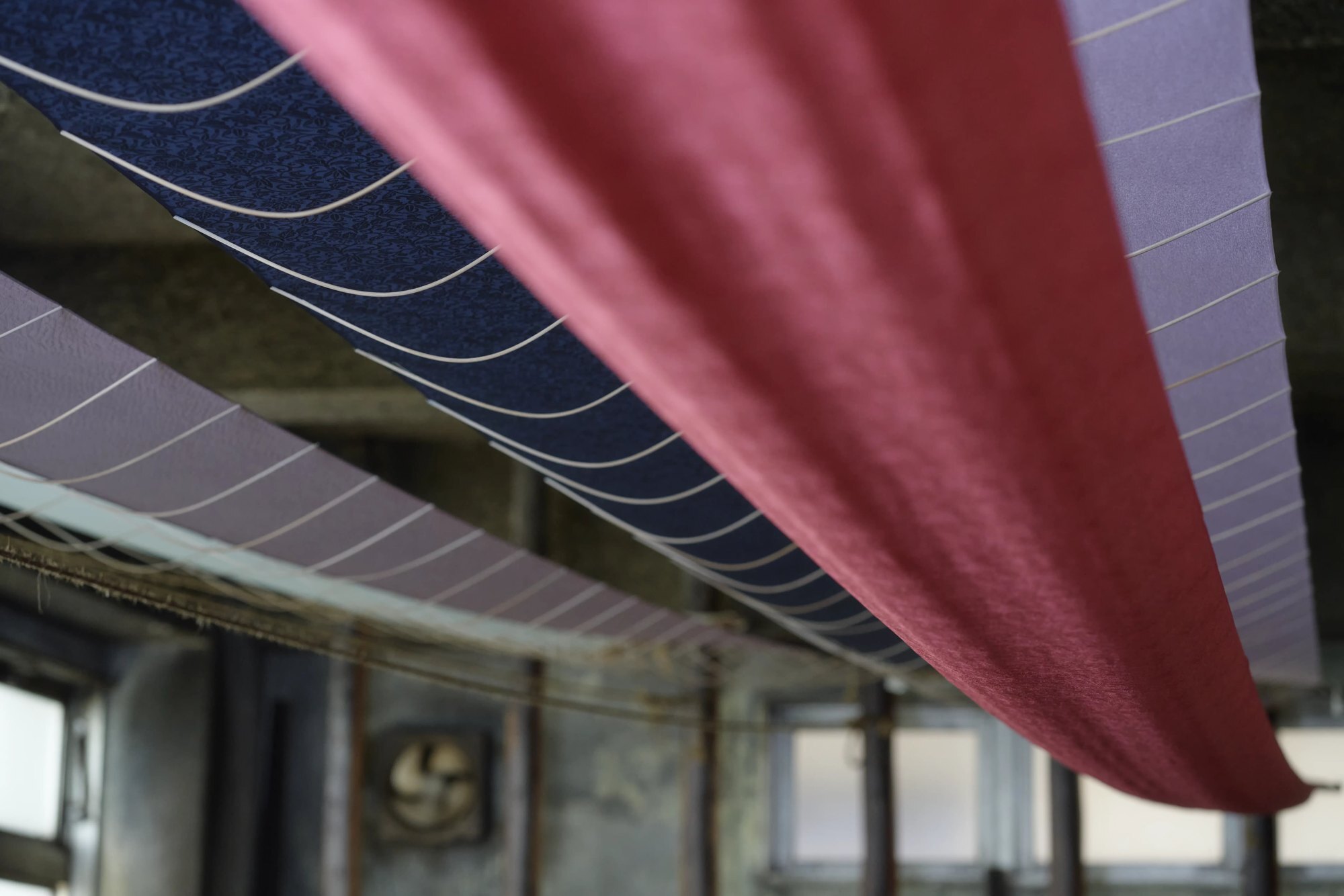
The second layer is there for those who know where to look. Domyo's main building stands at Ikenohata in Ueno, the same district as the Tokyo National Museum. The house describes the five-storey building, completed in February 2016, as arranged in the order of the work: the kumihimo archive, the dyeing room, the design room and the workrooms descend floor by floor from the top, and finished cords are sold on the ground floor. When we visited, the first thing to come into view on entering was cord in every colour. On the floor above, the sound was of tama, the weighted bobbins, striking one another at the braiding stand; on a floor higher still, light fell on silk just dyed.
The third layer is the work itself: the hands at the stand, which sit on the floors above the shop. One way toward it is offered by the house itself: kumihimo classes and a hands-on experience at the marudai, the round braiding stand, in which a first-timer braids nara-gumi. What the experience involves, and what Kiichiro Domyo hopes a newcomer takes from it, is in our conversation with Kiichiro Domyo.
The Obijime Today: Fewer Kimono, a Cord Still Being Made by Hand
Kimono are no longer everyday wear in Japan, as Kids Web Japan puts it, though people still like to wear them at various times throughout the year.
Domyo has kept braiding by hand. Kiichiro Domyo said the house makes a little over a hundred new pieces a year, and that "with domestic thread alone our company uses about 2% of Japan's entire production volume." Its history page lists what the cords now go into: obijime and haori himo for daily wear, ceremonial cords, and ties and accessories for Western dress.
That list carries the cord beyond the obi, as 1876 once carried it from the sword to the obi. Asked for a closing message, Kiichiro Domyo did not speak of the obijime alone: "To make things for Japanese dress and for Western dress; through the Kumihimo classes, to broaden the base; for guests who come to Japan from abroad, through the Kumihimo experience, to have them know not only the technique but Japanese culture." The obi gave a sword cord its second life. What the cord does next is being decided in Ueno, by a house that has already moved its craft once.