
A trip to Japan can easily end with a length of kumihimo in the luggage and no clear idea what it is. It turns up as a bracelet cord from a craft stall, the tie on a gift bag, the braided string looped through an omamori charm bought at a shrine — and none of it announces what it really is.
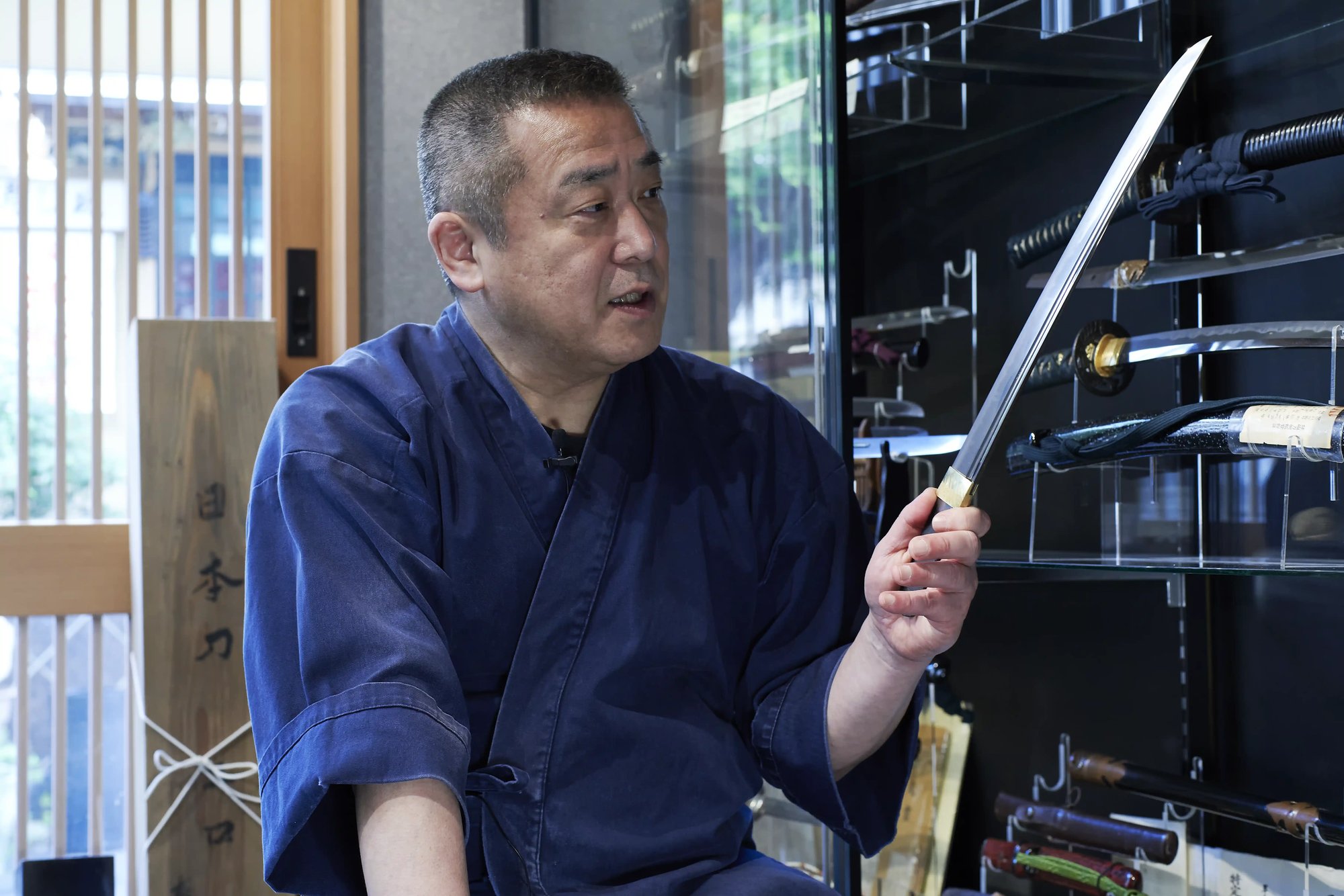
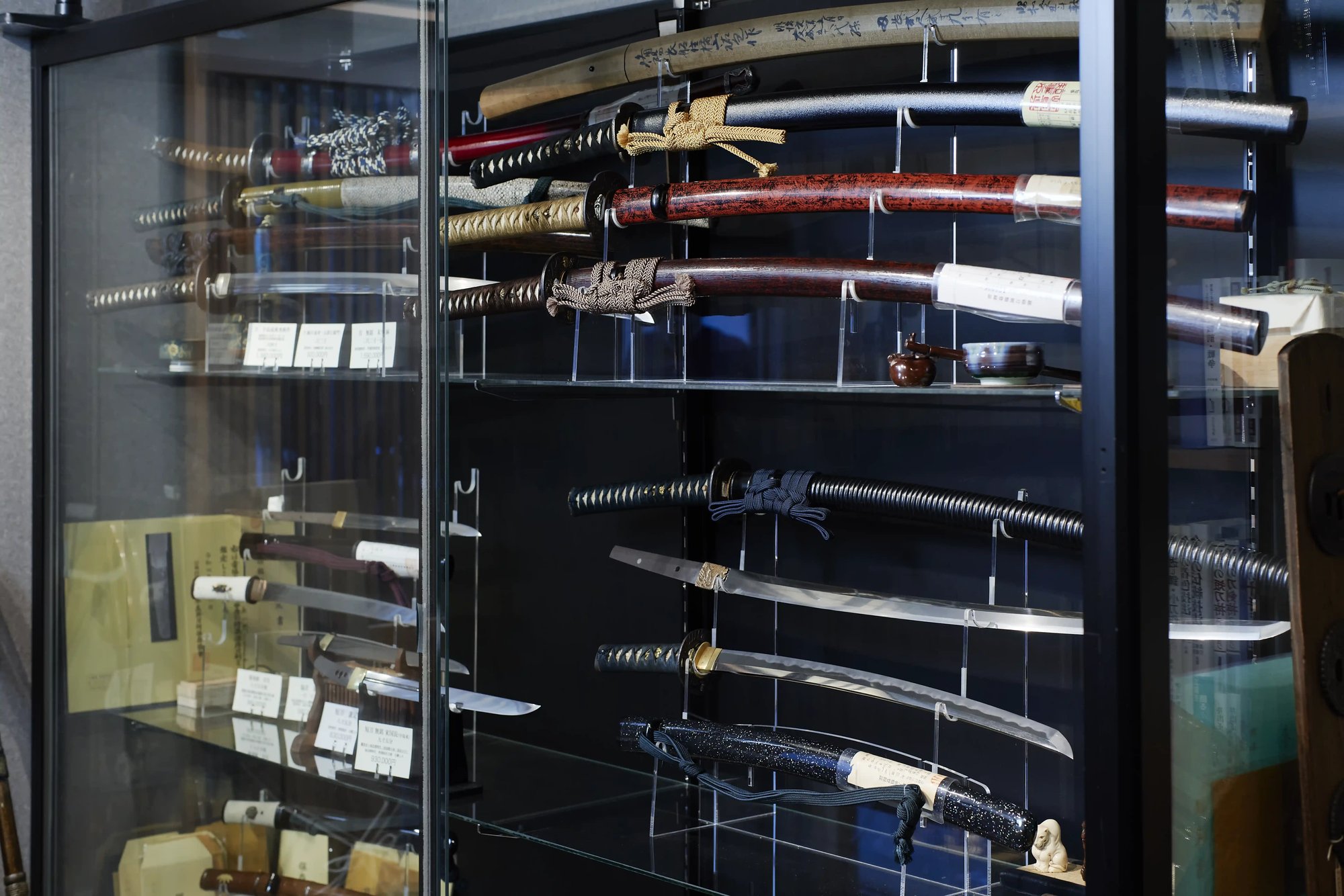
Kumihimo, Japanese silk braiding, has a documented history running well over a thousand years, and for centuries it was not decoration at all: it was the cord a samurai trusted to keep his sword in place.
In Ueno, Tokyo, one house — Domyo Co., Ltd., which calls its work Yusoku Kumihimo — has kept making it for more than three hundred years, and still hand-dyes and hand-braids the silk cords it makes for kimono, refusing the machines that took over the rest of the trade. This is the story of how a battlefield technology became a fashion accessory, of the stands it is braided on, and of what a craft protects when it insists on staying slow.
What Is Kumihimo? The Meaning of Japan's Braided Silk Cord
Before the history and the workshop, the word itself needs pinning down — because kumihimo is not a type of cord. It is the name of a technique.
Kumu plus himo: the name of a method, not an object
Kumihimo (組紐) refers to the Japanese craft of braiding silk into cord, historically used for sword cords, obi sashes, and ceremonial items. The word combines kumu, to braid, with himo, cord — so the kumihimo meaning is, literally, "braided cord," and the honest answer to "what is kumihimo" is a method, not a finished shape or a single pattern. Silk threads are bundled onto weighted bobbins called tama, set around a stand, and moved through a fixed sequence until they interlock into one elastic cord.
Domyo's own description of its work sets braiding beside weaving and knitting as the three basic ways of joining fiber. In a braid, the threads run on the diagonal, turn back at the edges, and zigzag on for as long as the cord continues.
That structure is also the short answer to how kumihimo differs from macramé. Macramé builds its pattern from knots; kumihimo builds its pattern from the order in which threads cross. Kiichiro Domyo, the house's president, makes a related point about braiding outside Japan: there, he says, it "developed in the direction of making knots and ornaments, but the structure itself did not advance much."
Japanese braids of this kind fall into three broad families by cross-section — round, square, and the flat braids called hiragumi — with representative types said to number around thirty, and several hundred braiding methods in all once variations and specialized ones are counted.
Where the work starts: silk, dye and tamatsuke
The braiding itself starts long before anyone sits at a stand. Raw silk is scoured to strip the stiff natural gum, sericin, from the fiber, twisted to the desired thickness, dyed against a matched sample, divided by the number of strands each bobbin will carry, and set onto individual weighted bobbins in a step called tamatsuke — the process of arranging silk threads onto weighted bobbins before braiding.
Only then does an artisan sit at the stand and move the threads through their sequence, at a pace of roughly one cord a day to one cord in two days.
Getting the thread onto the stand in the first place is its own skill. Threads are separated according to how many strands belong on each bobbin, and pulling with too much force at this stage can gradually tangle the thread before the braiding even starts — which is exactly the kind of thing experience teaches a hand to avoid.
On a cord whose color changes partway through, an uneven pull during tamatsuke shifts where the change lands.

From Battlefield to Obi: The Samurai Origins of a Braided Cord
Sutra cords, court sashes and armor: a thousand years in brief
Kumihimo history in Japan is said to begin around the sixth century, when the craft arrived from mainland China; Domyo's research institute ties its arrival to the coming of Buddhism. Kiichiro Domyo traces its uses era by era: sashes for Nara-period civil officials, the garments of the Heian nobility, and, from the Kamakura period on, the arms and armor of the samurai.
The house's history of the craft adds names. Nara-gumi, Sasanami-gumi, Kara-gumi and Anda-gumi survive at the Shōsōin and Hōryūji. The Heian period developed dan-zome, dyeing one thread in stages of color, and its cords hung nobles' swords, tied sutra scrolls and suspended amulets. The Kamakura period produced kikkō-gumi for lacing armor. By Kiichiro Domyo's account, late Heian to Muromachi cords reach structures four to eight times more complex than Nara-period ones. Kumihimo declined in the Sengoku wars and was revived in the Edo period, when its main use became the sword cord.
Place mattered too. Craft cultures grew up around Kyoto; Domyo, an Edo–Tokyo house, developed from the Edo period on. Kiichiro Domyo distinguishes the two by color: the Kyoto and Kansai manner favored the showier and softer, while Tokyo long preferred the understated — plain, yet with depth of color.
Samurai were not only customers. Domyo's history records that Edo samurai researched braiding, held that a warrior should make his own equipment, and recorded methods in texts such as Shika Sūyō and Hyakkō Hishō. As their households grew poorer, braiding became piecework done at home; the house's fifth-generation head, family memory holds, visited samurai homes in the last years of the shogunate to press for finished cords.
Sageo: The Sword Cord That Made Kumihimo a Warrior's Craft
The cord samurai wound around their swords had a name: sageo — and it had always been made as kumihimo. Thread merchants, in Domyo's own account of its history, "supplied a great many craft braids" for this purpose, across the centuries when a sword was ordinary daily equipment.
It is easy to read a functional object like sageo as a footnote to the more visible history of kimono and obi; for the centuries before the transition described next, the demand came from the other direction — the arms and armor of the samurai.
What "Yusoku" claims, and the house that claims it
Domyo calls its work Yusoku Kumihimo (有職組紐). Asked what makes it "Yusoku," Kiichiro Domyo explained that the word came from yūshiki, "having knowledge," and that the house uses it in this sense: "that we hold every technique of the Kumihimo that has a history of well over a thousand years in Japan, and that we bring it to life in present-day making." Our interview glosses the word as a lineage of kumihimo knowledge authorized within imperial court culture, a sense "traditional" alone would lose.
The claim comes with examples. Anda-gumi techniques and patterns, many of which remain in the Shōsōin's kumihimo, live on in today's belts and neckties, and the cord used on the Heike Nōkyō sutra scrolls at Itsukushima Shrine is used in present-day obi-jime.
Domyo's history dates the business to 1652, as a thread merchant said to have been founded by a samurai of the Takada domain who became a townsman, though no clear record survives. Domyo has kept making kumihimo in Tokyo for more than three hundred years. From the Meiji era onward, Western braiding machines arrived and most of the trade took them up. In the time of the sixth-generation head, Domyo set the opposite policy: no machines at all.
That decision also sent the house back into its own history. By Kiichiro Domyo's account, there is nowhere else studying historical kumihimo on a large scale, and Domyo has become something closer to a research institution than a typical workshop. Across generations, Domyo's staff have examined and reproduced kumihimo attached to Buddhist statues and suits of armor around Japan, building an archive that already runs to hundreds of faithful reproductions.
What he names as his artisans' greatest strength is the ability to understand and reproduce those complex structures. The beauty of a color or a pattern is only one axis they judge; the other is how the cord performs once worn — easy to tie, hard to come undone, elastic, and pleasant to the touch.

When a Sword Ban Ended a Craft's Original Purpose
When an 1876 law erased kumihimo's main market overnight, the technique did not disappear. It moved into the obi-jime, and the house turned to research on the Shōsōin's cords.
Haitōrei, 28 March 1876
On 28 March 1876, the Dajōkan — the highest organ of the new Meiji government — issued the edict remembered as the haitōrei. The National Archives of Japan holds the record, filed as volume Tai-00223: it prohibited carrying a sword except in full court dress, and for military, police, and officials in uniform.
For a craft whose customer wore a sword daily, this was not a shrinking market — it was the end of one. The sageo trade kumihimo workshops had supplied for centuries, along with the tsuka-ito that wrapped sword hilts, had nowhere left to go.
From Sword Cord to Obi-Jime: How Kumihimo Found a New Purpose
The transition did not happen by accident. In the late Edo period the otaiko-musubi way of tying the sash had already become established, and holding that sash in place created a demand the sword trade could be moved into.
The fit was closer than it sounds: today's women's obi-jime is almost identical to the sword sageo of that same era in length, width, and braiding method — only the coloring changed, growing more vivid to suit women's attire.
A technique built to hold a blade in place now holds a sash instead, largely unaltered in its engineering. That is the pattern worth noticing across kumihimo's history — a use disappears, and the technique itself does not; it moves.
When did the obi-jime appear? The sources disagree on the timing
In our interview, Kiichiro Domyo places the otaiko-musubi in the late Edo period. Domyo's history page says it became established through the Meiji era, that Meiji obi-jime were mostly narrow braids with metal clasps, and that the thick braids once used for sageo came into use only gradually; the obi-jime became the byword for kumihimo between the Meiji and Taishō eras. Japan House Los Angeles, presenting Domyo's work, notes that decorative cords were already tied over the obi in the Edo period.
Our reading: Japan House already uses the word obi-jime for the Edo period, so a cord on the obi predates the sword ban, while the sword-cord braid as the standard obi-jime belongs to the decades after it. Kiichiro Domyo's own dating points the same way: he speaks of signature patterns made "since a hundred years ago, when the Kumihimo obi-jime first appeared."
How Mori Ōgai sent the house to the Shōsōin
The next turn in Domyo's history came from an unlikely direction: literature. In the Taishō era, novelist Mori Ōgai — appointed Director General of the Imperial Household Museum in 1917, a post he held, overseeing the museum's Shōsōin holdings, until his death in 1922 — asked Domyo (or, in the house's history page, gave it permission) to survey the kumihimo held at the Shōsōin Repository in Nara, the imperial storehouse whose contents were donated roughly 1,300 years ago.
The house's research-institute page dates the request to the end of the Meiji era; Ōgai's 1917 appointment fits the Taishō dating in our interview. That page also lists the Shōsōin kumihimo again, as commissioned research, from 1968 to 1990.
That survey became the starting point of Domyo's ongoing research practice: patterns reconstructed from the Shōsōin holdings still sit in the house archive and still enter production.

Nara-gumi and the Hand That Won't Be Rushed
Nara-gumi and Yatsu-gumi, the first braids a visitor learns
Two very old methods still taught have names: Nara-gumi, many examples of which survive in the Shōsōin, and Yatsu-gumi, paired with it in Domyo's own beginner course. Both are what a first-time visitor braids on the Marudai, the round stand.
The path from that first lesson to real skill is long and deliberately staged. Artisans begin, Kiichiro Domyo explains, on the simplest stand with only about four tama, then add bobbins and more complex methods. Once a trainee can manage the Marudai comes the Takadai, the high stand, square in form and carrying a greater number of tama.
Alongside the stands, he lists what else has to be learned "in good balance": what the historical masterpieces were used for, how to match color with color, and how to match a kimono with an obi-jime.
Before the braid: how a hand-braiding house builds its thread
The thread carries more engineering than it looks. Domyo's main thread starts from a raw silk grade called 21-naka. Raw silk is reeled to thicknesses measured in denier (one Japanese mill lists 14, 21, 27 and up); 21-naka names a thickness grade, not a count of strands. Four strands of it are combined and given a lower twist; three of those bundles are then combined and given an upper twist, so each finished thread holds twelve strands of 21-naka. Usually, Kiichiro Domyo says, a lower twist combines only two. The extra step costs more effort; in return, "a very firm and beautiful Kumihimo results."
The workshop dyes, by his estimate, three to four thousand colors a year. A large factory, he says, puts all the dye in at the start for an enormous quantity of thread, with no fine adjustment possible afterward: "It is a single decisive attempt." Obi-jime need little thread, so dyeing small batches by hand lets the house make as many colors as possible, each as intended.
Domestic silk, prized for the whiteness its high-transparency water gives the raw thread, is used for the whites and pale colors — and now accounts for only about 0.05% of what the house uses. Even so, the domestic thread Domyo does use comes to about 2% of Japan's entire production.
Fūai, and why a machine cannot make it
This is the judgment that separates a hand-braided cord from a machine-braided one, in the words of Domyo's president and CEO, Kiichiro Domyo: "In hand-braiding you can weaken or strengthen the force partway through, so you can make a braid with elasticity and with fūai — a texture that emerges only through adjustment by hand." A machine pulls its weights continuously, at uniform tension, producing a cord with no elasticity. A hand can vary that tension mid-braid, and the variability is the point. Our interview drew one criterion from this for telling a fine hand-braided cord from an efficient substitute: not finishing in a single attempt.
He adds that many braiding methods are possible only by hand: switching the pattern partway through a cord, for one, or dan-zome, a single strand of thread dyed in varying colors along its length. Domyo's research notes on the court hirao sash show what that can demand: after surveying five hirao at the Kyoto National Museum in 1975, the house made five dan-zome hirao, each taking a year to braid, the dyed lengths adjusted a few millimeters at a time for every thread path.
The patterns themselves — the Miidera series, the Nara-gumi Four-Color Dan cords, and why the house recolors a historical design instead of copying it — are the subject of our article on where kumihimo patterns come from.

Marudai, Takadai and Other Kumihimo Stands
Every kumihimo stand does the same basic job. Japan House Los Angeles, explaining the structure of Domyo's braids, describes it this way: threads tied off at one end pass through the center of the stand, are divided into groups each weighted with a wooden bobbin, and are passed across, over and around each other until the cord emerges beneath. Kiichiro Domyo puts it more modestly: "It is not some large machine."
The marudai, or round stand
The marudai is the round stand: a wooden top with a hole at its center, the tama hanging around its edge. Japan House associates it with the rounder braids with a thicker cross-section that Domyo files under kakugumi, the square braids. It is also where every beginner at Domyo starts, with Nara-gumi or Yatsu-gumi.
At Domyo there is one Marudai per artisan — "like one's own partner." The tama wear down until they need replacing after thirty or forty years; the stand lasts about a century, taking on the oil of the hands and turning "an amber color."
The takadai, or high stand
The takadai, the high stand, is a taller frame than the marudai, and Japan House pairs it with the wide, flat hiragumi. PieceWork magazine's guide to kumihimo adds that its threads act as both warp and weft, and that it is used for flat braids and more intricate patterns. At Domyo it is the second stand an artisan learns, after the Marudai is under control.

Ayatakedai, and a stand built for the Shōsōin
PieceWork names the ayatakedai, or bamboo stand, as the third of the common stands: it makes flat braids similar in structure to bands woven on an inkle loom, with separate warp and weft threads.
Domyo added a stand of its own. To reproduce Shōsōin braids, the house built what it calls a parallel stand (heikōdai), on the supposition that Nara-period braiders may have used something like it. The stand is the house's educated guess about an ancient tool, and it reproduces the distinctive curves in the lattice of the Shōsōin's braided sashes.
Kumihimo disk, bracelet kits and the real thing
None of this is an argument against the foam disk sold in craft stores. A kumihimo disk kit is a genuine, simplified entry point into the same technique — the same logic a Marudai artisan uses, scaled down to a disk, craft-store cord, and no dye process at all.
It teaches the sequence. It does not teach, and was never built to teach, what happens when the material and the hand are both allowed to vary. Japan House gives one measure of what a kit leaves out: the delicacy of a cord depends on the temochi, the number of strands on each bobbin, and on how many bobbins there are. More strands on fewer bobbins braids faster, and makes a larger, coarser cord.
What type of string is best for kumihimo? For practice on a disk, the kit's cord does the job. For the cord itself, the traditional answer is silk, and the difference sits upstream of the braiding: the silk, the dyeing, and the twist described earlier. Domyo's own hands-on workshops use 100% silk and the same tools its artisans use.
At Domyo, the Nara-gumi a first-timer braids on the Marudai is worked into a bracelet or a strap to take home: the same idea as a kit bracelet, made in silk. The kit teaches the pattern. Only the workshop produces the material judgment behind it.

Mushin at the Marudai: Braiding as a Quiet Discipline
What mushin means at the stand
Domyo describes the interior state that braiding eventually produces using a word usually associated with meditative practice: mushin (無心) — a state of selfless, unforced focus, in which the hands move with practiced ease while the mind settles into quiet stillness. In his own words: "To braid Kumihimo in mushin amid that is like sitting zazen — seated Zen meditation — at a temple: the body is moving, yet the mind comes into a very settled state."
The house's own description of braiding calls it endless repetition, and warns that stray thoughts show in the finished cord.
Is kumihimo easy? The first fifteen minutes
Mushin is not the starting point — it is what repetition earns. By Domyo's own account, the first fifteen minutes or so at the Marudai are difficult for a first-timer: remembering the sequence, working out whether a given move goes right or left, failing at it more than once. The methods themselves are chosen to be learnable; Nara-gumi and Yatsu-gumi are, in his description, "easy to braid even for first-timers."
Only past that stretch, once the hands take over what memory was straining to hold, does the settled state become reachable. There is no version of kumihimo where the calm comes before the struggle.

The Access Hierarchy: From Museum Case to a Seat at the Marudai
Three different ways to encounter kumihimo — from a museum case anyone can walk past, to the working floors of a house that is not a museum at all.
Behind museum glass
The most visible layer is institutional, though less freely available than it sounds. Historical cords sit behind glass in Japan's national museums. The Shōsōin's treasures are kept in storehouses managed by the Imperial Household Agency, which says that a number of them are displayed every autumn at the Nara National Museum. For a traveler, that annual exhibition is the window to plan around.
Workshops and classes open to anyone who looks
A second layer is open but has to be found. Domyo runs hands-on workshops in Tokyo and Kyoto, and its kumihimo classes, founded in 1968, teach the house's methods to students; the classes hold an exhibition of student work every year. This is where the technique can be learned rather than read about.
A private visit to the working house
The third layer is the house at work. Domyo's current building, completed in February 2016, runs the process from the top floor down — archive, dye room, design room and workroom — with finished cord sold on the ground floor. A private visit through the braiding and dyeing floors, ending at a stand of your own, is described on our Domyo kumihimo experience page.
As Bespoke Discovery puts it in describing how these visits work: "The workshop is a place of work first, and a place to visit second. Its rhythm takes precedence over ours."
Domyo's own full interview and the closer, quieter behind-the-scenes visit that followed it go further into what that access actually involves than one article can.
Kumihimo Today: From Sword Cords to Western Dress and New Materials

A hundred new designs a year, and a label called OYMOD
The obi-jime remains kumihimo's most common present-day form, but it is no longer the only one. Domyo designs a little over a hundred new pieces a year, often around a single theme — a Japanese National Treasure's pattern, the coloring of a European textile, or Persian art, brought down to the scale of a braid.
Kiichiro Domyo describes wanting to make kumihimo "for Japanese dress and for Western dress" alike, and the house has also launched a separate label, OYMOD — "Domyo" read in reverse. Its page is frank: where a use calls for great volume, very fine cords or strict precision, OYMOD may use machine or hybrid production and materials other than silk, while the kimono side, Yusoku Kumihimo Domyo, keeps to hand-dyed, hand-braided silk.
The sword has not quite left either: for a 2026 exhibition at LVMH Métiers d'Art in Paris, the house made a sageo for a Bizen sword, crossing Japanese and French color and form. And Japan House notes that the braid structure is now applied to carbon fiber, in cords used for products from aircraft to artificial limbs.
Who carries it next
Kiichiro Domyo states the aim for visitors from abroad plainly: through the hands-on experience, "to have them know not only the technique but Japanese culture." Domyo's 2021–2023 touring exhibition at Japan House in Los Angeles, São Paulo and London was, by the house's account, the largest exhibition of Japanese kumihimo to date.
The sixth-generation head refused mechanization so that the handmade culture of kumihimo would not disappear. The question of what has to be carried forward, and by whose hands, is now held by whoever leads the house.
Kiichiro Domyo, the workshop's current president and CEO, traces his own answer back to the decision that first brought him into the business, after years spent in a separate career as an architect: "Even young as I was, I felt this was a technique that had to be properly passed on to the next generation."