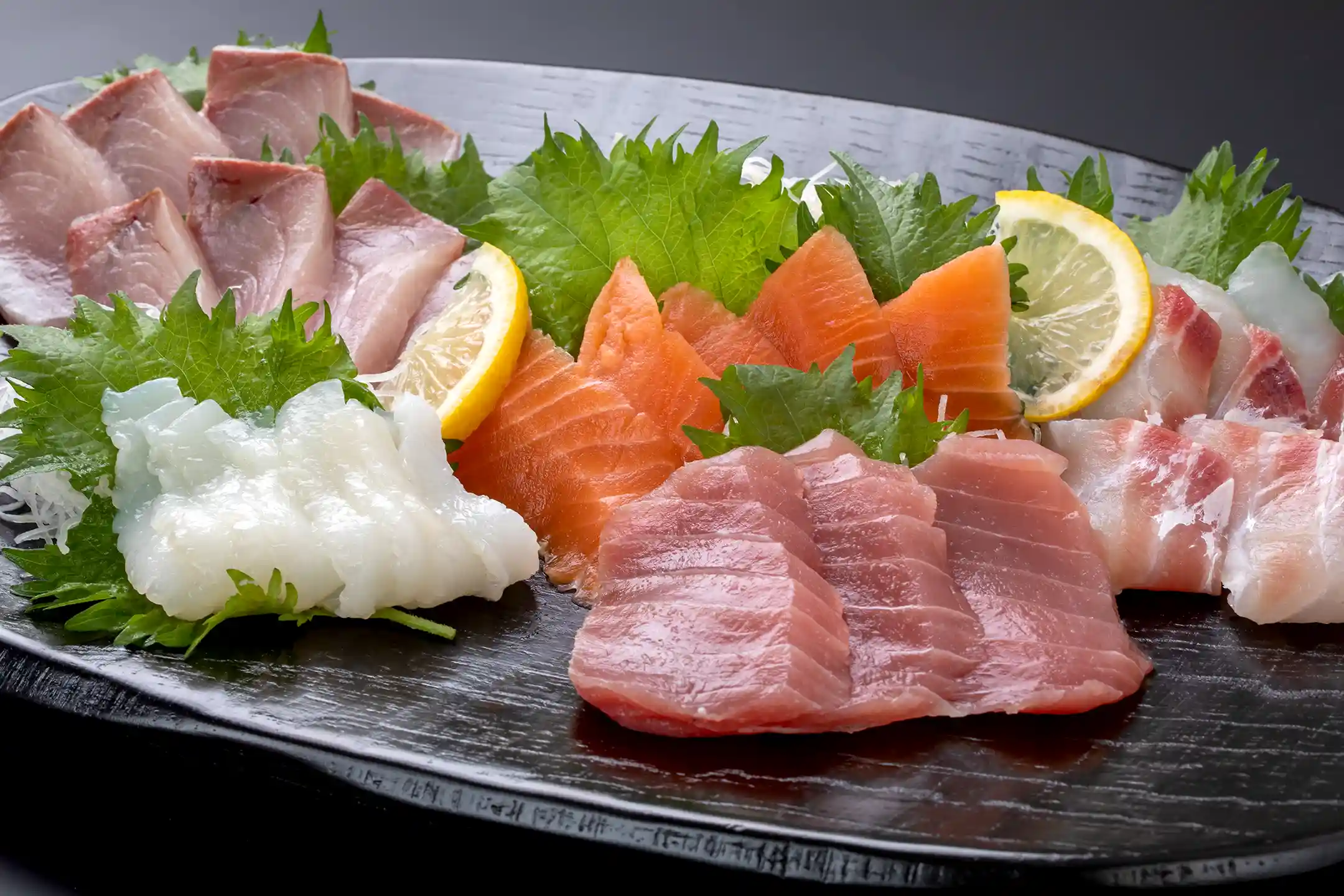
The oldest thing called sushi in Japan contained no vinegar, was not eaten fresh, and came packed in rice that was never meant to be eaten. Japanese raw fish culture did not begin with a chef slicing tuna at a counter. It began as a preservation technology, and much of what now looks like refinement was built on top of that older, sourer problem. This is a history of how a way of storing fish became a way of judging it.
Before Japanese Raw Fish Was Raw: Narezushi and the Fermented Centuries
The ancestor of sushi is narezushi, fish packed in salt and cooked rice and left to ferment. It is a borrowed method, not a native invention. The Japanese rice-industry reference site Komenet describes it as a Southeast Asian technique for processing fish that reached Japan out of China along with rice cultivation itself.
The rice is there to do a job. It saccharifies, then undergoes lactic acid fermentation, and the acid it releases is what keeps the fish edible for months. In the same process the animal protein breaks itself down into umami. This is where the sourness in the word sushi comes from, long before anyone poured vinegar on anything.
What the Rice Was For
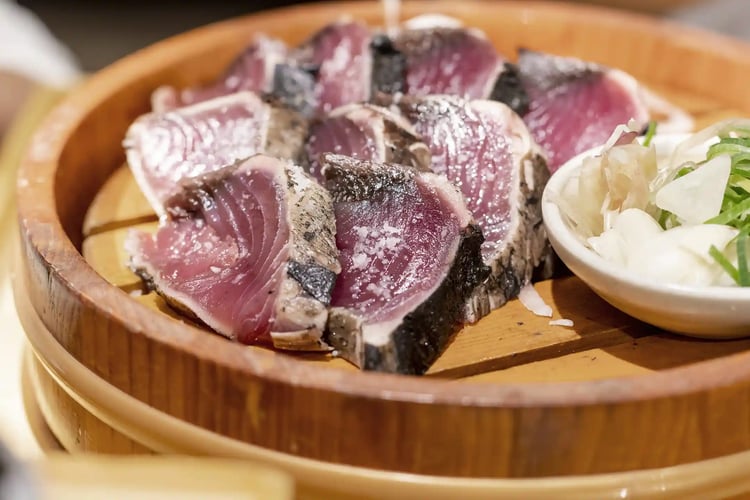
Here is the detail that reorders the whole story. Komenet is explicit that the rice was a pickling bed and not food: it was not there to be eaten. That single sentence separates narezushi from everything a visitor recognizes as sushi today, because modern sushi is defined by eating the rice.
The fish was the point and the grain was the machine. Anyone standing at a counter in Ginza is eating the inversion of the original dish.
This is also why narezushi was worth taxing. The same source records it sent up to the capital as tribute from the provinces of Ōmi and Wakasa in the Nara period, and the court ordering it paid as tax by the Heian period.
The wooden shipping tags excavated at the Heijō palace site show what that tax network moved. The Nara National Research Institute for Cultural Properties describes labels attached to goods arriving from across the country: rice, salt, bonito, wakame, sweetfish, abalone. To convey the distances involved the institute gives one worked example, a month for the one-way trip from Musashi province, in what is now Tokyo, to Nara. Ōmi and Wakasa sat far closer than that. The point is not that every shipment took a month, but that a state was routinely moving fish over distances measured in days rather than hours, which is a problem you solve with salt and fermentation or not at all.
Why Japanese Eat Raw Fish: The Question Is Backwards
The romantic answer is that Japan is an island nation surrounded by fish, so of course its people eat fish uncooked. Set that beside one fact already established and one that follows, and it stops working.
The oldest form of sushi was not raw at all; it was fermented for months. And the city that shaped the country's high cuisine had poor access to sea fish: the City of Kyoto describes its food culture as having formed over more than twelve hundred years since Heian-kyō in an inland basin set away from the sea. Proximity to fish is not what produced the cuisine.
So the useful question is not why Japanese people eat raw fish. It is what removed the need to preserve it. The next chapter is that answer in three parts: souring got fast, the catch came from directly offshore, and the techniques invented to survive the gap outlived the gap.
Sashimi Enters the Written Record in a Court Official's Diary
The word sashimi has an often-cited early appearance, and it belongs to a bureaucrat, not a cook.
Nakahara Yasutomi was a court official of the Muromachi period. His diary, the Yasutomi-ki, is held by the Archives and Mausolea Department of the Imperial Household Agency as seventeen parts in a mid-Edo copy, covering the years from 1419 to 1455, according to the Imperial Household Agency Archives catalogue.
The Japanese magazine Precious reports that the entry dated the fifteenth day of the eighth month of 1448 contains a description of sashimi much like the modern dish, and that this is thought to be why August 15 came to be called Sashimi Day. It is worth noting how carefully the magazine hedges: it presents the connection as a supposition, and states plainly that Sashimi Day was not established by any company or organization and that nobody knows who first proposed it. A commemorative date with no author is a more honest object than a founding myth.
The etymology is contested, and both explanations are worth carrying. One holds that the fish's fin was stuck into the sliced flesh so a diner could tell what species was on the plate once the head was gone. The other holds that the verb for cutting was avoided as an inauspicious word, so the verb for piercing was substituted. The first explanation is about identification, the second about superstition. Neither is about the knife.
The same magazine notes that sashimi and otsukuri are not two different dishes. They are two ways of naming the same thing, separated by region and by how the plate is composed, with otsukuri in everyday use in the Kansai region.
.webp?width=750&height=500&name=Sushi_Kanagawa_Japan_(2013).webp)
Ukiyo-e and the Sushi That Was Stacked, Not Laid Flat
Woodblock prints are the closest thing we have to photographs of Edo eating, and they record a serving convention that has been quietly inverted.
The Japan Fisheries Association points out that in prints such as Utagawa Kuniyoshi's Shima-zoroi Onna Benkei, Utagawa Toyokuni's Sushi Zuki, and works by Utagawa Hiroshige, pieces of sushi are piled upward instead of laid out in a row. Citing Suehiro Yasuo's Sakana Zukushi, it treats stacking as the basic way sushi was plated in Tokyo from the Edo period through the Meiji era, persisting at least into the Taishō era.
The flat arrangement that looks neutral to a modern eye had a name and a reputation. The association quotes Ōkawa Tomohiko's Gendai Sushigaku to the effect that stacking was the proper method, and that laying pieces out on a plane, called nagashizumi, was the way of the pleasure quarters, their restaurants and the stalls around them. The same quoted passage goes on to say that before the war, having nagashizumi delivered to an ordinary household could draw a rebuke along the lines of not bringing the licensed quarter's caterer's sushi into a respectable house.
Look at the photograph above with that in mind. The arrangement that is now simply how sushi is served once carried a name and an association that a prewar household would have caught immediately, and the association notes that the background to the change remains a mystery.
One remnant of the older plating is still in front of you and goes unremarked. Komenet explains that nigiri used to be genuinely large, large enough that a piece was cut into two or three to be eaten, and that this is why sushi is still served two or three pieces to a plate today. What you are given was never a portion size. It is the ghost of a single piece.
Kuniyoshi's print also names a real shop. The verse worked into the image refers to the sushi of Ataka no Matsu, and the association identifies the establishment as Matsu-ga-zushi, describing it as known as the shop that created hand-formed sushi. Hold that claim lightly, because it does not agree with the other one in this article: Komenet credits the invention of nigiri to Hanaya Yohei in the Bunsei era. Two reputable Japanese sources, two different origin shops. Whichever you prefer, sushi was street food with brand loyalty two centuries before it was a luxury.
Edomae Sushi Was Built on Two Accidents
Two things had to change before nigiri could exist, and neither was a culinary decision.
The first was souring. As long as acid meant waiting months for fermentation, sushi was a preserved good. The Muromachi period produced namanare, a half-fermented form eaten before the process finished, and Komenet marks this as the point at which the rice itself became something people ate and enjoyed for its salt and sourness. Then, in the Edo period, rice vinegar became widely available and the wait collapsed from seasons into hours, which the same source credits with the spread of hayazushi, or fast sushi.
The second was geography without refrigeration. Edomae originally meant the catch taken from the waters in front of Edo, in what is now Tokyo Bay. With no cold chain, the fish had to be worked on: salted and vinegared like gizzard shad and mackerel, simmered, or marinated in soy as zuke. Those treatments began as the way to keep a fish usable through a summer afternoon.
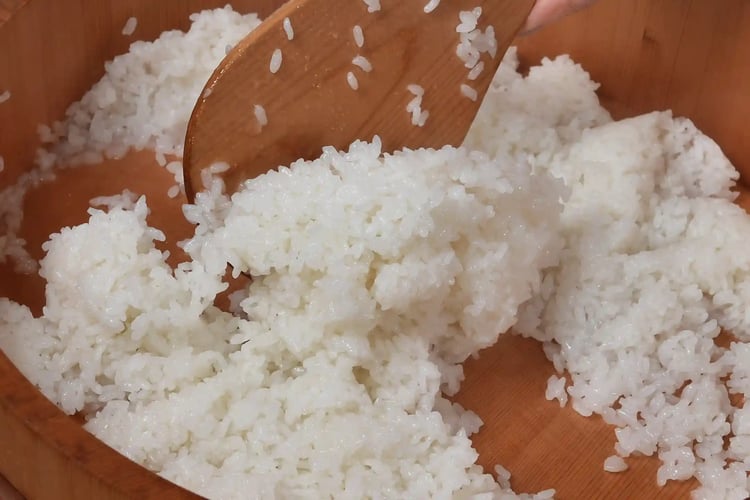
This is the misconception worth correcting first. The curing you meet at a serious Edomae counter is usually presented to visitors as a chef's refinement. Its origin is a constraint, and it outlived the constraint. Both things are true, and the order matters: the technique came from necessity and was kept because it was good, not the other way around.
Toro Began as a Discard
The most expensive thing on a modern sushi menu was thrown away within living memory, and the account of how that changed comes with its own caveats attached.
Yoshino Sushi Honten in Nihonbashi was founded in 1879 and is now run by its fifth generation, Yoshino Masatoshi. The travel publication Toretabi places the birth of toro at the shop around 1919, reporting it as what the shop is said to be rather than asserting it as fact. A poor catch had made lean tuna hard to obtain, so the fatty belly meat that was otherwise headed for disposal was formed into nigiri instead, and the name arrived in conversation with a customer, from the sense of the fat melting in the mouth.
The fifth-generation owner is refreshingly unwilling to overclaim. He tells Toretabi that lean tuna was hard for every sushi shop to buy at the time, so other shops may well have been serving the belly in the same period. What settled it, in his telling, is that the third generation went on television and asked any other shop claiming to have originated toro to come forward, and nobody did, so the family says it started there.
%20Sushi.webp?width=750&height=500&name=Succulent%20Otoro%20(Premium%20Fatty%20Tuna)%20Sushi.webp)
A shortage, a discard, a diner's offhand remark, and an unanswered appeal on television. That is the provenance of the most reliable status signal in Japanese dining. Nothing about it was designed.
How to Read a Counter: Judging Raw Fish in Japan
Most guides to Japanese raw fish tell you what to order. The harder and more useful question is what separates a serious counter from a competent one, and the answer is rarely the fish itself.
Start with the rice, because it is where technique shows and where it is hardest to hide. Yoshino Sushi Honten makes its sushi rice, according to Toretabi, with kasuzu alone, a red vinegar brewed from sake lees, plus salt, and no sugar. That is a specific, checkable position rather than a matter of taste. Ask what vinegar is in the rice and whether sugar goes in, and you have asked a question the counter can actually answer.
Then watch what happens to the piece before it reaches you. Komenet records that the sushi chef brushed nikiri, soy sauce and mirin simmered to drive off the alcohol, onto the topping himself, and states plainly that dipping the fish into soy sauce yourself is a recent habit. Seasoning finished at the board is the older practice, and it is usually mistaken for a modern refinement.
Even here the line is softer than guidebooks make it. The Yoshino owner tells Toretabi that the shop brushes nikiri on, but that a guest who prefers plain soy sauce is welcome to use it. A soy dish on the counter tells you about a house's posture and very little about its quality.
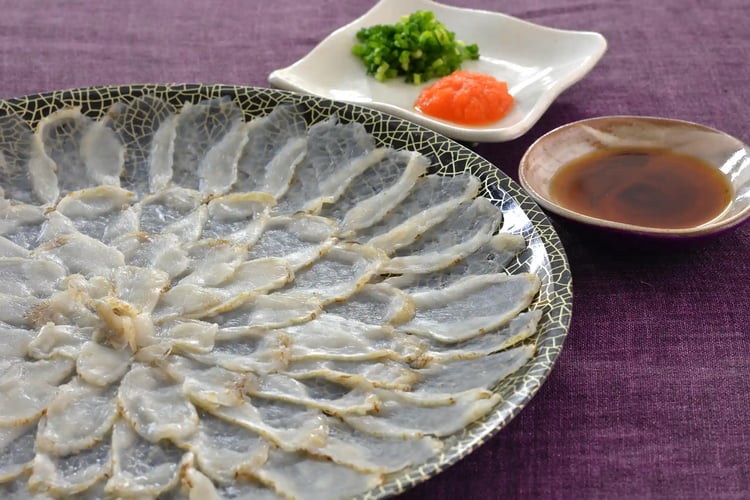
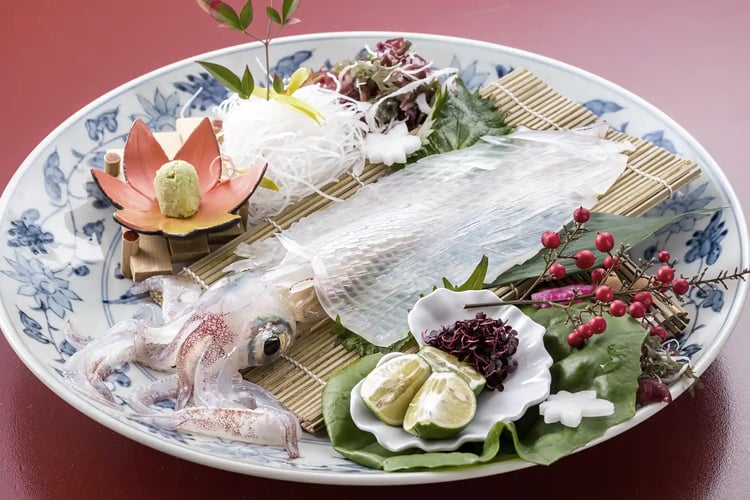
The plate above is the extreme case of the same principle: pufferfish cut thin enough to read the pattern of the dish through the flesh, where what you are paying for is largely the blade and the hand behind it.
Freshness deserves the same skepticism. The assumption that the best fish is the fish killed most recently is the one most visitors carry in, and the Edomae repertoire described above sits awkwardly beside it: curing, marinating, and simply holding a fish are all deliberate delays. A counter that treats time as a tool is not compromising on freshness, it is using a different axis, and judging it by the clock will get you the wrong answer.
What Has Already Been Lost
Scarcity is easier to feel when it has a name attached, and the Edomae repertoire has been thinning for a century.
The dining guide Kiwamino puts a number on it that is worth carrying: of the shops descending from the Yohei line, only two survive, Yoshino Sushi Honten in Nihonbashi and Kizushi in Ningyōchō, founded in 1923.
Kizushi keeps items that have largely disappeared elsewhere. Kiwamino lists its tazuna-maki and its karako-zuke of kuruma prawn, and serves its egg in the kurakake style. It also records something better than a list: the shop serves marlin haramo, a topping the guide describes as having once come close to dying out, and credits Kizushi with much of the reason younger and mid-career chefs have come back to marlin at all. That is a named house reviving a named ingredient, which is the rarest kind of fact in food writing.
If you want to know what has been lost from Japanese raw fish culture, order the things that sound unfamiliar rather than the things that sound famous.
Raw Fish on the Right Vessel: Season, Tableware, and the Tea Room
Japan treats the plate as part of the dish, not as a surface for it, and the clearest statement of that idea belongs to a single artist.
Kitaōji Rosanjin, the potter and cook, left the phrase utsuwa wa ryōri no kimono, the vessel is the garment of the food. The National Museum of Modern Art, Kyoto used it as the title of a workshop held alongside its 2015 Rosanjin exhibition, describing it as the spirit in which he weighed tableware against what was served on it.
Applied to sashimi, the idea is practical rather than decorative. The same slices carry differently on glass than on heavy stoneware, and a host who has chosen between them has made a decision about the dish and not about the table. That is the whole content of Rosanjin's phrase, and it is why vessel selection sits inside cooking in Japan instead of alongside it.
Seasonality here is not a general reverence for nature but a set of specific enthusiasms with places attached. The Yamaguchi Prefecture Tourism Federation makes the case for its own coast in exactly that register, pairing summer with hamo around Shūnan and Hōfu, winter with tilefish landed at Hagi and monkfish at Shimonoseki, and noting that its Sea of Japan and Seto Inland Sea grounds have different characters. Our guide to Japanese food culture follows the same regional logic across other dishes.
Kaiseki, Mukōzuke, and the Rule About Summer
In the meal served at a formal tea gathering, raw fish has a fixed position and a fixed name.
The Omotesenke school of tea describes the tray handed to each guest as a low oshiki carrying rice, soup, and mukōzuke, with the meal built on soup, mukōzuke, a simmered dish, and a grilled dish. Sashimi is what ordinarily fills the mukōzuke. The school also explains the name kaiseki through the tradition of Zen monks holding warmed stones against the body to endure hunger during training, which is why the word points at plain food rather than lavish food.
The detail worth carrying home is a restriction. Omotesenke records that at a summer morning tea gathering the meal is reduced to soup, mukōzuke, and a simmered dish, and that the custom is to keep raw fish away because of the season. A tradition often presented to visitors as unlimited refinement contains a rule about when raw fish is inappropriate.
Kyoto's ryōtei work inside the same inheritance, and the state has now said so formally. Kyō-ryōri, the cuisine of Kyoto, was entered in the national register of intangible cultural properties on November 17, 2022, according to the Agency for Cultural Affairs' Cultural Heritage Online record. What the entry protects is worth reading closely: not recipes, but the unification of cooking, room setting, and reception, carried by three parties at once, the proprietor, the cook, and the women who work the rooms. The plate is one part of a designation that also covers the room and the greeting. Our guide to Kyoto kaiseki takes the meal itself up in more detail.
Japanese Seafood Culture Today: Salmon, Stocks, and Access
The last forty years brought two changes to Japanese raw fish, and neither came from a kitchen.
How Salmon Reached the Sushi Counter
Salmon is now a standard item on Japanese sushi menus. It is also the newest arrival in the repertoire, and it arrived as an export campaign.
The Norwegian Seafood Council dates the effort to 1985, when a delegation led by Thor Listau, then Norway's fisheries minister, traveled to Tokyo under the name Project Japan. The council puts Norwegian salmon exports to Japan at two tonnes in 1980 and at more than 45,000 tonnes a year two decades later, and reports that around 30 percent of Norwegian salmon is now eaten raw as sushi.
The trade publication Fish Farming Expert, reporting on the same anniversary, notes that raw salmon was absent from the Edo period and that no shogun ate it that way.
So the honest version is this. An item many visitors treat as quintessentially Japanese entered the canon within the working lives of the chefs now serving it, and it entered because a foreign government set out to sell fish. That is not a criticism of salmon. It is a correction to the idea that the counter is a fixed inheritance. It has always absorbed whatever the supply chain delivered, which is exactly what happened with tuna belly a century earlier.
What Sustainability Actually Changed
Resource management in Japan is a policy program with numbers attached. The Fisheries Agency's resource management pages set out management by total allowable catch, with the stated aim of maintaining or restoring stocks to levels capable of delivering maximum sustainable yield. The agency records the expansion of stock assessment to 192 species by fiscal 2021, and a target of restoring fisheries production, excluding aquaculture and seaweed, to 4.44 million tonnes by fiscal 2030.
At the restaurant end, certification has begun to appear. Matsunozushi, an Ōmori sushi house founded in 1910 and now in its fourth generation, announced in February 2021 that it had obtained MSC and ASC Chain of Custody certification, describing itself as the first long-established sushi restaurant in Japan to do so. The same house's sushi-making experience has been presented by the Tokyo Convention and Visitors Bureau as a Tokyo luxury activity on its Timeless Tokyo platform.
At the volume end, Kura Sushi opened a branch at the Osaka-Kansai Expo site on April 13, 2025. Its announcement describes an exterior using roughly 336,000 reclaimed shells set in a plaster made without artificial materials, bound with a glue derived from seaweed, and a menu that puts low-utilization species such as nizadai to work. Note what is being claimed and what is not. This is a building and a menu, not a statement about what the fish costs the ocean.
The older idea underneath all of it is simply rotation. A repertoire that changes with the season does not lean on one species all year, which is a form of restraint that predates the word for it.
Three Levels of Access to Japanese Raw Food Culture
It is worth being explicit that Japanese raw fish culture is not equally open. The three levels below are separated by knowledge and introduction far more than by the size of the bill.
Anyone can walk in. Ōmichō Market in Kanazawa has, by the Japan National Tourism Organization's account, 300 years of history, and its guided tour with a cooking class runs two hours or more, covering seasonal fish at the stalls and dashi and knife work afterward. Our Kanazawa food guide covers the surrounding city.
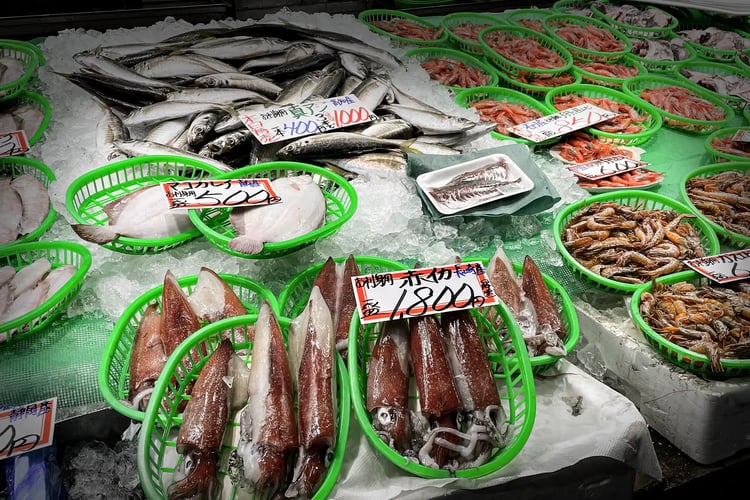
You can book if you know it exists. Tokyo now has two markets doing different jobs: Toyosu Market, which took over the wholesale trade, and the Tsukiji Outer Market, where the retail shops stayed put. A facility called Sushi Making Class in Tsukiji opened in that outer market on July 1, 2024, running ninety-minute multilingual sessions, according to the operator's announcement. Our Tsukiji guide sets out the market itself.
And there is a third level that no booking page reaches: the small room where a family keeps a technique that is no longer commercially rational, and where a visit happens because someone made an introduction. Knowing that this layer exists changes how you read the first two. The market tour and the class are real, and they are also the outer edge of something that does not advertise.