One of the deepest layers of Japan’s hot spring culture is the tradition of mixed-gender onsen, known in Japanese as konyoku onsen. These are baths where people of all genders soak together. Historically, they grew out of tōji※long-stay therapeutic hot spring retreats intended to heal illness※, and today many of these traditional mixed onsen in Japan are being rediscovered as serene destinations for adults seeking quiet nature and deep relaxation for both body and mind.
If you are new to Japanese culture, just hearing the words “mixed bathing” may feel like a big step. And if you have ever typed “traditional mixed onsen Japan” into a search bar, you may still be wondering what actually awaits you. In this guide, you will find a structured introduction to everything you need to know to enjoy Japan’s traditional mixed-gender onsen with confidence—from their historical background and current rules, to regional characteristics, how to choose where to go, and how to turn your visit into a holistic wellness experience.
Why not take your first step toward a calm, restorative “grown-up hot spring journey” where your body and your mind can truly unwind?
What Are Japan’s Traditional Mixed-Gender Onsen?|History and the Present of Traditional Mixed Onsen in Japan
Mixed-gender onsen are scattered all over Japan. When you understand how they came to be and how they exist today, you can step into these traditional mixed onsen in Japan with both cultural respect and peace of mind. In this chapter, you will explore their historical background, modern styles, and the legal framework that shapes them.
History and Cultural Background
For Japanese people, bathing has always meant much more than simply staying clean. There is a deep culture behind it. Since ancient times, hot springs bubbling up across the land have been regarded as “gifts from the gods,” and historical records show people of all ages, regardless of gender, soaking together and enjoying the baths.
In the Fudoki, a collection of regional chronicles compiled in the Nara period, you find descriptions of Tamatsukuri Onsen in present-day Shimane Prefecture, where many men and women gathered every day to bathe for pleasure. It notes that if you soak twice, the waters are effective against all kinds of ailments. Such hot springs were revered as sacred “kami-yu,” or divine baths. At that time, there was no concept of separating men’s and women’s baths—mixed bathing was a completely natural custom.
/The%20streets%20of%20Tamatsukuri%20Onsen%20at%20night.webp?width=800&height=533&name=The%20streets%20of%20Tamatsukuri%20Onsen%20at%20night.webp)
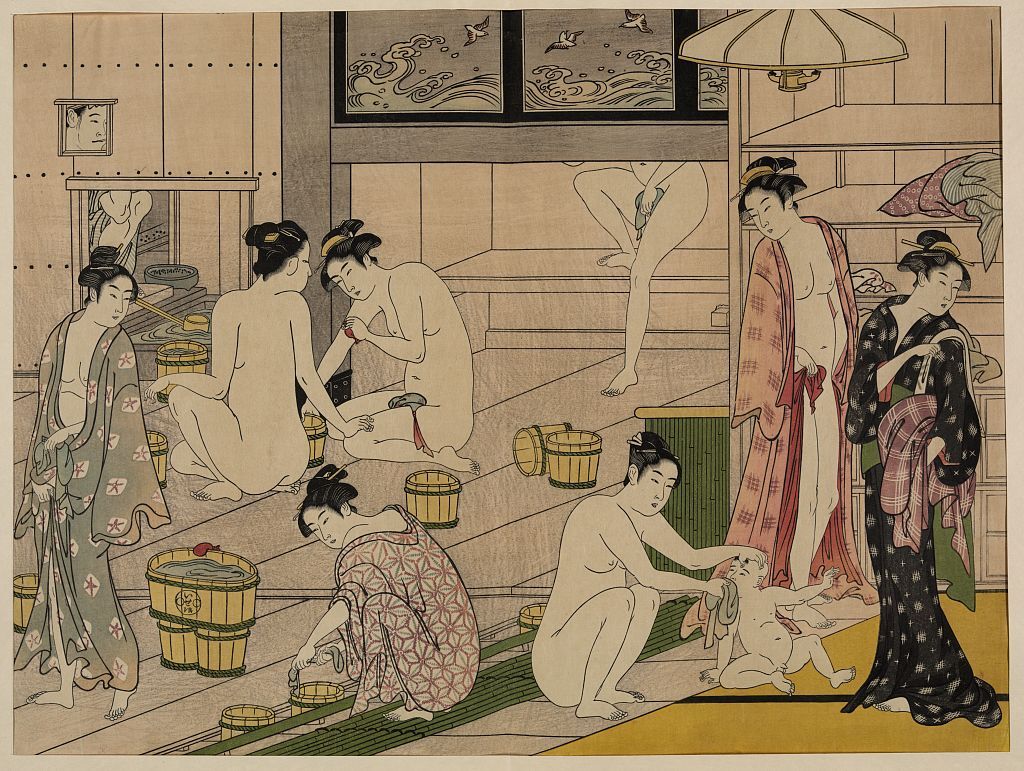
After Buddhism arrived in Japan, temple bathhouses were opened to ordinary people during the medieval period, and bathing became firmly rooted in daily life. By the Edo period, public bathhouses called sento appeared in the cities, and bathing culture became part of everyday urban life. At that time, Edo’s bathhouses were basically mixed-gender. Common townsfolk enjoyed what the Japanese call “hadaka no tsukiai”—literally “naked companionship”—soaking together and socializing in the nude.
When Westerners began visiting Japan in the mid-19th century, however, many were shocked to see men and women bathing naked together. Commodore Perry of the United States, who came to Japan in the 1850s, recorded that “men and women bathe together without concern,” and is said to have been greatly surprised by Japanese customs. Partly in response to such overseas reactions, the Meiji government banned mixed bathing in urban areas in 1869 as part of its modernization policies. As a result, only hot spring areas with a long-standing mixed-bathing tradition were exceptionally allowed to continue, while creating new mixed-gender baths became, in practice, impossible(*1).
Mixed bathing culture went through a period of decline, but underneath it lay a distinctly Japanese way of relating to others, often expressed by that phrase “naked companionship.” When you remove your clothing and social status and share the same water, the emotional closeness and sense of trust it creates has long helped strengthen community bonds and bring healing within families.
Modern Mixed-Bathing Styles and Facility Types
Most of the mixed-gender onsen that remain in Japan today are hot spring areas that have preserved traditions dating back to before the Meiji era—places that can almost be considered “living historical heritage.” Broadly speaking, these facilities fall into four main types.
Mixed open-air baths at ryokan inns
Some long-established hot spring ryokan offer large open-air baths (outdoor baths) where all genders can bathe together. The appeal lies in soaking in spacious rock baths or fragrant cypress tubs while being embraced by nature in every season.
To help you feel comfortable, many of these inns allow yuamigi (bathing robes) or wearing a bath towel wrapped around the body. If you time your visit for late at night or early morning, when there are fewer people around, you can often enjoy a quiet atmosphere that feels almost like having the bath to yourself—especially valuable if you are trying a traditional mixed onsen in Japan for the first time.
Community bathhouses (local public baths)
In hot spring towns or small villages, you may find simple community bathhouses that locals and guests of nearby inns share. In recent years, most of these have become gender-segregated, but in some remote hot spring regions—especially in Tohoku—mixed-gender community baths still remain.
Because these baths also function as local social hubs, it is important to greet people and be considerate—letting others go first, keeping your voice gentle, and so on. For you as a traveler, bathing alongside local residents lets you feel the warmth of everyday hot spring culture in a very direct way.
Private baths (family baths)
Private baths are reserved for one group at a time, effectively allowing “private mixed bathing.” Some ryokan provide bookable private open-air baths where couples, families, or close friends can relax together without worrying about being seen by others.
The trade-off is that usage is often limited to 30–60 minutes. To make the most of the bath’s effects in a short time, it helps to warm your body in advance—say, by taking a quick shower or a brief dip in another bath beforehand—so you can relax from the moment you step in.
Wild hot springs, or noyu
These are natural outdoor springs in the mountains or along riverbanks. In some cases there may be nothing but a single simple rock pool, which naturally makes them mixed-gender. There is usually no changing room, and the sense of openness is extraordinary—but using them requires proper preparation and a strong awareness that you are responsible for your own safety.
In recent years, some local governments have begun managing these wild springs in light of concerns about manners and environmental protection, and you are expected to follow the rules they put in place.
As you can see, mixed-gender onsen today exist in a variety of forms. However, because creating new mixed baths is generally not permitted under local ordinances based on the Public Bath Houses Act and on how public health guidelines from the Ministry of Health, Labour and Welfare are applied, many people now argue that existing mixed-gender onsen should be protected as “valuable cultural heritage”(*1).
At the same time, some inns have decided to abolish mixed bathing altogether due to problems with poorly behaved bathers, such as people nicknamed wani-zoku (“crocodiles”), who are known for persistently staring at women. In fact, the number of mixed-bathing hot spring inns and public baths has reportedly declined from around 1,200 locations in the 1990s to about 500 in 2021(*2).
Against this background, many hot spring areas are introducing women-only time slots, lending yuamigi, and taking other steps so that you can enjoy mixed bathing in comfort and with peace of mind.
How to Choose Traditional Mixed Onsen in Japan|Regions, Spring Qualities, and Experience Themes
Once you start thinking, “I want to try a mixed-gender onsen,” the question becomes: where should you go? When you choose based on the character of each region, the type of hot spring water (onsen quality or senshitsu), and the kind of experience you want to prioritize, your trip to a traditional mixed onsen in Japan becomes far more satisfying.
In this chapter, you will learn about the features and best seasons of different regions, basic knowledge of the main spring qualities, and how to choose hot springs that match your preferred travel theme.
Regional Characteristics and Best Seasons
Hokkaido & Tohoku: Snowy Landscapes and Hidden Mountain Springs
In northern Japan—Hokkaido and Tohoku—what stands out most are remote hot springs set in dramatic natural surroundings, especially in winter. The highlight here is the classic “snow-view bath.” Soaking in an open-air bath while gazing out at a pure white landscape is unforgettable.
For example, at Sukayu Onsen in Aomori Prefecture and in the Nyūtō Onsenkyo area of Akita Prefecture, you can encounter dreamlike scenes where falling snowflakes mingle with clouds of steam rising from the baths.
/Nyuto%20Onsen%2c%20a%20secluded%20hot%20spring%20hidden%20in%20the%20mountains%20of%20Akita.webp?width=800&height=533&name=Nyuto%20Onsen%2c%20a%20secluded%20hot%20spring%20hidden%20in%20the%20mountains%20of%20Akita.webp)
In deep winter, especially from February to March, snowfall is at its peak. Bathing while trees stand cloaked in white is an experience that feels completely removed from everyday life. However, winter also brings icy and closed roads, so your access plans need to be cautious and realistic. If you drive, snow tires are essential, and you should check for seasonal suspension of bus or train services. When you take proper safety measures, the reward of deliberately heading for a snowbound hidden hot spring is more than worth the effort.
In Towada-Hachimantai National Park, which spans Aomori, Akita, and Iwate Prefectures, a report shows that 14 out of 43 hot spring inns still offer mixed bathing (as of September 2022)(*1). Many of these places have preserved mixed bathing because the available spring sources were limited and had to be shared, so a single bath was used by everyone regardless of gender. The hot spring culture that took root here—generations of families soaking together as part of long-stay tōji stays—has been quietly passed down over time(*1).
Beyond winter, fresh green from May to June and autumn foliage in October are also ideal seasons. When there is no snow, it is easier to reach wild outdoor baths tucked deep in the mountains, letting you enjoy forest bathing and hot spring bathing at the same time. On the other hand, major holidays such as the mid-August Obon period and Golden Week tend to be very crowded. If you are seeking quiet, it is wise to avoid those times.
Kanto & Koshinetsu: Famous Hot Springs Within Easy Reach of Tokyo
Hot springs in the Kanto region around Tokyo and the Koshinetsu area (Yamanashi, Nagano, Niigata) are perfect for weekend trips. Places like Takaragawa Onsen in Gunma and Shirahone Onsen in Nagano are well-known inns with mixed-gender open-air baths and relatively easy access from the Tokyo metropolitan area.
/The%20rustic%20charm%20of%20Shirahone%20Onsen%2c%20famous%20for%20its%20soothing%20mineral%20waters.webp?width=800&height=1200&name=The%20rustic%20charm%20of%20Shirahone%20Onsen%2c%20famous%20for%20its%20soothing%20mineral%20waters.webp)
In these regions, you will also want to experience the culture of local community bathhouses (soto-yu). For example, the public baths of Nozawa Onsen in Nagano are gender-segregated, but as you move from bath to bath alongside local residents, you catch a glimpse of what it means to include hot springs in your daily life.
Weekend trips often mean short itineraries, such as leaving Friday night and returning Sunday. To restore your energy efficiently, it helps to limit yourself to travel and a light soak on the first day, and then plan a more leisurely round of baths on the second day.
Famous hot springs that can be reached by shinkansen or limited express trains—such as Kusatsu Onsen in Gunma or Zao Onsen in Yamagata—are popular options you can fully enjoy even on a weekend. Because these areas are in high demand, early reservations are essential. Around Karuizawa, a well-known summer retreat, hot springs can be packed in summer, while winter tends to be relatively quiet—something to keep in mind if you enjoy tranquil baths.
Local governments and ryokan associations in many regions display bathing etiquette rules—no photography, no visible tattoos, and so on. Before you bathe, take a moment to check the signs and brochures so that you can be the kind of guest local communities are happy to welcome.
Hokuriku, Tokai & Kansai: Historic Hot Spring Towns and Long-Established Inns
In Hokuriku (Ishikawa, Toyama, Fukui), Tokai (Shizuoka, Gifu, Aichi), and Kansai (including Kyoto, Hyogo, Wakayama), you will find many historic hot spring towns and traditional ryokan inns. At places like Yamashiro Onsen in Ishikawa or Gero Onsen in Gifu, some inns have histories stretching back hundreds of years, and the architecture, interior design, and cuisine are attractions in their own right.
/The%20UNESCO%20World%20Heritage-listed%20Tsuboyu%20bath%20in%20Yunomine%20Onsen.webp?width=800&height=533&name=The%20UNESCO%20World%20Heritage-listed%20Tsuboyu%20bath%20in%20Yunomine%20Onsen.webp)
Mixed-gender baths are relatively limited here, but this is a region where you can discover hidden gems, including inns belonging to associations like the “Nihon Hitou wo Mamoru Kai” (Association to Protect Japan’s Hidden Hot Springs).
A stay at one of these venerable inns is packed with pleasures that you cannot fully savor in just one night. If you stay for two nights or more, you can explore nearby sights during the day, soak in the hot springs in the evening and morning, and then enjoy quiet time for reading or meditation in your room at night.
In some inns that have a single large mixed open-air bath, male guests are asked to refrain from bathing during certain evening hours to make it easier for women to enter. If you still feel shy, one practical—and slightly charming—approach is to take turns with your partner as “lookout,” watching the entrance while the other bathes.
Winters in Hokuriku bring snow, but major destinations like the Kaga Onsen area are well-served by roads and public transport, which makes travel relatively straightforward.
In contrast, at places like Kawayu Onsen in Wakayama Prefecture, you can enjoy an ultra-natural mixed-bathing experience in the Sennin-buro, a huge open-air bath created by digging into the riverbed in winter. However, whether you can bathe or not depends heavily on river conditions and weather. Checking the latest information from local tourist association websites and planning a flexible itinerary is essential.
Chugoku, Shikoku & Kyushu: Rich Variety of Waters and Landscapes
From western Japan down to Kyushu in the south, volcanoes have created an abundance of hot spring regions, especially in Kyushu. Beppu Onsen in Oita Prefecture is Japan’s number one in both number of sources and volume of hot water. It is said that seven of the ten main types of hot spring water found across Japan bubble up within the city(*2).
From milky sulfur springs, to fizzy carbonated springs, to salty chloride springs known as “heat-retaining baths,” you can enjoy a range of therapeutic effects in a single trip—one reason Beppu is in a league of its own. Other regions are equally distinctive.
In Kurokawa Onsen in Kumamoto Prefecture, nearly 30 ryokan take part in a “bath-hopping pass” system that gives you access to multiple baths, including mixed open-air baths. You can stroll through a quiet mountain valley, stopping in at various baths as you go.
At Ibusuki Onsen in Kagoshima Prefecture, you can try sunamushi-buro, a unique sand-steam bath where you are buried in warm sand (these are gender-segregated), and on remote islands you find places like Hirauchi Kaichū Onsen on Yakushima, a natural rock bath that disappears under the sea at high tide.
Visiting such remote island or deep-mountain hot springs demands solid planning, especially for long-distance travel. You will need to check ferry times and bus schedules, and arrange your accommodation carefully.
If you have plenty of time, another idea is to turn your trip into an “onsen pilgrimage.” In Shikoku, for example, you might start at Konpira Onsenkyo in Kagawa Prefecture and then extend your journey to the Lamp-no-Yado※an inn famous for having no electricity※ in the mountains of Kochi. In the Chugoku region, you could move from one well-known spring to another—Okutsu, Yubara, Kaike, and more—creating your own route.
As you go, you will not only feel differences in spring quality from place to place, but also become more aware of each region’s volcanic history and geology. Many travelers come away with a new sense of wonder at just how profound Japan’s hot spring culture really is.
Kyushu’s relatively mild climate makes it comfortable to travel even in winter, but summer falls in the typhoon season. If you plan to visit remote islands in summer, it is wise to build in an extra “weather buffer day” in case ferries are cancelled.
Wherever you go, avoiding crowds is the key to a high-quality hot spring journey. Aim for weekdays, periods just after major holidays, or off-season travel. At your inn, consider going to the baths right after check-in, or late at night and early in the morning. With a little strategy, you can secure quiet times when few others are around.
In those tranquil moments, when you feel yourself becoming part of the surrounding nature in a mixed-gender open-air bath, the experience becomes a true “gift to yourself.”
A Woman’s Guide to Traditional Mixed Onsen in Japan
If you are a woman, mixed-gender onsen may be something you are “curious about, but a little nervous to try.” In this chapter, you will find detailed tips to help you enjoy mixed bathing in comfort and with confidence—from how to choose facilities, to what to bring, to smart ways of using your time.
By adding a few women-focused strategies, you can turn your encounter with this traditional culture into a positive and empowering experience, even if it is your first time visiting a traditional mixed onsen in Japan.
Checking Women-Only Time Slots and Layout
Women-only time slots
Many inns with mixed-gender baths make an effort to lower the psychological barrier for women by introducing time-based gender rotations.
For example, an inn may designate “20:00–21:00 as women-only” or “8:00–9:00 as women’s time,” during which men are not allowed to bathe and only women may enter(*1). Before your trip, check the official websites of the inn or hot spring facility to see the timetable for the mixed bath and whether there are women-only slots.
If such a women-only time is available, going then allows you to fully enjoy the mixed bath without worrying about being watched. If there are no special time slots, it helps to aim for quieter times such as weekdays, or during dinner hours when many guests are in the dining room.
The layout from changing room to bathtub
In a mixed bath, one of the biggest concerns for women is “how much of my body will others see as I move between spaces?” To ease this worry, it is helpful to understand the building’s layout in advance and check the route from the changing area to the bath.
The ideal is when you can step straight from the changing room into the water. In some rock baths, however, you may need to walk a short distance through the open-air area in a yuamigi or wrapped in a towel. If that distance is long, your sense of vulnerability increases. Reading reviews and studying official photos beforehand will help you picture the setup and choose a place that feels right for you.
Recently, more inns have created women-only zones within mixed open-air baths. For example, one corner of a large mixed pool may be separated by a screen and reserved solely for women. This might be called a “women’s bath corner” or “women-only zone.”
If you want to try mixed bathing but still feel hesitant, you can start by entering that women-only zone. Once you feel more at ease, you can “step across the line” into the truly mixed area outside the partition.
The key is to gradually expand the range in which you feel safe. Everyone is a beginner the first time. There is no need to push yourself beyond what feels comfortable; just enjoy mixed bathing at your own pace and on your own terms.
Choosing Yuamigi and Swimwear
What is yuamigi?
Yuamigi are simple garments designed specifically for bathing in hot springs. Most are made for women and come in styles like shoulder-strapped one-piece dresses or wrap skirts that cover the body while still allowing you to feel the water.
They are usually made from light, quick-drying fabrics such as polyester, often treated so they do not cling too tightly to the skin. Sizes are often “one size fits most,” but if you are tall or prefer a looser fit, it can be worth looking for brands that offer larger or more generous sizes.
Rental or purchase?
At many inns that encourage or allow mixed bathing, you can borrow yuamigi at check-in (sometimes free, sometimes for a fee). At Sukayu Onsen in Aomori Prefecture, for example, the Ministry of the Environment conducted a trial where both men and women wore bathing garments, and many women reported that “their resistance to mixed bathing disappeared”(*2). As this shows, yuamigi can be your strongest ally when you venture into a mixed bath.
If rentals are available, feel free to use them. If not, you can always purchase one beforehand via online shops and bring it with you.
By contrast, ordinary swimwear is not allowed at most traditional hot springs in Japan. Although yuamigi and swimsuits may look similar, regular beachwear—especially bikinis—often exposes more skin and may become transparent when wet, making them unsuitable.
If you really prefer to bathe in swimwear, you will need to choose facilities that explicitly allow it, such as some leisure-style hot spring complexes or specific mixed open-air baths.
/Rotenburo%20(Open-air%20bath).webp?width=800&height=533&name=Rotenburo%20(Open-air%20bath).webp)
Powder Rooms and Amenities
For many women, skincare and haircare after bathing are just as important as the soak itself. Even in very traditional hot spring inns, powder rooms and vanity spaces have become more common and better equipped in recent years.
When you check facilities, it helps to look at:
whether hair dryers are available and how powerful they are
whether basic skincare products (toner, lotion, etc.) are provided
whether cotton swabs, cotton pads, hairbrushes, and makeup remover are available
High-end ryokan usually provide a full range of amenities. In contrast, simple mountain bathhouses and rustic community baths may not have much more than the baths themselves—sometimes not even a hair dryer. In places like that, you can towel-dry your hair thoroughly and then use your own travel hair dryer back in your room. Packing a compact folding dryer in your suitcase can give you extra peace of mind.
Hot spring water often “resets” your skin—removing dead cells and washing away sebum—so your skin’s ability to absorb products increases after bathing(*2). This can be a wonderful opportunity, but also a risk. If the provided amenities are too strong for your skin, they may cause irritation.
If you have sensitive skin, it is a good idea to decant your usual skincare products into small travel bottles and bring them along.
If your goal is to become a true “post-bath beauty,” the first five minutes after you get out of the water are crucial. In a clean, comfortable powder room, give your skin plenty of moisture and a light layer of oil, so that it can recover and glow.
Making the Most of Private Baths and In-Room Open-Air Baths
If you feel that “mixed bathing is still a little too much,” private baths and in-room open-air baths are excellent options. They let you enjoy the hot spring itself while keeping your privacy fully protected—a wise way to approach mixed-bathing culture at your own speed.
If you are traveling as a couple, for instance, you might start by reserving a private bath and enjoying a quiet hot spring time just for the two of you. Once you feel more relaxed and confident, you can decide whether to try the shared mixed open-air bath as a next step.
Private baths often require a reservation, so when you arrive at the inn, it is best to secure a time slot right away. Popular times—after dinner or in the early morning—fill up quickly. If advance booking is possible, making a reservation before your trip will give you more flexibility. Since each session is usually limited to 30–60 minutes, think ahead about how you want to spend that time.
For example, you could enjoy a private open-air bath in the late afternoon before dinner, relax over your meal, rest in your room afterwards, and then make a brief visit to the large public bath (including the mixed open-air bath, if there is one) before bed. This kind of flow lets you taste a little bit of everything without overextending yourself.
If you choose a room with its own open-air bath, you gain the luxury of bathing whenever you like, for as long as you like. You do not have to worry about other guests at all; it is almost like having your own personal hot spring.
The price is higher, but for a special occasion it may be well worth considering. Some guests say that after thoroughly relaxing in their in-room bath, they felt so good that they spontaneously wandered out to try the inn’s large mixed open-air bath as well. Once your body and mind are warmed and at ease in your private space, it can be much easier to take that next step into a shared mixed bath.
Recommended Traditional Mixed Onsen in Japan by Region
Across Japan, you will find hot springs that still carry the mixed-bathing tradition into the present day. In this chapter, we introduce representative traditional mixed onsen in Japan in each region, along with their charms and practical travel tips.
Use this as a starting point when you narrow down where to go based on your personal interests. From snowbound northern mountains to subtropical islands in the south, a wide variety of landscapes and hot waters are waiting for you.
The Appeal of Mountains and Hidden Springs in Hokkaido and Tohoku
Snow-view open-air baths and silver winter worlds
When it comes to Hokkaido and Tohoku, winter hot springs in remote mountain areas are the star attraction. One of the top recommendations is Sukayu Onsen at the foot of Mt. Hakkoda in Aomori Prefecture. Its vast “Thousand-Person Bath,” built entirely from cypress and said to cover 160 tatami mats’ worth of space, is one of Japan’s premier mixed baths. In winter, steam billows up to the ceiling while a forest of snow-covered trees spreads out beyond the windows.
As its nickname suggests, the bath feels large enough to hold a thousand people, creating an extraordinary sense of openness. Women can enjoy it more comfortably by wearing yuamigi, and many say this makes it easy to relax. In recent years, Sukayu has also introduced women-only time slots, making the bath more accessible. The Ministry of the Environment has even highlighted it as a model case for preserving mixed-bathing culture(women-only times available)(*1).
Another famous spot is Tsurunoyu in Nyūtō Onsenkyo, Akita Prefecture, known for its milky-white sulfur springs and mixed open-air bath. As a setting for snow-view bathing, it is hard to beat; at night, the fires lit around the bath add to its almost otherworldly atmosphere.
Because roads in Tohoku’s mountain areas can be challenging in winter, one practical strategy is to rely on public transport plus inn shuttle buses or tour buses where available. If you do drive, pay close attention to the weather forecast and give yourself plenty of time so you do not feel pressure to hurry. And if a snowstorm does leave you temporarily snowed in at your inn, you can always embrace it as a chance to do nothing but soak in the hot springs—a very “skilled traveler’s” way of seeing things.
The atmosphere of traditional tōji hot spring cures
Tohoku is home to many long-standing tōji hot spring resorts, and in such places mixed bathing tends to feel very natural. At Osawa Onsen in Hanamaki, Iwate Prefecture, for instance, there is a riverside mixed open-air bath called “Osawa no Yu,” used by both locals and visitors. The bath is built in an open, unhidden style, clearly visible from the riverbank, but precisely because of that, it offers an intense sense of being at one with the surrounding nature.
In historic tōji inns, you can often feel that there is nothing particularly special or unusual about men and women bathing together. Behind this lies a culture of caring for family members in need of assistance during long tōji stays—helping with bathing regardless of gender(*1). Mixed bathing here is truly part of everyday life, a remnant of the way people deepened bonds through “naked companionship.”
/Family-sized%20private%20bath.webp?width=800&height=533&name=Family-sized%20private%20bath.webp)
Venturing even deeper into the mountains, you reach places like the Lamp-no-Yado (Aoni Onsen) in Aomori Prefecture, an inn without electricity. At night, you bathe in mixed open-air baths lit only by the soft glow of oil lamps, creating the uncanny feeling that you yourself have slipped back in time and become a tōji guest of centuries past. Because the lighting is dim, you do need to watch your step carefully.
Many of these deep-mountain hot springs close during winter, so it is essential to check their operating seasons before you travel.
Kanto and Koshinetsu|Famous Springs and Community Bathhouse Culture
Secret-feeling spots within easy reach of the capital
If you are looking for traditional mixed onsen in Japan that you can reach on a day trip or weekend from the Tokyo area, Takaragawa Onsen in Gunma Prefecture is a prime candidate. Nestled in a valley beneath the Tanigawa mountain range, it feels pleasantly remote, yet you can get there from Tokyo in about three hours by shinkansen and bus.
Takaragawa’s signature attraction is its expansive riverside open-air baths: three large mixed open-air baths plus one women-only open-air bath. Women are provided with colorful yukata-style yuamigi free of charge, allowing you to enjoy the magnificent scenery without feeling self-conscious. Cherry blossoms in spring, lush greenery in summer, fiery leaves in autumn, and snow in winter—the scenery is beautiful year-round. It is an ideal place to step away from the city and reset yourself. Many women who have made their mixed-bathing debut here say they could fully enjoy the views thanks to the yuamigi.
Bathhouse-hopping in community baths
In the Koshinetsu region, Nozawa Onsen in Nagano is famous for its network of public bathhouses (soto-yu). Although all of these are gender-segregated, they offer a special atmosphere in which locals and visitors share the baths and naturally interact.
If you stop by a bathhouse like Ōyu on a morning stroll, you may find local grandmothers soaking together, chatting and laughing, saying “It’s good, isn’t it?” as they enjoy the water. Even though these baths are not mixed, the spirit of “naked companionship” is the same, and sometimes they will kindly say things like “Take your time and relax” to a stranger like you.
Such community bath cultures exist in hot spring towns across Japan. Matsunoyama Onsen in Niigata and Shibu Onsen in Nagano are just two well-known examples. Stopping by local public baths like these on your way to a mixed-bathing destination adds another layer of richness to your trip.
Do remember that community baths often have their own local rules: “no soap in the bath area,” “how to use the buckets,” and so on. Take a moment to read the signs and follow the local etiquette.
Planning a weekend getaway
Because hot springs in Kanto and Koshinetsu are so popular, weekends can be crowded. One clever workaround is to travel to somewhere near your destination on Friday night and stay over. That way, you can start sightseeing and bathing on Saturday morning, and keep Sunday mainly for the journey home.
For example, if you are traveling from Tokyo, you could take a shinkansen to Ueda in Nagano on Friday night, stay there, and then rent a car on Saturday morning to explore Shibu Onsen and the Akiyama-go area, where mixed open-air baths are scattered here and there. The extra time cushion will also make you feel more mentally relaxed about trying mixed bathing.
Or, you might choose to take a weekday off instead, and enjoy famous hot springs when they are quieter. Any onsen feels more moving when there are fewer people around. Stepping away from your work and everyday routines to spend time in a peaceful hot spring town is exactly the kind of travel that suits a wellness-oriented lifestyle.
Enjoying Traditional Ryokan in Hokuriku, Tokai, and Kansai
The charm of long-established inns
In Hokuriku, Tokai, and Kansai, you will find many distinguished ryokan that have long been beloved by writers, artists, and other cultural figures. Yamashiro Onsen and Yamanaka Onsen in the Kaga Onsen area of Ishikawa, for instance, are known as places where poets like Matsuo Bashō and Yosano Akiko soaked in the baths and composed their works.
In such inns, mixed-gender baths themselves are rare, but you can enjoy their renowned waters in private baths or in-room open-air baths. Traditional Japanese architecture, elegantly maintained gardens, and refined local cuisine such as Kaga kaiseki all add to the sense that you are immersing yourself in classic Japanese aesthetic culture.
If you stay for more than one night, you can truly linger. On the first day, you might explore the inn, sample its different baths, and enjoy a leisurely dinner. On the second, you can visit nearby sights before returning for a nap or another bath. That unhurried use of time is one of the greatest luxuries a long stay can offer.
Even if your chosen inn does not have a mixed open-air bath, there may be nearby outdoor baths that do allow mixed bathing, which you can visit as walk-in guests. In Okuhida, Gifu Prefecture, for example, there is a riverside open-air bath at Shin-Hotaka Onsen where mixed bathing is possible and swimwear is recommended. Some inns offer shuttle services to places like this, so it is always worth asking at the front desk.
Pairing food and hot springs
Hokuriku and Tokai are treasure houses of both mountain and sea delicacies. Local cuisine is one of the greatest pleasures of an onsen trip. From firefly squid in Toyama Bay, to Hida beef, Matsusaka beef, Echizen crab, and eel from Lake Hamana, the list of seasonal specialties goes on and on.
After a soak in a mixed bath, enjoying a beautifully prepared meal is a wonderful way to restore your energy. A moderate amount of local sake or wine can enhance the experience, and eating while your body still feels gently warmed from the baths is particularly satisfying.
Just be careful not to drink too much. It would be a shame to miss out on the early-morning bath the next day because you overdid it at dinner.
Timing your visits to shared mixed baths
Although this region does not have huge numbers of mixed-gender baths, some well-known spots include the golden and silver baths of Arima Onsen in Hyogo Prefecture and the Sennin-buro in Kawayu Onsen, Wakayama (a giant mixed open-air river bath available only in winter). Arima’s main baths are gender-segregated, but by reserving private baths you and your partner can enjoy them together.
At Kawayu’s Sennin-buro, guests wear swimwear in an enormous mixed open-air bath dug from the riverbed each year by local youths. It has a lively, almost festive atmosphere, and soaking there under the cold winter sky with many other bathers can feel surprisingly liberating.
Because events like this draw crowds at certain times, it is important to avoid peak hours if you prefer a quieter experience. If you are staying overnight nearby, you may be able to use the baths early in the morning or later at night. If you ask the inn staff, “When is it usually quiet?” they may quietly share their favorite timing tips.
If you are staying multiple nights, you can experiment with different times of day: early morning amid the mist, late at night under a starry sky, or twilight with the sound of the river beside you. Finding the moment that feels most special to you becomes part of the pleasure.
Nature and Variety of Waters in Chugoku and Kyushu
Volcanoes and the diversity of hot springs
Kyushu is one of Japan’s greatest hot spring regions. Alongside Beppu Onsen in Oita and Kurokawa Onsen in Kumamoto, you should not overlook Kirishima Onsenkyo in Kagoshima Prefecture. Kirishima is a historically important hot spring area where the samurai Sakamoto Ryōma is said to have spent his honeymoon. Sulfur springs and other types of water bubble up there from multiple sources.
As for mixed bathing, some inns in areas like Shin’yū Onsen and Myōken Onsen within the Kirishima region offer mixed open-air baths along mountain streams. Listening to the sound of water rushing past and birds singing as you soak can feel profoundly cleansing.
Staying in remote island and mountain hot spring areas
Some traditional mixed onsen in Japan are open only for day use, with few or no nearby accommodations. Hirauchi Kaichū Onsen on Yakushima island in Kagoshima Prefecture, for instance, is a mixed open-air bath that appears only at low tide; there are few places to stay nearby, so most visitors lodge elsewhere on the island and drive there by rental car.
In cases like this, you will need to check tide tables and plan your movements around the island so that you reach the hot spring during low tide. Other examples include Osorezan Onsen in Aomori Prefecture, where you can bathe only in summer and stay at a temple lodging, and hot springs like Ichinokurasawa Onsen on Mt. Tanigawa in Gunma, which are combined with mountain hut stays and hiking.
Think about your own travel style. If you enjoy the outdoors, you might prepare for camping or mountain lodge stays. If you prefer comfort and style, you can combine further-flung hot springs with high-quality hotels, even if they require extra travel time. Flexibility in how you plan your accommodations will pay off.
Although much of western Japan has a mild climate, summer brings typhoons and autumn can mean heavy rain. Before your trip, check local weather patterns, and think about backup plans in case conditions change—reordering the places you visit, switching to a different hot spring area, and so on. In that sense, it is wise not to pack your schedule too tightly; leaving some breathing room makes adjustments much less stressful.
When you travel with nature as your partner, things do not always go exactly as planned—but that unpredictability is part of the charm. If you set out ready to enjoy even unexpected twists as part of the story, you are likely to come home with unforgettable hot spring memories.
Designing Your Wellness|From Breathing and Meditation to Better Sleep
Hot springs do much more than ease physical fatigue—they are also a perfect setting to enhance your mental wellness. In this chapter, you will find practical methods for turning your time in mixed-gender onsen into a comprehensive reset for body and mind. Even if your main goal is to visit a traditional mixed onsen in Japan, using these methods will let you carry the benefits home with you.
By combining correct breathing techniques with bathing to balance your autonomic nervous system, slipping into a gentle meditative state amid the steam, and improving the quality of your sleep afterwards, you can amplify the benefits of your journey far beyond the bath itself.
/A%20woman%20unwinding%20in%20the%20hot%20spring%20waters%20of%20a%20traditional%20rock%20bath.webp?width=800&height=533&name=A%20woman%20unwinding%20in%20the%20hot%20spring%20waters%20of%20a%20traditional%20rock%20bath.webp)
Combining Bathing with Breathing Techniques
Box breathing
The first method to try is a simple breathing technique. When you soak in hot water, your parasympathetic nervous system naturally becomes more active and your body relaxes. To deepen that effect, slow, deep breathing is very effective.
One highly recommended method is “box breathing,” a technique also practiced by U.S. Navy special forces. The pattern is: inhale for 4 seconds, hold for 4, exhale for 4, hold for 4—four equal beats forming a “box.”
More concretely:
inhale gently through your nose for a count of four
keep your lungs full for another count of four
exhale slowly through your mouth for four
remain with empty lungs for four seconds
Repeat this “4-4-4-4” square rhythm several times as you sit in the bath. Even after a few rounds, you may notice your heartbeat slowing and your mind becoming clearer.
The important points are to keep your posture upright yet relaxed, and let the tension drain from your shoulders. If you imagine that your body is lightly floating in the water, the breathing will feel easier and more pleasant.
The 4-7-8 breathing method
Another option, famous for helping with sleep, is the “4-7-8 breathing method” proposed by Dr. Andrew Weil. In this technique, the ratio of inhale, hold, and exhale is set at 1:2:4—for example, inhale for 4 seconds, hold for 7, and exhale for 8.
While soaking in the bath, inhale through your nose for a count of four, filling your lungs. Hold your breath gently for a count of seven. Then exhale slowly through your mouth for a count of eight, perhaps making a soft “whoosh” sound. As you breathe out, imagine that you are releasing not only your physical tension but also any worries or mental clutter.
Because the exhale is longer, this method encourages parasympathetic activity more strongly, potentially lowering heart rate and blood pressure. Used before bedtime, it is said to support deeper sleep, and in combination with a hot spring bath, many people report drifting off more easily. Since your body is already warm and relaxed after bathing, it is a particularly good time to try.
With both breathing techniques, it is crucial not to push beyond what feels comfortable. Do not hold your breath so long that you feel dizzy, and avoid doing too many cycles at once. Focusing on your breathing for just the first few minutes in the bath, and then letting it return to a natural rhythm, is enough.
Simply inhaling the warm, faintly mineral-scented air and exhaling slowly can bring a sense of order back to your inner world. The combination of hot springs and conscious breathing is a free, portable relaxation method you can use anywhere. It is well worth trying.
Starting “Steam Meditation” in the Bath
Focusing on your senses
Hot springs are also an ideal environment for meditation. As a form of mindfulness—anchoring your attention in the present moment—meditating while you are held by warm water can be a very accessible practice, even if you are a complete beginner.
The method is simple. Sit in a comfortable position in the bath and gently close your eyes. Start by turning your attention to your breathing, taking a few deeper breaths like those described earlier, until you feel your body and mind begin to settle.
Then, open your ears to the sounds around you: water flowing into the bath, wind rustling through the trees, the calls of distant birds… Sounds you might normally overlook become vivid. Let your awareness rest on each of these sounds in turn, and feel yourself existing “here and now” in the midst of them.
Next, shift your focus to the sensations on your skin: the warmth of the water wrapping around your body, the slight buoyancy lifting some of the weight of gravity, the cool touch of outdoor air on your face if you are in an open-air bath. Taking all this in with your five senses, savor it as fully as you can.
If thoughts about work, family, or tomorrow’s plans surface, notice that you are “thinking,” and then gently let those thoughts go. You can bring your attention back to the sound of the water, or to your breathing, or to one particular sensation that feels grounding. In the hot spring environment, your awareness naturally turns inward, so even a short period of focus can have a meaningful meditative effect.
Tips for Optimizing Sleep
Timing your bath
For high-quality sleep, it is ideal to finish bathing about two hours before you plan to go to bed. Human bodies tend to become sleepy as core temperature drops. If you warm up first and then allow enough time for your temperature to fall naturally, sleep comes more easily.
One guideline is: soak for 15–20 minutes in water at 38–40°C and finish your bath about one to two hours before bedtime(*2). By the time you slip under the covers, your body temperature will have dropped just enough to help you enter deeper sleep.
On a hot spring trip, this might mean enjoying your evening bath soon after dinner, then spending the hour before bed quietly in your room—reading, chatting, or simply resting. You might be tempted to take another dip just before you sleep, but if you can, limit yourself to a brief footbath so that your core temperature does not rise too much. Your body will thank you the next morning when you wake up refreshed and ready for another soak.
Caffeine and alcohol
It is easy to drink more than usual when you are traveling, but if you care about your sleep, it is worth thinking about your relationship with alcohol. A modest drink can certainly help you relax, but too much will fragment your sleep, making you wake repeatedly or feel parched in the night.
Because hot springs themselves can cause mild dehydration, adding alcohol on top—and its diuretic effect—can worsen that. Make sure to drink water as a “chaser” alongside any alcoholic beverages.
As for caffeine, it is best to avoid it in the late afternoon and evening. You may feel an urge to drink a bottle of coffee milk after your bath, as is traditional in many Japanese bathhouses, but if you are sensitive to caffeine, consider choosing a decaffeinated version or another drink altogether.
Digital detox
Even if you have loosened your muscles and calmed your mind in the bath, staring at your smartphone and bathing in blue light just before bed will undo much of that calming effect. At least for the nights of your trip, try a digital detox. Turn off your phone, switch off the TV, and dim the lights in your room.
What you will hear in that quiet is the sound of insects and wind, perhaps the murmur of a river—a reminder that your life has space for stillness, too. Hot springs offer a rare chance to reclaim that “margin” in your days.
Let yourself sink into the gentle fatigue that comes after a good soak, close your eyes, and wait for sleep to come. If you like, you can put a drop of your favorite essential oil near your pillow and take a few slow breaths in its scent. Breathing in the clean night air of a hot spring town, you may feel as if every cell in your body is being renewed by deep, restorative sleep.
In Closing|Beyond Quiet and Warmth
Japan’s traditional mixed-gender onsen are more than just sightseeing spots. They are a rich cultural practice that connects people to each other and to the natural world.
When you let your shoulders drop in a cloud of white steam, it can feel as if the burdens you carry every day are gently sliding off. In the water, status and titles no longer matter. Standing naked in nature, each person returns to being simply themselves.
It may be in those moments that you truly reconnect with who you are, and a new sense of balance between body and mind begins to emerge.
So—are you ready to take that step? Japan’s mixed-gender hot springs can offer you a small “pocket of Zen” within your everyday life. A grown-up hot spring journey chosen for its quiet and its wellness benefits will almost certainly bring deep nourishment to your body and spirit.
On your next holiday, consider traveling a little farther than usual to entrust yourself to one of these traditional baths and treat yourself with kindness. What awaits you there are gentle smiles, renewed energy, and memories of healing that will make you think, “I want to come back here again.”
Author Bio
Maoko Shibuya
Content Planner & Writer Holding a master’s in Digital Marketing and experience across global markets, Maoko blends international perspective with a deep appreciation for Japan’s cultural heritage. She plans and writes compelling narratives that reveal the country’s beauty and depth, drawing on her passion for travel, local cuisine, and cultural exploration.