/Mixed-gender%20onsen%20(konyoku).webp)
English-language writing on konyoku — Japan's mixed-gender bathing — tends to treat it as a curiosity, and the pieces we read all get the same central fact backwards. Mixed bathing in Japan is not a loophole the country forgot to close. It is a regulated exception that the Japanese government is currently spending public money trying to keep alive.
This guide covers what the rules actually say, why mixed onsen in Japan survived in the specific places they did, what you are expected to wear — which is the question travelers most often get wrong, because the answer is opposite at two inns in the same prefecture — and where to go.
What Konyoku Is, and What the Law Actually Says
/The%20streets%20of%20Tamatsukuri%20Onsen%20at%20night.webp?width=800&height=533&name=The%20streets%20of%20Tamatsukuri%20Onsen%20at%20night.webp)
Konyoku means mixed bathing: one pool, no partition between men and women, everyone undressed. A mixed gender onsen was the ordinary condition of Japanese bathing for most of its history, and it is now rare enough that a traveler can spend a month in Japan and never encounter it.
How rare, exactly, is a fair question, and it has no good answer. There is no official count of mixed baths in Japan — not at the Ministry of the Environment, which keeps the hot spring statistics, and not at the Ministry of Health, which regulates bathhouses. Neither collects konyoku as a category. The English articles we found that give a figure — usually something like twelve hundred falling to seven hundred — cite no source, and we could not trace one behind them.
What does exist is a single sentence in a Ministry of the Environment briefing paper, summarizing a talk given at one of its roundtables by the onsen specialist Kitade Kyoko: mixed bathing facilities have more than halved in twenty-eight years. That is a specialist’s estimate reported in a government file, not a government statistic, and the paper gives neither a starting year nor an absolute number. It is the best figure in circulation, and it is worth knowing how thin it is.
The numbers that are solid describe the surrounding contraction rather than mixed bathing itself. The Ministry of the Environment counted 3,170 hot spring resorts in Japan in the 2009 financial year and 2,839 in 2024. Mixed baths are disappearing inside an onsen economy that is itself shrinking.
The legal position is more interesting than "it's banned except in a few places." Japan's Public Bath House Act requires operators to take measures for public decency, and since a 1948 administrative notice that requirement has been read, primarily, as a prohibition on mixed bathing. But the Act itself never mentions konyoku. The prohibition lives in guidance and in prefectural ordinances, and both of those leave room.
In December 2020 the Ministry of Health, Labour and Welfare revised its Guidelines for Hygiene Management in Public Bath Houses. The operative line is short: children of roughly seven and over are not to bathe together across sexes. The previous figure had been ten. Two things about that document matter, and neither survives into the English summaries. First, the notice states plainly that it is technical advice to local government under the Local Autonomy Act — it is not law, and it binds nobody. Second, it is therefore prefectures, not the national government, that set the age, and they did so on their own timetables: Tokyo amended its ordinance in January 2022, Shizuoka and Gunma not until October 2023. Osaka, which has no age in its ordinance at all, moved anyway — it revised its administrative guidance to seven in March 2021.
The result is a patchwork. As of April 2025, according to a survey by the Research Institute for Local Government, 111 authorities use seven, fifteen use eight, and thirty-one — including Osaka, Chiba, Hiroshima and Niigata — have no age written into their ordinance at all. Osaka, for one, follows the national figure through internal guidance instead — which is a fair illustration of how the system actually runs: advice that binds nobody, followed almost everywhere. In Chiba the prefecture simply asks visitors to avoid mixed bathing from age seven.
Seven Years Old, in 1885 and Again in 2020
Here is the part that reframes the whole subject. The 2020 revision was not a new standard. It was a return to a line drawn 135 years earlier.
Mixed bathing in Japanese cities was not first banned by the Meiji government, which is the usual account. Edo prohibited it during the Kansei reforms of the 1790s, and Kyoto did so in 1843 — both well before Japan opened to the West. What changed after 1868 was enforcement, and its reach.
The sequence is documented in a peer-reviewed study by Kawabata Miki of Ritsumeikan University, which reproduces the ordinances in full. In 1868 the bathhouses near the newly opened foreign settlement at Tsukiji were ordered to stop mixed bathing. Tokyo Prefecture issued a general prohibition in 1869, Kyoto in 1871. By 1874, running a mixed bathhouse was a listed petty offense. And in the Tokyo revision of 1885, the rule acquired a number: bathing areas must be divided so that men and women cannot see one another, and no one aged seven or over may be mixed.
/Nyuto%20Onsen%2c%20a%20secluded%20hot%20spring%20hidden%20in%20the%20mountains%20of%20Akita.webp?width=800&height=533&name=Nyuto%20Onsen%2c%20a%20secluded%20hot%20spring%20hidden%20in%20the%20mountains%20of%20Akita.webp)
Seven. The same figure Japan legislated its way back to in 2020, after a century and a quarter at ten.
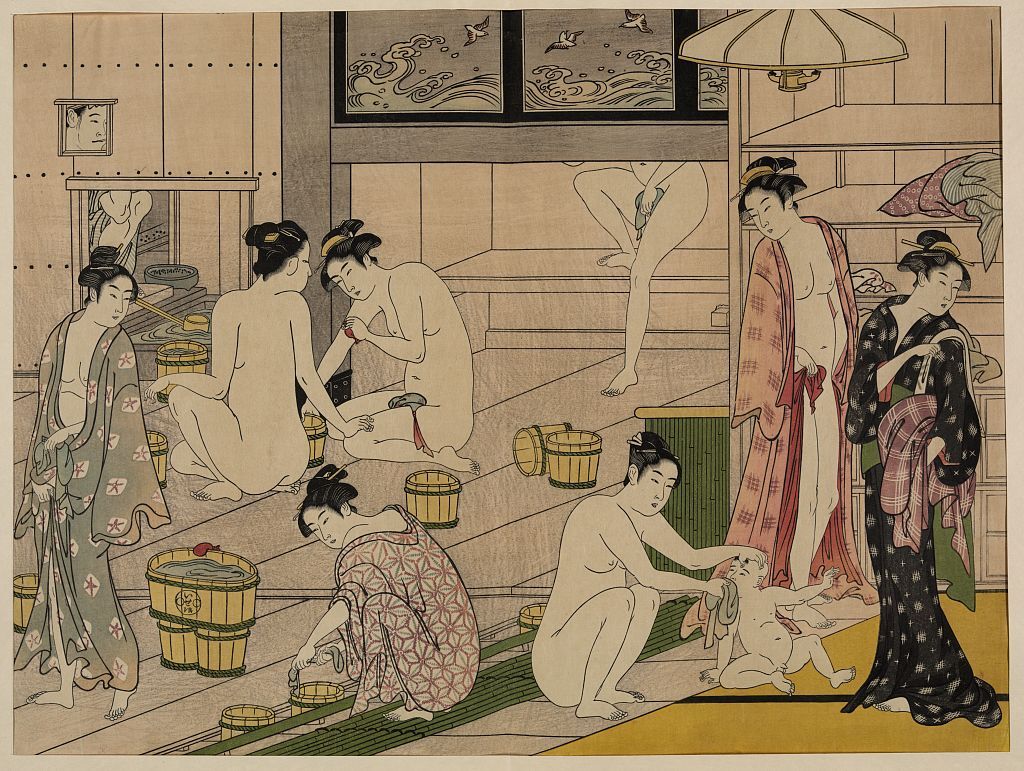
The print below is not a picture of mixed bathing, and that is the point of including it. Kiyonaga made it in 1780, a decade or so before Edo prohibited the practice, and he titled it The Women’s Bath — the separated room, drawn at city scale, while the mixed one was still ordinary elsewhere.
It is tempting to explain all of this as embarrassment in front of foreigners, and that explanation is half right. Kawabata states that Western visitors' gaze lies behind the Meiji-era prohibitions, and the Tsukiji order of 1868 is direct documentary evidence of it. But the same study is careful to add that the bathhouse regulations treated mixed bathing alongside fire prevention, sanitation and crime — fire prevention especially — rather than as a single moral question. The single-cause version is the one the sources themselves push back on.
What is striking is that the Japanese government now says the immodest part out loud, in English. The Japan Tourism Agency’s own multilingual commentary on the history of konyoku describes the first Western visitors as people who were, in its phrasing, as prudish as they were jingoistic, and says the Meiji government banned mixed bathing in towns in February 1869 out of a desire to be seen as an equal by the great powers. It quotes an English traveler of 1860, Edward Barrington de Fonblanque, calling the Japanese depraved and obscene. It is unusual for a national tourism body to publish that about its own country, and it lines up with the academic account to the month.
One caveat about that same page. It states that only mixed baths predating the ban may operate and that opening a new one is prohibited. That is not what Akita Prefecture’s ordinance says, at least: it allows the governor to grant exceptions to the mixed-bathing rule for baths fed by abundant natural springs, with no clause restricting this to existing ones. Nor does it match what has happened — at Kusatsu Onsen’s Sainokawara open-air bath, which opened in 1987 with separate men’s and women’s pools, the men’s pool has been mixed one evening a week since 2019.
Why Mixed Bathing in Japan Survived Where It Did
The places where konyoku persisted are not the places that were most permissive. They are, for the most part, the places that were hardest to partition.
The Ministry of the Environment set this out in a 2022 briefing paper, and its reasoning is refreshingly unromantic. Mixed baths survived where the spring rises directly into the pool, where the volume is fixed by nature rather than plumbing, and — this is the one nobody expects — where hydrogen sulfide gas pools in the room, so that a dividing wall would trap it. Add the role of the shared bath in tōji, the long therapeutic stay, and you have the actual explanation: not license, but geology and architecture.
/The%20rustic%20charm%20of%20Shirahone%20Onsen%2c%20famous%20for%20its%20soothing%20mineral%20waters.webp)
The same paper notes what follows from that. Inns with a mixed bath tend to sit closest to their source, which is also what makes their water good; and their bathhouses tend to be old, because a building you cannot remodel is a building that survives. The mixed bath is a symptom of the thing that makes these places worth visiting.
Tōji is the other half. Where a bath was somewhere families stayed for weeks, cooking their own meals, the mixed pool was the room where people met.
How long a tōji stay ran depended on who you asked, and still does. The National Diet Library, writing on the history of the practice, notes that by the medieval period seven days counted as one cycle and three cycles — twenty-one days — was held to be the minimum worth doing. Sukayu Onsen, which is one of the places where all of this survived, tells its guests something different: three days to a cycle, three cycles, about ten days. Both are stated as received wisdom rather than prescription, and the gap between them is a fair measure of how local this culture is.
It is worth resisting the neat conclusion here. A tōji inn is not automatically a mixed one: Tamagawa Onsen in Akita, one of twenty-three facilities in the country certified by the Ministry of Health as a hot spring health promotion facility — a designation that can make a doctor-prescribed stay deductible against medical expenses — runs a self-catering tōji wing and says nothing about mixed bathing anywhere on its site.
Innkeepers asked by the Ministry of the Environment why konyoku had lasted at their own establishment gave answers that amount to a shrug: it had never occurred to them to change it, or the spring simply came up that way.
The Tourism Agency adds the human half of it: farming families returning to the same spring year after year, and healthy family members helping sick ones into the water regardless of sex. Its own summary of why the practice held on in the northeast is blunter still — the sheer remoteness of the place.
If you want the wider context, our guides to what an onsen is and how to bathe in one properly cover the ground this article assumes.
The Japanese Government Is Trying to Save Konyoku Onsen
In November 2021 the Ministry of the Environment launched something called the Mixed Bathing Project — literally, "mixed bathing ten years from now." Its stated purpose is to preserve the tōji culture of Towada-Hachimantai National Park, of which the mixed bath is treated as a constituent part, and to make that bath usable by women, by younger visitors, by sexual minorities and by foreign travelers.
/The%20UNESCO%20World%20Heritage-listed%20Tsuboyu%20bath%20in%20Yunomine%20Onsen.webp?width=800&height=533&name=The%20UNESCO%20World%20Heritage-listed%20Tsuboyu%20bath%20in%20Yunomine%20Onsen.webp)
The project's first field site was Sukayu Onsen in Aomori, and its instrument was the yuamigi — a garment worn in the bath. The Japan Tourism Agency has published an official English account of the trial, which is worth reading for the detail that Japanese has a dedicated word for bathing clothes at all. The Ministry's own figures from the trial: after wearing a yuamigi, roughly seventy percent of men and eighty percent of women said their reluctance about mixed bathing had gone. Attendance rose, and the share of people bathing alone fell while the share bathing with someone rose. Regular customers, the report adds, were not uniformly pleased.
This is a strange and rather moving thing to find in a government document: a national agency treating a bathing custom as heritage worth engineering a solution for, rather than a problem to be regulated away.
Yuamigi: What to Wear in a Konyoku Onsen, and Why Two Inns Disagree
Now the practical question, and the one where we found the English-language answers least reliable. There is no national rule about what you wear in a mixed bath. The ordinances govern the age at which mixing stops; they say nothing about clothing. Ministry of Health officials, asked about this during the Environment Ministry's consultations, said essentially that anything meeting water-quality standards is fine and that the sensible control is a rule about cleanliness — which is why inns that permit yuamigi so often forbid you from bringing your own.
So the rule is set inn by inn, and it goes both ways. Two examples, both mixed baths, both in Gunma Prefecture, an hour apart:
- Hōshi Onsen Chōjukan states that in the Hōshi-no-yu bath, wearing a yuamigi or wrapping yourself in a bath towel is not permitted. The bath is mixed from 11:00 to 20:00, women-only from 20:00 to 22:00, and mixed again overnight.
- Takaragawa Onsen Ōsenkaku does the reverse. Its day-use rate includes a Takaragawa yuamigi, and garments you bring yourself may not be used. The inn's English page dates the change to April 2019 and attributes it to rising numbers of international guests and repeated requests from women and families.
/Rotenburo%20(Open-air%20bath).webp?width=800&height=533&name=Rotenburo%20(Open-air%20bath).webp)
Sukayu Onsen sits between the two: since May 2024 it rents a yuamigi for 500 yen and sells a women’s one for 1,300, and states that wearing one is optional — but, again, it must be the inn's own. Yubara Onsen's Sunayu in Okayama, which is free and open around the clock, suggests a yuamigi for women without requiring it, and rents one on a deposit basis: you pay 2,000 yen and get 1,000 back when you return it.
At the far end of the range, some inns have given up nude mixed bathing altogether rather than lose the shared bath. Jigoku Onsen Seifuso in Kumamoto now requires clothing in the water, and says it changed precisely so that everyone could use the bath together without having to think about it; its day rate includes the garment and a towel. Others frame the garment as preservation: Gorokaku at Oigami Onsen in Gunma keeps two of its open-air baths mixed, it says, in order to pass the custom on, and rents a yuamigi for 300 yen to men and 400 to women.
So the spectrum runs from forbidden, through optional, to compulsory, to nudity abandoned in order to keep the bath shared. All four positions are held by inns describing themselves as guardians of the same tradition.
One distinction worth carrying with you. A nyūyokugi is not a yuamigi. The first is a medical garment for people with surgical scars or skin grafts, promoted nationally by the Ministry of Health; the second is ordinary bathing clothing for mixed baths, promoted by the Ministry of the Environment. Translated into English both become "bathing garment," and the policies behind them are unrelated.
The Problem at Mixed Gender Onsen, and How Good Inns Handle It
There is a reason mixed baths have been closing, and it is not squeamishness about nudity. The Ministry of the Environment's briefing paper names it in plain language, using the slang term as it circulates: harm caused by so-called wani-zoku — "crocodiles," men who lie in wait in mixed baths — is reported, it says, in the form of being looked at sexually. The same document reports that reluctance about mixed bathing falls with age among men, while more than sixty-five percent of women across every age group feel it.
The paper gives no figures for incidents, and we found no inn using the word on its own site. What inns do instead is publish rules about behavior, and the best of them are unusually direct. Geto Onsen in Iwate keeps a page of mixed-bathing manners that opens by saying that once a mixed bath is given up it cannot be created again, and then gets specific: do not monopolize a small pool for a long time, do not sit down in the entrance, keep your voice low, no alcohol, no phones, no photographs. Read against the reported behavior, that list is a precise description of what a "crocodile" does.
/Family-sized%20private%20bath.webp?width=800&height=533&name=Family-sized%20private%20bath.webp)
Sukayu’s own record of what it tried is in a Ministry of the Environment planning document, and it is candid. Manners in the thousand-person bath had deteriorated to the point that women said they found it hard to use; the inn put a screen up inside the bath and ran an awareness campaign; neither, the document says, had much effect. The bathing-garment days began after that. It is a rare thing to see a failed intervention written down in a government file.
The measures inns have adopted are women-only hours, required or optional bathing garments, and in some cases the end of nude mixed bathing altogether. It is worth being accurate about the reasons they give: they cite women's discomfort, the growth in international guests, and unease among younger visitors. None of them names the wani-zoku as the cause. The connection is one you can reasonably draw; it is not one the sources make for you.
Where to Find Konyoku Onsen in Japan
Six konyoku onsen in Japan that are open to day visitors, and that publish their own rules clearly enough to plan around.
Sukayu Onsen, Aomori. The Hiba Sennin-buro — the "thousand-person bath" — is a single hall of Japanese cypress covering 160 tatami mats, fed by four separate sources. Women-only from 8:00 to 9:00. Day-use admission is 1,000 yen for adults through 30 November 2026; from 1 December 2026 the inn has announced 1,500 yen and shorter hours of 9:00 to 16:00.
Hōshi Onsen Chōjukan, Gunma. A Meiji-era bathhouse, nothing worn in the water, women-only 20:00–22:00. Day use 1,500 yen, received 11:00–13:30, closed Wednesdays.
Ōsawa Onsen Tōjiya, Iwate. The clearest surviving example of a working tōji inn, with communal kitchens where guests cook for themselves, and rooms from 3,780 yen per person for two sharing, up to 5,630 yen for a single — consumption tax included, bathing tax extra. Its Ōsawa-no-yu open-air bath is mixed, with a women-only hour from 20:00 to 21:00 — suspended in the height of summer, when horseflies are about.
Namari Onsen Fujisan Ryokan, Iwate. The Shirozaru-no-yu is a deep standing bath cut into the rock, mixed, with three women-only windows through the day — 6:00 to 7:00, 11:00 to 13:00 and 20:00 to 22:00. The inn keeps a working tōji wing alongside its ryokan rooms, and says plainly that it does so because so many tōji houses have had no choice but to close.
Sainokawara Rotenburo, Kusatsu, Gunma. Not a survival but an addition: since 2019 the men’s pool at this large public open-air bath has run a mixed session on Friday evenings, 17:30 to 20:00. Garments are compulsory, and the arrangement is asymmetric — men are lent one free, women rent one for 400 yen. It is the clearest evidence that mixed bathing in Japan is not simply a closed category winding down.
Yubara Onsen Sunayu, Okayama. Free, riverside, open twenty-four hours, with separate simple changing huts. Closed Wednesday mornings for cleaning.
/A%20woman%20unwinding%20in%20the%20hot%20spring%20waters%20of%20a%20traditional%20rock%20bath.webp?width=800&height=533&name=A%20woman%20unwinding%20in%20the%20hot%20spring%20waters%20of%20a%20traditional%20rock%20bath.webp)
Two cautions. Every price above comes from the inn's own site and none of them states whether tax is included except Ōsawa, which does; and Takaragawa's Japanese and English pages currently disagree with each other on both price and closing time. Call before you plan around a number. For a broader route through Japan's hot spring regions, see our complete guide to Japanese onsen.
From one spring to the wider landscape

Conclusion
The useful way to think about konyoku is not as a survival of old permissiveness. It is a practice that cities outlawed in the 1790s, that the Meiji state pushed to the margins, that persisted in mountain valleys mostly because the springs there could not be plumbed into two halves, and that a national ministry is now trying to keep from disappearing — by inventing a dress code for it.
If you go, the two numbers to hold are seven and zero: seven, the age at which Japan separates bathers, drawn in 1885 and redrawn in 2020; and zero, the number of national rules about what you may wear once you are in the water. That second one is decided at the front desk of whichever inn you have chosen, and it is worth asking before you undress.