Kayotei has ten rooms and works with more than twenty craftsmen. That ratio is the whole proposition, and it is the reason to choose it over a larger ryokan with a longer list of facilities — particularly if you are booking for an anniversary, where the thing that matters is whether the inn can respond to you rather than what is on the amenity list.
This guide covers what the inn actually is, the hot spring it sits in, the artisan network it runs, and the practical questions — rooms, booking, access — that decide whether it suits the occasion you are planning around.
What Kayotei Is: Ten Sukiya Rooms in Yamanaka Onsen
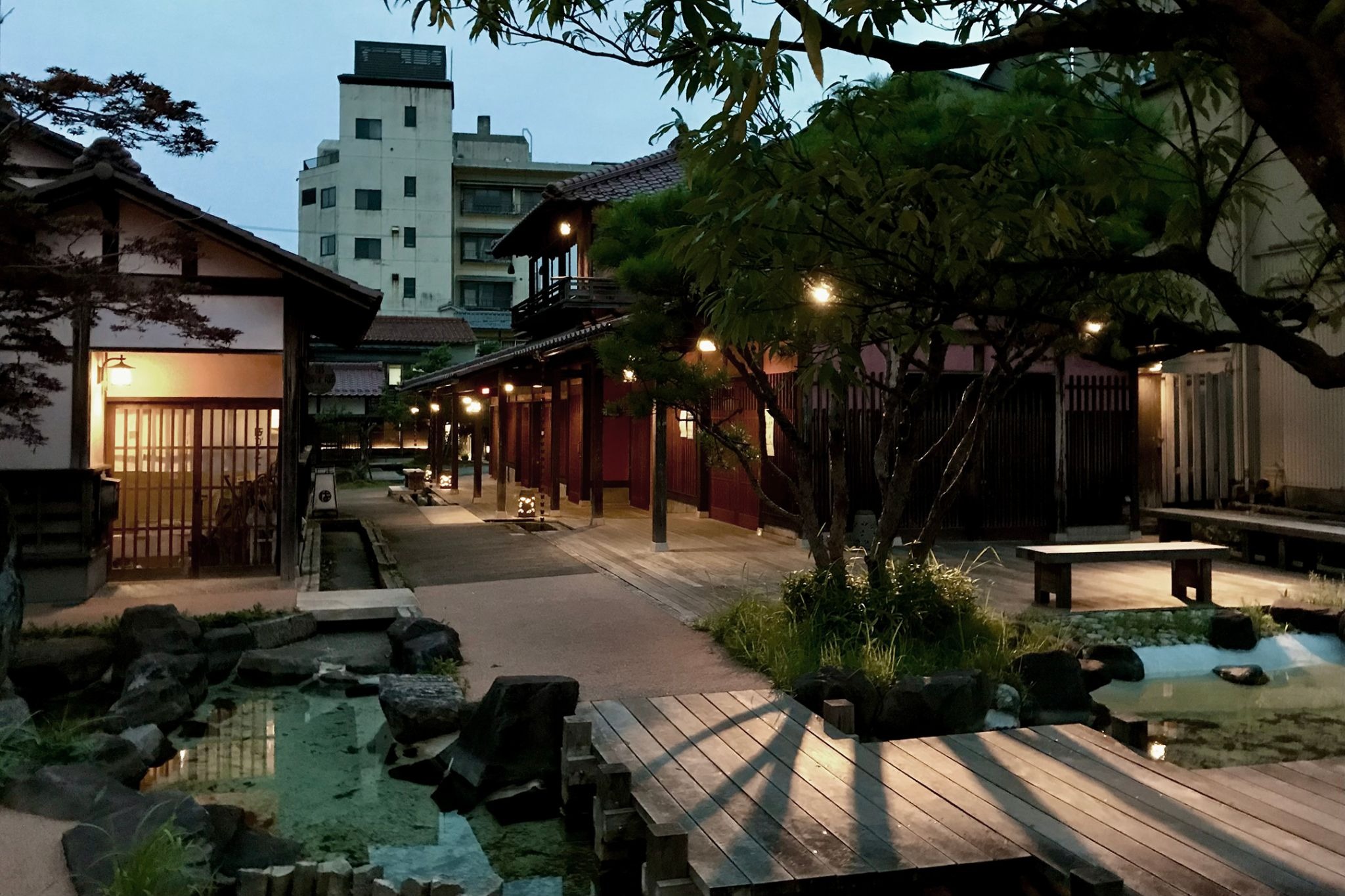
Kayotei stands in Yamanaka Onsen, in Kaga City in Ishikawa Prefecture, and it is small on purpose. Its own English listing describes ten suite rooms arranged in the sukiya manner — the architectural idiom of the tea pavilion, which means restraint, natural materials left visible, and rooms designed around a sightline rather than a floor plan.
Ten rooms sets the terms for everything else. There is no lobby to cross, no lift queue, no dining room seating a hundred. It also means the inn is booked well ahead.
Sukiya is worth unpacking, because it is not a decorative style. It grew out of the tea room, and its rules are subtractive: no ornament that is not structural, materials shown as they are, and a deliberate asymmetry that keeps the eye moving. A sukiya room can look plain to a visitor expecting grandeur. What it is doing is directing attention outward, at the garden, and at whatever is placed in the alcove that week.
The practical consequence for a guest is that the rooms are quiet in a specific way — few hard surfaces, paper and wood absorbing sound — and that they reward staying in them. This is not an inn to use as a base for day trips.
Yamanaka Onsen Ryokan History: What Bashō Found Here
The spring is older than the inn by a long way, and the local tourist association's account is worth knowing before you get in the water.
Discovery is credited to the monk Gyōki some thirteen centuries ago. The version that matters more is the later one: in the Jishō era at the end of the Heian period, Hasebe Nobutsura, a steward from Noto, is said to have seen a white heron treating an injured leg in a small stream, and to have opened twelve bathhouses on the strength of it. Those twelve are described as the beginning of Yamanaka's ryokan trade — Kayotei is at the end of a line that starts there.
The water is a simple hot spring, hypotonic, weakly alkaline, and hot: 45.2 degrees at source. Weakly alkaline water is the kind that feels slightly slippery and leaves skin soft, which is what people mean when they call a spring a bijin-no-yu.
Yamanaka is one of the springs that gave Kaga its reputation, and the town sits along the Daishōji River rather than around a station forecourt, which is why the walk below is part of the stay rather than an excursion from it.
Then there is Bashō. He arrived on the twenty-seventh day of the seventh month of Genroku 2, ranked Yamanaka alongside Arima and Kusatsu as one of the three finest springs in the country, wrote a verse about not needing to pluck chrysanthemums where the water already carries their scent — and stayed nine days.
Nine days is the detail to hold. Oku no Hosomichi is a walking journey of about five months and some 2,400 kilometres, and Bashō was moving almost continuously. Stopping for nine days in one bathhouse town is, in that context, an unusually strong review — and it is also where he parted from Sora, his travelling companion, who was ill and went on ahead. The place has a claim on one of the more consequential pauses in Japanese literature.
The Artisan Network and Yamanaka-nuri Lacquerware
This is the part that separates Kayotei from other small ryokan in the price band, and it is not a decorative claim.
More than twenty local craftsmen and producers are affiliated with the inn as an Ishikawa regional group, and guests can visit their workshops — lacquer, porcelain, papermaking. Among them are the Satake lacquerware studio and the Fujisawa Shigeo porcelain studio working in Kutani ware.
The lacquerware in daily use at the inn comes from three generations of the Satake family — grandfather, father, and the present head, who works the lathe alongside his own son in a workshop full of tools they made themselves. Pieces can be bought: plates and saucers from 10,000 to 35,000 yen, soup and rice bowls from 15,000 to 80,000, and a lacquered wine glass at 150,000.
The other thing the ratio buys is access. These are private studio visits arranged through the inn rather than scheduled group tours — and the listing is explicit that advance booking is required for each of them. That is the reason to raise a workshop visit when you reserve the room, not after you arrive.
Ishikawa carries an unusual number of surviving crafts for one prefecture — lacquer at Yamanaka and Wajima, porcelain at Kutani, gold leaf and dyeing in Kanazawa — and they are conventionally traced to the patronage of the Maeda lords of Kaga, whose domain was the largest in the country after the shogunate's own holdings. What Kayotei has assembled is a working remnant of that.
The craft itself is old. Yamanaka lacquer is dated to the Tenshō era of the Azuchi-Momoyama period, and the town's speciality within it is kiji-biki: the turning of the wooden base on a lathe, before any lacquer is applied. Wajima is known for the coating and Kanazawa for the decoration; Yamanaka is known for the wood.
The significance is in the sequence. You eat off the bowl first and meet the person who turned it second, which is the opposite of how craft is usually sold to visitors. So what you are looking at in a Yamanaka workshop is a lathe and a person, not a display case.
If craft is the reason you are going, our guides to onsen around Kanazawa and the Kaga onsen villages cover the wider area this sits in.
Rooms, Baths and Dining at Kayotei Ryokan
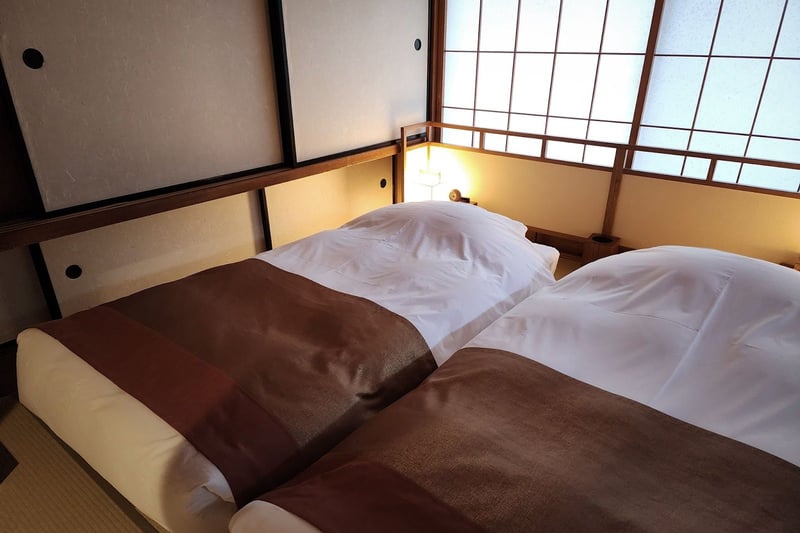
Rooms. Ten suites, in sukiya style, each with its own outlook — tatami, shōji screens, and a tokonoma alcove. The windows are wide, and in the rooms that face it the gorge is the room's actual subject.
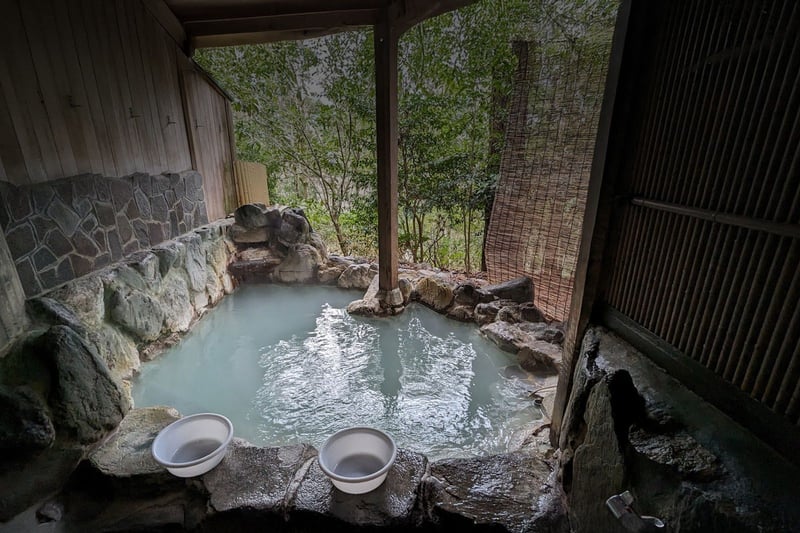
Every room has its own open-air bath, which is the single specification that most changes how a stay of this kind feels: the bathing is not an expedition down a corridor at a fixed hour. Dinner runs from 18:00 to 19:00, breakfast from 7:00 to 9:00, and the inn offers both in-room dining and a private dining room. Check-in is 13:00 and check-out 12:00 — an unusually long occupancy, and a deliberate one.
Ask when booking which rooms face the gorge and which face the garden; at this size the difference between rooms is real and the inn will discuss it rather than assign you one.
Baths. The house baths run on the 45.2-degree source described above. A simple hot spring — tanjun onsen — is the mildest classification in the Japanese system: low dissolved mineral content, no strong smell, and mild enough to bathe in repeatedly across a stay. Note that a genuinely hot simple spring is best taken in short immersions with breaks, not in one long soak — and that weakly alkaline water rewards not scrubbing afterwards.
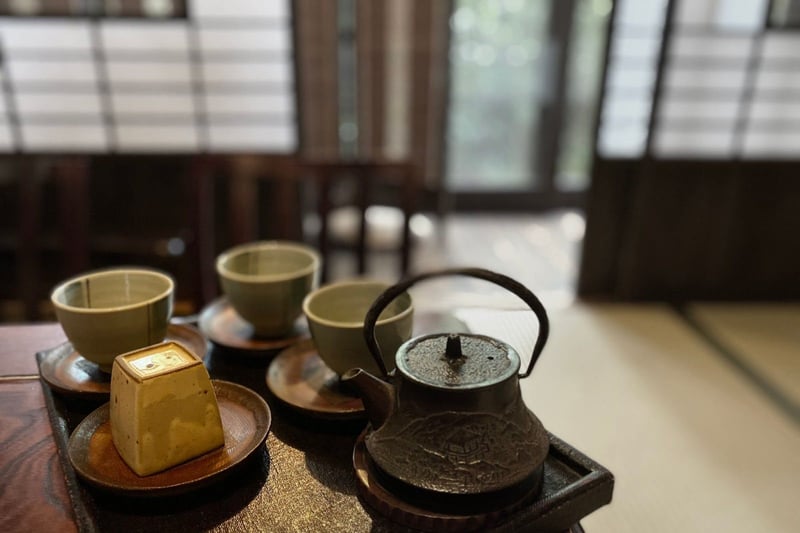
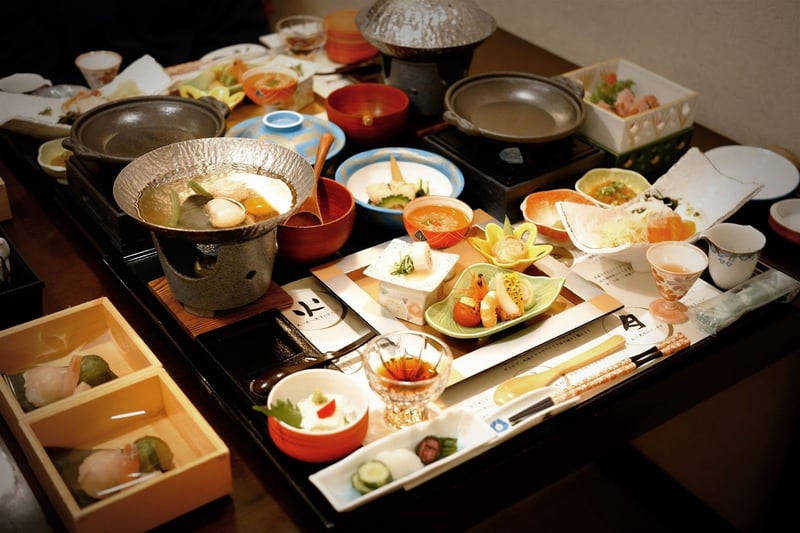
Dining. Kaga cuisine, served in the lacquer — which is the point at which the craft stops being a display and becomes cutlery. Kaga ryōri is one of Japan's named regional cuisines, and its marker is the use of the local ware as part of the dish rather than as a container. Ishikawa's kitchen is built on the Sea of Japan in winter and mountain vegetables in spring, and the two seasons produce almost different menus. If you are choosing when to go on food alone, winter is crab and spring is sansai.
Booking Kayotei Yamanaka Onsen: Access and What to Ask
Booking. Reserve directly. At ten rooms the inn is small enough that the front desk is the person who will handle your stay, and requests — an anniversary, a dietary restriction, a workshop visit — are better made in that conversation than through a booking platform. Rates change by season and the inn publishes them on its own site rather than in a fixed table.
Access. Yamanaka Onsen is in Kaga, and the nearest station is Kaga Onsen on the Hokuriku Shinkansen. Reckon on about two hours forty-five minutes from Tokyo and a little over two hours from Osaka to the station.
From Kaga Onsen Station it is roughly twenty minutes by taxi, or about thirty minutes on the Kaga Onsen bus for a fare in the region of 430 yen. Komatsu Airport is about thirty-five minutes by taxi, or an hour if you chain the airport bus, the train and a local bus — worth knowing if you are flying in domestically rather than coming by rail. A car can also be arranged in advance from Kanazawa Station, which is the sensible option if you are arriving late or with luggage.
The brewery. Matsuura Shuzō, known locally as Tsukushiya, is in the town, and a visit to it is one of the maker calls the inn can arrange — again with advance booking. Tasting is available at the shop. Between the lacquer workshops, the Kutani porcelain studio and the sake, Yamanaka supports a full day of makers without leaving the valley, which is the practical reason to stay two nights rather than one.
What else is there. Iōji, the temple that guards the spring, is attributed to the same monk Gyōki credited with finding the water, and keeps a vermilion pagoda and an image of Yakushi, the healing buddha — which is the logic of a hot spring town made architectural.
The footbaths. Yamanaka keeps public foot baths around the town, which sounds like a small thing and is the practical reason the gorge walk works: you can break it, sit, and put your feet in without going back to the inn. They are free. One of them, Kasa-no-tsuyu by the Kiku-no-yu bathhouse, takes its name from the verse Bashō wrote when he and Sora parted here.
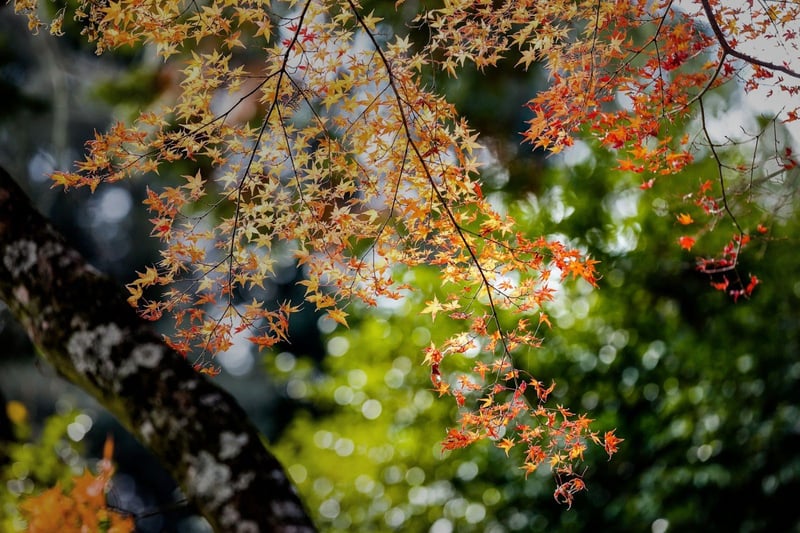
When to go. Ishikawa's winter is the crab season and its most sought-after, which means it is also the hardest to book and the most expensive. Autumn in the gorge and the spring mountain-vegetable season are the quieter alternatives. Snow is a real consideration in Kaga; check what the road from the station is doing.
What to ask. Three questions are worth putting to the inn before you arrive: which room, whether a workshop visit can be arranged for the day you are there, and what the kitchen has that week. All three have real answers at this scale and none of them do at a large hotel.
For the walk, the Kakusenkei gorge path runs 1.3 kilometres from Kōrogi Bridge down to Kurotani Bridge, along the Daishōji River below the town, and it is the landscape Bashō was writing about.
Two of the bridges are worth stopping at. Kōrogi Bridge is built entirely of cypress; the tourist association records that the current structure, completed on 12 October 2019, is the fourth of its name — the bridge is rebuilt rather than preserved, which is its own comment on how this valley treats wood.
Ayatorihashi sits roughly midway between the two, and is the opposite proposition: a 94.7-metre pedestrian bridge designed by Teshigahara Hiroshi, head of the Sōgetsu school of ikebana and a film director besides. A gorge that holds a four-generation cypress bridge, an avant-garde ikebana master's S-curve, and a 1930s stone arch at the far end is a fair summary of what Yamanaka is.
If you are comparing ryokan more broadly before deciding, our guides to what an onsen is and how to bathe properly cover the conventions this inn assumes you know.