The Japanese word for flower is hana (花), so flower in Japanese is simply hana. That is the entire translation, but hana in Japanese has a dictionary entry much longer than that: the Digital Daijisen gives the word 19 numbered senses. The rest of this guide covers what the word does once you have it. The same sound names a nose and an edge. A second character, 華, is also read hana. And the word has pointed at different flowers and different ideas since the eighth century.
Quick answers. The word for flower is hana (花). Chinese-derived compounds use the reading ka, as in kabin (花瓶, vase), while native compounds keep hana, as in hanami (花見, blossom viewing). Use 花 for the plant, and expect 華, which is also read hana in hanayaka (華やか, showy) and is read ka in compounds such as karei (華麗, magnificent) and, for flower arranging, kadō (華道). Beyond the flower itself, hana can mean cherry blossom in particular, the peak of something, a star performer and a tip. Hana meaning cherry blossom became a common use after the late Heian period, while in some Nara-period poems the same word means plum blossom. The sections below name the source for the main claims.
Hana (花): reading, kanji grade and the words that share its sound
The character 花 is a first-grade kanji, one of the characters Japanese children learn in their first year of school, according to the Digital Daijisen entry for the character. It has a borrowed Chinese reading, ka, which appears in kabin (vase), kadan (flower bed) and kaika (blooming). It also has the native reading hana, which is the word on its own and sits inside compounds a traveler meets quickly: hanami (blossom viewing), hanabi (fireworks), hanataba (bouquet), hanayome (bride) and hanamichi, which comes up again below.
What does hana mean in Japanese beyond the flower of a plant? The Daijisen's senses include a plant that bears flowers, cherry blossom, the best time of something (an actor in his prime, for example), a tip, and the flower-themed card game hanafuda. Both dictionaries record the pale blue of dayflower juice, hanada, as a color taken from the flower. The Nihon Kokugo Daijiten adds the mold that grows on rice, barley and soybeans, koji, with a 1563 example in which koji is explained as what people call hana. A word with that range is easier to read once you know which sense a sentence needs.
Two other common words share the sound: hana (鼻, nose) and hana (端, edge or tip). The folklore section of the Heibonsha encyclopedia's entry on the flower, reproduced on the same Kotobank page, offers one explanation of the overlap. It says that in Japanese hana broadly means the tip of a thing, so the edge and the nose are both hana, and it gives the ear of rice and the treetop as examples of such tips. Pitch accent separates the words once a particle follows. The Wikipedia article on Japanese pitch accent lists the flower as final-accented, so the pitch drops on a following particle, the nose as unaccented, so it stays high, and the edge as initial-accented, so it falls after the first syllable. The flower and the nose can sound identical when said alone, the article adds, although some speakers still keep a consistent difference. In practice context settles it.
The first example the Seisen edition of the Nihon Kokugo Daijiten, Shogakukan's historical dictionary, gives for the plant sense of the word comes from the Kojiki of 712. It is a song about a sacred camellia, and the word is spelled there with phonetic characters. The first hana the dictionary shows, in other words, is a camellia, and neither plum nor cherry.
Hana (花) or hana (華): one reading, two characters and a rule for choosing
The character 華 is also read hana. The Digital Daijisen files both characters under one headword, with a usage note that for plants you write 花. The dictionary's entry for 華 gives the second character a different job. Its senses include showy and splendid (karei (華麗), magnificent; gōka (豪華), luxurious; eiga (栄華), glory), brilliance, the finest or most beautiful of its kind, and China itself (Chūka (中華)). It is a jōyō kanji, on the government's list of everyday characters, but the dictionary lists no school grade for it, unlike 花.
The two characters share a history. The Jitsū character dictionary by Shirakawa Shizuka, quoted on the same site, puts the two in a single word family and reads the old form of 華 as a picture of a flowering plant. Going by the shape of the character alone, Shirakawa writes, 栄 would be the blossom of a tree and 華 the blossom of a plant. That is a reading of the form, not a rule of usage.
For writing, the working rule is short. The character 花 is for the thing with petals and for the compounds that point at one, such as hanataba, kadan and hanami. The character 華 is read hana in hanayaka (華やか), and in compounds of splendor it takes the reading ka, as in karei and gōka. Flower arranging is a place where the two characters meet: the Daijisen's first sense of 華 is simply "flower," with kadō (華道) as its example, and the Nihon Kokugo Daijiten records kadō (花道), written with 花, for ikebana, so the same discipline appears as either. Read that second spelling as hanamichi and you are in a kabuki theater. Our guide to samurai flower arranging covers the art as kadō.
Flower names in kanji: when the character and the plant disagree
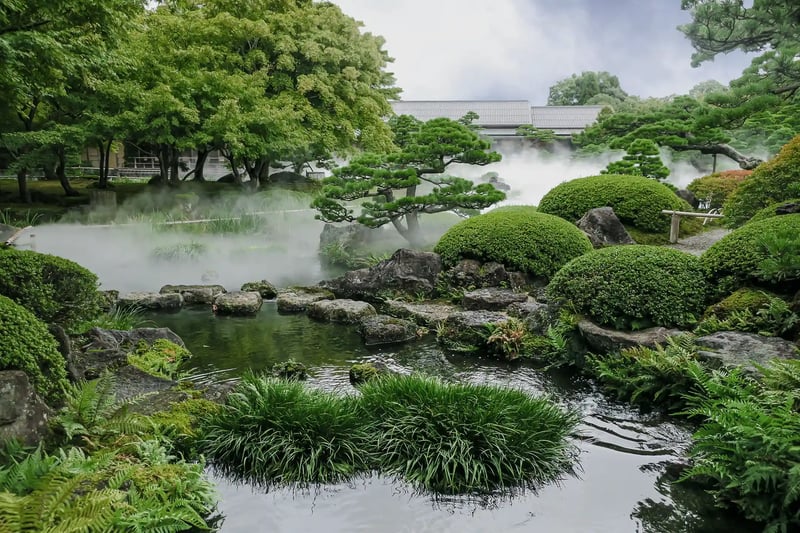
The kanji entry for 花 in the Digital Daijisen includes a list of 16 hard-to-read words (nanyō), and the list works as a warning about flower names. It includes ajisai (紫陽花, hydrangea), ichijiku (無花果, fig), ominaeshi (女郎花) and sazanka (山茶花). Several of the readings do not follow from the characters, so on a sign or a menu the reading has to come from a dictionary. The same list also holds words that contain 花 and are not flowers. The Daijisen defines oiran (花魁) as a courtesan, in particular a high-ranking one, and also as a sweet-potato variety, short for oiran-imo, with purplish-white flesh. The Nihon Kokugo Daijiten defines kyasha as elegant and delicate, and spells it 花車, 花奢 or 華奢, so the same word is written with both characters from the previous section.
Ichijiku (無花果) shows how far a name can drift from the plant. The characters read "no-flower fruit," and the Daijisen says they are the Chinese name of the fig. Its entry for the fig adds that the plant does flower: in early summer it forms an egg-sized pod that holds many male and female flowers, none of them visible from outside. The fig arrived in Japan in the Kan'ei era (1624-43), the Daijisen says, and it is an autumn word in haiku.
The camellia's spelling is tangled. The Daijisen's kanji entry for the character 椿 gives it a Chinese meaning first, a deciduous tree known as chanchin and a legendary long-lived tree, and lists the camellia (tsubaki) separately, under the native reading. The Chinese name of the camellia is sancha (山茶), the Daijisen says, and the Nihon Kokugo lists several spellings of tsubaki, among them 椿 and sancha (山茶). The sazanka is written 山茶花 from that Chinese name, although the Nihon Kokugo gives a different Chinese name for the sazanka itself. According to the Nihon Kokugo, the spelling appears in the late medieval period and was first read sanzaka, and the form sazanka is seen from the seventeenth century.
Other names carry a history of their own. The Nihon Kokugo's earliest example of ajisai is a Man'yōshū poem that spells it phonetically, and its note says the name seems to come from atsu, to gather, and a word for true indigo, sa-ai, for blue flowers growing in clusters. Ominaeshi is one of the seven flowers of autumn in the Daijisen. The Nihon Kokugo records its use as a figure for women in waka, citing a Kokinshū poem by Henjō, and quotes the eleventh-century Nōin utamakura, which tells poets to compare the flower to a woman.
For a flower name in kanji, then, trust the dictionary's reading and treat the characters as a hint. The character 椿 can mean a Chinese tree, ichijiku (無花果) names a plant that does flower, oiran (花魁) is a courtesan, and kyasha (花車) means delicate.
Did hana mean plum before it meant cherry?
Japan's current era name, Reiwa (2019), was taken from the preface to a set of 32 plum-blossom poems composed at a banquet in 730 at the house of Ōtomo no Tabito, governor of Dazaifu, and recorded in book 5 of the Man'yōshū. The scholar Ōishi Yasuo starts from that fact in a paper in Kokugakuin Japan Studies 2 (2021), an English translation of his 2019 article, and then questions a common belief: that plum blossom was the favorite flower of the Nara period until cherry took over in the Heian period. The Japanese dictionaries tell a version of that story, so the two accounts are worth reading side by side.
The Nihon Kokugo Daijiten lists a sense of hana that means plum blossom in particular, explained as the flower that blooms ahead of the others and was loved from the Nara period. Its Man'yōshū example calls the plum "the flower that blooms first." The next sense is cherry blossom, which the dictionary says appears to have settled in the late Heian period, after which, it says, hana meaning sakura is a common use. Both dictionaries give a reason. The Daijisen says the sense arose because cherry blossom stands for all flowers, and the Nihon Kokugo says it arose because cherry is the flower that represents spring. The Daijisen quotes a poem from the Kokinshū, which the Nihon Kokugo dates to 905-914 and attributes to Sosei: "Who knows where the wind that scatters the blossoms takes shelter? Tell me, and I will go and reproach it."
Ōishi counts what the Man'yōshū says. Of the 150 or 160 plants it mentions, bush clover (hagi) leads with about 140 poems, plum comes next with 120, and cherry blossom has 41. About one third of the plum poems, 42, trace back to the 730 banquet and its follow-up poems. Plum appears nowhere in the Kojiki, the Nihon shoki or the regional gazetteers (fudoki), he notes, and hardly appears in the Man'yōshū itself before 730. The poets who wrote several plum poems all belong to the circle of the Ōtomo clan, and ume is a Chinese loan word for a tree that was not native to Japan. Plum blossom was a theme almost confined to the Ōtomo poetic circle, he writes, so it cannot stand for everyone in the Nara period. He adds that a strong claim is hard to make, because the 31 plum poems of book 10 are anonymous. When Nara poets wrote a bare hana about blossoms on spring mountains, he judges it reasonable to read cherry.
Read together, the sources suggest a messier record than a handoff from plum to cherry. Plum was the theme of one poetic circle, Ōishi reads the bare hana of the Man'yōshū's spring-mountain poems as cherry, and by the late Heian period hana meaning cherry was a common use. The habit survives in everyday Japanese. The Daijisen lists a sense of hana meaning blossom viewing, "in particular of cherry blossoms," and another meaning the flowering itself, "mostly said of cherry," with hana no tayori, news that the blossoms have opened, as its example. The earliest example the Nihon Kokugo gives for the proverb hana yori dango, dumplings over blossoms, is from around 1532, in the spring section of a haikai collection, and the proverb dictionary says the hana in it is the cherry blossom of hanami. In haiku a bare hana is a spring word. Our collection of Japanese phrases for travel has a section on proverbs like this one.
The stages of the cherry blossom have words of their own. The Daijisen defines hanagasumi as full-bloom cherry that looks white from a distance, as if veiled in haze, and hanafubuki as cherry petals scattering in a swirl like a blizzard, a spring word. It defines hanaikada as petals floating on water in a line like a raft, a spring word as well. In the first two, the Daijisen's gloss reads hana as cherry blossom.
The stage senses of hana: star, walkway and gratuity
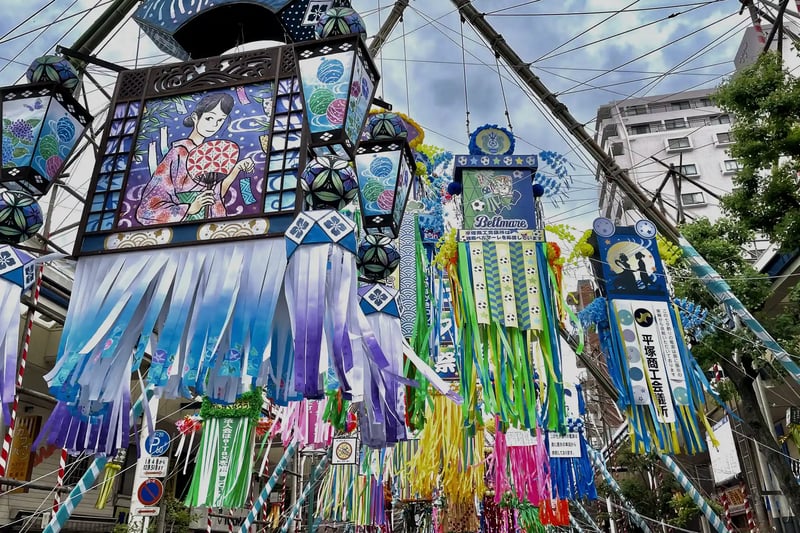
Around 1400 the Noh actor Zeami gave the word a technical meaning. In the Fūshikaden, his treatise on Noh, hana is the quality in a performance that moves the audience. The Daijisen defines it as the state in which a performance stirs viewers, and the charm that produces it, and the Nihon Kokugo Daijiten quotes Zeami saying that hana, interest and novelty are the same thing. The same dictionary already records hana as splendor and prosperity in the Eiga monogatari of about 1028 to 1092, so Zeami's term sits beside an older sense of the word.
The stage vocabulary then splits into separate senses, each with its own record. Hanagata, literally "flower shape," is given by the Daijisen as an abbreviation of hanagata yakusha, the leading actor of a troupe. The Nihon Kokugo's earliest example for that sense is from a 1638 haikai collection, and today the word covers any popular figure, such as gyōkai no hanagata, the star of an industry.
Hanamichi is the raised walkway that runs through a kabuki audience to the stage, and where its name comes from is disputed. The Daijisen and the Nihon Kokugo give the explanation that it began as a path along which fans presented hana, gifts and tips, to favorite actors, and the Daijisen dates the walkway to the Kanbun era (1661-73) and its completion to about 1736-41. Two other encyclopedias on the same page are less sure. Heibonsha's says there is no settled account of the name's origin and finds it reasonable that the name refers to the actor as a flower or to an actor dressed up as he enters. The Nipponica says the usual explanations lack evidence, favors a name likening the actor to a flower walking down a showy road, and dates the walkway to about 1684-1704 and its settling to about 1716-36.
Sumo has its own hanamichi, the passages wrestlers use to reach the ring, which the Nihon Kokugo links to a story of Heian court tournaments in which wrestlers entered wearing artificial flowers of aoi and yūgao, the latter now meaning bottle gourd. To "decorate the hanamichi" (hanamichi o kazaru) is to leave at a high point, usually to retire in glory. If you plan to watch kabuki, our kabuki dance guide covers the dance side of the theater.
The gratuity sense has its own explanation. The Nihon Kokugo records hana as a gift of money or goods given to performers and sumo wrestlers, and derives it from the sense of a gift attached to a branch of flowers. The Daijisen lists hana o hazumu, literally "to be generous with the flower," for giving a generous tip. Hana o motaseru, "to let someone hold the flower," means to hand someone else the credit, and the dictionary's earliest example is Zeami's own treatise, in a line about the supporting actor. The Daijisen's example for the showpiece sense shows how far the word traveled: a saying that calls fires and brawls "the flowers of Edo," meaning the sights the city was known for.
English made a similar move and then lost the link. According to Wiktionary's etymology of flour, the word was spelled "flower" until about 1830 and meant the finest part of the ground grain. In both languages a word for the bloom became a word for the best part of something.
Flower words and the calendar: morning glory is autumn, camellia is spring
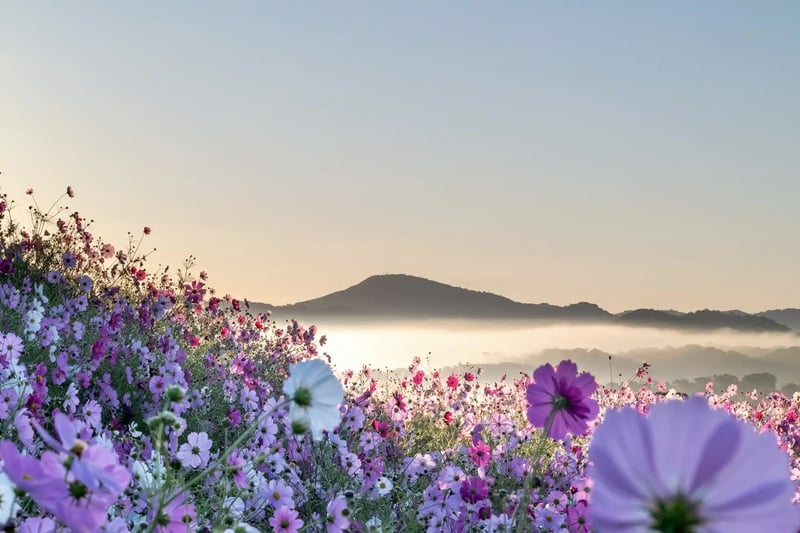
Haiku season dictionaries, called saijiki, sort words by season. The Daijisen defines a saijiki as a book that collects haiku seasonal words, classifies and explains them, and gives example verses. The season printed beside a flower word, in a saijiki or in the season tag of a dictionary entry, is a convention, and it does not always match the bloom.
Morning glory (asagao) opens its trumpet-shaped flowers on summer mornings, the Daijisen notes, yet the same entry labels it an autumn word and quotes a Bashō verse to match. The Nihon Kokugo Daijiten's note on the word gives one clue: the Nara-period asagao is hard to pin down and is safest read as the bellflower, and the Man'yōshū knows it as a flower of autumn fields. A guess of our own, which no dictionary states for morning glory, is that the old calendar also helps. The Nihon Kokugo's entry for risshū says that in ancient China and Japan autumn began on that day, around 7 August (the Daijisen says 8 August), so a flower open in August sits on the autumn side of the line.
Camellia (tsubaki) is a spring word, and the Daijisen's example is a Buson verse about a camellia dropping and spilling yesterday's rain. Its flowering is a separate matter: the Nihon Kokugo says it blooms in early spring and, in some regions, in winter. A camellia can therefore be a cold-season flower in a travel guide and a spring word in haiku. Its relative the sazanka, which the Daijisen says flowers white in late autumn and sheds its petals one by one, is a winter word, with a Shiki verse set in a study. Bush clover (hagi), the most-sung plant of the Man'yōshū, is an autumn word and one of the seven flowers of autumn.
Fireworks show how a label can move. The word hanabi means "flower fire," the first example the Nihon Kokugo gives is a 1574 diary entry by Date Terumune, and the Daijisen files it today under summer. The Nihon Kokugo notes that Edo-period haiku books mostly placed fireworks in autumn, probably because they belonged to the Obon season, and that the word came to feel like summer once fireworks became an entertainment for cooling off. The practical rule is to treat a flower's poetic season as a label and its bloom time as a separate fact to look up.
How Tokyo counts the cherry blossoms as they arrive
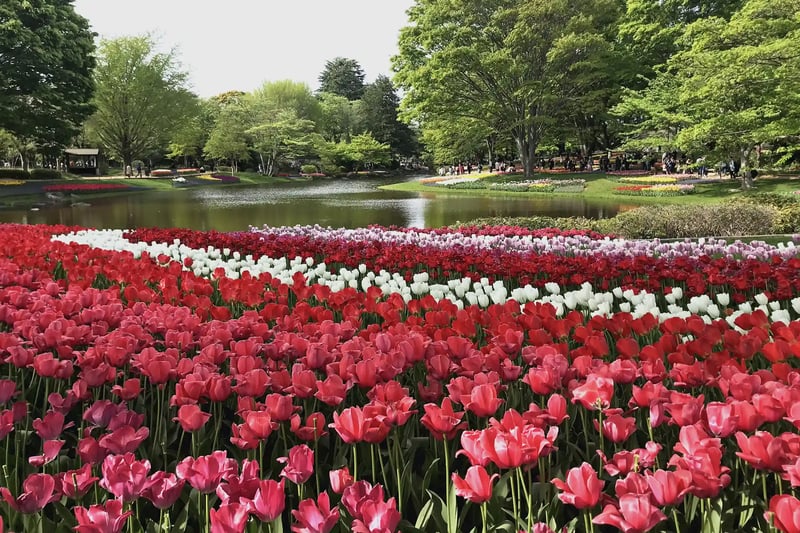
Nationally, the Daijisen defines sakura zensen, the cherry front, as a line joining the bloom dates of cherry trees across Japan, especially Somei-Yoshino. The front starts north from Kyushu and southern Shikoku in mid-March and reaches Hokkaido in early May, and the name comes from the line's resemblance to a weather front. In Tokyo, the Japan Meteorological Agency tracks the cherry blossoms to follow how the season is running, early or late. According to the agency's Tokyo cherry page, first bloom is the first day five or six or more blossoms have opened on one designated tree, and full bloom is the first day about 80 percent or more of the blossoms are out. The tree stands at Yasukuni Shrine. The agency has observed it since 1966, after using a tree on its own grounds, and its Tokyo statistics in their current form start in 1953.
The average first-bloom date for 1991 to 2020 is 24 March and full bloom is 31 March. The earliest first bloom in the records is 14 March, reached in 2020, 2021 and 2023, and the latest is 11 April, in 1984. The same office also tracks flowering of plum, hydrangea and silver grass, and the color change and fall of maple and ginkgo leaves, six items in all for Tokyo. For the gardens and ikebana lessons where the vocabulary comes to life, our guide to how to say "beautiful flower" in Japanese covers where to go and what the words mean when you get there.