Chirashi sushi is one of Japan’s signature dishes—and it’s hard not to be captivated by it. Its festive, jewel-like appearance draws you in, and the flavors keep unfolding with every bite. Whether you encounter it as a casual chirashi sushi bowl at a lunch spot or as a meticulously arranged box at a sushi counter, the appeal is the same: vivid color, thoughtful balance, and a sense of celebration. In this article, you’ll get a seamless, start-to-finish explanation: the basics and definition of chirashi sushi, how it differs from dishes people often confuse it with, the regional characteristics you’ll encounter across Japan, and even the “why” behind what makes it delicious—down to the aesthetics of plating. By the time you reach the end, you’ll understand chirashi sushi on a deeper level and come away with practical tips to enjoy it even more, whether you’re making it at home or discovering it on your travels.
Chirashi Sushi Basics: Its Definition and How It Differs from Similar Dishes
Let’s start by grounding ourselves in the fundamentals of “chirashi sushi.” By clarifying what it is—and sorting out how it differs from similarly named dishes—you’ll clear up the points that tend to cause the most confusion. Once you understand its distinctive structure (vinegared rice plus toppings), everything that follows will click into place.
Definition of Chirashi Sushi: Scattering or Arranging Toppings Over Vinegared Rice
Chirashi sushi is a type of sushi made by scattering (or arranging) a variety of toppings on top of—or mixed into—vinegared rice. The name is wonderfully literal: it comes from the method of “scattering” ingredients over sushi rice, and it’s sometimes simply called “chirashi.” One major distinction is that it uses vinegared sushi rice, which sets it apart from donburi-style seafood bowls (and many other rice bowls) that use plain steamed rice.
In the context of Edomae sushi (the traditional sushi style of Tokyo and the surrounding area), chirashi sushi often refers to neatly arranged sushi toppings (neta) placed beautifully over vinegared rice. Meanwhile, in many regions outside Kanto, it’s more common for “chirashi sushi” to mean vinegared rice mixed with cooked ingredients, then finished with garnishes like thin egg ribbons (kinshi tamago) and nori on top.
In other words, there are two broad styles—an “arranged” style and a “mixed” style—and both are included under the wide umbrella of chirashi sushi.
How Kaisendon Differs from a Chirashi Sushi Bowl: Vinegared Rice, Sauces, and When You Eat It
Next, let’s look at a dish that’s often compared to chirashi sushi: kaisendon. (In English-speaking contexts, people sometimes also compare chirashi to a poke bowl; the easiest way to stay oriented is to focus on the rice and the Japanese “sushi” approach—vinegared rice and ingredient-specific preparation—rather than treating them as interchangeable “raw fish bowls.”)
Kaisendon is typically served as a bowl of plain steamed rice (not seasoned with vinegar) topped with fresh seafood sashimi. Chirashi sushi, as described above, differs first and foremost because it uses vinegared rice. Since the rice itself is already seasoned, it’s designed to taste satisfying even without pouring soy sauce over everything. In Edomae-style chirashi, the etiquette is to avoid drizzling soy sauce directly over the bowl; instead, you pour a little into a small dish and dip only what needs it. That custom exists because each topping is prepared appropriately in advance—vinegar-cured, simmered, marinated, and so on—and the ideal seasoning differs from topping to topping.
By contrast, many kaisendon shops serve the bowl with a signature sauce already poured on top. Pairing thicker-cut sashimi with a sweeter soy-based tare can make it especially compatible with plain rice(*1). The typical dining context also differs. Kaisendon is often described as a relatively modern, boom-era dish that grew popular as an accessible set meal at tourist-area eateries and seafood markets. For example, generous bowls piled high with sea urchin (uni) and salmon roe (ikura) in Hokkaido markets are said to have helped spark nationwide popularity(*2). Chirashi sushi, on the other hand, has long been enjoyed at sushi restaurants and as part of celebratory home meals, with a history of appearing in more formal settings as well.
So the difference isn’t only “vinegared rice vs. plain rice.” It’s also the care and technique applied to the toppings (marinating, curing, simmering), and the cultural setting in which the dish is served. That’s why you can clearly distinguish kaisendon from chirashi sushi.
How Bara-zushi, Bara-chirashi, and Gomoku-zushi Differ: Mixed In or Placed on Top
You may also encounter similar-sounding names like “gomoku-zushi” and “bara-zushi.” A common explanation goes: “Chirashi sushi has nothing mixed into the vinegared rice, while gomoku-zushi is vinegared rice mixed with various ingredients.” But that’s not an official definition—names vary by region and generation.
For instance, in the Kansai region, sushi made by mixing ingredients into vinegared rice is often called “gomoku-zushi” or “bara-zushi.” Conversely, the style that places sashimi on plain-looking vinegared rice may be distinguished and called “nama-chirashi.”
In Tokyo and other areas where Edomae sushi is mainstream, you may see “bara-chirashi” used to describe a bowl where finely chopped seafood is scattered loosely over vinegared rice. The important thing to note is that “bara-chirashi” at a Tokyo sushi shop is not the same as “bara-zushi,” which developed as a traditional regional dish in places like Okayama and across Kansai. Edomae “bara-chirashi” is the scattered chopped-topping style, while Kansai “bara-zushi” is, like gomoku-zushi, a mixed-in style that evolved into a local specialty. Some regions also use the term “gomoku-chirashi,” which can be confusing—but at its core, the distinction is whether ingredients are mixed in or scattered/placed on top.
Historically, home-style sushi mixed with ingredients like egg ribbons and sweet-simmered dried shiitake (gomoku-zushi / bara-zushi) was widely enjoyed across Japan from earlier times, while Edomae chirashi (the style topped with raw fish) is often said to have become common later. One story says that when nigiri sushi became popular in Edo, sushi chefs began making chirashi as a staff meal using leftover toppings, and that it later entered menus as a proper offering from the Meiji period onward. Along the way, another account says that “chirashi with raw fish came to be distinguished by calling it kaisendon.”
That said, today the naming can be inconsistent from shop to shop. In practice, if it says “don” it’s treated as kaisendon, and if it says “chirashi” it’s treated as chirashi sushi—often depending on the provider’s choice of name. If you don’t want to get lost, don’t rely on the menu title alone. Look for the real clues: vinegared rice or plain rice, mixed-in rice or toppings arranged on top.
Sushi Menu Terminology: Edomae Chirashi, Kaisen Chirashi, Kyo Chirashi, Gomoku Chirashi
When you order chirashi sushi at a sushi restaurant, you may see several different names on the menu. Let’s cover the most common ones.
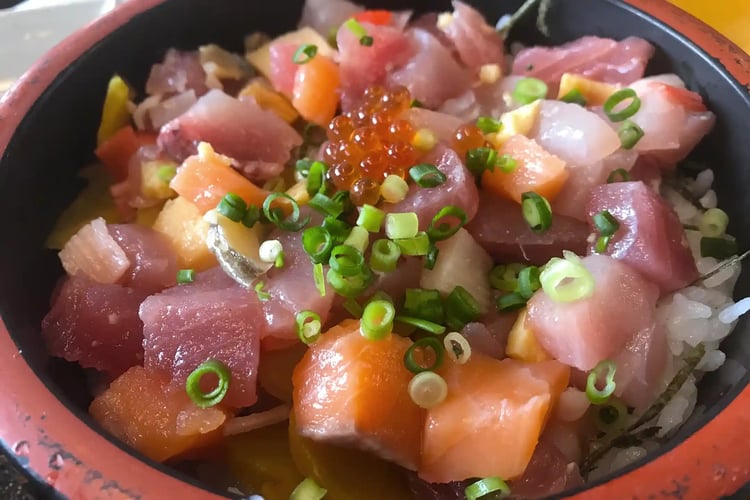
First is “Edomae chirashi.” As explained earlier, this refers to the Edomae style associated with Tokyo: chef-crafted chirashi sushi built primarily around seafood, with technique and precision at the forefront. Sushi toppings like tuna and white fish are arranged beautifully over vinegared rice, and each topping is seasoned appropriately—marinated, simmered, or otherwise prepared.
By contrast, the term “kaisen chirashi” (seafood chirashi) is sometimes used—even in sushi restaurants—in a way that feels closer to kaisendon: a visually lavish bowl packed with abundant seafood. It often uses vinegared rice, but depending on the shop, the line between it and kaisendon can be blurry.
Next is “kyo chirashi.” This is Kyoto-style chirashi sushi. As you’ll see later, it often avoids raw ingredients and instead uses items like chirimen-jako (tiny dried/simmered sardines) and yuba (tofu skin), resulting in an elegant, refined flavor profile(*3). At long-established Kyoto sushi houses, it may be offered as a boxed set (oritsume). For example, a well-known shop in Gion, Kyoto serves kyo chirashi as part of an assortment of Kyoto-style sushi alongside saba-zushi and hako-zushi(*4).
Finally, “gomoku chirashi” refers to the mixed-in style mentioned above. In Kansai and much of western Japan, when someone says “chirashi sushi,” they often mean this gomoku style. That’s why some Kanto-area shops deliberately label it “gomoku chirashi” to distinguish it from Edomae chirashi. Once you know these terms, you’ll be able to read a sushi menu with confidence—and order the style of chirashi sushi you’ll enjoy most.
Types of Chirashi Sushi: Two Families—Arranged Style and Mixed Style
Broadly speaking, chirashi sushi comes in two major styles: “arranged style” and “mixed style.” As mentioned earlier, which one people call “chirashi sushi” can vary depending on the region. Here, though, we’ll use this as a clear organizing framework so you can deepen your understanding. Once you hold this classification in your mind, it becomes much easier to grasp the distinct features and histories of chirashi sushi across Japan.
Arranged Style: Key Traits of Edomae Chirashi and Kaisen Chirashi
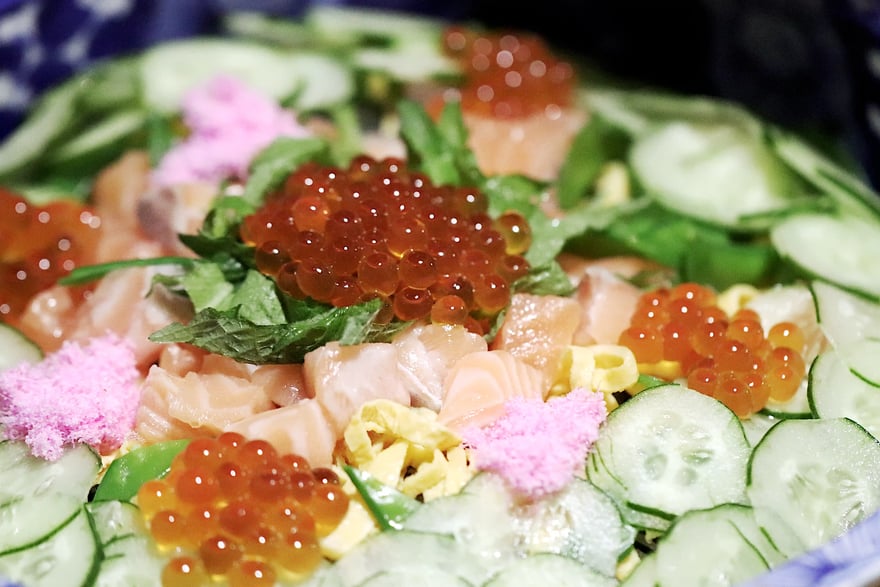
“Arranged style” chirashi sushi is exactly what it sounds like: toppings are placed and composed on top of vinegared rice. The classic example is Edomae chirashi, where colorful sushi toppings—tuna, white fish, shrimp, salmon roe, anago (conger eel), and more—are laid out beautifully over the rice. It’s visually striking, and the seafood spread across the vessel can feel like opening a jewelry box.
With Edomae chirashi, you’re not only enjoying visual beauty—you’re also tasting the craft behind each topping. A piece of tuna might be marinated in soy sauce (zuke) to concentrate umami; kohada (gizzard shad) may be vinegar-cured; anago might be simmered until tender and brushed with a sweet sauce. The same craftsmanship used in nigiri sushi is brought directly into chirashi, and because the seasoning is adjusted topping by topping, you don’t simply pour soy sauce over everything. Instead, each bite is balanced, and different flavors harmonize as you move through the bowl.
Dishes labeled “kaisen chirashi” often fall into this arranged category as well, especially when the focus is on variety and abundance of seafood. You may see lavish toppings like ikura and uni piled high—so generous that the rice disappears beneath the surface. Kaisen chirashi has also developed in distinctive ways in port towns around Japan; as you’ll read later, part of its charm is that the local catch becomes the star.
Arranged-style chirashi makes a strong visual impression and photographs beautifully, which helps explain why it’s especially popular today with younger diners and travelers. But behind the glamour is something more delicate: a sushi chef’s precise attention to ingredients. In Edomae sushi, toppings are seasoned so you can enjoy them even without dipping in soy sauce. In chirashi sushi, too, the balance between vinegared rice and toppings is carefully tuned. The tang of the rice, the savoriness of the seafood, and the aromas of wasabi and nori come together—simple at a glance, yet surprisingly deep.
Mixed Style: Key Traits of Gomoku Chirashi and Bara-zushi
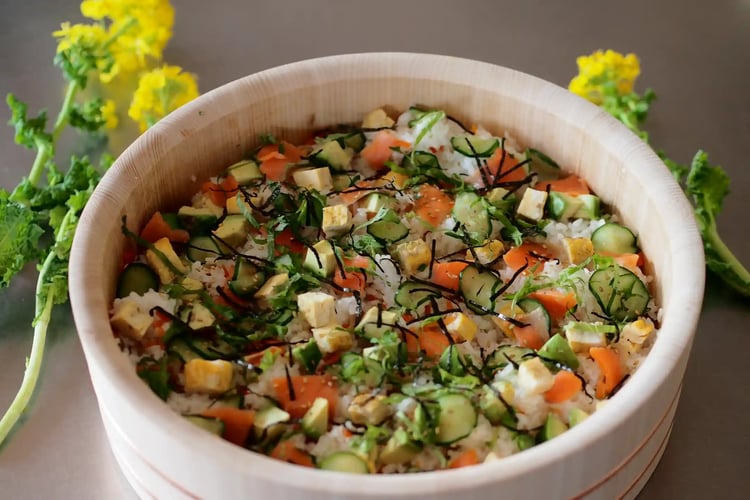
“Mixed style” chirashi sushi is made by mixing ingredients directly into the vinegared rice. A typical example is Kansai-style gomoku chirashi (also called bara-zushi), where finely chopped ingredients like sweet-simmered shiitake, kanpyo (dried gourd strips), sweet-and-sour lotus root, carrot, and bamboo shoots are folded into the rice. Many of these base ingredients are simmered with dashi or made from dried foods, so the flavor deepens as you chew—quietly satisfying and richly layered.
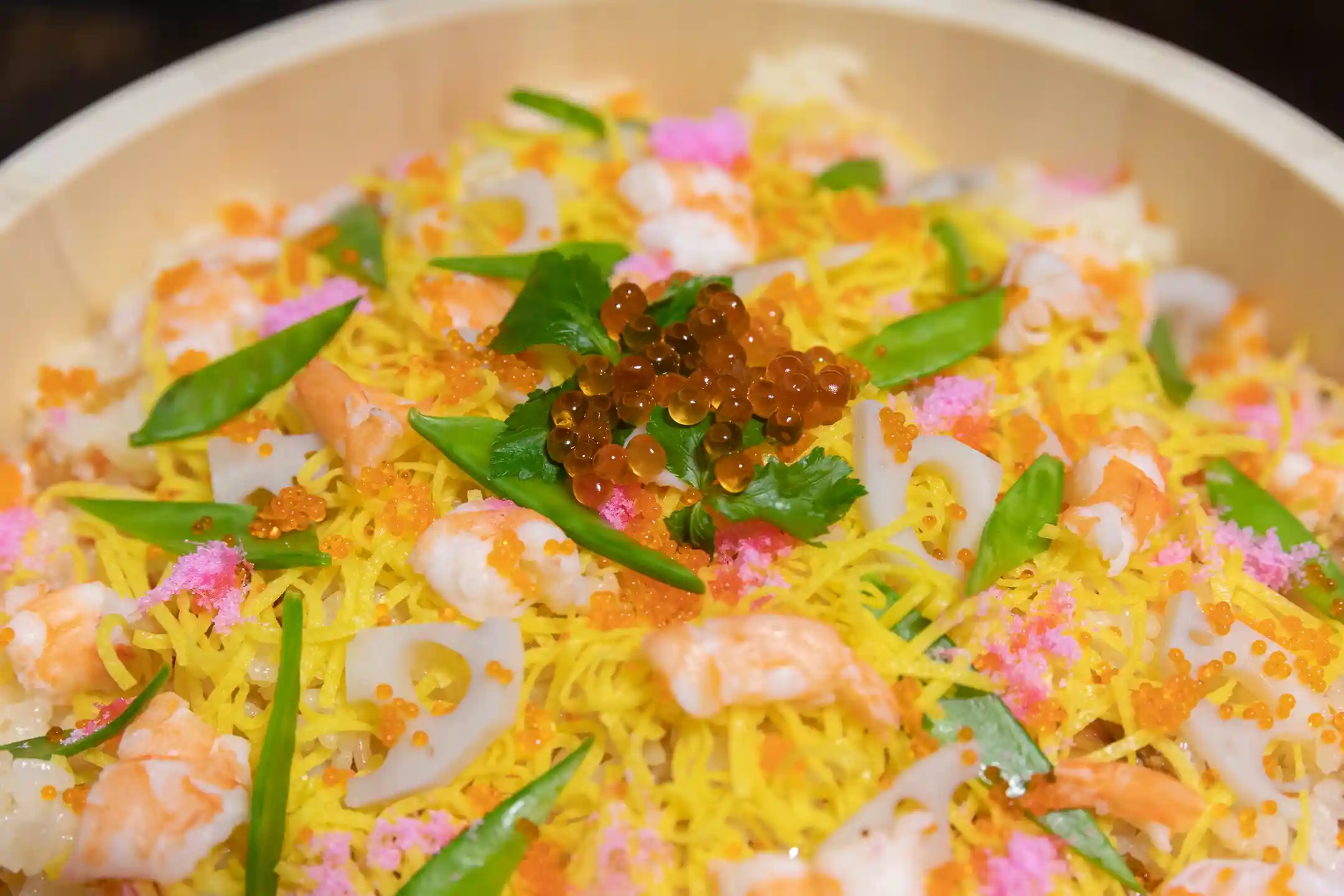
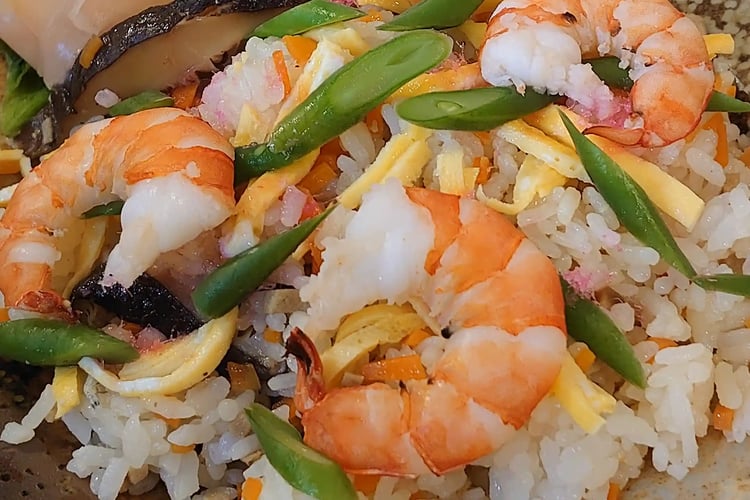
After mixing, the finishing touches bring it to life: boiled shrimp or grilled anago might be placed on top, then egg ribbons, snow peas, red pickled ginger, and shredded nori are scattered as garnish. With these layered components, the tang of the vinegared rice gains depth, sweetness, and aroma, rounding into an overall mellow flavor.
Gomoku chirashi has also been passed down as home cooking, and the ingredients can vary slightly from region to region—and even from household to household. You might hear, “In our family we use simmered fresh shiitake instead of dried,” or “Our bara-zushi includes ginkgo nuts and chestnuts.” That family-by-family creativity is part of what makes mixed-style chirashi so fascinating. Since it doesn’t rely on raw fish, it tends to keep better, and in earlier times it was especially valued as a celebratory “hare-day” (special-occasion) dish that could be prepared ahead.
Mixed-style chirashi carries the wisdom and playful spirit of people who wanted to make festival days and seasonal celebrations feel abundant, even within modest everyday meals. Over time, that impulse helped shape its hallmark: a generous, complex flavor created by combining many ingredients(*3). Another advantage is harmony over time—because the flavors are already integrated, it can still taste wonderful even after it sits. That’s why, for gatherings like Hinamatsuri (Girls’ Day) or New Year’s, families might prep it the day before and simply plate it on the day, instantly creating an impressive dish. Gomoku chirashi and bara-zushi may be humble, but they’re deeply comforting—an embodiment of the kind of home flavor people often call “mom’s cooking” in Japan.
Chirashi Sushi for Seasonal Events: A Classic for Hinamatsuri and Other Hare Days
Chirashi sushi has long been a staple for hare days—special, celebratory occasions. The most famous example is Hinamatsuri on March 3, when chirashi sushi is served at the Girls’ Day festival to wish for healthy growth.
Why chirashi sushi for Hinamatsuri? There are several theories, but one widely cited reason is that it includes ingredients considered auspicious. For example: shrimp symbolizes longevity (the idea of living until your back bends), lotus root—because it has holes running through it—expresses the wish to “see the future clearly,” beans suggest the hope of living diligently and energetically, and the golden color of egg ribbons evokes treasure and good fortune(*2). In this way, chirashi sushi became beloved as an “edible good-luck charm”—a festive dish filled with bright ingredients carrying celebratory meaning.
%20Seafood%20Chirashi%20Sushi.webp?width=750&height=500&name=Hinamatsuri%20(Girls_%20Day)%20Seafood%20Chirashi%20Sushi.webp)
When Hinamatsuri became established in the Edo period as an event to celebrate young girls by displaying dolls, families began preparing more elaborate and colorful foods. Bright, springlike chirashi sushi was a natural fit for the Peach Festival. It also helped that chirashi sushi can be made in large quantities and shared easily. Unlike nigiri, you don’t need to form each piece individually; you can assemble it in a large box and portion it out, making it ideal for a family table where everyone gathers. Many households also enjoy decorating it together—adding egg ribbons and shrimp with children—turning plating into part of the celebration and creating warm memories.
That combination—good fortune symbolism, visual festivity, and practical ease—is exactly why chirashi sushi became a Hinamatsuri classic. It also makes sense that chirashi appears at other celebratory moments: spring hanami bento, school entrance celebrations, autumn harvest festivities, and more. With its vibrant colors, chirashi sushi brings seasonality and joy to the table, making it a distinctly Japanese kind of celebratory meal.
The History and Culture of Chirashi Sushi: Hare Days and Urban Dining Culture
From here, let’s trace the historical path chirashi sushi has taken—and the cultural backdrop that shaped it. When you go beyond “what it is” and learn the story of where it came from and how it developed, your experience of eating chirashi sushi becomes richer. We’ll unpack the origins of sushi as a fermented food, the role chirashi played within the refined Edomae sushi culture of Japan’s cities, and its enduring relationship with celebratory tables that continues today.
Sushi History: From Fermented Sushi to Quick Sushi with Vinegared Rice
If you follow sushi’s larger history, its roots are often described as reaching back to fermented sushi traditions—sometimes linked to broader preservation practices across Asia.
In ancient times, sushi took the form of narezushi (fermented “matured sushi”), made by packing fish with salt and rice and preserving it through lactic acid fermentation. As fermentation progressed, the rice became too mushy to eat, so at first people ate only the fish and discarded the rice (the rice served mainly to prevent spoilage). Over time, the idea emerged that “throwing away the rice is wasteful,” and the fermentation period was shortened so that a slight tang remained and the fish could be eaten together with the rice—this became namanare-zushi, often considered an early prototype of sushi.
Later, people refined the process further, aiming for something that could be made and eaten quickly. By adding acidity with vinegar, they could finish it on the spot. This became hayazushi (“quick sushi”), and it formed the prototype for today’s sushi rice—vinegared rice made by mixing vinegar into cooked rice(*1).
As hayazushi culture spread, nigiri sushi is said to have been born in Edo in the late Edo period, often credited in tradition to a man named Hanaya Yohei. Bite-sized vinegared rice formed by hand and topped with fish, nigiri was sold at street stalls and quickly became a famed Edo specialty.
Of course, in an era without refrigeration, handling fish required ingenuity. Methods were established to preserve and improve flavor—salting, vinegar-curing, simmering, marinating—especially for seafood caught in Edo Bay (Tokyo Bay). This became the foundation of Edomae sushi: not just “freshness,” but bringing out umami through skilled preparation(*2). Through this historical evolution, sushi developed into diverse forms—nigiri, pressed sushi, rolls, chirashi, and more—eventually becoming a beloved staple of Japanese food culture.
Hinamatsuri and Chirashi Sushi: Why It’s Chosen for Celebratory Tables
As mentioned earlier, chirashi sushi is considered indispensable for Hinamatsuri. One reason lies in the auspicious symbolism of its ingredients, but there are also cultural and practical reasons. In the Edo period, Hinamatsuri became established as a celebration where dolls were displayed and young girls’ growth was honored, often with gatherings of family and relatives. As these celebrations took root, more elaborate “feast” foods were prepared, and chirashi sushi—beautiful to look at and perfectly springlike—was an ideal choice.
Chirashi sushi is also easy to prepare in advance and easy to serve to a crowd. Because it can be assembled as a whole, on Hinamatsuri day not only the mother but also children can join in decorating and plating it—strengthening the sense of togetherness that makes a family event feel special. It also pairs well with hamaguri clear soup, another classic Hinamatsuri accompaniment. Hamaguri (clams) are considered auspicious because their shells match only their original pair—symbolizing a good match and marital harmony. Enjoying chirashi sushi alongside hamaguri soup is said to make the meal feel even more celebratory.
In this way, chirashi sushi has been chosen for special occasions because it brings together three strengths at once: color, meaning, and practicality. Even today, many families make chirashi sushi for home parties, graduations, and school entrance celebrations, keeping the tradition very much alive.
Refined Edomae Chirashi at Sushi Restaurants: Craftsmanship and Etiquette
Within Edomae sushi culture, chirashi sushi has long stood as a second star alongside nigiri. Edomae chirashi, said to have begun as a staff meal for sushi chefs at the end of the Edo period, became refined after the Meiji era and entered sushi restaurant menus as a formal offering. When you eat Edomae chirashi at a sushi restaurant, you can sense the chef’s technique and gestures in every detail.
For example, the way seasonal toppings are cut to the ideal thickness and placed carefully so each slice stands out against the vinegared rice is truly edible art. One famous shop in Ginza even offers a special “bara-chirashi” in a boxed takeout format, tightly packed with toppings like soy-marinated tuna and simmered anago—prepared so the flavor remains satisfying even after time passes. Chefs describe this “work” applied to the toppings, and the balance with the shari (sushi rice), as exactly what makes it Edomae chirashi.
In Edomae tradition, the dish is already seasoned when it reaches you; the basic idea is that you simply eat it as-is. Just before serving, a chef might brush on nikiri soy sauce with a quick stroke, presenting it as a finished piece. As with nigiri, chirashi is arranged and seasoned so soy sauce doesn’t pool at the bottom of the bowl—each topping is adjusted so the whole composition stays clean and complete. The accumulation of these small, precise gestures gives a single box of chirashi sushi a sense of artistry.
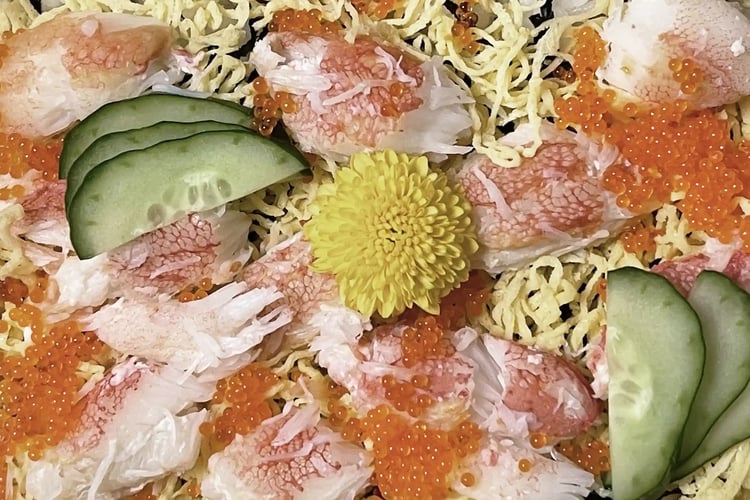
The moment you lift the lid, a rich aroma rises; colors balance in harmony; even the placement—how your chopsticks move through it—feels considered. Edomae chirashi sushi condenses a sushi chef’s aesthetic sensibility into one vessel, becoming something you don’t just “eat,” but also experience. And when you taste it, you may find yourself—without even realizing it—stepping into an understated world of history, tradition, and Edo-style “iki” (refined chic).
How Chirashi Sushi Changes by Region: Eastern Japan, Western Japan, Kyoto, Okayama, and More
Because chirashi sushi developed across Japan, it reflects local food cultures and the ingredients available in each place—resulting in remarkably diverse styles. In this chapter, we’ll move from the broad contrast of eastern vs. western Japan to especially distinctive regional examples such as Kyoto and Okayama. Once you understand how geography and food culture intertwine, your anticipation naturally grows: “What kind of chirashi sushi will I discover when I travel?” Let’s dive into the personalities of chirashi sushi by region.
Eastern Japan: Traits of Edomae Chirashi (Red Vinegar, Marinating, Nikiri)
In eastern Japan—especially the Kanto region—the dominant style is Edomae chirashi sushi. Its defining trait is that while it centers on seafood, it also showcases the hallmark “handwork” of Edomae technique.
For tuna, that might mean zuke—marinating in a soy-based sauce to concentrate flavor. For kohada (gizzard shad), it means curing in vinegar for a clean finish. Shrimp may be boiled in salted water, peeled, and lightly tightened in sweet vinegar. Anago is simmered until tender and brushed with a sweet glaze (tsume). In this way, each topping is prepared with an extra step.
These techniques originally emerged as practical solutions: Edo’s sushi chefs needed ways to preserve toppings and season them appropriately. Even when soy sauce is used, Edomae style traditionally avoids pouring it over the whole bowl; you take a bit into a small dish and dab only the topping you’re eating.
The vinegared rice itself may also be thoughtfully crafted. In high-end Edomae sushi, some chefs season the rice with akazu (red vinegar made from sake lees). Akazu gives the rice a slightly brown tint and a distinctive depth of umami. By keeping sugar minimal and making the rice more sharply tangy, the flavor can harmonize beautifully with richer toppings(*1). In Edomae chirashi assembled this way, the vinegared rice supports the deep flavors of each topping, and everything comes together as a single, finished bite.
At the same time, you’ll also find local “arranged style” chirashi across eastern Japan that highlights regional specialties: boldly topped uni and ikura in Hokkaido, nodoguro (blackthroat seaperch) and sweet shrimp in Niigata, or even simmered river fish in parts of northern Kanto(*2). These fall broadly into the eastern “arranged” family, but they can differ from Edomae sushi-shop chirashi depending on whether akazu is used and whether the toppings receive classic Edomae preparation.
If you encounter a local chirashi while traveling, try enjoying the difference in flavor using the region’s own soy sauce and condiments. It’s a simple way to make the experience even more vivid.
Western Japan: Gomoku Chirashi and Bara-zushi
In western Japan, home-style gomoku chirashi sushi (bara-zushi) is deeply rooted. It’s made by mixing sweet-simmered shiitake and kanpyo, carrots, bamboo shoots, and other ingredients into vinegared rice. The charm lies in how the dashi-scented seasoning—often built with soy sauce and mirin—soaks into every grain. Because it typically avoids raw fish and instead leans on dried foods and simmered ingredients, it creates a deep, layered umami that opens up the more you chew.
Compared to Kanto, Kansai-style sushi rice is sometimes seasoned slightly sweeter and cooked a bit softer, balancing the stronger flavors of the mixed-in ingredients(*3). On top, egg ribbons, red pickled ginger, and shredded nori are scattered for color and fragrance. Regional variations are plentiful: in Kyoto, as you’ll see, it’s often finished with refined ingredients like yuba and chirimen-jako, while in Nara and Shiga you may find finely chopped narazuke or shibazuke mixed in.
Along the Seto Inland Sea, bara-zushi developed further into a rich combination of sea and mountain ingredients, sometimes featuring vinegar-cured small sea bream or grilled anago. Okayama’s famous “bara-zushi,” in particular, carries a story: when the Okayama domain lord Ikeda Mitsumasa issued a frugality order—“one soup, one dish”—people are said to have decided that at least on festival days they would make something splendid by scattering many delicacies across one sushi dish. True to its name, it’s visually vibrant. Vinegar-cured Spanish mackerel (sawara), grilled anago, shrimp, octopus, simmered local vegetables, yellow chives (kiniira), rapeseed blossoms—sea and mountain bounty harmonize atop one bed of rice in a way that feels genuinely celebratory.
Across western Japan, the keywords are shelf-stability and harmony. With dried foods and simmered ingredients, the dish keeps well, and the flavors blend more deeply with time. For events, it may be prepared the day before and served once the taste has settled.
There’s also a winter custom in parts of western Japan: serving chirashi sushi as “mushi-zushi” (steamed sushi), reheated in a steamer basket. Warm rice topped with comforting ingredients, rising steam carrying aroma—mushi-zushi is a local favorite that can warm both body and spirit on chilly days.
Overall, western Japan’s chirashi sushi tends to feel gentle and comforting, reflecting home kitchens and the gifts of the land. It remains carefully preserved as regional cuisine across many areas.
Kyoto: Traits of Kyo Chirashi
Kyoto’s chirashi sushi, in a word, is elegant and delicate. Kyoto is well known for pressed mackerel sushi and box sushi, but chirashi sushi (also sometimes called “bara-zushi” in Kyoto) has primarily been made at home. Its defining qualities appear in both seasoning and ingredient choices.
First, the vinegared rice is tuned to an exquisite balance—“not too sour, not too sweet.” Sugar is restrained, and the vinegar is allowed to fragrance the rice softly rather than dominate. The toppings often match this gentle approach: yuba, chirimen-jako, konnyaku, nama-fu—ingredients closely associated with Kyoto food culture. Yuba in particular feels distinctly Kyoto: lightly simmered in a sweet-savory seasoning, torn into fine strands, then mixed into the rice to add unique umami and texture. Chirimen-jako (small fish simmered/dried) may be cooked with sansho, adding a lively aroma that works as an accent. Since raw fish isn’t used, the overall color palette can appear subdued, but it’s lifted with the yellow of egg ribbons and the green of kinome (young sansho leaves), bringing a sense of seasonality.
Kyoto cuisine is often described as an “aesthetic of subtraction,” where both flavor and presentation avoid excess so the ingredients can shine. Kyo chirashi follows the same sensibility: even when many ingredients are used, each is finely cut, and the overall taste is gathered into a calm, harmonious gentleness. The finished sushi tends to settle into a pale, unified tone, with a soft drift of kinome or ginger aroma—understated, composed, and quietly beautiful.
In Kyoto, chirashi sushi may also be packed into boxes for hanami bento or served as part of meals connected to tea gatherings. It’s designed to look especially beautiful in plain wooden boxes or lacquered vessels, giving you a tangible sense of “the beauty of negative space.” Kyoto also treasures seasonality: adding rapeseed blossoms or bamboo shoots in spring, or using momiji-fu (maple-leaf wheat gluten) in autumn—details that reflect the time of year even through color alone.
For example, over a bed of egg ribbons, an autumn version might be topped with carrot cut into maple-leaf shapes—creating “a season you can feel with your eyes.” Kyoto’s kyo chirashi isn’t flashy, but when you take a bite, the umami of ingredients and dashi gradually spreads, leaving a gentle finish and lingering aftertaste. It’s like quietly viewing a garden from a Kyoto tea room—modest, yet full of depth.
When you visit Kyoto, why not seek out kyo chirashi at a long-established catering shop or sushi restaurant? It’s a graceful way to savor Kyoto’s refined tastes.
Okayama: Traits of Bara-zushi and Regional History
Okayama Prefecture’s specialty “bara-zushi” is one of Japan’s most iconic local chirashi styles. Its most immediate hallmark is its lavish abundance. The vinegared rice includes finely chopped Okayama-grown yellow chives, and the surface is generously decorated with shrimp, anago, octopus, vinegar-cured sawara (Spanish mackerel), lotus root, sweet-simmered shiitake, egg ribbons, red pickled ginger, and more—an extraordinary spread of sea and mountain ingredients. The colorful scattering across the entire surface is fittingly called “festival sushi,” and you can practically feel the history of people making it competitively for festivals and hare days.
According to a well-known tradition, in the mid-Edo period the Okayama domain lord Ikeda Mitsumasa ordered commoners to practice frugality, issuing a decree along the lines of “for everyday meals, one soup and one dish.” But people still wanted to treat themselves on festival days. So the thinking went: “If we put all the side dishes onto a single plate, it would still count as one dish.” They chopped fish, vegetables, and even meat into small pieces, mixed them into sushi rice, and then scattered every possible delicacy on top as well. This is said to be the origin of Okayama bara-zushi (there are various theories, but it’s a famous episode).
That’s why Okayama bara-zushi can feel like the ultimate “generous” sushi. With each mouthful, different flavors and textures emerge one after another from rice scented with sweet vinegar: the crisp bite of lotus root, the richness of tender simmered anago, the springy savoriness of shrimp, the clean acidity of vinegar-cured sawara, and the refreshing aroma of yellow chives and kinome. It’s lively—almost like a festival happening right inside your mouth.
For people in Okayama, bara-zushi is a special feast, and even today it remains essential when people gather for festivals, Obon, and New Year’s. Local sushi shops sell luxurious boxed bara-zushi that’s popular with travelers as well. If your journey takes you to Okayama, do yourself a favor and try it. In a single box, you’ll taste history, local pride, and a playful spirit—and you’ll likely leave feeling genuinely satisfied.
Local Seafood Chirashi: Port-Town Differences Expressed in a Single Bowl
Because Japan stretches far from north to south and is surrounded by the sea, port towns across the country have developed local seafood chirashi sushi that highlights what their waters provide. For example, in Otaru, Hokkaido, “kaisen chirashi” piled generously with uni, ikura, and crab—often called Hokkaido’s three great seafood treasures—is famously popular, with toppings packed so densely you can hardly see the rice(*2). Along the Sanriku coast of Tohoku, you can enjoy chirashi starring seasonal ingredients like saury, scallops, or ikura from autumn salmon. In Hokuriku, you might see local catches such as white shrimp, nodoguro, and sweet shrimp placed on top—sometimes marinated or kombu-cured for added depth. In Sea of Japan port towns in the San’in region, fresh fish like hatahata or horse mackerel may be seasoned in soy and scattered alongside tamagoyaki, with local ingenuity on display.
Because differences in seafood appear so directly, these local chirashi bowls feel richly individual. And it’s not only about seafood—sometimes you’ll even find collaborations with other local specialties.
For instance, in Obama City, Fukui Prefecture, some shops serve a luxurious seafood chirashi alongside their famous “kodai no sasazuke” (small sea bream lightly vinegar-cured and pressed with bamboo leaves), offering travelers the joy of tasting a regional specialty and a chirashi bowl in one sitting. In a sense, port-town seafood chirashi is a jewelry box filled with the sea’s gifts from that place.
When you travel, it’s absolutely worth seeking out a “you can only eat it here” seafood chirashi at local fish markets and restaurants. Since seasoning can reflect regional soy sauce and miso styles, even similar seafood can taste noticeably different from place to place. Local seafood chirashi is like a mirror of each region’s marine environment and food culture—and one meal can become a surprisingly vivid travel memory.
What Determines Deliciousness: Designing Vinegared Rice, Ingredients, Dashi, Aroma, and Texture
Chirashi sushi tastes wonderful not because it’s a random assortment of ingredients, but because it’s the result of thoughtful “design” down to the smallest details. Here, we’ll explain five key elements that shape its flavor. From how you make vinegared rice, to how you prep each topping, to how you incorporate seasonality and color, to how aromatics like garnishes and nori keep the experience lively, and finally to texture and temperature management—you’ll find plenty of practical insights you can apply at home with a professional mindset.
The Basics of Vinegared Rice: Balancing Rice, Vinegar, Sugar, and Salt—and Managing Temperature
At the foundation of delicious chirashi sushi is always excellent vinegared rice. The keys are the balance of rice, vinegar, sugar, and salt—and temperature control while mixing. Ideally, you cook the rice slightly firmer than usual. Sushi chefs often say, “Firmer sushi rice tastes better once it becomes sushi.” At home, you can either use slightly less water, or increase the rice amount a little while adding water according to your rice cooker’s markings to achieve a firmer cook.
While the rice is hot, quickly pour in awasezu (a pre-mixed seasoning of rice vinegar with sugar and salt dissolved into it), then mix with a slicing motion. The trick is to distribute the vinegar mixture across the rice as swiftly and evenly as possible, so it finishes without uneven patches. Once mixed, spread the rice immediately in a hangiri (wooden sushi tub) or a wide tray, cooling it while letting excess moisture evaporate. Fan it with a hand fan until the surface steam calms, then gently turn it from top to bottom, cooling until it reaches about body temperature.
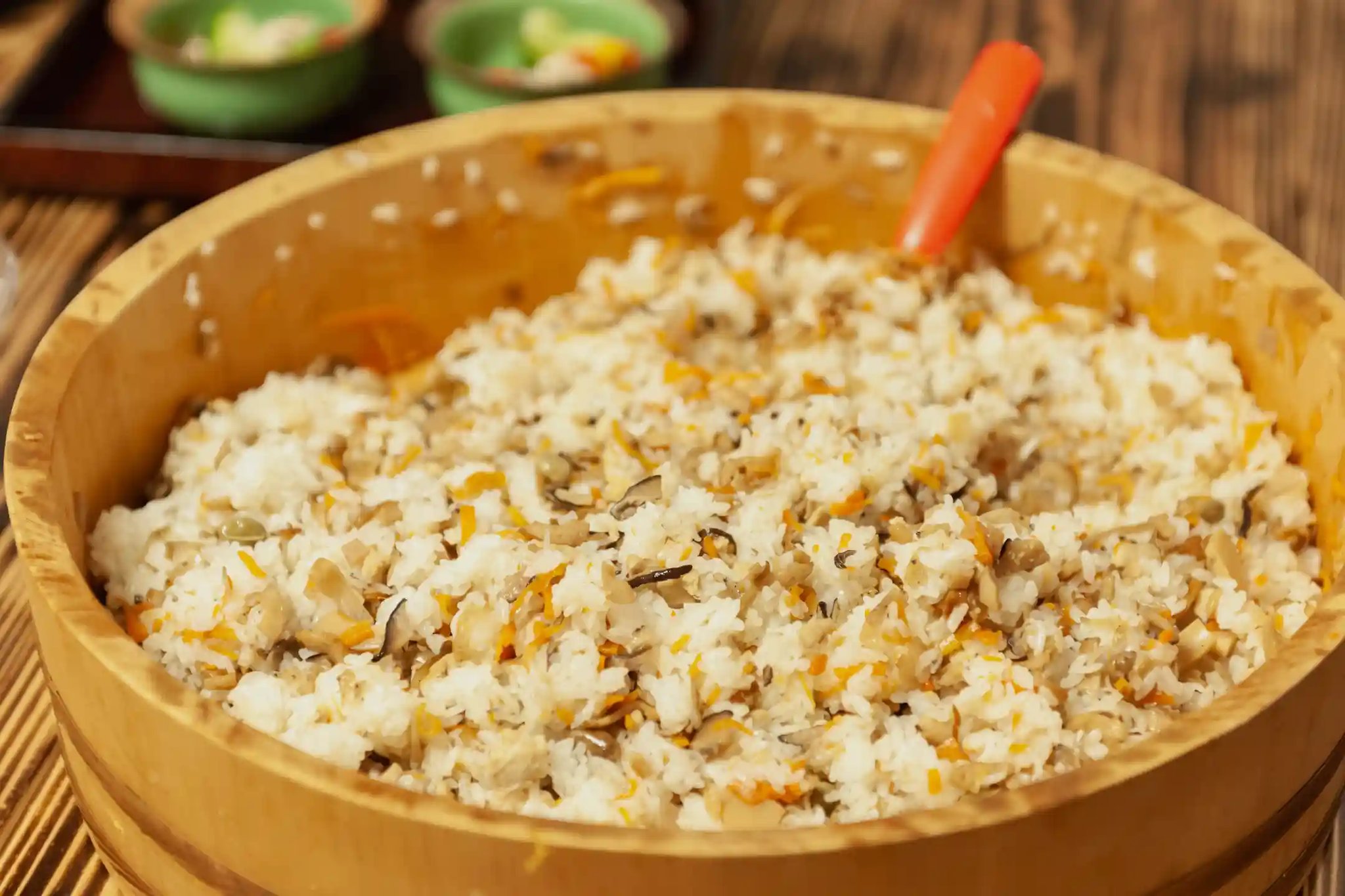
As a guideline, the ideal temperature is when you hover your hand over it and feel a soft warmth. Too hot, and the vinegar aroma can dissipate too much; too cold, and the vinegar won’t integrate properly and the rice won’t develop that glossy sheen. The balance of sugar and salt matters as well. In Edomae sushi rice, sugar may sometimes be omitted, but for home cooking, a moderate sweetness often tastes better—and sugar also helps keep rice from drying out as it cools, thanks to its moisture-retaining effect. Some households add a small amount of mirin for extra depth. Salt should be enough to tighten and define the sweetness and acidity.
Vinegared rice made this way should taste delicious even on its own. Is it not sticky, with grains standing distinct? Does it look glossy, and feel gently warm? When you pay attention to those details, the overall quality of your chirashi sushi improves dramatically. Vinegared rice may feel like a supporting player, but its quality can determine the entire impression of the dish.
Ingredient Craft: Not Only Raw—Simmering, Grilling, and Marinating Make the Difference
The deliciousness of chirashi sushi is supported by the preparation applied to each ingredient. It’s not only about using fresh ingredients—it’s about adding a thoughtful step: simmering, grilling, marinating, curing. With that extra care, the pairing with vinegared rice becomes dramatically better.
For example, even when using raw fish, you don’t necessarily place plain sashimi on top. You might lightly marinate it in a soy-based sauce to infuse flavor, or cure it with vinegar to remove odor and create a cleaner finish. That way, the fish contributes saltiness and umami that harmonize with the rice’s acidity and sweetness. Shrimp or hamachi can also become more compatible with vinegared rice if briefly boiled or blanched, then dipped in vinegar or tightened with citrus. If you prepare a chirashi sushi bowl at home with raw seafood, source it from a trusted vendor and keep it properly chilled for food safety.
Simmered ingredients matter, too. Dried shiitake and kanpyo are slowly simmered with sugar, soy sauce, and dashi, then cooled and finely chopped before mixing into the rice. Having absorbed the sweet-savory broth, they release dashi umami throughout the rice, and each chew brings a juicy, expanding flavor. This adds depth and cohesion to the whole dish. Grilled items also play their part: anago can be grilled until aromatic and coated with sweet sauce, and thick omelet (atsuyaki tamago) can be cooked fluffy with a gentle sweetness—each prepared to be delicious on its own before joining the sushi.
Because of this “work” applied to ingredients, vinegared rice, toppings, and seasonings become three parts of one integrated whole—creating a level of completion that goes far beyond simple mixed rice. People often say, “Chirashi sushi takes time.” But that’s another way of saying: when you truly engage with each ingredient and prepare it optimally, the final result becomes a balanced, harmonious plate. In professional sushi restaurants, this preparation is precisely where skill shines.
At home, you can still apply the idea. Even if you use a store-bought chirashi seasoning mix, adding just one thoughtful touch—like preparing grilled anago or vinegar-cured fish separately to place on top—can make your chirashi feel suddenly more authentic. Think of chirashi ingredients as an orchestra of raw, simmered, grilled, and marinated elements. Only when each is prepared appropriately do they create harmony—and if you taste with that lens, you may find a whole new layer of enjoyment.
Seasonality and Color: Choosing Ingredients by Season and Building a Color Composition
Chirashi sushi becomes even more compelling when you incorporate seasonal ingredients. In spring: sakura-dai (sea bream), clams, rapeseed blossoms, bamboo shoots. In summer: young ginger, edamame, hamo. In autumn: ikura from autumn salmon, chestnuts, ginkgo nuts. In winter: crab, winter yellowtail, yuzu. When seasonal delicacies join your chirashi, both flavor and color begin to carry the feeling of the season. For example, spring chirashi may use pale pink sakura-denbu (fish floss) and green snow peas to evoke cherry blossom season. In autumn, momiji-fu or simmered persimmon can bring a sense of fall foliage.
As a foundation for color planning, Japanese cuisine often uses the concept of “five colors”: red, blue/green, yellow, white, and black. When you include these in balance, food is said to look especially beautiful. In chirashi sushi, red can come from tuna, ikura, or red pickled ginger; green from cucumber, snow peas, or kinome; yellow from egg ribbons or yuzu peel; white from the rice or lotus root; black from nori or shiitake. The bright yellow of egg ribbons is particularly important—it acts as a central accent that makes other colors stand out.
At the same time, balance of intensity matters. Strong colors (like the vivid red of pickled ginger) stand out even in small amounts, so they’re best scattered as highlights across calmer tones (like the white of rice or the brown of simmered ingredients). Paler ingredients, by contrast, can form the base in larger quantities. This is how you create visual harmony that instantly reads as “delicious.”
Color also connects directly to the feeling of seasonality. Warm tones (reds and yellows) can add warmth in autumn and winter, while cool tones (blue-greens) can feel refreshing in summer. A bowl dominated by red and orange in midsummer may feel heavy, while a bowl dominated by green and blue in autumn may feel chilly. By consciously choosing colors that suit the season, you can influence not only how the dish looks, but also how it feels—your mood and even your sense of “temperature” as you eat. Adding a seasonal leaf (a cherry leaf, nandina leaf, or maple leaf) at plating time is another subtle, distinctly Japanese flourish.
In this way, making chirashi sushi with seasonality and color in mind becomes more than cooking—it becomes a cultural act of appreciating the seasons themselves. If you approach chirashi sushi as a way to reflect the changing year in one dish, you’ll likely find you taste it with a fuller, richer mindset.
Garnishes and Nori: Building Aromatic Layers So the Flavor Never Feels Flat
One of the quiet heroes that helps you enjoy chirashi sushi to the very last bite—without getting bored—is aroma: garnishes and nori.
Among garnishes, ginger is a classic. Thin slices of sweet-pickled ginger (gari) or red pickled ginger don’t just cleanse your palate—they also sharpen and define the overall flavor. If you add a little with each bite, your mouth resets, and you can approach the next bite with fresh attention. Kinome (young sansho leaves) is also commonly used. It carries the scent of spring, and when you place it on chirashi sushi, a refined aroma lifts through your nose, leaving a pleasant finish. Other household touches include scattering finely sliced shiso leaves or sprinkling toasted sesame seeds for nuttiness and freshness.
Then there’s nori. When you generously sprinkle shredded nori over chirashi sushi, the briny aroma spreads across the bowl and stimulates your appetite. Because nori’s aromatic compounds are highly volatile, the key is to add it just before eating. The crisp texture also joins in, creating an enjoyable contrast with the tender vinegared rice. Nori contains umami components (like glutamic acid), so it can also enhance overall savoriness through synergy.
There are also small but impactful variations: a whisper of ground sansho, or a touch of yuzu peel. In Kansai-style chirashi, for example, a very light dusting of ground sansho can add an adult, gently tingling fragrance. In winter mushi-zushi, yuzu peel may be added so its aroma rises with the steam.
These aromatic layers give chirashi sushi “edges” and rhythm. They stimulate your palate anew, refresh your senses through layered fragrance, and help you enjoy every bite all the way through. Aroma is a major pillar of deliciousness, and in a dish like chirashi—where many flavors intersect—how you design aroma can make or break satisfaction.
When you eat, try paying attention to the moment ginger or nori enters the bite—what changes in the aroma, and how it shifts your perception. That awareness alone can make chirashi sushi feel even more vivid.
Texture and Temperature: Sashimi Thickness, Moisture, and Rice Condition Change the Experience
Chirashi sushi’s enjoyment isn’t determined by taste alone—texture and temperature can dramatically change how it feels to eat. Let’s start with texture. Even the thickness of sashimi changes your perception. Tuna is often cut slightly thicker to create presence, while firm, crunchy shellfish may be sliced thin so it integrates more smoothly with soft vinegared rice. Each ingredient has an ideal thickness.
When you combine ingredients with different textures—chewy octopus and crisp lotus root alongside tender simmered anago and fluffy scrambled egg—the experience becomes even more pleasurable. In mixed sushi, the contrast between the crisp bite of burdock or lotus root and the soft, moist richness of shiitake and kanpyo becomes a key accent. Fluffy egg ribbons, snappy snow peas, crisp nori—this harmony of textures within one bowl is one of chirashi sushi’s greatest pleasures.
Next, temperature. Chirashi sushi is generally considered most delicious at around body temperature—slightly warm. Sushi chefs often say nigiri rice should be at body temperature, and chirashi follows the same logic: if the rice is too cold, flavors blur; if it’s too warm, vinegar evaporates more strongly and the acidity can become overly sharp. If you prepare vinegared rice and cool it appropriately before plating, both toppings and rice can harmonize without dulling each other’s strengths(*1).
There are also cases where chirashi is intentionally served warm, as in mushi-zushi. In that case, the vessel may be warmed as well, and eating it piping hot becomes a comforting winter pleasure. Temperature management matters both at restaurants and at home. If you take sashimi straight from the refrigerator and place it on rice, the temperature gap can feel jarring on your tongue. Ideally, let sashimi sit briefly at room temperature to rise slightly before placing it on the rice. Alternatively, marinating can help integrate flavor and also make temperature differences feel less pronounced.
Finally, the moisture level of the vinegared rice affects texture. If it’s overly wet and heavy, it feels cloying; if it’s too dry and crumbly, it’s hard to swallow. By using rice cooked to an appropriate firmness, and distributing the vinegar mixture evenly so the rice becomes glossy and cohesive, you get that ideal texture where it gently loosens in your mouth. That “how the shari falls apart” is essential to creating unity with the toppings.
To summarize: your impression of chirashi sushi is shaped greatly by textural contrast and temperature harmony. Skilled chefs design these elements and serve chirashi at its best moment. At home, too, if you pay attention to how you cut ingredients and the temperature at which you serve them, you can aim for a higher level of comfort and refinement. You may find yourself thinking, “It’s the same ingredients—so why does it feel so different?” and genuinely surprising yourself.