As the quintessential Japanese greeting, “konnichiwa” distills the delicacy and aesthetic sensibility of the culture into sound. It does more than stand in for a simple “Hello.” Within this brief word, you’ll find the Japanese inclination to honor the person before you and a value system that prizes harmony and balance.
In this article, you’ll get a step‑by‑step guide to pronouncing “konnichiwa” accurately, while also exploring the cultural backdrop and philosophy that give it such subtle beauty. You’ll discover practical techniques and hands‑on learning programs you can try for yourself. Read on, and let yourself feel—more deeply—the language and the aesthetics that shape it.
「Konnichiwa」 Pronounced Correctly in Japanese—Key Points
When you take your very first step into Japanese, “konnichiwa” is often the word you learn. Ideally, you articulate its five morae—ko・n・ni・chi・wa—with even spacing. In IPA notation, it appears as [koɲɲitɕiɰa], and two features tend to challenge English speakers: the nasal “n,” whose resonance sits inside the oral cavity, and the unforced affricate “chi,” which you should release without a strong puff of air (*1)
The final syllable is written with the character “は” (ha) but pronounced “wa”—an exceptional usage that mirrors the historical drift between written and spoken Japanese (*2) ([Bunka][2]). In the Tokyo dialect, an odaka (tail‑high) pitch accent is standard: the pitch peaks just before the last mora and then drops. If you keep that gentle fall in mind, you’ll produce a restrained yet centered tone that sounds poised and confident (*3)

Why the “は” in 「Konnichiwa」 Is Pronounced “wa”
In the courtly speech of the Nara and Heian periods, the role of particles was signaled clearly, and final vowels were held softly. From the Muromachi period onward, spelling and pronunciation gradually diverged, leaving today’s pattern in which “は” is heard as “wa” (*2). This mismatch between orthography and sound shows how Japanese evolved by prioritizing function over the sheer “correctness of appearance,” standing in telling contrast to Western languages whose written forms hew strictly to standardized spelling.
Intonation and a Natural‑Sounding 「Konnichiwa」
Because you pause almost evenly at each mora, “konnichiwa” can sound level to ears accustomed to English stress accents. The highest pitch arrives in the “nichi,” then settles gently on “wa” in the odaka pattern (*3). If you record yourself and look at the waveform, you can spot where your peak actually occurs. That visualization will help your body internalize a rhythm different from your native language—one of the quickest routes to sounding natural.

The Aesthetic and Philosophical Sensibilities Embedded in 「Konnichiwa」
The expression began as set phrases like “How are you today?” or “It’s fine weather today, isn’t it?”—ready‑made ways to attend to the person in front of you (*1) ([forbesjapan.com][4]). Japanese greetings do more than convey information; they cultivate the “occasion,” confirming the relationship at hand. In that sense, they differ from the immediate, transactional feel of a handshake or a quick “Hi” common in English‑speaking contexts (*2) ([toyo.repo.nii.ac.jp][5]). With a few syllables, you shape the “ma”—the shared space between you and the other person—and create a sense of ease. It’s a way of experiencing time not by slicing it into units, but by savoring it together.

How 「Konnichiwa」 Connects to Japan’s Culture of Omotenashi
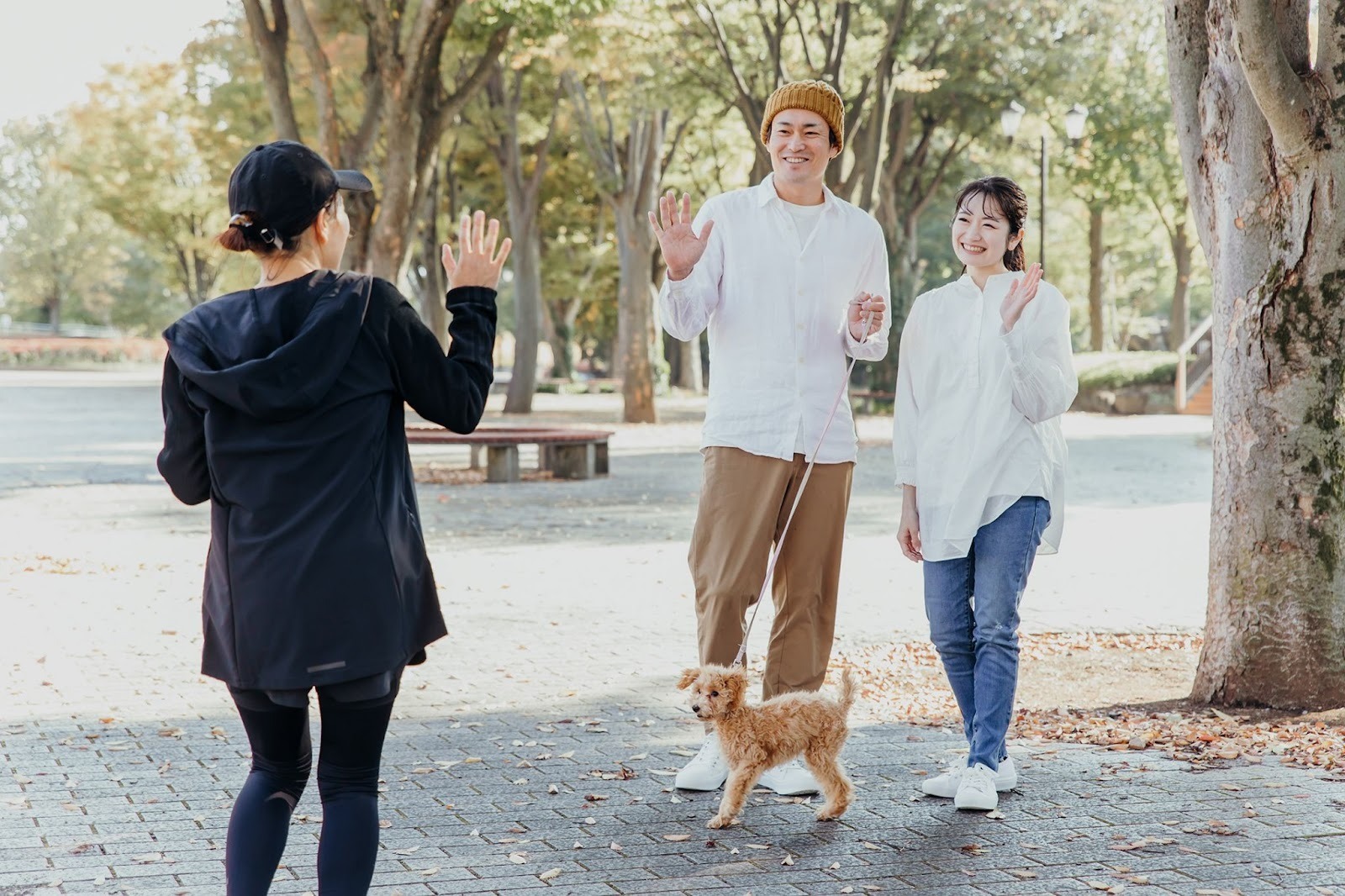
Japan’s tourism authorities recommend beginning any welcome for international visitors with a smile and a greeting (*3) ([Ministry of Land and Transport][6]). That advice captures a hallmark of Japanese hospitality: the service provider keeps self‑assertion in check and prioritizes the guest’s comfort. “Konnichiwa” does more than mark the time of day; it acts as a cue to honor the person in front of you and harmonize the air you share.
What 「Konnichiwa」 Teaches You About Restraint and Nuance
Ending with a soft downward contour, “konnichiwa” leaves a lingering aftertone. That restraint aligns with a value system that favors harmony over forceful self‑assertion (*2). By softening the resonance, you leave room for the other person’s response and keep the exchange fluid. In that stance, you can glimpse the long history of a society that has learned to coexist by adjusting one’s position within cultural diversity.
Practical Techniques for Delivering a Beautiful 「Konnichiwa」
If you want that refined resonance, three habits matter: ① segment vowel length precisely, ② keep the /tɕ/ affricate unaspirated, and ③ make a gentle dorsal closure for the nasal /ɲ/ (*1) ([Bunka][7]). Avoid pulling your mouth corners too far back; direct your breath downward to project calm. That poise plays well in business, too. In online meetings, higher frequencies get emphasized, so aim for a slightly lower pitch—your softness will come through more clearly (*2)
Business‑ or Formal‑Ready Pronunciation and Phrases for 「Konnichiwa」
In formal settings, start a touch lower on “ko,” rise through “nichi,” then settle quietly on “wa” to maintain the odaka contour. The effect is sincere and composed. If you add a small bow before you speak and synchronize movement with voice, you embody the Japanese ideal of words and posture as a single, integrated expression (*3)
Keeping 「Konnichiwa」 Natural in Everyday Life
At a café or on your travels, shorten the micro‑pauses between morae for a lighter rhythm—it instantly reads as friendly. Ease off abdominal tension and thread a fine stream of air between your teeth. Even at modest volume, your greeting will carry crisply, showcasing a hallmark of Japanese: “gentle yet clear” (*2).

Where You Can Experience the Broader Beauty of Japanese Pronunciation via 「Konnichiwa」
To polish your pronunciation in earnest, you can receive direct coaching from specialists at the National Institute for Japanese Language and Linguistics’ “Language Resources Workshop” (*1) ([clrd.ninjal.ac.jp][10]). In Tokyo’s Yotsuya area, Street Academy (Sutoaka) hosts ongoing small‑group pronunciation workshops with native instructors, often starting around ¥3,000 per session (*2) ([street-academy.com][11]).
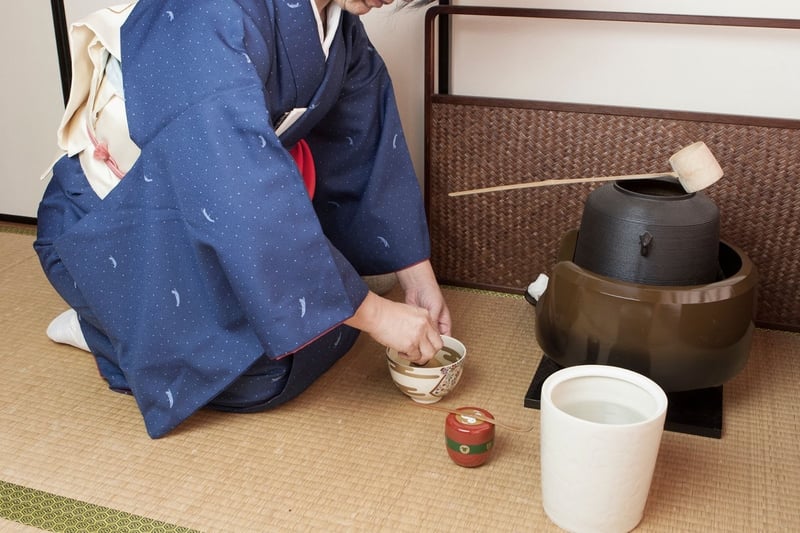
You can also explore tea ceremony or incense ceremony classes, where calm, precise movements harmonize with voice—ideal for feeling the full‑body rhythm of Japanese, “konnichiwa” included (*3) ([Ministry of Land and Transport][12]).

Cultural Exchange Experiences and Workshops to Sharpen Your Japanese Pronunciation
・National Institute for Japanese Language and Linguistics, “Japanese Everyday Conversation Corpus” Commemorative Seminar: phonetics scholars give live demonstrations and pronunciation coaching (held twice a year)(*1)
・Street Academy “Beautiful Japanese Pronunciation Course”: intensive small‑group training on pitch accent and rhythm(*2)
・Kyoto Gion Tea Ceremony Experience “A Bowl of Harmony”: learn to align voice and action from the first greeting to the final bow(*3)