teamLab Borderless Complete Guide 【Azabudai Hills】—From “teamlabs borderless” Search to Your Visit

Maoko Shibuya
Maoko Shibuya
June 3, 2026

teamLab Borderless Complete Guide 【Azabudai Hills】—From “teamlabs borderless” Search to Your Visit

Even if it’s your very first visit—or you’ve just typed “teamlabs borderless” into a search bar while planning your Tokyo trip—you can enjoy teamLab Borderless without feeling lost, literally or figuratively. The world-renowned digital art museum, “teamLab Borderless,” reopened in 2024 in Tokyo’s Azabudai Hills.

In this guide, you’ll find everything you need to know: ticket prices, how to get there, highlights inside the museum, and smart ways to make the most of your visit. Blending a touch of scholarly insight with sensory, emotional description, this article invites you into a boundary-free art experience with the lightness of a travel magazine you might leaf through over coffee.

What Is teamLab Borderless at Azabudai Hills? Essential Information and the Overall Experience

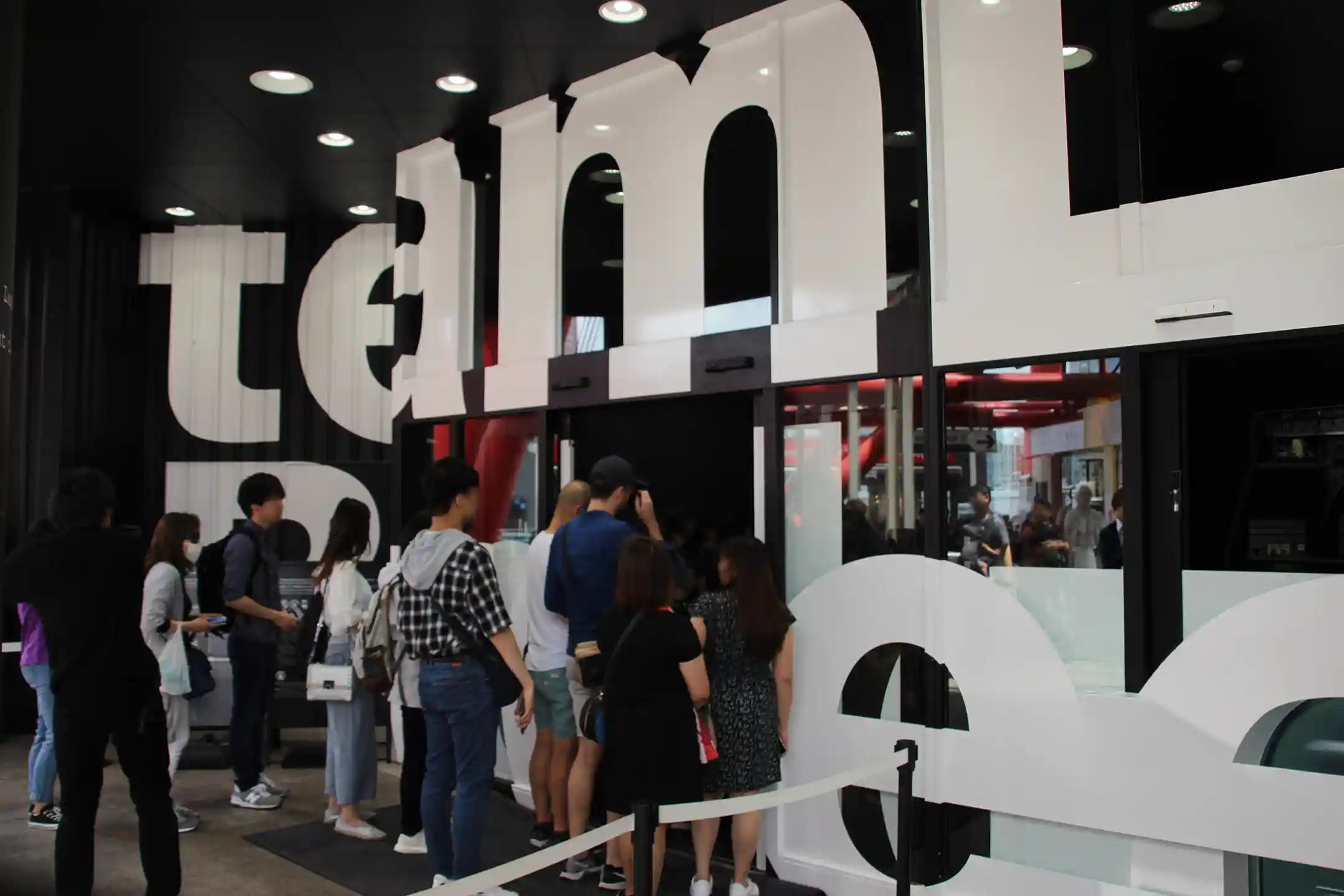
Located in Tokyo’s Azabudai Hills, MORI Building DIGITAL ART MUSEUM: EPSON teamLab Borderless (hereafter “teamLab Borderless”) is an immersive digital art museum created by the art collective teamLab (*1). Often searched for under variations such as “teamlabs borderless” by overseas travelers, the museum sits on the first basement level of Azabudai Hills Garden Plaza B (Azabudai 1-chome, Minato-ku, Tokyo). Across a vast exhibition area of about 7,000 square meters, more than 75 works—including many new pieces—unfold around you.

Opening hours are generally from 9:00 to 21:00 (last entry is one hour before closing). Since closing days are irregular, it’s best to double-check the latest information on official channels before you go (*2). All tickets are by advance reservation only, with specific dates and times, and visitors from all over the world compete for a limited number of slots.

According to the Azabudai Hills official website, in the first year after opening, 98% of tickets were sold out, and around 1.55 million people from more than 130 countries and regions visited (*3). This level of popularity means you’ll want to secure your ticket as early as possible at the trip-planning stage.

If you had to describe the experience in a single phrase, a visit to teamLab Borderless is “an adventure wandering through one continuous world without boundaries.” There is no map and no fixed route. You step into an ocean of light and sound and explore as artworks interact with one another—and with you and other visitors—moment by moment (*4).

Artworks spill out from the walls and floors of each room, constantly shifting in response to each other. You don’t just stand and watch; you walk, seek, and stumble upon one discovery after another, creating an experience that is yours alone (*4). True to its official description as “a museum without a map,” there is no prescribed order to follow. You decide your path with your own feet and curiosity. Since the works are continuously changing in response to the environment and the presence of viewers, every visit offers a fresh sense of wonder.

The Meaning of “Borderless” and the Value of the Experience

At the heart of teamLab Borderless lies the concept of “borderless” itself—a philosophy that aims to transform the very nature of a museum visit. Artworks do not remain neatly contained; they cross the boundaries of individual rooms, drift into corridors and other spaces, interact with different works, and sometimes merge with them (*5).

There is no strict line between artwork and viewer, either. You don’t just look at the work; you are immersed in it. As you move through the space, even the psychological border between yourself and others begins to feel more continuous and fluid (*5).

By dissolving the walls between art and audience—and even between visitors themselves—you are no longer a passive “viewer.” Instead, you become an active “explorer,” using your whole body to co-create new experiences.

In many of the installation spaces, your movement and presence are reflected in real time, creating a sense of improvisation where the same scene never appears twice. For example, in the waterfall installation cascading over a massive rock, the flow of water changes depending on where people stand. In the work featuring clusters of glowing spheres that spread ripples of light as you approach, no two patterns ever repeat (*6).

This accumulation of ephemeral, never-to-be-repeated moments is what gives Borderless its unique experiential value. As you explore this “continuous world without boundaries” with all your senses and your intellect fully engaged, you gradually feel that you yourself have become part of the artwork’s world. That feeling—of being inside the work rather than outside looking in—is the innovative dimension of art that teamLab Borderless offers you.

What to Know Before You Go Inside

teamLab Borderless is a museum designed so that “getting lost” is part of the experience. To really enjoy it, there are a few key points worth knowing in advance.

First, the absence of a map is intentional. It’s part of expressing “one continuous world without boundaries,” so there is no guided path. On your first visit, you may feel disoriented in the darkness and lose your sense of direction—but that confusion is itself part of the process of discovery.

Try walking guided by your senses: distant sounds echoing from somewhere, a faint glow spilling through a corridor, a flash of color just around the corner. Even spaces that seem like dead ends may hide projections that appear when sensors detect your presence, so it’s worth pausing and taking a slow look around.

Tokyo,_Japan,_December_2018_IMG_2496_(48438724957)

Another defining feature of Borderless is the highly dynamic way multiple works are interconnected. Visuals of flowers or animals that you see in one space may drift into another room later. Fish drawn by visitors might not only swim through the digital sea within the facility, but also “travel” to other venues around the world.

Many installations shift with time and the flow of people. Some works look distinctly different in the morning versus the evening, or on weekdays compared to weekends. Because of this constant variability, it’s difficult to ever say, “I’ve seen everything once, so I’m done.” The museum is designed so that every return visit brings new discoveries and makes you want to come back again and again.

If you find a piece you particularly like, it’s well worth revisiting it at another time of day or coming back on a quieter day to see how it feels under different conditions.

In this ever-evolving Borderless world, the best way to enjoy yourself is not to cling too tightly to prior knowledge or fixed expectations. Let your curiosity lead the way, wander freely, and you’ll have the most rewarding experience.

Highlights and Must-See Installations at teamLab Borderless

At the Azabudai Hills edition of teamLab Borderless, you’ll find a wealth of standout installations that you simply don’t want to miss. In this section, you’ll get to know the works especially recommended for a first visit—their appeal, how they change over time, and how they connect with other pieces. These are the key viewing points to keep in mind as you wander.

Bubble Universe/Microcosmoses

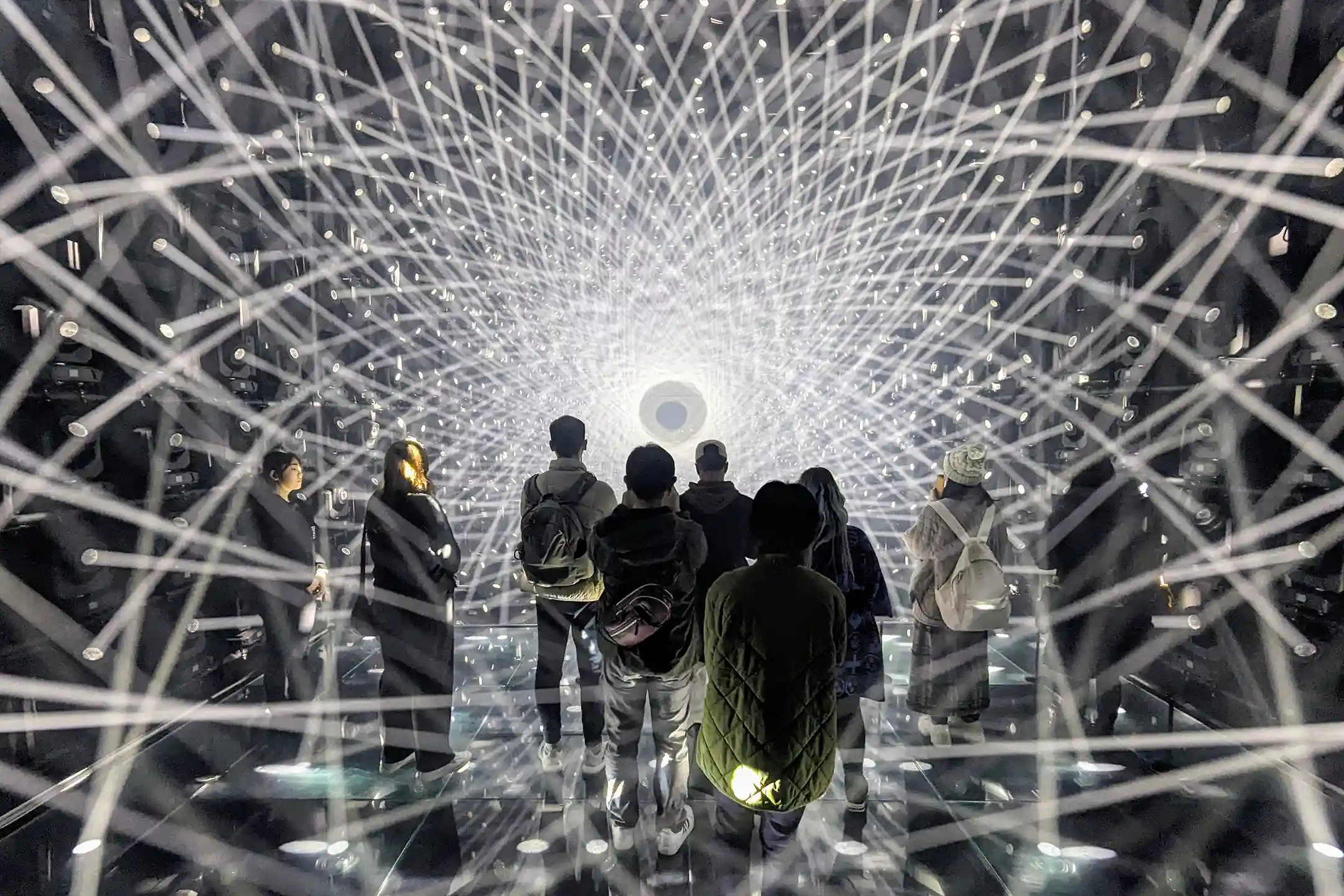
One of the signature attractions of the Azabudai Hills Borderless is the fantastical space “Bubble Universe/Microcosmoses,” where countless spheres of light float in the air. In a large room lined with mirrors on the floor and ceiling, spheres of various sizes—like bubbles of light—suspend from above, gently shimmering.

When you stop near one of the spheres, the closest one suddenly glows brightly, emitting a clear tone. That light then spreads to the neighboring sphere, and then the next, rippling through the entire space (*2).

As the light passes from sphere to sphere, it races around the room in a long, continuous chain, eventually tracing a single sweeping line of light that links all of them like one grand stroke (*2). If several visitors cause different spheres to light up simultaneously in different parts of the room, those multiple waves of light cross paths in midair, creating a complex, never-to-be-repeated harmony of light.

The patterns and colors of the light emitted by the spheres shift with time. If you linger here for a while, you’ll feel the atmosphere transform dramatically. In a brighter setting, white light moves with almost clockwork regularity across the space. When the room darkens, the light shifts into vivid colors, and suddenly the space looks like a cosmic field where stars in a galaxy are twinkling all around you (*3).

Standing in this room, you become the one who sets off the waves of light, even as you feel yourself enveloped inside a miniature universe—a microcosmos. As a new centerpiece of Borderless, this installation will likely leave you in awe with both its immense scale and its deeply interactive nature.

TeamLab_Borderless,_Odaiba,_Tokyo,_Japan_(49070860212)

Universe of Water Particles(水の粒子の宇宙)

The gigantic digital waterfall “Universe of Water Particles on a Rock where People Gather” is one of Borderless’s iconic installations, beloved since its days at the original Odaiba museum. A waterfall several meters high is projected as though water were endlessly flowing down a huge rock. When you stand near the base of the rock, you can actually see the flow parting around your feet.

In that moment, your body becomes like the “rock” that shapes the terrain, and the water’s path changes in response to your presence. That sensation—of your physical body influencing the course of a digital waterfall—is one of the special pleasures of this work.

The waterfall never flows the same way twice. The streams continually alter their course according to people’s movements and the surrounding environment, so the scene in front of you exists only in that particular instant. You feel keenly that what you’re seeing now is a one-of-a-kind artwork, a moment that will never return.

The wall and floor onto which the waterfall is projected do not feel like separate surfaces. The virtual water simply spills down onto the floor, so even the real floor you’re standing on feels like part of the artwork. Your position and movements, combined with the influence of other digital works entering the space, cause the waterfall’s expression to shift from second to second.

Through this interplay, “Universe of Water Particles” offers a powerful sense of nature and humans, reality and art, merging without clear borders.

You can certainly just stand there and gaze at the waterfall in a kind of quiet trance. But if you walk slowly around the basin, you’ll notice the water changing its flow in response to you—so do try moving and watching carefully. Combining fluid simulation with interactive digital technology, this installation embodies Borderless’s worldview: “your body becomes the terrain, and you become part of the artwork.”

Sketch Ocean and Sketch Factory

“Sketch Ocean” is a participatory work that families with children and adults alike can enjoy together. Here, you draw sea creatures—fish and other marine life—on paper. Your drawing is then scanned and released into a vast digital ocean projected on a large screen.

Seeing a fish you drew yourself swim out into a digital world, weaving through the sea alongside fish drawn by many other people, is surprisingly moving. You can also touch the fish on the screen. When you do, they may dart away in surprise, or if you tap the feed bags floating around, the fish gather and “eat,” adding another playful layer of interaction.

Sometimes, the fish swimming in this digital ocean leave the boundaries of the room and travel into other spaces within the museum. The tuna, especially the schools of tuna, have a special role: they sometimes “leave” Tokyo’s Borderless entirely, swim into teamLab exhibitions around the world, and then return to Tokyo accompanied by tuna drawn by visitors in those other locations. Watching characters you created venture beyond the room, or even outside the country, feels like a story perfectly suited to the name “Borderless.”

The drawings you make in Sketch Ocean don’t have to stay digital memories. At “Sketch Factory,” you can have your fish—or your family’s creations—scanned and turned into original goods such as pin badges, T-shirts, or tote bags right on the spot (*4).

You can watch your drawing being transformed into a real product in front of your eyes, and the moment you hold the finished item in your hand becomes a special memory for both children and adults. Even after you return home, you can look at these items and recall the time you helped create the artwork. In that sense, the combination of Sketch Ocean and Sketch Factory is a uniquely Borderless style of creative souvenir.

Limited-Time Displays and New Installations

Although teamLab Borderless is a permanent museum, it is also a living one that evolves every time you visit. There are seasonal and event-based limited-time displays—for instance, at the former Odaiba Borderless, the famous “Forest of Resonating Lamps” occasionally featured special color palettes that appeared only during certain periods.

New installations are regularly added, and past works are often updated. For the relocation and reopening at Azabudai Hills, many new pieces were unveiled, including Bubble Universe and Megalith Crystal Formation (*1). Even after opening, the official website and social media channels continue to share news of new works and special projects, so it’s worth checking them before you go.

Since Borderless is a permanent museum in Tokyo, the works are essentially not traveling exhibitions and are rarely lent to other regions. This is a world you can only experience here.

That said, teamLab as a collective holds numerous solo shows and permanent exhibitions in Japan and abroad, and works developed for Azabudai Hills Borderless sometimes appear overseas in a different form.

In that sense, Borderless Tokyo is a node in a wider global network of teamLab works. This space gathers cutting-edge digital art, and even after the renewal, new pieces continue to emerge one after another. By keeping an eye on these ongoing updates and revisiting over time, you can enjoy watching the world of Borderless deepen and expand.

TeamLab_Borderless,_Odaiba,_Tokyo,_Japan_(49070857867)

Exploration Strategies——Designing Routes That Let You Enjoy “Getting Lost”

To make the most of Borderless, it helps to embrace the idea of being “happily lost” in a museum with no map. In a space where no official route is set, there are views you’ll discover only if you trust your own curiosity and senses as you walk.

Below, you’ll find suggestions for how to move through the museum on your first visit, and ideas for returning visitors who want to deepen their experience.

How to Walk Through on Your First Visit

On your first trip to Borderless, it’s better not to stress about “seeing everything.” Instead, let your curiosity lead you organically through the space. About 75 artworks are scattered across a huge area. As a starting point, you might focus on the major installations in the large rooms while also staying alert for small rooms and hidden spaces so you don’t accidentally pass them by.

Some doors and corridors may look dark or a little intimidating at first, but if you take a step forward, an entirely different world can suddenly open up in front of you.

At the former Odaiba Borderless, for example, a mysterious room called “Forest of Resonating Lamps” was tucked behind a small, easily overlooked entrance, and some visitors walked past without noticing it. In the new Borderless, it is very likely that there are similarly tucked-away areas and corners that are easy to miss. If a path catches your eye, it’s worth gathering your courage and going in.

If at some point you feel truly lost, remember that this is part of the adventure unique to this museum. There is no fixed route, but staff members are positioned at key points and can guide you if needed. If you can’t find a particular artwork, don’t hesitate to ask someone nearby.

The museum is larger than you might expect, and you can easily lose track of time as you wander back and forth. For a first visit, it’s good to plan at least two to three hours, and if possible, leave yourself about half a day to really relax into the experience.

You’re free to take photos, but when it’s crowded, it helps to be considerate and take turns. If you think of photography as part of the shared communication in this surreal space, you’ll likely enjoy the atmosphere even more.

TEAM_LAB_univers_az

How to Deepen Your Experience on a Second (or Third) Visit

From your second visit onward, try exploring Borderless from a slightly different angle. Once you’ve experienced the space and have a rough sense of its structure and atmosphere, you can move more intentionally if you like.

For example, you might spend more focused time with works you rushed through previously, or you might revisit the same piece at a different time of day and see how it transforms. Some installations change noticeably depending on environmental conditions—morning versus evening, weekday versus weekend, how many people are present.

Lighting, ambient sound, and the density of other visitors all influence the impression you get from a work. On a return visit, you can savor the differences by comparing your experiences.

You can also actively “use” the presence of crowds to your advantage. In Bubble Universe, for instance, when many people are in the room, waves of light flare up all over, and the entire space becomes a lively, pulsing field of responses. In contrast, at a quiet time in Universe of Water Particles, you may be almost alone with the waterfall, creating a contemplative, intimate encounter.

Since each work has a different ideal viewing situation, it can be rewarding to visit at different levels of crowding and see how that alters the experience.

After a few visits, if you discover a favorite installation, consider using it as a “base camp” for your exploration. For example, you might start at Sketch Ocean, release your fish into the sea, head off to explore other rooms, then circle back later to see if you can find your fish again. Using a work you contributed to as your anchor point helps you sense the continuity and circulation among the installations in Borderless on a bodily level.

This high degree of freedom is one of Borderless’s defining traits. On later visits, you might deliberately set a fixed route for yourself, or do the opposite and walk in a completely different order every time. Either way, you’ll be fully immersed in this “world without boundaries.”

How Is teamLab Planets Different from teamLab Borderless——Which One Should You Visit?

In Tokyo, there is another permanent digital art venue besides Borderless: teamLab Planets TOKYO DMM in Toyosu (hereafter “teamLab Planets”). If you’re wondering, “Which one should I go to?” it helps to understand the differences between the two experiences, especially if you’ve found this article while searching for terms like “teamlabs borderless” or “teamLab Borderless Tokyo.”

TeamLab_Borderless,_Odaiba,_Tokyo,_Japan_(49070116233)

Free-Roaming vs. One-Way Route

teamLab Borderless is a “free-roaming” museum where you wander as you like and discover works along the way. teamLab Planets, on the other hand, follows a “one-way route” format. Once you enter Planets, you proceed along a single direction, experiencing each work in a set order.

Because of this, you generally can’t go back partway or revisit the same piece multiple times at Planets.

In Borderless, however, you’re free to move between rooms in any order and at any time. You can return to a favorite installation over and over, and rearrange your viewing sequence according to your own pace.

The content of the experience is also quite different. As its tagline “a museum where you walk through water” suggests, Planets emphasizes bodily sensations—walking barefoot through water or soft surfaces. You take off your shoes, go barefoot, and feel your way through the space.

For example, you wade through a real pool of water where projected koi swim around your legs, or climb up a sloping terrain made of soft, cushion-like material. The focus is strongly on touch and physical sensation.

Borderless, in contrast, is a museum you enter with your shoes on. Rather than tactile surprises, it leans more into visual and auditory immersion.

At Planets, each area has controlled entry, so it’s relatively easy to take photos calmly in each space—but the time you can spend in each work is somewhat limited by the flow of the route. In Borderless, you control how long you stay and where you go, so crowding can sometimes mean other people appear in your photos, but you also have the freedom to wait patiently for the perfect shot in your favorite spot.

Families, Couples, Solo Visitors——Who Is Each Best For?

Both facilities can be enjoyed by visitors of all ages and backgrounds, but there are some tendencies in who might feel more comfortable where.

If you’re traveling with very young children, Borderless may be easier. Since it doesn’t involve wading through water, and its style is more open and exploratory, it can be less demanding for younger kids (*1).

teamLab Planets is also very popular with children, but some parents may worry about them getting wet or about safety around water (*1). Strollers are not allowed inside either facility, but at Planets, because you move entirely barefoot, using a baby carrier becomes particularly important.

On the other hand, for older children, the extraordinary experience of stepping into water and feeling the works through their bodies at Planets can become a vivid, unforgettable memory.

For couples, Planets has a special sense of occasion as a limited-time venue. There is something memorable about walking hand in hand through dimly lit spaces, relying on each other as you move along the route. With a relatively compact required time (around 1.5 to 2 hours is a common benchmark), and with fewer restaurants or cafés directly around the Toyosu site, Planets works well as the “main event” in a focused date plan.

Borderless, by contrast, invites a more lingering experience. You can take your time with the works, then head to nearby restaurants afterward and talk about your impressions at length. This lends itself to dates where you enjoy a relaxed afterglow rather than rushing on to the next thing.

If you’re visiting solo and want to fully immerse yourself in art, Borderless—with its large number of works and no strict limit on how long you stay—is particularly suitable. You can roam freely, taking in and photographing the works at your own pace.

You can certainly visit Planets alone too, but because everyone proceeds along the same route together, it’s harder to extend the time spent in a particular work of your own accord. That said, if you’d like to experience a series of high-impact installations within a shorter time frame, Planets might be a better match.

In terms of access, Borderless has the advantage of being located in central Tokyo (in the Toranomon/Roppongi area), making it easy to incorporate into a broader sightseeing itinerary. Planets is about a 30-minute train ride from Tokyo Station to Shin-Toyosu Station, plus a short walk. It’s slightly more out of the way, but the flip side is a calmer environment with less of the city’s bustle.

Planets opened originally as a limited-run museum expected to close in 2022, but due to its popularity, its run has been extended through the end of 2027 (*2).

Borderless, on the other hand, is a permanent facility. Still, the Odaiba version did close after about four years, so there’s no absolute guarantee that the Azabudai Hills edition will continue unchanged forever. The exhibition content or operating period could evolve in the future.

In that sense, Planets is a “now or never” experience, while Borderless is a place you can return to repeatedly to discover new layers. Their charms are different, so if your schedule allows, experiencing both and comparing them for yourself is highly recommended.

Accessibility and Visiting teamLab Borderless with Children

teamLab Borderless is designed so that a wide range of people can enjoy it, but if you’re visiting with small children or using a wheelchair, it helps to know a few practical points in advance.

TeamLab_Borderless_Azabudai_Hills

Facilities and Staff Support

The museum is fundamentally barrier-free, with elevators and ramps that allow wheelchair access. However, for safety reasons, there are some areas and works that cannot be accessed by wheelchair or may be difficult to experience fully. Staff members are stationed throughout the facility and are ready to help, so if you’re unsure about anything, feel free to speak up.

Strollers are not allowed inside the museum, so if you’re with an infant or toddler, you’ll need to leave your stroller in the designated area near the entrance and use a baby carrier or similar (*1). The lighting inside is quite dark, and in crowded areas it can be easy to lose sight of a small child, so make sure to hold hands and move together.

For nursing and diaper changes, there are multi-functional restrooms with diaper-changing tables available. If you need a quieter space, staff may be able to guide you to a more peaceful spot, so don’t hesitate to ask. If your child is sensitive to loud sounds or bright, flashing lights, bringing ear defenders or other sound-reducing items can provide extra comfort and peace of mind.

Tips for Enjoying Borderless with Kids

When visiting Borderless with children, it’s a good idea to agree on a few basic rules beforehand. For example: no running in the dark, stay close to your family, and if you feel you’re getting separated, stop moving and wait in place.

Before going inside, teach your child to ask the nearest staff member for help and to say their name clearly if they get lost. It also helps to pick a landmark—such as a distinctive piece near the entrance—as a family meeting place in case you become separated.

There are many works throughout Borderless that invite children to take the lead in exploring. As a parent or guardian, try to follow your child’s pace and give plenty of time to the pieces that catch their interest. In Sketch Ocean, for instance, drawing together, watching the creatures you created appear on the screen, and then hunting for “your” fish becomes a shared memory in itself.

If your child gets tired or overwhelmed by the dark environment, don’t force it. You can step out into the lobby for a break or visit the museum’s tea house to sit down with a drink. Staff are used to supporting families with children, so it’s perfectly fine to ask for help.

If you enter with the mindset that you’re exploring a mysterious “borderless” world together as a family—while staying mindful of safety—your visit can become a memorable experience for both you and your children.

How to Spend Time in the Area (Hotels, Restaurants, Cafés)

To extend the pleasure of the digital art experience, it’s worth planning what you’ll do before and after your visit. Inside and around Azabudai Hills, you’ll find hotels, restaurants, and cafés where you can relax and talk, giving your mind and body a chance to settle and reflect on what you’ve just seen.

Your Base for Staying: Janu Tokyo (Inside Azabudai Hills)

Directly connected to Azabudai Hills, the luxury hotel Janu Tokyo is an ideal base for a visit to Borderless. As the first-ever hotel of Aman’s sister brand, Janu Tokyo offers 122 guest rooms, eight restaurants and bars, and extensive spa and wellness facilities (*1).

The guest rooms are refined spaces that blend contemporary design with Japanese aesthetics. Many rooms feature balconies where you can look out over Tokyo’s cityscape and the greenery of Azabudai Hills.

Since Borderless, located in Garden Plaza B, is part of the same complex, you can take the hotel elevator down and reach the museum in just a few minutes without worrying about the weather. You might, for example, enjoy a leisurely breakfast at the hotel, wander down to immerse yourself in Borderless, and then later return to the bar lounge to share your impressions over drinks. This kind of seamless flow makes for a truly luxurious stay.

TeamLab_Borderless,_Odaiba,_Tokyo,_Japan_(49070108848)

Restaurants Inside Azabudai Hills

After having your senses heightened by digital art, it can be soothing to unwind with a calm meal. Azabudai Hills is home to a variety of excellent restaurants, but here are two particularly relaxing options.

One is Izakaya Uchiyama, a modern Japanese gastropub with a hidden, intimate feel. In this quietly stylish space, you can savor seasonal Japanese dishes crafted with care. There are counter seats and semi-private rooms, making it easy to enjoy a meal at your own pace (*2).

Another is SAAWAAN Bistro, where you can enjoy authentic Thai cuisine with bold spices in a chic, contemporary setting. The restaurant is also accommodating to families, with details like baby chairs that make dining with children easier (*2).

Both places are ideal for revisiting your impressions of Borderless through conversation over dinner. Many of the restaurants in the complex are popular and often require reservations, so if your schedule is set, it’s wise to book in advance.

Quiet Cafés and Bars

After the stimulation of digital art, you may crave a quieter space with dimmer lighting to bask in the afterglow. Within Azabudai Hills, Sta. Azabudai is a somewhat hidden dining bar that opens onto a lush courtyard. The atmosphere is casual, with comforting homemade dishes like fried chicken and spring rolls, but the greenery-filled, tranquil setting makes it perfect for retreating from the bustle and taking your time (*3).

You can stop by not only at dinner but also for lunch or a café visit. On the terrace, you can enjoy tea time in gentle natural light during the day. With relatively short wait times and a relaxed mood, it’s an excellent place to pause after your Borderless visit and let the experience sink in.

In this way, how you spend the time around your visit can greatly enrich the overall experience. A calm environment and a moment to center yourself before entering help you focus on the art, while time afterward to share your impressions and savor the afterglow deepens the impact of what you’ve seen.

In Closing

This guide has taken you through the many facets of teamLab Borderless at Azabudai Hills—its essential information, highlights, and ways to enjoy it to the fullest. Once you experience this world of digital art that flows freely across boundaries, you may well find yourself captivated by its depth. Whether you’re visiting for the first time or returning for another look, there is always a new way for you to savor the ever-evolving world of Borderless.

As one of Tokyo’s newest cultural highlights, teamLab Borderless offers its visitors a steady stream of surprise and discovery, born from the fusion of art and technology. If you arrived here after searching for “teamlabs borderless,” this borderless adventure in art can help turn that simple search into a rich, real-world experience. After your visit, why not linger over your impressions—share them with your companions, or simply sit with the afterglow—and talk about what future art experiences might look like?

This borderless adventure in art may well bring new stimuli and a fresh sense of inspiration into your life.

Author Bio

Maoko Shibuya

Maoko Shibuya

Content Director
Content Planner & Writer Holding a master’s in Digital Marketing and experience across global markets, Maoko blends international perspective with a deep appreciation for Japan’s cultural heritage. She plans and writes compelling narratives that reveal the country’s beauty and depth, drawing on her passion for travel, local cuisine, and cultural exploration.