Located in Toyosu, teamLab Planets TOKYO is an immersive digital art museum where you can literally let your whole body sink into art. Under the concept of “Body Immersive” (immersing the entire body), you walk barefoot through water, are enveloped in light and sound, and enjoy the unique feeling that you yourself have become part of the artwork.
Since its opening in 2018, teamLab Planets has attracted visitors from Japan and around the world. Thanks to its huge popularity, what was initially a limited-time project has been extended until the end of 2027(*1). In this article, you will find everything you need to enjoy teamLab Planets—often searched for online simply as “teamlab planets”—whether it’s your very first visit or you’re coming back for a repeat experience: an overview of the museum, how to best appreciate the works, the optimal visiting times and what to prepare, plus ideas for nearby spots to visit before and after.
Once you step inside, you set off on a journey into an extraordinary world where you merge with the art. From planning your visit to tips on how to experience the installations, this guide will help you make the most of your immersive art experience in Toyosu, Tokyo.
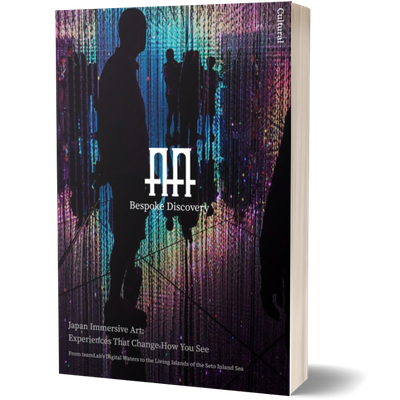
This article is one way in — a single experience held up to the light. The Japan Immersive Art Digital Guide gathers the artists, the spaces they build, and the ideas behind them into one connected reading.
First an Overview and the Basics|What is teamLab Planets TOKYO?
teamLab Planets is a digital art museum located in Toyosu, Tokyo. Under the concept of “a museum where you enter water and a garden where you become one with flowers,” you experience a series of massive artworks with your entire body, barefoot in the space(*1).
The interior is filled with works created by the art collective teamLab. As you and other visitors immerse yourselves in these works together, the boundaries between yourself, other people, and the world gradually become blurred(*1). When the museum opened in July 2018, it mainly consisted of four water-based installation spaces. In 2021, the outdoor “Garden Area” was added (including a gigantic orchid garden artwork), and in January 2025 the “Forest Area” joined the lineup, featuring a creative athletic field and educational projects.
As of 2025, the museum is structured into four main zones—Water / Garden / Forest / Public Area (with “Public Area” as the official term for the outdoor public zone)—with dozens of artworks in total. It continues to evolve, quite literally, as “a museum where you enter water and a garden where you become one with flowers.”
Since the exhibition content is updated and changed periodically, it’s a good idea to check the official website for the latest information before you go. The official English name of the facility is teamLab Planets TOKYO, although many people simply look it up as “teamlab planets,” and this article follows that usage. Access from Toyosu Station and how to purchase tickets will be explained later, but first, let’s look at what makes this experience unique in terms of design.
What Does a “Full-Body Immersive” Experience Design Mean?
The most distinctive feature of teamLab Planets is the way it is designed so that you, as the viewer, jump into the world of the artworks with your entire body. Instead of a traditional museum setting where there is a clear separation between “viewer” and “viewed,” you become part of the work itself and help shape the artwork together with others.
Inside the museum, there are many interactive works that respond to your presence and movement. The artworks and visitors constantly influence one another in real time, causing the space to transform moment by moment so that it never returns to the exact same state(*2). Because of this, every instant becomes a one-of-a-kind encounter with emergent art, and each visit leaves you with fresh memories.
This idea of “co-creation” is at the core of teamLab’s philosophy. It’s no exaggeration to say that “the experience itself is the artwork.” By immersing yourself with others, allowing your presence and theirs to influence the work, you are invited to search for “a new relationship in which the self and the world are continuous”(*1). Experiencing art through all five senses and your entire body allows you to merge with it, turning your visit into something that lingers powerfully in your mind long after you leave.
Representative Types of Spaces (Water, Mirrors, Flowers・Light・Particles, Sound・Fragrance)
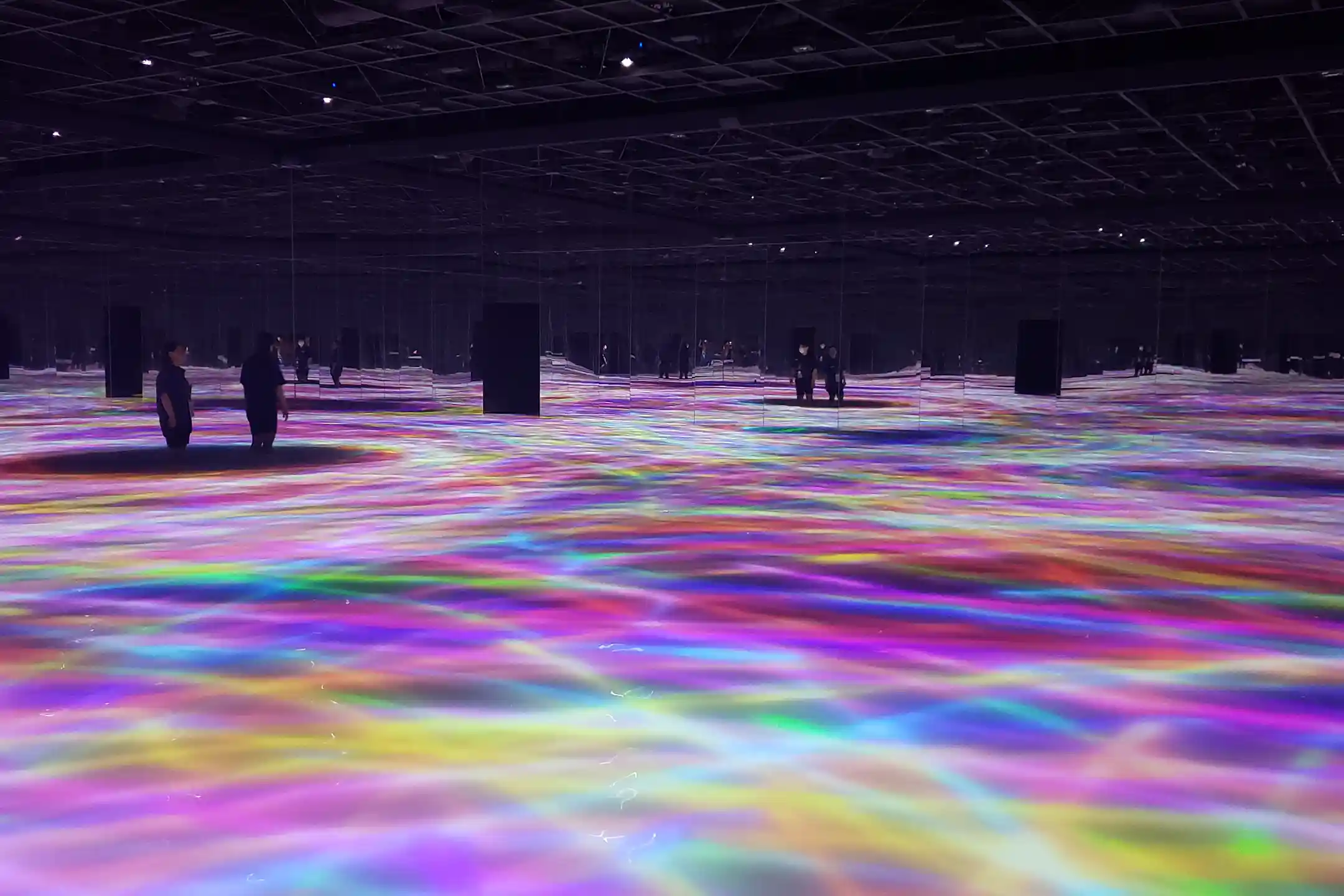
At teamLab Planets, you walk through a sequence of different spaces, each with its own theme and texture. One of the signature space types is the “water space.” Here you actually wade into water up to around your ankles or knees, and ripples and projected images respond to your footsteps. You feel the temperature and movement of the water and the floating visuals directly on your skin, as if you have become part of the surface itself.
Next is the “mirror space.” Some rooms are entirely white with mirrored floors and walls, while others use countless LEDs reflected in mirrors to create spaces that feel as though they extend into infinity. These mirrored environments are a hallmark of teamLab Planets, making your own figure and the silhouettes of others appear within the work and further dissolving the boundary between reality and art.
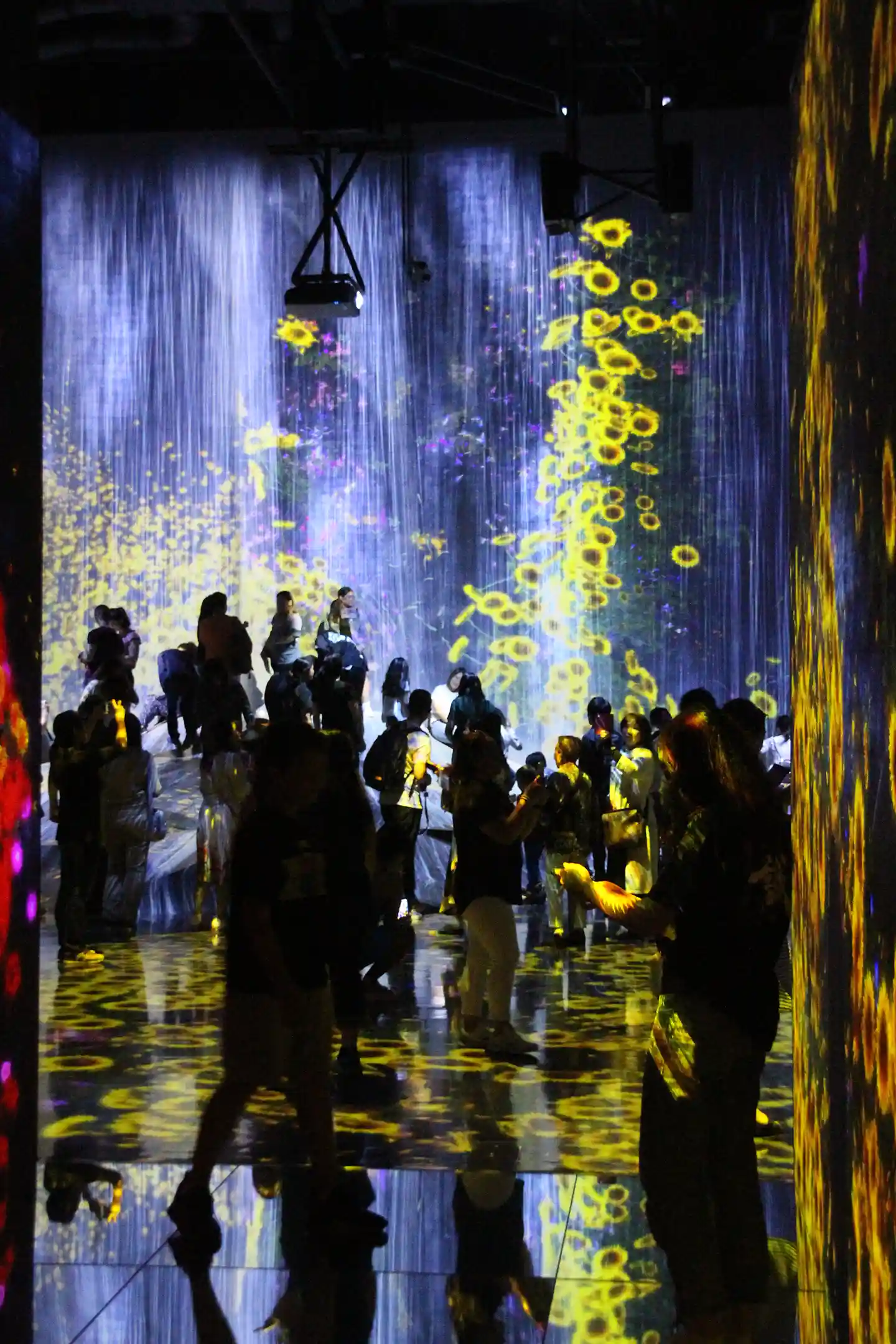
Then there are the “flower, light, and particle spaces,” where projections of flowers spread in all directions and installations made of glittering particles of light surround you. In one iconic piece, you stand among 13,000 real orchids suspended in the air. Real flowers and digital art are woven together, and their appearance changes depending on the time of day—daytime and nighttime show different faces(*2).
To appeal to your senses even further, subtle “sound and fragrance designs” are scattered throughout the museum. Each corridor is designed with slightly different lighting and scents, so your vision, smell, and touch are sharpened with every step(*3). For example, in a room full of blossoming flowers, a floral scent gently drifts through the air, amplifying your feeling of immersion in the world of the artwork.
In this way, the sensation of the water, the visual impact of the mirrors, the dreamlike quality of flowers and light, and the carefully crafted sound and fragrance are all combined to offer each person a truly one-of-a-kind experience at teamlab planets Tokyo. The exact lineup of installations may be updated in the future, but regardless of the space, the key is to use your body, notice subtle changes, and stay aware of what you are feeling moment to moment.
.webp)
Four Axes of Appreciation (Space, Time, Body, Others)
To get the most out of teamLab Planets, it helps not only to follow the suggested one-way route but also to consciously use your own sensitivity as a guide. One helpful way to do this is to keep four “axes” in mind as you move through the museum.
The first axis is “space.” Pay attention to the way each installation expands—its height, depth, and overall layout—and notice how you feel standing within it. Simply changing where you stand or where you look can completely alter the scenery, so try to take in the entire atmosphere of each room.
The second axis is “time.” Many teamLab works evolve over time. For example, in a space where seasonal flowers bloom and wither in cycles, you’ll start to see the transitions if you stay for a while(*4). Rather than rushing through, pause and share the flow of time with the artwork.
The third axis is “body.” Notice the texture of the floor beneath your bare feet, the cool or warm sensation of the water, and the way your eyes slowly adjust in the dark. Mobilize all of your senses and observe your body’s reactions. By walking slowly, stopping, or even crouching down, you may discover perspectives that you would otherwise miss.
The final axis is “others.” The people around you are also an important part of the artwork. Many pieces visibly change through the movements of the visitors—shifts in light or sound occur because someone else is there. Embrace these changes triggered by other people’s presence, and enjoy the sense of sharing a space together.
By relating to each work through these four axes—space, time, body, and others—rather than just following the route mechanically, you can deepen your immersion. There is no rule about “how long you should stay” in front of each piece. The key is to linger as long as you feel drawn to and to engage at your own pace. That, in itself, is the ideal way to appreciate teamLab Planets in Toyosu.
Best Times to Visit teamLab Planets and How Long to Stay
If you want to avoid crowds and enjoy a more comfortable visit, the day of the week and time of day you choose are key. On the whole, weekdays tend to be less busy than weekends and public holidays.
Tickets are sold with reserved time slots in 30-minute increments. Thanks to this system, extreme crowding at specific times is less likely than it was at teamLab Borderless (a similar facility previously in Odaiba). Even so, popular daytime slots can still see long lines, and during peak times you might wait 30–90 minutes to enter the building(*1).
So, when is the best time to arrive at teamlab planets if you want a smooth entrance and a relaxed experience? The sweet spot is in the late afternoon and evening. In fact, evenings tend to be relatively quiet, and local information sites even highlight the later time slots as “hidden gem” hours, recommending that you “visit as late as possible”(*2).
Close to closing time, visitor numbers drop, and some works take on a different atmosphere compared to the daytime—for example, the calm mood at night and the outdoor areas lit up against the night sky. The downside is that late time slots can sell out depending on the day, so advance reservations are essential.
Early morning sessions also tend to be comparatively smooth for entry. However, because the museum is very popular with tourists, morning slots can still be fully booked. If you can only visit on weekends or consecutive holidays and know it will be crowded, plan to arrive early and line up for your reserved time slot with plenty of leeway.
It’s also helpful to have a rough idea of how long you’ll stay. teamLab Planets does not impose a strict time limit, but to truly enjoy the experience you’ll want to set aside about two hours. Official guidance after the 2025 expansion states that “it takes around two to two and a half hours to go through all areas”(*3).
Before the expansion, many people reported spending about one and a half to two hours. With the addition of new zones and more artworks to explore, aiming for a bit over two hours is recommended. Of course, this varies by person: if you move quickly and only spend a few minutes at each piece, you can finish sooner; if you take time to photograph and observe the changes in each work, your visit may stretch to nearly three hours.
On average, many visitors seem to settle around two hours, but it’s best to plan flexibly according to your own interests. If you’re visiting with small children, factor in extra time for changing clothes and taking breaks—adding about 30 minutes will make things more relaxed. In any case, coming with enough time that you don’t feel rushed will help you sink into the world of the art much more deeply.

How to Spot the Less Crowded Time Slots
As mentioned above, the least crowded times at teamLab Planets tend to be weekday evenings(*2). If you choose one of the last time slots on a weekday, you’ll often find that the after-work visitors and tourists have already cycled through, giving you a quieter experience.
Reports consistently say that “coming as late as possible is best,” and the sessions just before closing are often considered hidden gems. On the other hand, midday on weekends and holidays (around 12:00–15:00) tends to be peak time, and those reservation slots also fill up quickly. If weekends are your only option, aiming for the very first morning slot is a smart move. Some visitors say that Sunday mornings around 9:00 are relatively calm and that they could walk through at a relaxed pace even with children.
Weather can also influence crowd levels. You might assume that rainy days draw more people to indoor attractions like this, but on days with really bad weather, some people stay home altogether. As a result, there are reports of heavy-rain evenings being surprisingly quiet at teamlab planets Tokyo.
Estimated Time Required and Flow Through the Space
The basic flow inside the museum is as follows: after entering, you put your belongings in a locker, take off your shoes, and go barefoot into the “Water Area.” When you finish there, you return once to the locker area, dry your feet, put your shoes back on, and then proceed to the “Garden Area” (after the Forest Area was added in 2025, some parts of the route were adjusted, but the path remains essentially one-way).
The order of Water Area → Garden Area is fixed, but how long you spend in each work is entirely up to you. The estimated time of about two hours is just an average. If you prefer to savor the experience slowly, feel free to plan for two and a half hours or more(*3).
For instance, the first water installation is quite dark at the beginning. When you enter the sloped passage, it’s worth stopping for a moment to let your eyes adjust before you start walking and focus on the feeling of water around your legs and the sound of the flow. Once your vision adapts, the luminous waterfall reveals itself, and its scale is truly overwhelming. When you reach the top, turn around and look back over the whole slope and waterfall—it’s a powerful view.
After passing through the waterfall, you enter a large room where images are projected onto the water’s surface (often called the “water basin room”). Here it’s best to walk slowly, one step at a time. If you walk too fast, the water surface becomes choppy and the images at your feet are harder to make out. It’s also effective to stand completely still.
When you stop moving, the projected koi fish approach and swim around your feet. If a fish touches you, it transforms into flowers and scatters. Because of this programming, standing still lets you see flowers blooming all around you—winter blossoms in winter, cherry blossoms in spring, and so on, changing with the seasons. Take your time, pause, and really watch how the patterns of flowers evolve around you.
Don’t miss the subtle details either: the shimmer of light rippling across the water, and the waves that radiate out where you step. As you place your foot down, ripples spread and the koi scatter away. Discovering these small interactions makes the water installations even more fascinating.
When taking photos, don’t rush. Wait for a moment when other people are not in frame, and you’ll capture much better shots. If the space isn’t crowded, you may even get a magical photo of your reflection alone on the water surface.
Since the water spaces require you to watch your footing, your soles receive a lot of sensory input—temperature, texture, and flow. Normally we pay little attention to what the soles of our feet feel, but here they become an important channel for the experience. As you move, also glance upward and around: sometimes unexpected imagery is projected on the walls or high above you. Pausing occasionally and taking in the full 360-degree view will help you enjoy the space as a whole.
Overall, the route is designed so that the beginning is more physically stimulating—walking in darkness, wading through water—and the later sections are calmer, with soothing flowers and light. You could say the sequence is curated to guide you through waves of tension and release.
If you simply follow the route, you’ll naturally experience this rhythm. But giving yourself permission to slow down, breathe deeply, or sit and rest when you need to will help your body and mind stay balanced. Rather than clinging to the “recommended time,” it’s better to move on whenever you feel ready. In the end, that mindset tends to lead you to a stay that feels just right.
What to Wear and What to Bring to teamLab Planets
To fully enjoy teamLab Planets, the ideal is to come in comfortable clothes that let you move easily, bringing only the essentials. First, a basic point about clothing: you must remove your shoes and go barefoot inside the museum. In the water areas, your legs will get wet up to about adult knee height. It’s therefore best to wear pants you can roll up past the knee or shorts(*1).
Jeans are fine as long as you can roll the cuffs up. However, you’ll need to take off tights or stockings. Women can enter wearing skirts, but because some spaces have mirrored floors, very short skirts are best avoided for peace of mind(*2).
In the room where the entire floor is mirrored, mini skirts may reflect your underwear. To prevent this, staff provide free loaner half-pants in a simple design (numbers are limited).
If you’d like to dress up and wear a skirt, consider wearing shorts underneath for coverage. There are simple private changing cubicles that anyone can use near the entrance area, so you can change clothes right after entering. You can also switch to loaner half-pants or remove tights there, so bringing a spare item of clothing if needed will give you extra security.
Visiting teamLab Planets with Children, During Pregnancy, or with a Wheelchair
teamLab Planets is designed to be enjoyed by both children and adults, but if you’re visiting with little ones, there are a few points to keep in mind.
There is no age limit for entry, but preschool children must be accompanied by a guardian. Strollers are not allowed inside the museum; instead you park them in a designated area near the entrance and secure them with a lockable wire.
Inside, you’ll find diaper changing stations, special trash bins for diapers, and a nursing room, so even families with babies can feel comfortable. However, some artworks are only realistically accessible to children who can walk around on their own (roughly age three or four and up). For example, the sloped water passage is manageable for children around four to six, who can walk while holding the handrail, but younger toddlers will need to be carried.
Some children may be frightened by the darkness. In that case, don’t force them forward. Instead, stop and give them time to get used to the feel of the water around their feet and the light in the space. Simple reassurance like “Once we climb this slope there will be a beautiful room” can help them feel safe enough to continue.
In water-based works, it is recommended that small children be held by an adult. To avoid any risk of slipping or going under, please keep holding their hand or carrying them securely.
For visitors who are pregnant, there are a few works that cannot be experienced for safety reasons(*4). The official information also warns pregnant visitors not to overexert themselves. In particular, pieces such as the “Soft Black Hole,” where the floor surface is unstable, and the sloped water passages may be off limits due to the risk of falling.
If you are unsure, it’s best to ask staff at the entrance. You can choose to experience only the safer areas, such as the flower and light zones, and exit partway if you feel uncomfortable. Since pregnancy is a time to take special care of your body, please participate with your own safety as the top priority.
Visitors using wheelchairs can also enter, but the route is slightly different in some sections. Staff will guide you to accessible paths and explain any necessary precautions. If you enter with your own wheelchair, protective covers will be placed on the tires.
The museum is basically barrier-free, but for safety reasons there are a few works that cannot be accessed by wheelchair, such as the “waterfall of light at the top of the hill” and the “Soft Black Hole.” In these cases, staff will help you take an alternate route.
During crowded times, you may need to move more slowly while being mindful of those around you, so your visit might take a little longer than usual. There are multipurpose restrooms inside the facility, and if anything is inconvenient, don’t hesitate to ask staff for assistance.
For visitors using canes or those who feel unsteady on their feet, going barefoot may make walking feel less secure. In such cases, staff can accompany you through the museum. Overall, teamLab Planets is designed with universal access in mind, but some works do require more active movement. Be sure to enjoy the experience within the limits that feel right for your own physical condition and circumstances.
Highlights and Ways to Enjoy Each Space
On your first visit to teamLab Planets, it’s natural to want to keep moving forward along the route. But if you want to draw out the charm of each space, it helps to be conscious of a few points. In this section, you’ll find tips for sinking deeper into the world of the major installations. You don’t have to rush through everything. Give yourself permission to stop, open up your senses, and truly feel each room.
How to Maximize Your Experience of the Water Installations
When you enter a water space at teamlab planets Tokyo, start by simply standing still for a few dozen seconds and letting your eyes adjust to the darkness. This is especially important in the first sloped “waterfall of light” room, where you suddenly find your legs immersed in water up to your knees after walking through a pitch-black passage. Focus first on the sensation of the water around your feet and the sound of its flow. As your vision adapts, the glowing waterfall gradually appears, and you’ll likely feel its sheer scale and intensity. Once you reach the top of the slope, don’t forget to turn around and take in the entire waterfall and passage from above.
Beyond the waterfall, you enter a large room where images are projected onto the water surface—the so-called “water basin room.” Here, be very deliberate with your steps. Walking slowly helps keep the water surface calm so you can see the images clearly. It’s also effective to remain motionless for a while.
When you stand still, koi fish begin to swim closer to your feet. When a koi touches you, it bursts into flowers and scatters. The programming is designed so that stillness causes flowers to bloom around you—winter flowers in winter, cherry blossoms in spring, and so on. By pausing, you can watch the pattern of flowers change in detail.
You’ll also want to notice the delicate interplay of light and water: the way light ripples with your movements and the rings of waves that spread from where you step, causing the koi to scatter. Once you start seeing these tiny interactions, the water works become even more compelling.
When photographing this space, don’t rush. Wait for moments when fewer people are in the frame to capture better images. If the room isn’t crowded, you may be able to shoot an almost dreamlike photo showing only your reflection on the water surface.
Because the water installations demand that you pay close attention to your footing, your soles pick up rich information—temperature, the texture of the floor, the direction and speed of the water’s flow. Try to consciously enjoy the feeling of being wrapped in water through your feet. And don’t only look down: occasionally look upward or toward distant walls. Unexpected visuals may be projected there, too. Taking time to stand still and scan the space all around you will help you fully appreciate the entire room.
.webp?width=688&height=459&name=Overhead_and_underfoot_(48297984357).webp)
A Mindset for “Listening” to Light and Sound
Sound plays a crucial role in the installation spaces at teamLab Planets. Each work has its own soundscape or music, and the interplay between what you hear and what you see deepens the experience.
For instance, in “Infinite Crystal Universe,” where countless LEDs shimmer all around you, unfamiliar yet beautiful music spreads softly through the space, weaving together with the colors of the lights. Layers of irregular electronic and environmental sounds ebb and flow as the rhythm of the lights shifts, and the entire space is constantly transforming.
In moments like these, try closing your eyes and simply listening. Of course, you might also want to talk with the people you’re visiting with, but do keep your voices low and respect the quiet around you. That is not only considerate to other visitors but also essential for noticing more delicate sounds that only emerge in silence.
Some installations consist entirely of streams of sound with no obvious melody. If you keep listening, though, you may find that the sounds begin to feel like music in their own right—this transformation is very much part of the intent of the work. Raise your “sensory antennae” and tune into everything: the temperature of the floor, the humidity in the air, the faint breeze on your skin. Each space is crafted with its own environment, and by gently paying attention to these details, you’ll experience immersion that goes far beyond a purely visual visit.
If you can, take a short pause between works as you move from one room to the next. For example, when you step out of a dark space into a bright one, consciously give your eyes a moment to adapt. This intentional “reset” makes each transition smoother and more vivid. teamLab Planets is a total work of art made of light, sound, and fragrance. If you enter each room with the attitude of “listening” to all of these elements, you’ll find yourself in a richer dialogue with the artworks.
How to Take Photos and Videos—and Photo Etiquette (photo policy)
Photography and video recording are generally allowed inside the museum. When you encounter such beautiful scenes, it’s natural to want to reach for your camera, but there are a few manners and techniques worth knowing before you start shooting.
First, on the etiquette side: be considerate of other visitors. Flash photography is prohibited. A sudden burst of light in a dark space not only disrupts others’ experiences, it also breaks the atmosphere of the artwork itself. Also, be careful not to occupy the same spot for an overly long time while you focus on shooting. At popular photo spots, be mindful and take turns.
In terms of technique, many spaces in teamLab Planets are quite dark, so using exposure compensation and adjusting white balance will help you get better results.
In spaces full of lights, people’s faces tend to appear too dark. Try tapping on the person’s face on your smartphone screen and adjusting the exposure slider so that the face is properly lit. Be careful not to overexpose, though, or the background lights will disappear. For white balance, switching from auto to a “tungsten” or similar mode can sometimes reproduce the actual colors more faithfully.
Burst mode is another useful tool. As many installations change in an instant, shooting in rapid succession and then picking the best frame later makes it easier to capture fleeting moments. For example, the exact instant when a koi transforms into a flower on the water surface is very short—recording a video and extracting stills afterwards can also work well.
In mirrored spaces, experiment with angles that minimize unwanted reflections of yourself or the camera. Instead of holding your phone at chest level, try lowering it to around your waist; this can prevent the camera itself from being reflected directly on the mirrored floor.
For large mirror surfaces, taking photos from a low angle emphasizes the reflection, making it look as though your subject is floating in midair. As always, try to find moments and positions where other visitors are not accidentally captured in your shot. When it’s very crowded, it may be wiser to put the camera away for a while and focus on seeing and feeling the space with your own eyes.
Comparison|teamLab Planets vs Borderless
In Tokyo, alongside teamLab Planets, there was also teamLab Borderless (MORI Building Digital Art Museum: teamLab Borderless), a large-scale permanent exhibition formerly located in Odaiba. Borderless closed in 2022, but reopened in February 2024 in a new location at Azabudai Hills.
If you’re wondering, “So, should I go to Planets or Borderless?” this section is for you. The two facilities differ in experience design, the time it takes to go around, typical crowd levels, and the situations in which each one shines. Use this comparison to decide which best fits what you’d like to experience—or plan for both if you can.
Differences in Experience Design and Worldview
At first glance, teamLab Planets and teamLab Borderless may seem similar: both are digital art museums. But there are clear differences in how the experiences are designed. As mentioned earlier, Planets is built around “immersing your entire body.” You take off your shoes, feel the water and soft floors under your feet, and sink physically into the artworks.
Borderless, on the other hand, is based on the idea of a “museum without borders.” There is no map, and artworks move from room to room, crossing boundaries and connecting spaces. There is no fixed route; instead, you wander through a maze-like environment and encounter artworks in a more spontaneous, exploratory way.
Whereas Planets guides you along a more structured path to deliver intense immersion, Borderless hands you the initiative and focuses on the joy of discovery.
The nature of the works also differs. Planets leans heavily into physical sensations, using elements like water that you actually wade into and real orchids you move among. Borderless is more focused on expansive projection mapping and LED light displays that emphasize visual continuity and vast, connecting spaces.
At Borderless, for example, butterflies might be “born” in a room you’re not currently in, then flutter into your space later, showing how works can interlink across rooms. As you walk around, your movement even helps “grow” certain artworks, giving you a sense of nurturing the space.
Planets, by contrast, encourages you to confront each space more deeply and quietly, almost like a dialogue with your inner self. Borderless feels more dynamic, with scenes changing quickly as you explore. You could say that the key differences lie in the “degree of bodily immersion” and the “freedom of exploration.”
In terms of design, Planets emphasizes themes like “water,” “flowers,” and “garden,” strongly reflecting Japanese ideas of nature and, at times, a Zen-like calm. Borderless, true to its name, presents a seamlessly connected world that challenges even the Western notion of how art museums should be structured.
At the same time, both share teamLab’s underlying philosophy: the continuity between people and the world, and the expansion of art through digital technology. In that sense, Planets and Borderless are like siblings—both explore the dissolution of boundaries between self and other. It’s just that the approach and resulting impressions are quite different.
To sum it up in a simple phrase, you might think of Planets as physical and introspective immersion, and Borderless as spatial and adventurous immersion. Choosing between them depends on which kind of experience you’re craving.

Recommended Patterns for a First Visit
So, which is better for your very first teamLab experience—Planets or Borderless? In short: if you want intense immersion in a relatively compact amount of time, choose Planets. If you want to roam through a vast digital world and explore, choose Borderless.
Because Planets has a more curated selection of works, the theme is very clear and the impact of each experience feels straightforward. The moment you step barefoot into the water is so outside everyday life that it leaves a strong impression, making it an ideal entry point into teamLab’s world.
Borderless, by contrast, includes a huge number of pieces. If you try to see everything, it can feel overwhelming. But that variety also means you have a high chance of finding a personal favorite. It’s like going on a treasure hunt through a labyrinth of art. If you have more time and energy and you already love art or experiential spaces, Borderless can be a wonderful first challenge. Spending half a day wandering there is something you won’t soon forget.
If your schedule and budget allow, visiting both Planets and Borderless is ideal. Because the quality of the experience is different at each, seeing both gives you a fuller picture of “teamLab’s worldview” as a whole.
For example, if you’re in Tokyo for two days, you might spend the first day at Borderless and the second at Planets. Many people who have visited both say they “can’t choose which is better” and that “both are amazing,” so in the end it comes down to what you want to feel most. Do you want to immerse yourself deeply, or do you want to explore and wander? Your answer will point you toward your ideal teamLab experience.
(*1 Reference:Toyosu local media “Time-slot reservations bring peace of mind (different from Borderless)” https://toyosu.tokyo/event/teamlab-planets-tokyo-dmm-konzatsu/)
Nearby Spots|Restaurants, Cafés, and Architecture Walks (things to do near teamlab planets Tokyo)
After soaking in the art at teamLab Planets in Toyosu, it’s lovely to carry that feeling with you into the rest of your day. Spending time in a calm environment or taking a deep breath under the open sky helps settle the memories of what you just experienced.
In this section, you’ll find recommendations for meals, walks, and shopping spots to enjoy after your visit. Think of it as a way to bring the afterglow of the art back into your everyday life while savoring the Toyosu area.
A Waterfront and Architecture Walk
If you’ve come all the way to Toyosu, make time to enjoy a stroll by the water. teamLab Planets is located in Toyosu 6-chome, an area surrounded by canals and dotted with promenades and bridges. If you still have some energy after your museum visit, head toward Harumi Bridge Park.
The Harumi Bridge Park Promenade, which opened in 2025, is a new pedestrian bridge that repurposes an old railway bridge and is open 24 hours a day. During the day, you can enjoy the refreshing breeze; at night, you can walk through a beautifully lit, almost surreal landscape(*2).
Crossing this bridge leads you into the neighboring Harumi area of Chuo Ward. If your visit falls in the late afternoon or evening, consider taking a night walk. The surroundings of Toyosu and Harumi are filled with high-rise lights, the glow of Rainbow Bridge, and the gentle illumination of Tokyo Tower—there are many spots where you can enjoy a panoramic view of Tokyo’s city lights.
Among them, the view toward Harumi Pier from Harumi Bridge, and the nightscape of Odaiba seen from Toyosu Gururi Park (Toyosu Wharf Park), are particularly impressive. When you look at the city lights after your senses have been stirred by digital art, you may find the urban scenery even more beautiful than usual. The expansive sky and light reflections on the water surface feel, in a way, like an extension of teamLab’s art.
Along the canals, you’ll find benches where you can sit and let the evening breeze wash over you while you quietly revisit your memories of the artworks. A popular route is: “Planets → Harumi Bridge Promenade → cross into Harumi and return → Toyosu Gururi Park → around Toyosu Market.” Walking the loop takes roughly 40 minutes to an hour, but time passes quickly if you stop often to admire the view or take photos.
Some sections can be a bit dark at night, so take care with your footing. For safety, walk with at least one other person or enjoy the route while it’s still light out. Think of this urban stroll as a kind of “after-art program,” an extension of your teamLab experience.
As you transition from the digital art world back into the real city, you gently quiet your mind and bring your body back into everyday mode. That in-between time can be deeply satisfying, too. Enjoy the interplay of Toyosu’s waterfront and modern architecture and make the most of this little urban getaway.
.webp)
Shops & Gifts
Finally, let’s talk about where to find souvenirs and gifts connected to teamLab Planets and the surrounding area. You might want to take home something to remember your experience, or pick out a unique present for someone special. Just outside the museum, you’ll find an official shop area (such as the Living Art Store). Here you can buy items related to teamLab’s world.
With the expansion in 2025, a new “Orchid Glass House” was added. In this greenhouse-like space, orchids that were once part of the exhibitions are nurtured again, and you can enjoy tea or alcoholic drinks among them. Next door, at the Living Art Store, you’ll find revived orchids for sale alongside books and goods related to teamLab. Art books, postcards, and T-shirts are classic choices, but if you want something that really reflects your taste, look for minimal, craft-inspired items with a refined feel.
For instance, an incense holder with a motif from a teamLab work or a notebook made with washi paper would make an understated yet sophisticated gift. The exact lineup changes with the season, but you may find kaleidoscopes that capture the colors of the digital artworks or CDs featuring music from the installations(*2).
A particularly fun feature is “Sketch Factory,” which lets you turn your own creative experience into something you can hold. In the “Learn & Play! Future Park” area, children can draw pictures that are scanned on the spot and transformed into original goods like badges or T-shirts. Taking home a piece that you or your family created is a uniquely teamLab-style souvenir.
Looking beyond the museum, the Lalaport Toyosu shopping complex is packed with lifestyle and interior shops. If you want to carry the artistic mood home with you, you might enjoy browsing Scandinavian design stores or picking up simple, well-made items at MUJI. If you’re visiting in the evening, keep in mind that many stores close relatively early, so it’s wise to get your shopping done ahead of time.
Toyosu Market also offers local specialties such as seaweed and tea, but because these are not directly connected to the Planets experience, the teamLab official goods are still the top recommendation in this context. Find a favorite item that resonates with you and let it extend the afterglow of your time at teamlab planets.
Background Story|Where Japanese Culture Meets Digital Art
To truly talk about the experience of teamLab Planets, we can’t ignore the cultural background in which Japanese aesthetics and digital art intersect. Although the works make bold use of cutting-edge technology, you can sense Japanese sensibilities and thought patterns in many details. In Toyosu, a futuristic urban landscape, how are long-standing Japanese aesthetics being expressed?
And within the global trend of interactive art, what kind of role does teamLab play? In this chapter, we’ll explore the background story that helps you understand teamLab Planets more deeply—from Zen and Japanese garden philosophy to the history of audience-participation art.
Aesthetic Context
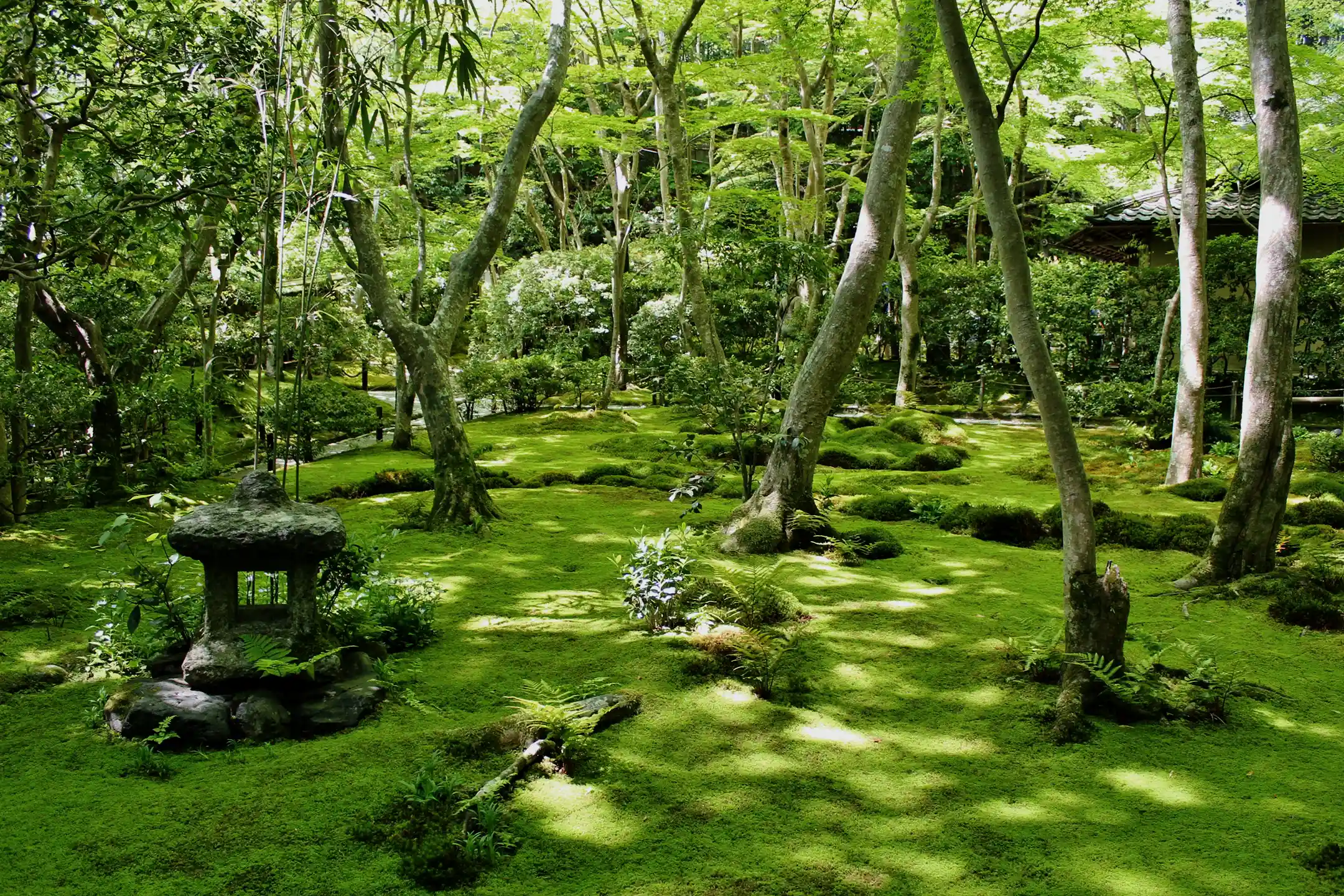
The spatial composition and concepts of teamLab Planets strongly reflect Zen thought and the aesthetics of Japanese gardens. The very phrases “a museum where you enter water” and “a garden where you become one with flowers” evoke traditional garden culture in Japan.
Japanese gardens, especially Zen gardens such as karesansui (dry landscape gardens), are quiet spaces where people can feel one with nature. It is sometimes said that temple gardens were developed as places where Zen monks, who trained in the mountains to unify themselves with the natural world, could continue that spirit within the temple grounds.
In “Floating Flower Garden,” an installation at teamLab Planets made up of countless orchids, something similar happens. When you enter the space, the mass of orchids around you rises to create a pocket of space where you can stand. When you leave, the flowers descend again and fill in the gap. This embodies a Zen expression that “heaven, earth and I share the same root; all things and I are one.”
The work is inspired by an old Zen story known as “Nansen’s flower” (“Nansen Ikkyū Hana”), which suggests that people see a single flower as if in a dream. In the same spirit, this garden invites you to become one with the flowers(*1).
As you sink into a cluster of blooms and meet others in the space, your flower-filled spheres overlap and merge into one. The experience recalls the Zen idea of “awakening” or enlightenment. In that sense, teamLab is using the newest technology to give form to age-old Zen worldviews in a contemporary setting.
The Lineage of Interactive Art and teamLab’s Position
One hallmark of teamLab’s work is that it is “completed” through your participation as a visitor. This kind of interactive or participatory art has its own historical lineage.
From the mid-20th century, contemporary art began to include works that involved audience participation. There were avant-garde performances known as “happenings” in the 1960s, and conceptual artworks that instructed viewers to perform certain actions.
In Japan, artist Toshio Iwai was highly acclaimed in the 1970s for interactive pieces where touching the projected image triggered changes in sound and visuals. From the late 1990s onward, advances in sensor technology and the spread of the internet led to more works that responded to people’s movements and voices. The ICC (NTT InterCommunication Center) frequently exhibited interactive art, helping establish what became known as “media art.”
teamLab, founded in 2001, initially focused on digital content production, but gradually began creating interactive installations and gained international recognition in the 2010s.
Borderless, which opened in Odaiba in 2018, was especially groundbreaking. As a “museum by a single art collective,” it set a world record for visitor numbers and rapidly normalized and industrialized experiential digital art(*2). Art, which had traditionally been something you quietly observed in a museum, was transformed by teamLab into a “theme-park-like experience” that invited a much wider audience through its doors. This shift stands out in the history of interactive art, and its influence is visible in immersive digital exhibitions that have since appeared around the world.
Examples include Atelier des Lumières in France and MEOW WOLF in the United States—large-scale, visitor-participation installations that have become global trends. teamLab is one of the pioneers of this movement, creating compelling experiences that draw people into art in new ways.
Thanks to teamLab’s success, digital art has now become a major form of cultural tourism. Museums and galleries everywhere are adopting interactive exhibitions, and experiential art is likely to increase even more in the future.
As one of the leading facilities in this field, teamLab Planets reminds you that you are not just a passive viewer; you are a “co-creator” who completes the work. By expanding what it means to experience art, teamLab has made a mark that will be remembered in art history.
Toyosu as a Stage
Finally, let’s think about Toyosu itself, the place where teamLab Planets stands.
Toyosu was once a reclaimed industrial area with shipyards and factories and remained primarily an industrial zone for a long time. In the 21st century, it underwent intensive redevelopment, giving birth to modern high-rises, Toyosu Market, and cultural facilities like teamLab Planets. The area is often seen as a symbol of “urban regeneration.” The fact that teamLab chose to base a permanent exhibition here is probably no coincidence. The wide-open sky and surrounding waters make the location part of the stage set.
After experiencing water and light inside the museum, stepping outside to the Tokyo Bay waterfront can feel strangely continuous. Some visitors may feel that, when they exit at dusk and see the reddish sky and canals spread out before them, it’s as if the world of the artworks has bled into reality. That, too, is part of Toyosu’s particular charm.
Toyosu is also emblematic of Tokyo as a water city. The surrounding canals are remnants of water transport routes dating back to the Edo period, making it a place where old and new coexist. The focus on water in teamLab Planets’ installations can be seen as an invitation to rediscover Tokyo as a city of water.
If you walk along the canals after your visit, you may be surprised by the contrast between the futuristic high-rises and the quietness by the water’s edge. Toyosu is land made by human hands—an area where human ingenuity and the force of nature meet. The digital art built upon that land becomes a powerful symbol of a “new relationship between humans and nature.”
In this sense, teamLab Planets cannot be fully separated from the city of Toyosu itself. As you leave the museum, take a moment to feel the surrounding scenery and atmosphere. It’s not just an extension of the artworks’ afterglow—it can also feel like a glimpse into the Tokyo of tomorrow.
Beyond a single room

In Closing
The experience at teamLab Planets TOKYO invites you to question the boundary between yourself and art and offers you a new vantage point on the world. Those moments when you touch water with bare feet and become one with light and flowers are a rare kind of emotion you don’t usually encounter in everyday life.
By keeping in mind the tips in this article—how to appreciate the works, the best times to visit, and ways to enjoy the surrounding area—you can make your time there even richer, whether it’s your first visit or you’re returning again. teamLab Planets is more than a simple exhibition; it is a space designed to speak deeply to your senses and your inner world.
When you dive in with your whole body into artworks that merge Japanese cultural essences with cutting-edge technology, all set against the open backdrop of Toyosu, you may find dormant sensitivities within you starting to awaken. Come with a relaxed schedule, give yourself time to feel the flow of time and co-create with others, and let the experience unfold at your own pace.
Chances are, what you encounter there will change not only how you think about art, but also how you see your everyday surroundings. Whether you first found out about it by searching “teamlab planets” online or through word of mouth, now it’s your turn to step into a “world without boundaries.” The moving experiences waiting for you in Toyosu are ready when you are—enjoy them to the fullest.
.webp)