.webp)
Two teamLab museums operate in Tokyo, and most of the questions travelers ask are really one question: which one, and is it worth the ticket. The forums are full of the argument. The official pages will not settle it for you, because they are not in the business of telling you to go somewhere else.
This guide answers the decision. It covers what Borderless actually is, how it differs from teamLab Planets in Toyosu, what you need to know before you arrive, and how to move through a building that has been designed to stop you knowing where you are.
This article is one way in — a single experience held up to the light. The Japan Immersive Art Digital Guide gathers the artists, the spaces they build, and the ideas behind them into one connected reading.
What Is teamLab Borderless?
teamLab Borderless — formally MORI Building DIGITAL ART MUSEUM: EPSON teamLab Borderless — is a digital art museum on the basement level of Garden Plaza B inside the Azabudai Hills complex in Minato ward, Tokyo. It is operated by teamLab with Mori Building, and it opened at this address in February 2024.
It had a previous life. The original Borderless ran in Odaiba from 2018 and closed in 2022, and it was not a modest success: trade coverage of the move reported 2.3 million visitors from more than 160 countries in its first year there. Announcing the relocation, the Tokyo Metropolitan Government's account called it a "dramatic evolution" of the museum rather than the same rooms at a new address. Some works came across from Odaiba; others, including the room that now anchors the place, were built for the new building.
The name is the design brief. Borderless describes the building's one structural idea. There are no room labels, no numbered route and no map handed to you at the door. Artworks are projected rather than hung, and they move: a work will leave one space, travel along a corridor and appear in another, sometimes interacting with a different work when it arrives. What you see depends on when you stand there, which means two visitors on the same afternoon do not see the same museum.
That single decision explains almost everything else about the visit, including the complaints. You cannot plan a route through Borderless in the way you plan a route through a gallery with a floor plan, and if you arrive determined to tick off a list of works, the building will frustrate you. If you arrive willing to wander, it will not.
teamLab Borderless vs teamLab Planets: Which Should You Choose?
This is the question the forums keep returning to, and it has a clearer answer than the arguing suggests. The two museums are not competing versions of the same thing. They are built on opposite principles, and one of them has a deadline.
teamLab Planets Runs Only Until the End of 2027; Borderless Is Permanent
Start here, because it changes how you plan rather than what you prefer.
Borderless at Azabudai Hills is permanent. teamLab Planets in Toyosu is not. It opened in 2018 as a limited run with a closing date, and that date has been pushed back more than once — most recently to the end of 2027, which is the date the museum's own site now gives. The pattern matters as much as the date: Planets has been extended before and may be again, but it is the one of the two that is scheduled to end at all.
If you are choosing between them on a single trip and you expect to return to Tokyo, the scheduling logic runs one way. Planets is the one with an expiry date. Borderless will still be there. Our guide to teamLab Planets covers that museum in the same detail if the deadline decides it for you.
Free-Roaming Versus a Fixed Route
.webp)
Borderless has no route. You enter, and the building declines to tell you where to go. Works migrate between spaces, so the same corner is not the same corner an hour later, and the experience is one of searching rather than viewing.
Planets is the opposite: a one-way path through a fixed sequence of rooms, several of which you walk through barefoot in water. You are moved along it. The design intent is immersion in a set order, and it delivers that reliably in a way Borderless deliberately does not.
The practical translation is straightforward. Borderless rewards time and patience and punishes a tight schedule. Planets fits a schedule, because the route has a beginning and an end and you cannot get lost in it.
Which One Fits Your Trip
Decide on the shape of your day, not on which museum sounds better.
Borderless suits a traveler with an unhurried half day, a tolerance for crowds in the dark, and an interest in the works themselves. It suits a second or third visit to Tokyo, when the checklist is already done and wandering is affordable.
Planets suits a first trip with a full itinerary, a fixed slot between other bookings, and anyone who would rather be carried through an experience than have to find it. It also asks you to go barefoot and to get the hem of your trousers wet, which is either a feature or a reason to choose the other one.
If you have the appetite for both, they do not cancel each other out — they are different enough that visiting both does not feel like doing the same thing twice. If you have one afternoon, take the paragraph above about deadlines and let that decide.
teamLab Borderless Tickets, Hours and What to Wear
The practical layer changes more often than the art does, so treat what follows as the shape of the thing and confirm the numbers on the official site before you book. The details below were checked against the Tokyo Metropolitan Government's official tourism listing in August 2026.
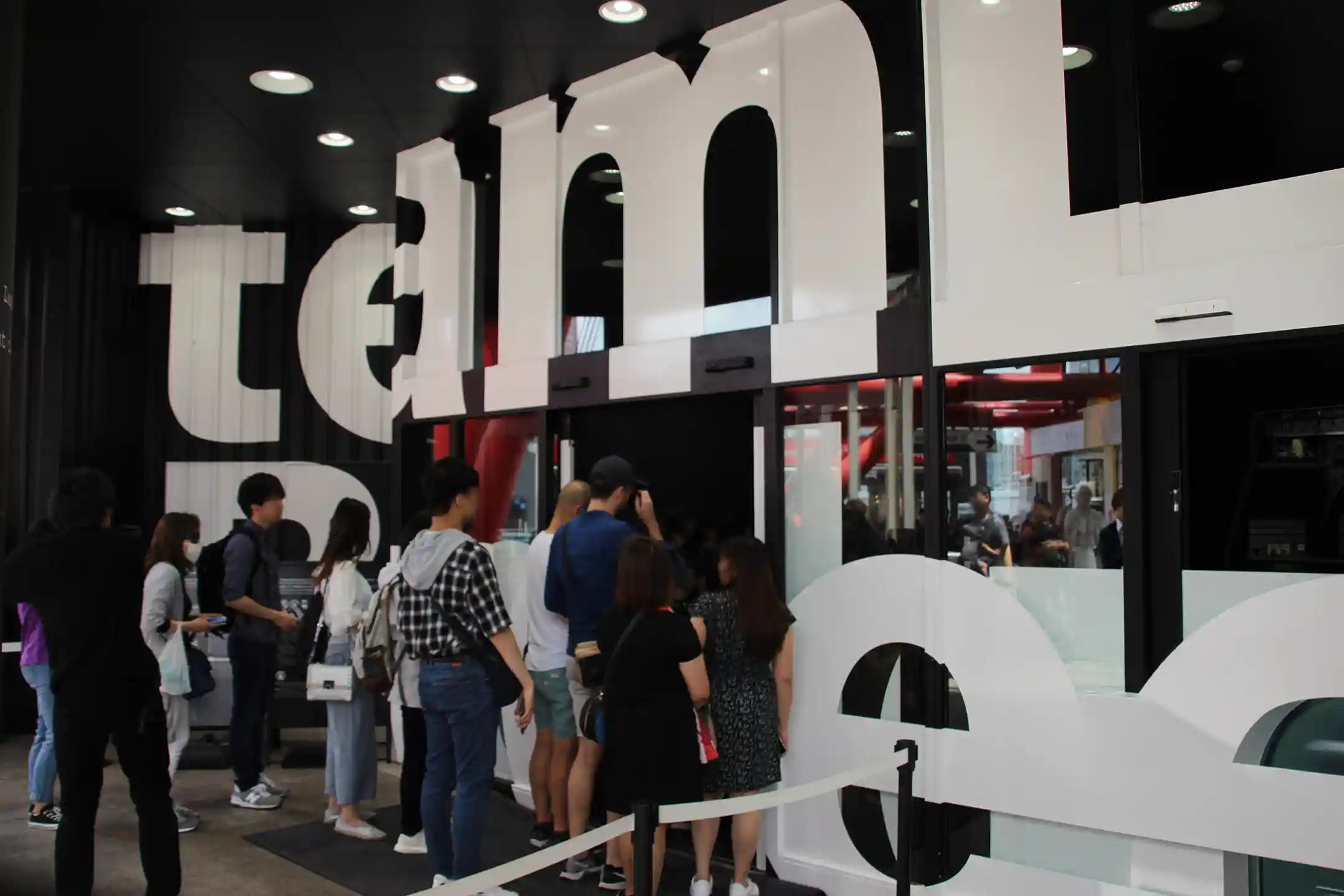
Tickets are dated and timed, and they are cheaper before you arrive. Admission is sold for a specific date and priced by day. Tokyo's official listing put adult admission from 3,800 yen when we checked it in August 2026, and noted that buying on site adds 200 yen. Advance online purchase is the norm, not a precaution, and popular slots go.
Hours run late. The museum opens in the morning and runs until the evening, with last admission an hour before closing, and closing days are irregular, not fixed to a weekday. That irregularity is the detail most likely to catch you out: check the calendar for your date rather than assuming a Monday closure.
Allow more time than you think. There is no route, so there is no natural end. Two hours is a realistic floor and three is comfortable; people who allocate ninety minutes tend to be the ones who leave feeling they missed something.
Wear the right things. Tokyo's listing recommends comfortable shoes and clothes that are easy to move in, and specifically suggests white or plain clothing — the works are projected onto whatever is in the room, and a plain surface catches them. Skirts are worth reconsidering, since several rooms have mirrored floors.
Photography is allowed; flash is not. The spaces are dark and the works are light, which is a difficult combination for a phone camera and an easy one to spoil for everyone else with a flash.
Getting there. The museum is on the basement level of Garden Plaza B inside the Azabudai Hills complex, two minutes from Exit 5 of Kamiyacho Station on the Tokyo Metro Hibiya line. The complex itself is worth arriving early for if architecture interests you; our architecture guide to Tokyo covers the district.
The Installations Worth Planning Around
.webp)
Works are added, retired and rearranged, so a list of titles dates quickly and a way of choosing does not. What follows is the second thing.
The museum's signature spaces fall into three kinds, and knowing which kind you are standing in tells you how long to stay.
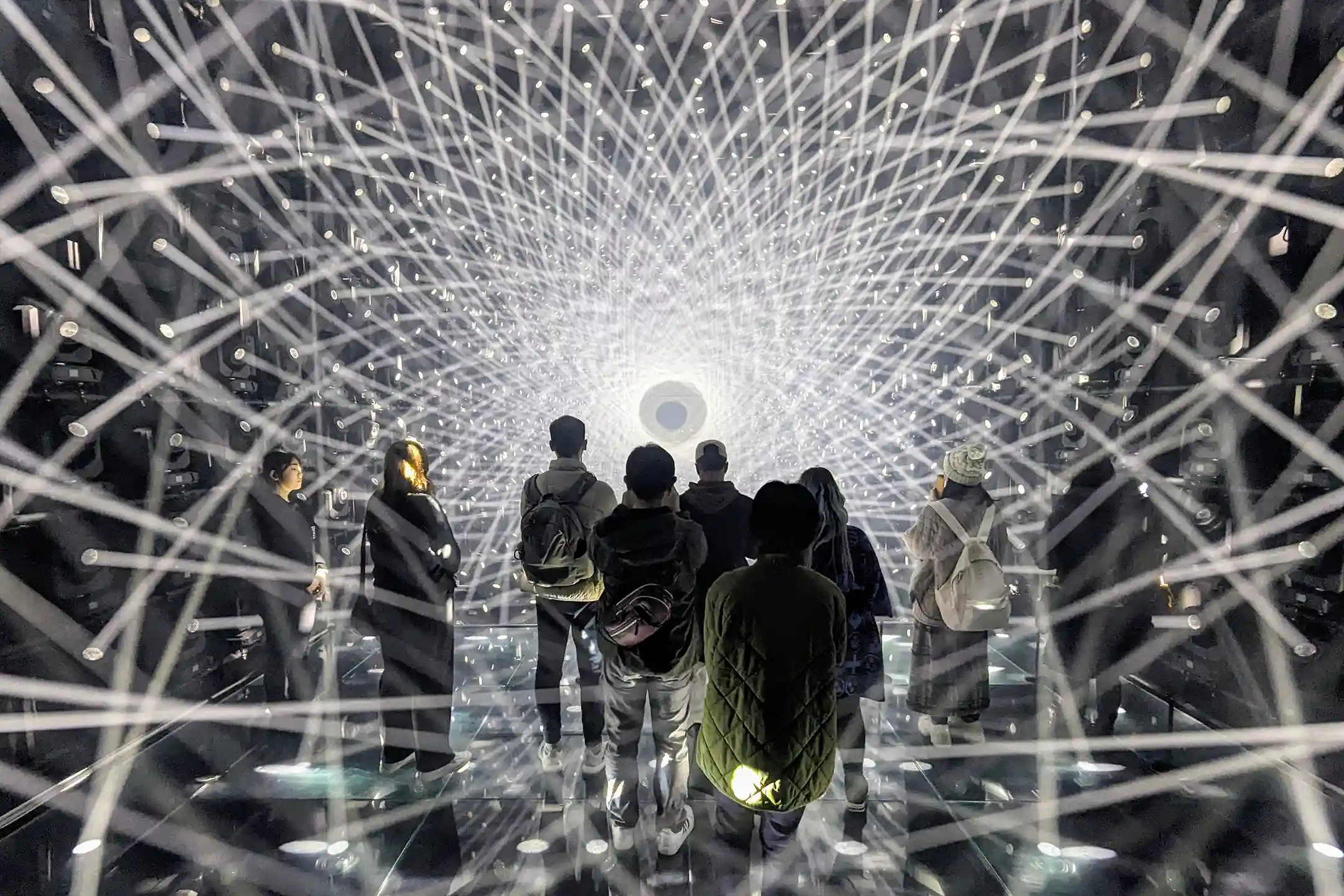
Rooms built on reflection. Mirrored floors and ceilings turn a modest space into an apparently infinite one, usually with suspended light sources multiplying away in every direction. Bubble Universe, built for the Azabudai opening, is the current example; the Odaiba museum's Forest of Resonating Lamps was the earlier one. These read instantly and photograph well, and they are where the queues form. Five minutes inside is usually enough to have seen what there is to see — with one caveat about Bubble Universe specifically. It is not only a light room; the spheres respond to people. Pause beside one and the nearest sphere brightens and sounds a tone, which then travels outward to its neighbors, so a single visitor standing still sends a line of light and sound across the room. Walk through it taking photographs and the thing it was built to do never happens.
Rooms built on flow. Water, flowers and light are projected as continuous systems that respond to where people stand — stand still in the path of a projected waterfall and it parts around you. Universe of Water Particles on a Rock where People Gather has done exactly this since the Odaiba years and moved with the museum. These are the works that reward staying. The system is running whether or not you are watching, and the interesting behavior often takes longer to appear than a passing glance allows.
Megalith Crystal Formation, made for the Azabudai building, is the clearest case and the one to give real time to. It runs in two parts. In the first, flowers bloom, wither and fall in a continuous cycle, and the cycle answers to you: as designboom described it at the opening, when people move the flowers disperse, and when they stand still the flowers flourish. The second part turns to waves, rising and collapsing, drawn from the way classical Chinese and Japanese painting handled water.
Notice what that instruction actually asks of you. This is a museum built to make you wander, with no route and no map, and its best works pay out only when you stop walking. The visitors who come away disappointed are almost always the ones who kept moving. Standing still for two minutes in front of one wall is the single technique that changes the day.
.webp)
Rooms you contribute to. Several spaces invite you to draw something, which is then scanned and released into the projected world to swim, walk or fly with everyone else's. Sketch Ocean is the one most visitors meet: you draw a fish, it is scanned, and it joins everyone else's in a projected sea. At the adjacent Sketch Factory your drawing can be printed onto a badge or a tote while you wait, which is the one souvenir here that is yours alone.
The shoals in that sea are also the clearest demonstration of what the museum's name means. Fish leave the room they were drawn in and swim into other spaces, and the tuna go further than that: the museum describes them leaving Tokyo for teamLab venues in other cities and returning accompanied by fish drawn by visitors there. A work that crosses not just room boundaries but national ones is about as literal a reading of borderless as the museum will give you.
One more category is worth knowing about: the museum operates a separate tea space where a drink is served and a work is projected into the cup as you drink it, the projection changing as the level drops. It is ticketed separately from admission, it is small, and it is the one part of Borderless that slows you down by design.
How to Navigate a Museum Designed to Get You Lost
.webp)
The most common request in travel forums about this museum is for a map of the rooms. There is not one, and the absence is deliberate. What can be planned is your own behavior.
Walk the whole thing once without stopping. Give the first twenty or thirty minutes to covering ground instead of looking properly. You are building a rough mental model of where the large spaces are and which corridors connect them. It feels like a waste of the first half hour, and it is the single thing that most changes how the rest of the visit goes.
Then go back to two or three spaces and stay. The works that reward attention are the flow-based ones, and they reward it on the scale of ten minutes, not one. This is the half of the visit that separates people who enjoyed Borderless from people who found it a crowded corridor with lights.
The closest thing to a route here is to follow a work instead of a room. When something leaves the space you are in, you can go with it — the museum suggests as much itself, and it is the only navigation the building offers.
A queue is information, but it is not one signal. A line at a mirrored room is worth joining and worth leaving quickly, since five minutes is the whole of it. A line at a drawing station or the tea space is a different calculation, because both are slow by design. An empty corridor often means a work is between appearances, which is a reason to wait instead of moving on.
Go late if you can. The hours run into the evening, and the last two hours tend to be quieter than the middle of the afternoon. In a museum where the experience is partly about the space around you, that difference matters more than it would in a gallery.
Travelers building a wider day around this can pair it with other immersive spaces in the city; our guide to immersive museums in Tokyo sets out how they differ from one another.
Beyond a single room

Conclusion
Borderless asks for a particular shape of visit and repays it: a dated ticket bought in advance, two or three hours, no list of rooms to tick off, one fast lap and then ten minutes standing still somewhere. Give it that and it is the more interesting of Tokyo's two teamLab museums, and the one that will still be there on your next trip. If your itinerary cannot give it that, Planets is the better booking for this trip — which is the decision this guide set out to settle, and the reason the deadline matters more than the preference.
Cover image: Tokyo, Japan, December 2018 IMG 2309 (48438744867) by Brian Jeffery Beggerly from S'pore (Singapore), Singapore, CC BY 2.0, via Wikimedia Commons