The image that comes with the words taiko drums is a stage: a row of drums, a line of players in matching coats, arms raised together. That image is accurate, and it has a date: Smithsonian Folkways puts the first such ensemble in 1951 and credits a named musician with it.
The word also covers drums that are nothing like that row. A drum played at a shrine rite. One of the four instruments behind a noh stage. None of those is the concert form.
This guide takes four steps, in that order: where the word's edges are, which drum the taiko is and when it is absent, how to listen without knowing the repertoire, and where in Tokyo it is scheduled. It is not a how-to. If you want to learn to play, that is a different article and a different trip. The drum sits alongside the other performing arts of Japan, and much of what follows is about telling those settings apart.
Where performance is scheduled, and how to read a programme before you book.
What the Word Taiko Does Not Cover
Used as the name of a genre, taiko points at one thing. Used as the Japanese word it comes from, it names a particular kind of instrument — and its boundaries are not where a visitor expects.
Kumi-daiko: The Ensemble Form, and How Recent It Is
Describing a recording by the O-Suwa Daiko Society, Smithsonian Folkways sets it out: "The creation of the taiko (drum) ensemble, or kumi-daiko, is credited to Daihachi Oguchi who organized his first kumi-daiko ensemble in 1951."
The next sentence is the one that changes how the stage looks. Oguchi, Folkways notes, was "[t]rained as a jazz drummer," and he "adapted the western concept of using different drum sizes to achieve different sounds to the traditional music form."
Folkways adds one more thing about the ensemble that matters for a traveller: the O-Suwa Daiko Society was "among the first to perform outside of the customary festivals and ceremonies."
None of this makes the concert form inauthentic. It makes it a piece of cultural invention with a name attached.
Kotsuzumi: The Three Settings, and the Drum That Is Not a Taiko
The drums the word covers have settings of their own, and three of them are not a concert hall.
The first is the shrine and its festival. The second is the noh stage, where the instruments include drums small enough to be held. The third is kabuki, where players perform in view on the stage or out of sight in a musicians' room — the Japan Arts Council, the public body that runs Japan's national theatres, calls them hayashi-kata in both arrangements.
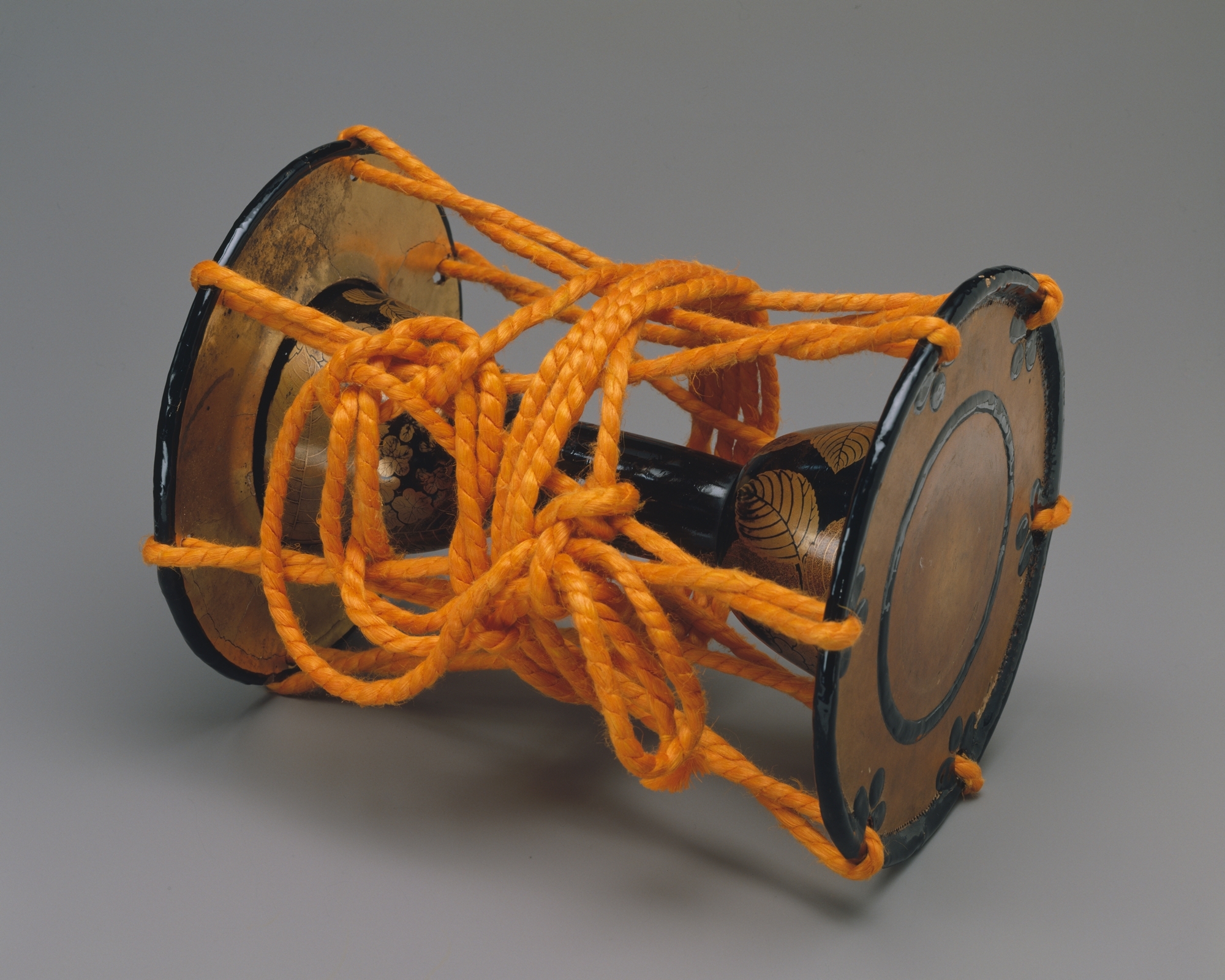
The second of those is where the word gives way, and it is worth being exact about it. The Metropolitan Museum of Art holds a small shoulder drum, a kotsuzumi, made for noh performance: seventeenth century, Edo period, lacquered wood with gold decoration, leather and silk, and about twenty-five centimetres long.
Note what the museum does not call it. Its title is "Small Shoulder Drum (Kotsuzumi) with Hydrangeas for Noh Performance" — kotsuzumi, not taiko.
A small drum held at the shoulder is not what the council calls a taiko.
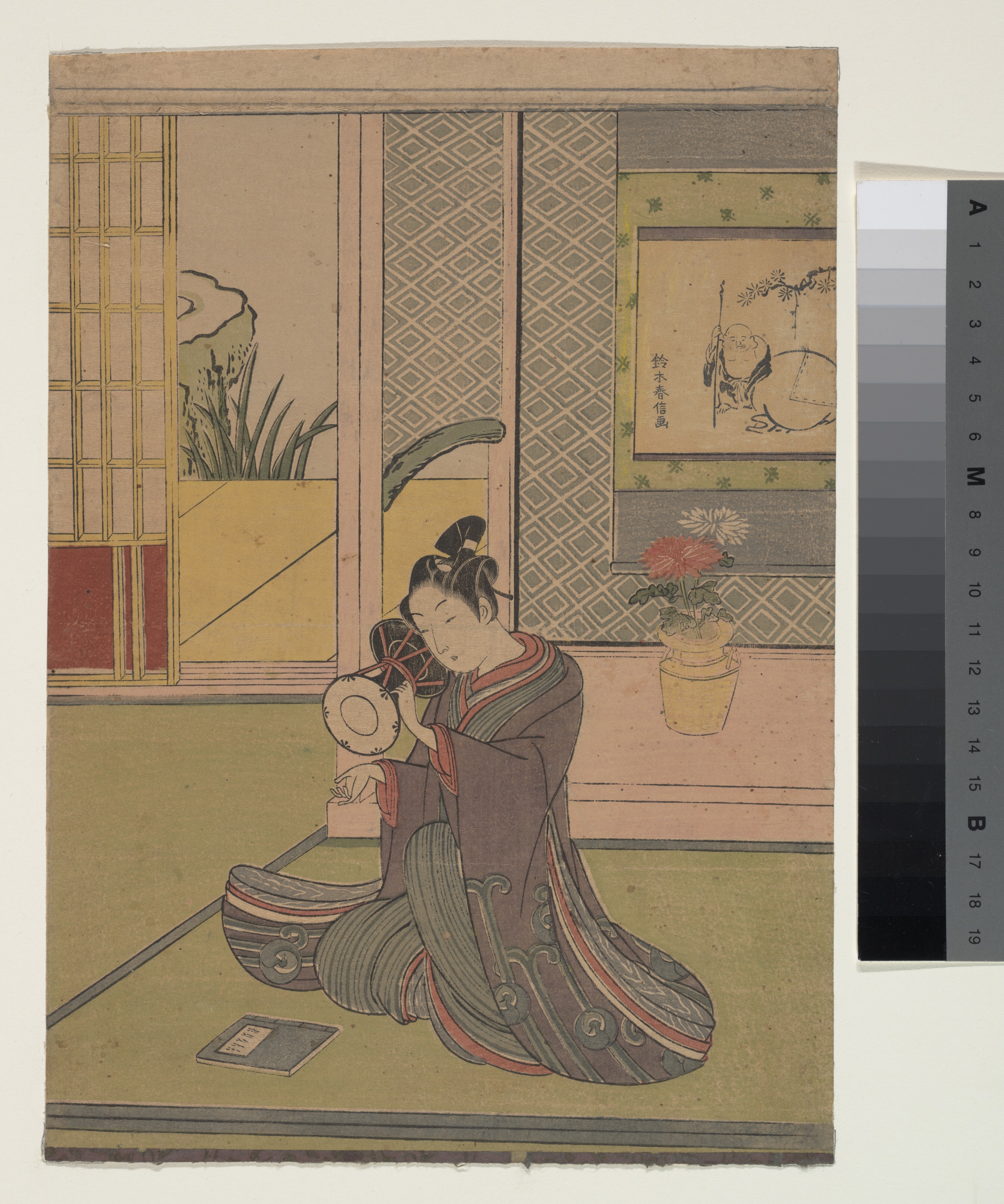
The same drum is not only a stage object. The Met also holds a print by Suzuki Harunobu, Young Man Playing a Noh Drum, and the museum's own description places the scene indoors and privately: "A young man beats a Noh drum in his private chamber. Behind him is a decorative alcove in which flowers are arranged in a bamboo basket before a painted hanging scroll featuring an image of Hotei."
Which Drum Is the Taiko, and When It Is Absent
Percussion is easy to describe badly. Loud, powerful, primal — none of which tells a listener what to attend to. Two things are worth settling first: which of the drums the word names, and whether it is there at all.
Which One Is the Taiko: the Council's Three Drums
Start with the council's own list. It lists the three drums of the noh ensemble as "kotsuzumi (shoulder drum); otsuzumi (hip drum); and taiko (stick drum)." Those parenthesised glosses are the council's English, and they are how the council distinguishes the three in English. They are not claims about the Japanese words.
Silence as Part of the Piece
The silence between strikes is the second thing.
The council does not say what a gap means. And one thing in the council's own description goes further than a pause. The Japan Arts Council's page on noh performers notes that "[t]he taiko is omitted in some plays" — in that repertoire the silence can be the instrument not being there at all.
What you should not do is date what you are hearing by ear. Smithsonian Folkways notes that "Oguchi's efforts led to the recovery of the Suwa style of music that had been lost during the last part of the 19th century and the early 20th century" — a local idiom that had gone out of use and was brought back. A pattern that sounds old may be a revival — something brought back rather than handed down unbroken.
Whether the gaps stay even or stretch is something you can hear without knowing the piece, and what it is for depends on the occasion you are standing in.
Listening to Taiko Without Knowing the Repertoire
Two habits are worth more here than a list of piece titles, and neither requires knowing what is being played.
Kumi-daiko: Count the Drums, Not the Players
Before anything else, count the instruments and note how many sizes are present.
One drum, or several of the same size, is a different proposition from several sizes together. It is the second arrangement that the Smithsonian ties to Oguchi: the ensemble he organised, and separately the western concept he adapted.
Counting also tells you which tradition you are in. The council's description of noh performers divides the musicians into "the flute, shoulder drum, hip drum, and stick drum groups" — four instruments, four groups of specialists, and in the example programme the council prints, one named player for each. A row of a dozen drums played by a dozen people is not a bigger version of that. It is a different arrangement.
Asking What the Drumming Is For
The second habit is asking what the drumming is for in the situation you are standing in.
A theatre has a room the musicians can be put in, and the council gives that room a name. The council names the arrangement twice: when the musicians play "together with nagauta singers and shamisen players on the stage, it is known as debayashi," while performances from the kuromisu, the musicians' room, "count as geza music." Two words for the same players, one of them for the arrangement that puts them on the stage with the singers and shamisen.
Neither setting is a lesser version of the other. The same question runs through a deliberately quiet itinerary: what the occasion is for changes what is being made.
Where Taiko Shows Up in a Tokyo Itinerary
Drumming is harder to schedule than a museum visit, for a reason that is structural. Both of the settings below are tied to dates that are not set for visitors: a festival happens when the shrine's calendar says so, and a noh programme carries the taiko only when the play calls for it.
That gives two places where the dates are published and you can plan against them — and a third that runs for weeks rather than on a single day.
Shrine Festivals: Whose Dates Are Published, and What They Name
The first is the shrine festival, and none of the pages mentions a ticket. What it does require is that your dates and the shrine's coincide, and the shrine decides which.
Festivals and ceremonies are the occasions Folkways calls customary for this drumming, and three Tokyo matsuri publish their schedules: Kanda Matsuri at Kanda Myojin, Sanja Matsuri at Asakusa Shrine, Sanno Matsuri at Hie Shrine. What those pages give you is dates, not a programme: only one of the three names a drum, and none of them promises one.
Asakusa Shrine's English page is the simplest: Sanja Matsuri "is held on the third Saturday and Sunday every May." Every year, fixed by the weekend rather than by a date, and stated in English.
The other two are annual too, but each has a full version that comes round every second year. Kanda Matsuri falls in May, and the shrine's own English page describes it as "held every other year in May." Its dedicated festival site is the page to read for the year you are going: it names the year as either a full festival or a kagematsuri, a lesser year in which the shinkosai procession and the mikoshi entry are not held. Its wording implies a festival held annually with the full version every second year, which is not quite what the shrine's English page says — and when we looked, its week-by-week programme was still the previous full year's. Hie Shrine's Sanno Matsuri site gives the recurring rule — every year in mid-June — and then names the year as a honmatsuri or not, the honmatsuri being the one year in two when the shinkosai procession runs.
The two full versions appear to fall in opposite years, so a trip that wants one has to be planned against that. Each site states its own year, and that is the thing to check rather than any pattern you infer from one year.
One of the three does name a drum and a time, and it is worth following because of what happened to it. Hie Shrine's page for its Chushu Kangensai — an evening of court music held, in the shrine's words, every year on an auspicious day of the mid-autumn moon — says that its own Sanno taiko is played at it. That page is also where you would find out that it is not happening: in one recent year the rite was cancelled for construction on the grounds, and the shrine streamed it from inside the hall instead.
That is the shape of the information, and it is worth knowing before you start searching. Of the three shrines' pages, the one that puts an instrument and a time on the same line is Hie Shrine's calendar of annual observances — its entry for the Chushu Kangensai reads 5:45 pm, Chushu Kangensai, with the shrine's own taiko, the Sanno-daiko, among the instruments played.But a line on an annual calendar is a slot rather than a promise: a cancellation appears on the individual event's page and not on the calendar, so the event page is the one to open. One further caveat: Asakusa and Kanda both have English pages — Kanda's gives the month, the address and four routes in — while Hie's festival material is Japanese only, so that is the one where you will be reading dates and place names. Kanda Myojin and Hie Shrine also appear in the guide to Tokyo's New Year shrine observances, which is a reasonable place to get your bearings on both.
Programmes That Name the Ensemble
The second is a ticket, and its dates are fixed months out. Two forms are worth checking, and the drums sit differently in each.
In noh the players can be named: the example programme the council reproduces — from a 2013 performance — lists the flute, shoulder-drum, hip-drum and stick-drum players individually, alongside the actors. The listing for the October performance below names only the title and the main performer, so a given bill may not tell you. In kabuki the same four instruments appear under a different label. The council's page on narimono states that "debayashi is performed mainly with a fue (flute; noukan or shinobue), kotsuzumi (shoulder drum), otsuzumi or okawa (hip drum), and taiko (stick drum); these instruments are generally known as a shibyoshi ensemble."
The council lists a taiko in the noh ensemble and again in debayashi, which is the arrangement that puts the players on the stage with the nagauta singers and shamisen. Worth knowing, and worth knowing that you cannot check it in advance: Shochiku's English pages for the month give the plays, the times and the prices, and say nothing about the musicians. Which arrangement a piece uses is something you find out when the curtain opens.
The venue to check is the Kabukiza, which Shochiku runs and which publishes each month in English. Its theatre page carries several months at once — the current run and the next few — each with its dates and its dark days, and, for some of the months, a curtain time and an on-sale date as well. It lists Single Act Tickets alongside the full-performance seats, so one act can be bought on its own, and notes a "[c]aptioning service (either English or simplified Chinese subtitles) available to rent" and a sold programme carrying a "[d]etailed English synopsis … at the end of the Japanese program."
One correction, because a guidebook address will cost you an afternoon. The Japan Arts Council states on its English site that the National Theatre in Tokyo "has been closed to undergo redevelopment, with its performances continually presented at alternative venues."
The National Noh Theatre is open, and the same listings carry a "Performance for Non-Japanese Theatre-Goers [Discover Noh & Kyogen]." Each performance has its own page, and that is the one to open. A recent one in the series billed a kyogen and a noh play together in the evening, and its page gave the curtain time with the finish marked as an estimate, "Commentary (English)", "[i]ndividual subtitle monitors … in English, Chinese, Korean, Spanish, French and Japanese" displayed on the seat backs, tiered seat prices with a student rate, the date reservations open, and the booking link. Those are the fields to expect; the numbers in them change with the bill.
Do not assume the drum will be there. The council's own page on noh performers sets out the ensemble — "hayashi uses four types of instruments: fue (flute); kotsuzumi (shoulder drum); otsuzumi (hip drum); and taiko (stick drum)" — and then adds the sentence that matters here: "[t]he taiko is omitted in some plays." The taiko is the one the council singles out as removable, and the council does not say which plays those are.
There is also something in the same building that needs no ticket at all. The theatre mounts free special exhibitions in the exhibition room on its first floor, usually 11:00 to 17:00, and announces them on the council's news pages. One recent one, The Beauty of Noh Drum, was drawn from the collection of Miyamoto Unosuke Shoten — a maker of taiko and festival equipment since 1861 — and put out "approximately 190 drum bodies … spanning the Muromachi through Edo periods." One warning about that page: the address at its foot is the Japan Arts Council's own, in Hayabusa-cho, Chiyoda. The National Noh Theatre is in Sendagaya, Shibuya, and that is where the drums are.
Two cautions about pages like that one. They do not always break a count down by type, and "noh drum" does not narrow it: the council counts a taiko among the noh ensemble's four. And the dates can disagree with themselves — on the page above, the heading and the body gave different end dates, and only the list of closed days settled it. Read the closed days as well as the run, and note which weekday they fall on. A room of drum bodies at Sendagaya, free while a run lasts, is a different proposition from a catalogue entry in New York.
Reading a programme before booking is the habit, and it slots into a Tokyo itinerary organised by district and theme without displacing much.
Japan Immersive Art — Experiences Th
What to Carry Into the Room
Three things to carry, in the order you will need them, and a fourth about where all of this is going.
The word has edges, and the council's own glosses are where to see them. The small drum held at the shoulder on a noh stage is a kotsuzumi, and the museum that holds one calls it that. Knowing where the word stops is the difference between hearing a category and hearing a genre.
The concert form is the recent one, and it has a named inventor and a year attached to it. That is a better thing to carry than an impression of age.
And listening starts with things you can do without knowing the piece: count how many drum sizes are sounding, notice whether the gaps stay even or change, and ask what the occasion is for.
The last thing is the one that is still moving, and it is moving in two directions at once. The ensemble form has kept travelling. Oguchi "led and starred in the performance of drumming and dance at the closing ceremony of the 1998 Nagano Olympics," and the Smithsonian lists the O-Suwa Daiko recording inside its UNESCO Collection of Traditional Music — a recording released in 1978, twenty-seven years after the first ensemble. Meanwhile the occasions it is scheduled on keep being published and withdrawn. Hie Shrine has had to cancel the evening at which its own Sanno taiko is played, for construction on its grounds, and it went on publishing the date and a live stream in place of the rite. That is a shrine rebuilding itself, not an art disappearing — and it is the reason to open the page for the occasion rather than trust the annual calendar. That is what a living schedule looks like from outside.