Everything written about Kobe beef fat says the same thing: it melts at body temperature. That is true, and on its own it explains nothing. The useful question is why this fat melts and other beef fat does not — and the answer turns out to complicate the grading system the whole industry runs on.
This guide covers the chemistry in plain terms, why a high marbling score does not guarantee good fat, and what any of it means when you are sitting at a counter deciding what to order.
The Wagyu Fat Melting Point: The Two Numbers That Matter
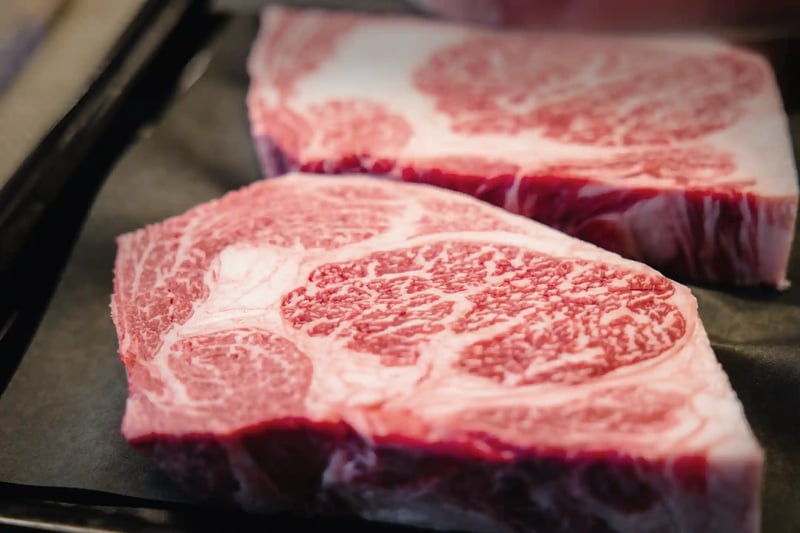
The Kobe Beef Marketing and Distribution Promotion Association — the body that issues the certification — is careful about this. What it points at is not the quantity of fat but low-melting-point fat worked finely into the muscle, together with abundant oleic acid for flavor and inosinate for umami — and the harmony between that and a lean meat it describes as fine-grained and delicately sweet.
Animal fat is a mixture of fatty acids, and each has its own melting point. Two of them do most of the work in beef, and they sit at opposite ends of the scale.
Drawing on Wood and colleagues, Irie Masakazu's 2021 review in the journal of the Japanese Society of Animal Science tabulates them:
- Stearic acid (C18:0), saturated — melts at 69.6°C
- Palmitic acid (C16:0), saturated — 63.1°C
- Oleic acid (C18:1), monounsaturated — 13.4°C
- Palmitoleic acid (C16:1), monounsaturated — −0.5°C
The ordering is systematic: saturated fats melt highest, monounsaturated next, polyunsaturated lowest. Linoleic acid sits at −5°C and linolenic at −11°C, which is why fats built from them are liquid oils at room temperature rather than solids.
Read those again. Stearic acid does not melt until 69.6 degrees — near the temperature of a hot bath, and far above anything that happens in your mouth. Oleic acid melts at 13.4, which is below room temperature on a mild day.
So the difference between fat that dissolves on the tongue and fat that coats it as a waxy film is not how much fat there is. It is which fatty acids that fat is made of. Wagyu runs high in the monounsaturated end of the table.
Kobe Beef Marbling: What the Animal Is Actually Doing
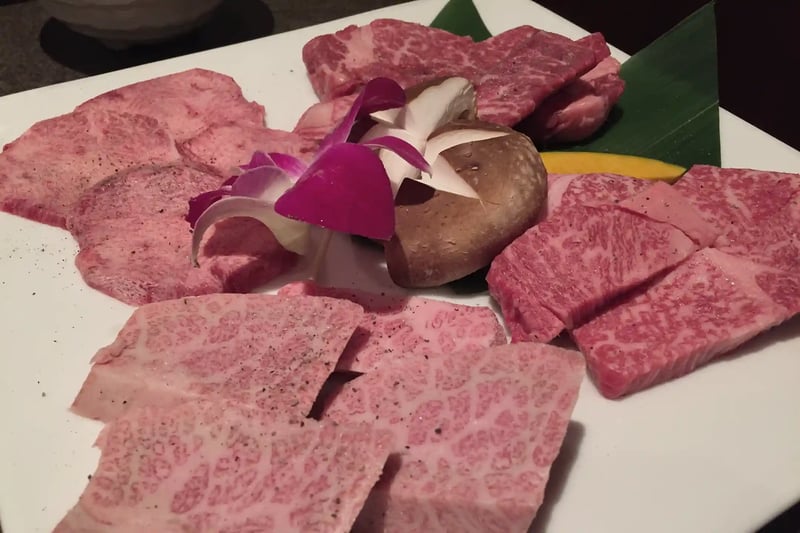
The mechanism is a conversion. Fat synthesis is unusually active in wagyu, and in the course of it stearic acid is converted into oleic acid — C18:0 falls, C18:1 rises. The review notes that the enzymes responsible become more active under heavy concentrate feeding and long fattening, which is precisely the regime Tajima cattle are raised under, and that the effect is most pronounced in the fat inside the muscle rather than around it.
That is the whole of it. A Kobe beef animal is not producing a different substance from other cattle. It is running the same chemistry further, for longer, and converting more of the hard fat into the soft.
How Japan Came to Eat This Fat at All
The chemistry is old; the appetite is not. Japan spent roughly twelve centuries not eating beef in any ordinary way, under Buddhist prohibition and the practical fact that cattle were working animals worth more alive.
Three things changed that in quick succession. The port of Kobe opened to foreign trade in 1868, and the foreign settlement wanted beef. In 1872 the Meiji emperor was reported to have eaten it — a deliberate act of state, meat-eating being staged as a marker of modernisation. And sukiyaki, a way of cooking beef that fitted a Japanese table rather than a Western one, spread nationally in the decades that followed.
The Tajima cattle in the hills behind Kobe were not bred for any of this. They were draft animals, kept for work in terrain that suited a small, sure-footed breed, and their reputation in the Edo period rested on qualities that had nothing to do with eating. What happened after 1868 is that a working herd was reassessed as a food animal — and the assessment that eventually followed, a century later, was the marbling grade.
Which is worth holding in mind when reading the certificate. The rules describe an animal that was never designed for them.
Kobe Beef Marbling Is Made in the Feed Shed
.webp?width=800&height=533&name=GrillingSearing%20Matsusaka%20Beef%20Steak%20(Hira-kaiFlank%20Steak).webp)
If the enzymes that convert hard fat into soft fat become more active under heavy concentrate feeding and long fattening, then the fat is largely a product of what the animal is given and for how long. Kobe beef feeding is accordingly elaborate.
Kobe Beef Ranch describes its own operation as drawing on a store of nineteen different feed materials — corn, barley, wheat bran, rice bran, sake lees, and rice straw from nearby fields among them — blended differently across three stages: the first three months, months four to seven, and the eighth month onward. The ranch says it is increasing the proportion drawn from local industry a little each year.
Note that those stage numbers count from the animal's arrival at the fattening barn, not from birth — the calf has already spent months with a breeding farm before it gets there. The certificate's 28-to-60-month requirement counts from birth. Either way the animal is kept far longer than a commodity beef system would keep it, which is what the enzymatic conversion described above requires.
The ranch describes what each stage is for. The first is about the animal's capacity to eat at all — grass, to enlarge the rumen and build the frame for what follows. The middle stage adds energy: corn, with brewer's grains and wheat bran for digestibility. The last and longest stage shifts to rice bran and barley, which the ranch says carry the elements that shape meat quality and flavor.
The economics follow from that arithmetic rather than from scarcity marketing. Years of feed on an animal that is small for a beef breed is simply an expensive way to produce meat.
Kobe Beef Marbling Scores Do Not Measure the Fat
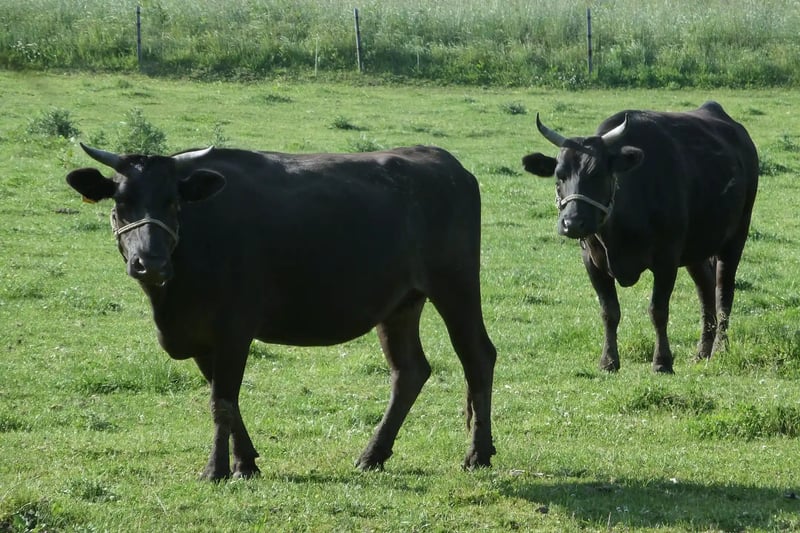
Here is the part that should change how you read a menu.
Japan's grading system scores marbling — the Beef Marbling Standard (BMS) number that Kobe beef must reach No. 6 or above to qualify. That number counts how finely and abundantly fat is distributed through the muscle. It does not measure what the fat is made of.
The review is specific about how separate the two things are. Fat quality in wagyu is highly heritable, at 0.6 to 0.7. But the genetic correlation between marbling and oleic acid or monounsaturated fat content is only about 0.1 — which in breeding terms is close to independent.
The practical consequence: a very high BMS score tells you there is a great deal of fat, finely dispersed. It tells you almost nothing about whether that fat melts well. Two A5 carcasses can differ substantially in the thing you will actually notice.
The review goes further: in wagyu, fat quality shows no significant correlation with marbling or with intramuscular fat content at all, and there is a sire effect — different bulls produce measurably different fat. It adds that other genetic influences exist too, and that fat quality can therefore be improved by breeding.
Kobe Beef Texture and the Question of the Bull
That matters for how you read the certificate. If fat composition varies by sire rather than tracking marbling, then the bloodline is a variable the grading system is not looking at.
Article 20 of the association's rules confines Tajima cattle to Hyogo's own registered sires, generation after generation. That does not make the fat uniform — the review's point is precisely that bulls differ — but it does mean the variation sits inside a single, closed, prefecturally maintained population rather than across the whole of Japan.
What it is not is a guarantee of fat quality. Nothing in the certificate measures that directly, and the review is clear that improvement comes through breeding selection rather than through the carcass grade.
Selection for fat quality is now done separately from the carcass traits, and genomic breeding values for it are calculated at the national level rather than by any one prefecture. Our guide to Japan's beef grading system covers what A5 does and does not certify.
The Aroma Called Wagyu-ka Has a Temperature
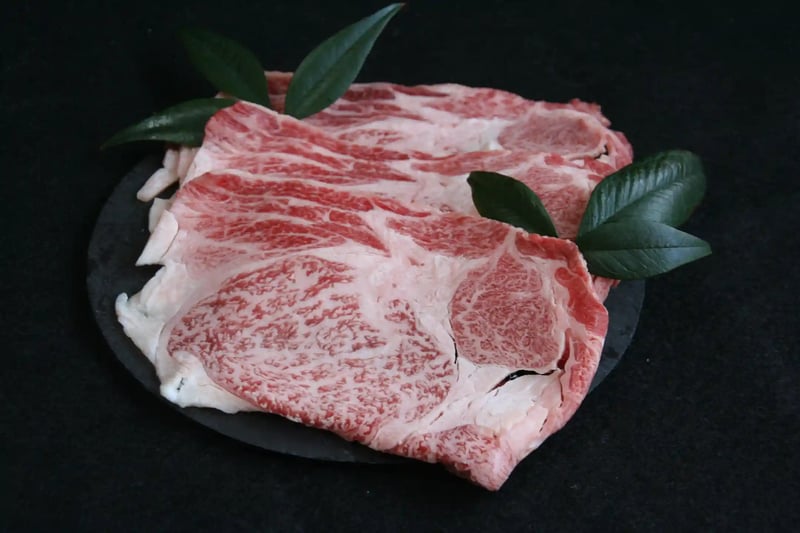
There is a smell specific to wagyu that the literature calls wagyu-ka — a sweet, rich note from the fat that ordinary beef does not produce. It is not always present, and the conditions under which it appears are surprisingly narrow.
The review reports that this aroma develops well when heavily marbled beef, aged in the presence of air, is heated to around 80°C. Not seared hard; not cooked through. Eighty degrees.
That single figure explains a great deal about how Kobe beef is served. A teppanyaki chef holding a slice briefly on a plate at controlled heat, rather than driving it hard in a pan, is working inside the window where the aroma forms and the fat renders without the meat tightening.
The free fatty acids released along the way do something else too: oleic and linoleic acid are read by the tongue not only as fat but as savoury and sweet, on nerve pathways distinct from the other tastes. The sensation is not a metaphor.
Wagyu Fat Melting Point Is Not the Whole of Juiciness
One more distinction that menus blur. Juiciness — the sense of liquid released as you chew — is generally a matter of the meat's water-holding capacity rather than its water content. But the review notes that heavily marbled wagyu actually contains rather less water than lean beef, so its juiciness cannot be explained that way: what accounts for it is the fat released during chewing.
The relevance is practical. Fat that melts below mouth temperature contributes to the sensation immediately; water lost to overcooking cannot be recovered by any amount of marbling. A heavily marbled cut cooked too long is dry and greasy at the same time, which is a genuinely unpleasant combination and an easy way to waste an expensive piece of beef.
It also explains why the same beef reads so differently in a hot pot. In sukiyaki the meat spends only seconds in liquid below boiling and the fat leaves into the broth; on a grill at high heat, the water goes as well.
More Sashi Is Not Better After a Point
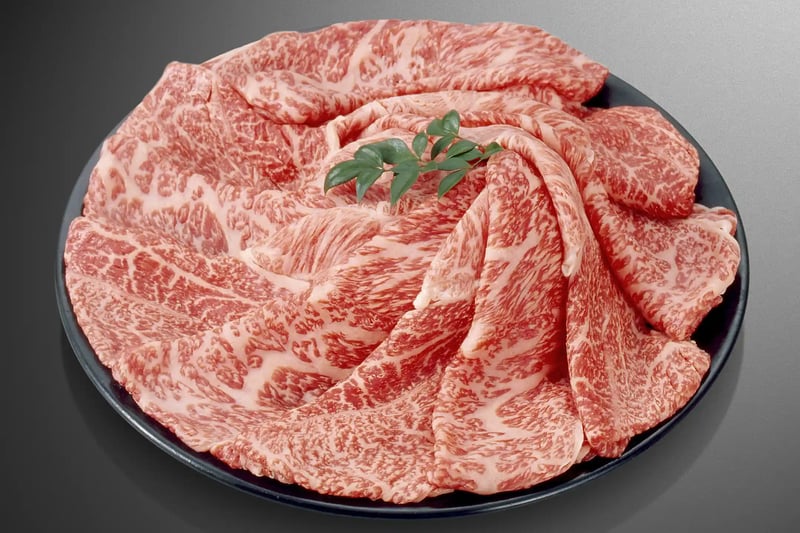
The same review carries a caution that the marketing does not.
Monounsaturated content and eating quality do not rise together indefinitely. The relationship is a curve, not a line: past a certain point, very high monounsaturated fat can degrade the physical properties of the meat, and studies have found defects appearing under high-temperature cooking. Very high monounsaturated content, in other words, is not simply better.
Quantity is more complicated, and worth stating carefully because the numbers are usually quoted without their conditions. Work cited in the review found consumer ratings plateauing at an intramuscular fat content of around 15 to 17 percent — but that finding is specifically about Australian consumers, and the review notes in the very next sentence that studies of wagyu, and of Japanese respondents, give high sensory scores at considerably higher fat content. Separate work found that between 3 and 11.9 percent, marbling made little difference to preference at all.
So the curve exists, but where it flattens depends on who is eating. What the review actually warns is that preference differs by country and region — a more useful caution for a visitor than any single threshold.
None of which makes the grade meaningless. It makes it a threshold rather than a scale — a line above which the fat behaves the way the cuisine assumes, and beyond which more is a different kind of claim.
This matches what good chefs do rather than what menus claim. A teppanyaki cook working with a heavily marbled cut manages heat to control how much fat leaves the meat, and serves a smaller portion than a visitor expects. Both are responses to a material that stops rewarding you quickly.
How the Association Verifies Origin by DNA
Everything above is worthless if the meat on your plate is not what the label claims, and this is the area where Kobe beef has the most to lose. The association's answer is genetic rather than documentary.
Tissue samples are taken from every certified carcass at the approved meat centers and held by the Hyogo Institute of Food Science, with a DNA management number written onto the Tajima-gyu certificate and the Kobe beef certificate. Any piece of meat in the chain can be traced back to it.
Since August 2023 the association has gone further and audits itself: registered shops are visited at random, samples are taken, and DNA testing is run against the reference. The results are published in full — every test, with a pass or fail against the shop.
The published record also matters for a reason that has nothing to do with fraud: it turns the association's own enforcement into something a customer can inspect. Publishing the rules is ordinary; publishing audit results against named shops is not.
That is an unusual thing for a trade body to do, because it can only produce bad news about its own members. It is also the most useful single fact for a visitor: the question is not whether a restaurant has a certificate on the wall, but whether it appears on a register that gets spot-checked.
Kobe Beef Texture at the Counter: What to Order
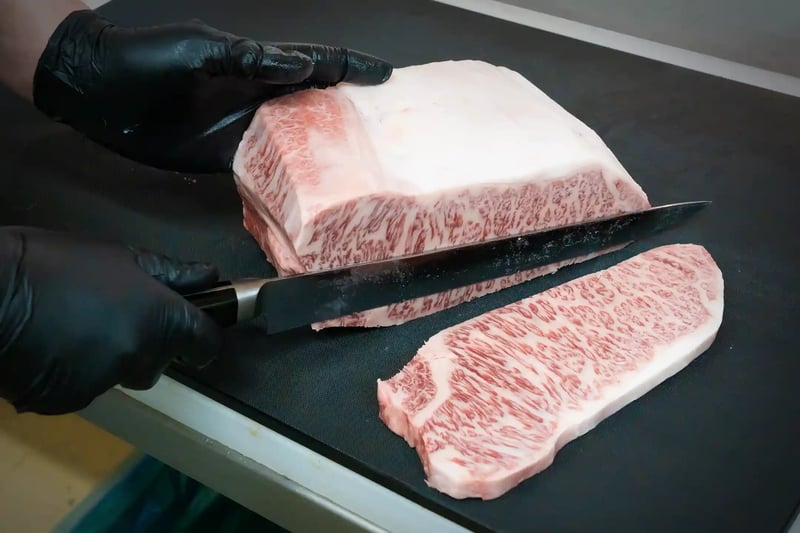
Several things follow from all of the above, and they are more useful than any list of restaurants.
Order less than you think. The point at which rich beef stops being pleasant arrives sooner than with any other meat, and it arrives faster the higher the grade. A course of small portions across several cuts beats one large steak.
Let it come to room temperature if the restaurant offers. Fat that starts at refrigerator temperature has further to travel, and the difference between a slice served cold and one rested is larger with this beef than with any other.
Do not order it rare. Fat that has not been warmed enough to render is the unpleasant version of exactly the quality you are paying for. Medium-rare is the convention and it is a technical one.
Take the leaner cut for the main. Fillet carries less intramuscular fat and is the cut that lets you finish a course. Sirloin is the demonstration piece; a slice of it is worth more than a plate.
Ask what the fat measured. A fat-quality indicator has been introduced at the wholesale markets under the association's own programme, so some restaurants now know the monounsaturated figure for the carcass they are serving. It is a more informative question than the grade.
Consider the hot pot. Thin-sliced beef in sukiyaki or shabu-shabu lets the fat leave into the broth rather than sit on the plate — which for a fat this soft is arguably the more sensible preparation, and is the older way of eating it in Japan.
For the certification itself, our guide to what Kobe beef is sets out the rules, and our Kobe beef tour guide covers where to eat it and how to book.
One story, opening onto many

Conclusion
The through-line of this article is that almost everything sold as a fact about Kobe beef fat is a fact about something else. "Melts at body temperature" is a fact about oleic acid. "A5" is a fact about how much fat there is, not what it is. "Marbling" is the visible consequence of a conversion happening at the enzyme level over two and a half years of feeding.
Two numbers are worth carrying away: 69.6 and 13.4. The first is the melting point of the saturated fat that makes ordinary beef fat waxy; the second is the melting point of the monounsaturated fat that Tajima cattle convert it into. The entire sensation people describe as melting on the tongue sits in the gap between them.
And one caution. The grade on the certificate measures how much fat is in the meat, not what that fat is made of — and in wagyu the review finds no significant correlation between fat quality and marbling at all. A5 is a real thing. It is not a promise about the quality you actually taste.
What does carry that promise is the clause nobody reads: that the animal descended from Hyogo's own bulls, and spent its whole life there. The bloodline requirement is not the ceremonial part of the certificate. It is the part doing the work.


.webp)