Heian Shrine reads as ancient. The vermilion, the scale, the long axial approach — all of it belongs to a vocabulary a visitor associates with the distant past, and the impression is rarely disturbed.
The shrine's own account does not. It says it was founded in 1895.
That is the beginning of a much better story than the one the building's appearance tells. In 1869 Kyoto stopped being the capital, and the city that had been the capital for a thousand years began losing its industry and its people. What followed was not resignation. It was a canal, a hydroelectric station, the line the bureau calls the country's first streetcar, an industrial exhibition and a shrine, all inside a quarter of a century, in a city that could not obviously afford any of it.
This article is about that quarter century, because it explains what you are actually standing in front of. The practical side of a Kyoto day is outside this article. Our guide to walking the old town takes the hours in another district. For Meiji waterworks elsewhere in the city, our guide to Kyoto's temples describes a red-brick Meiji aqueduct running through the grounds at Nanzen-ji. Where we describe something as it is now — what the canal supplies, what is open, when — we give the date we read it on.
Heian Shrine Is a Five-to-Eight Scale Model, and It Dates From 1895
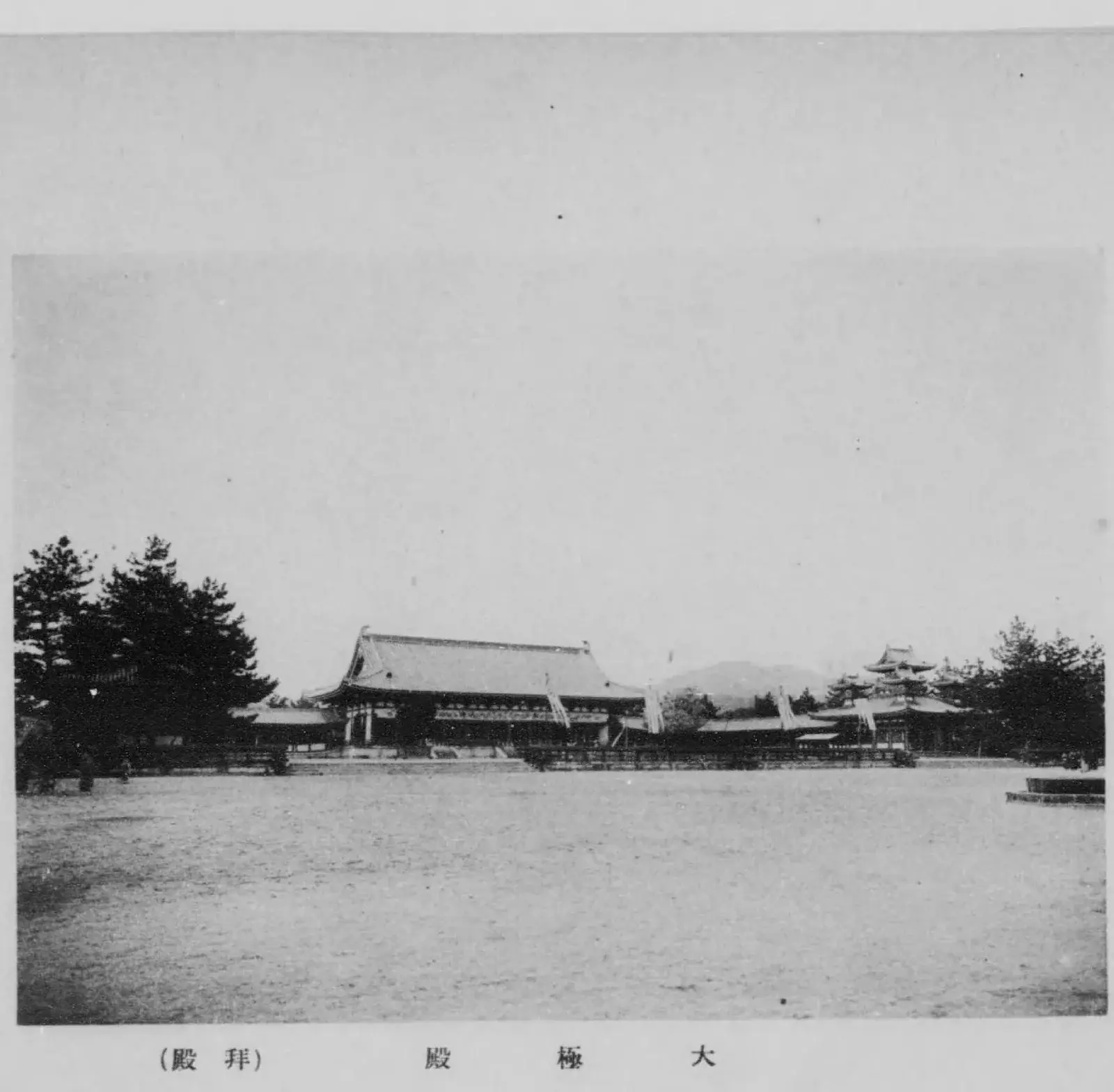
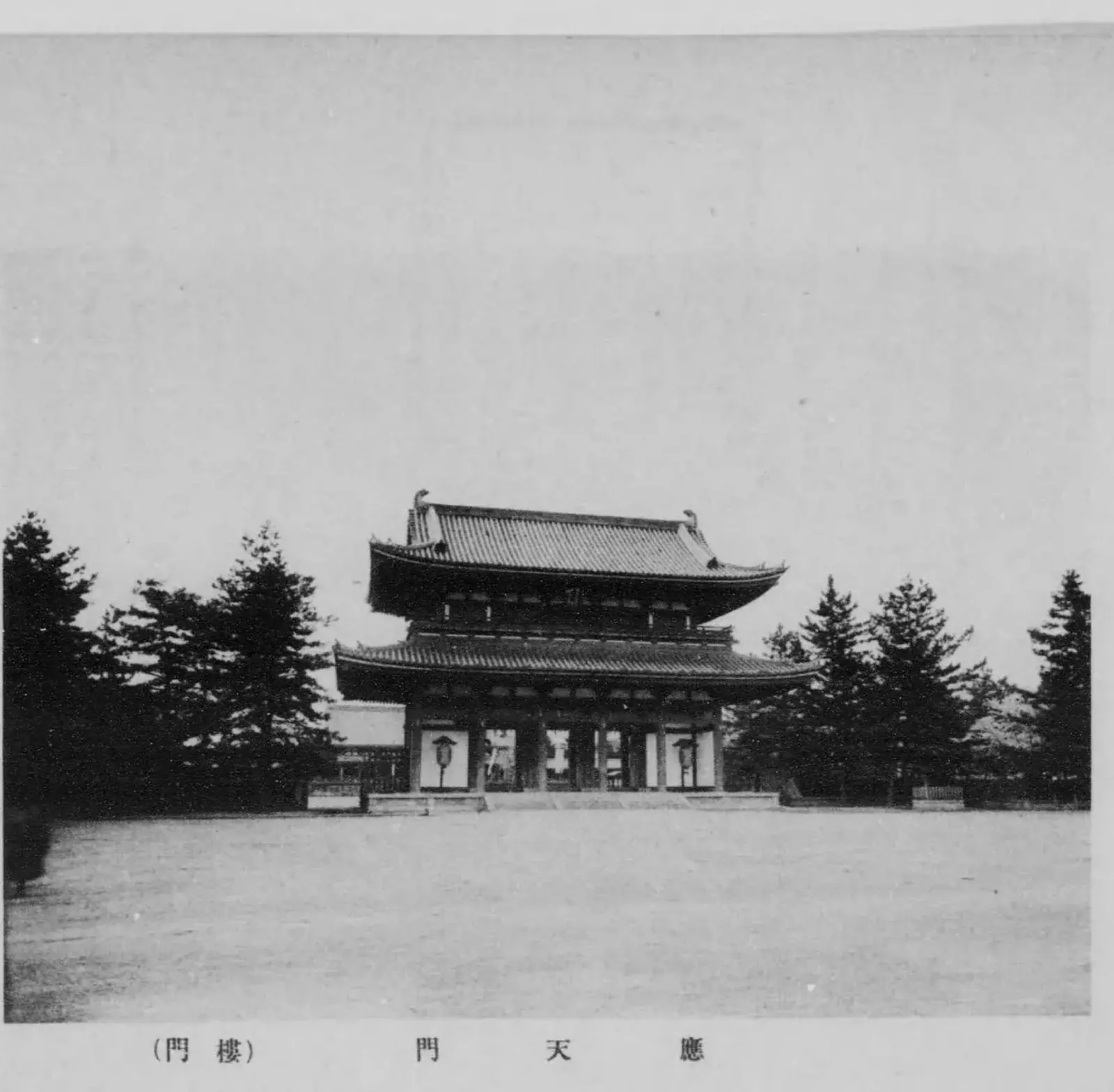
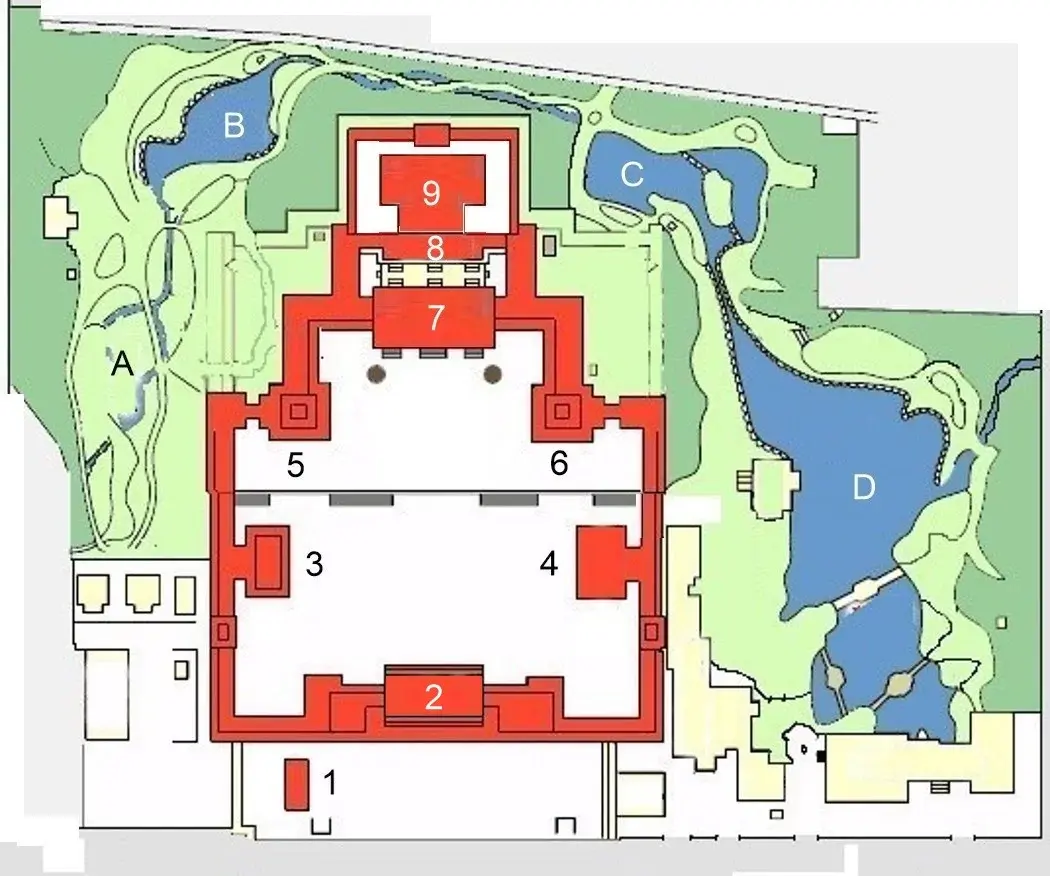
Start with what the shrine says about itself, in Japanese, on its own site. Heian Jingu describes itself as founded in 1895, the twenty-eighth year of Meiji, to mark eleven hundred years since the capital moved to Heian-kyo, as the general shrine of the citizens. It describes its halls as vermilion-painted buildings modelled on the Chodo-in, the main government compound of Heian-kyo. We read this on 13 September 2026.
Then read its account of why it exists. That part is usually left out. The shrine says it was founded in order to carry to later generations the elegant Kyoto that had flourished for more than a thousand years, and to carry to later generations the will of the many who staked themselves on the recovery of Kyoto, with a prayer for peace across the four seas.
The recovery of Kyoto. That phrase is doing a great deal of work, and the rest of this article is an attempt to say what it refers to.
What the Shrine Says About Itself, and What the Tourism Agency Says
There is a second, more detailed account on the same site, in English, and whose voice it is needs saying. The page states that the English-language text was created by the Japan Tourism Agency. The shrine publishes it; a government department wrote it. Articles that quote it do not always make that distinction.
On that agency's account, the shrine is a five-to-eight scale replica of one of the innermost parts of Heian-kyo, modelled on the State Hall of the Imperial Palace, the Chodo-in complex. Several of its buildings, including the Daigokuden and the Otenmon Gate, are designated Important Cultural Properties of Japan.
Hold the ratio for a moment, because it changes the object. A five-to-eight scale model is not a restoration and it is not a fantasy. It is a reduction, at a stated ratio, of a compound that had stood at the centre of the capital the city had just lost. Neither the shrine nor the agency says why five-to-eight was the ratio chosen. What the ratio does, whatever the reason for it, is keep the building from claiming to be the original.
The same agency text is explicit about purpose in a way the Japanese page is not. It says the shrine was one of several projects planned to celebrate the city's long history and encourage economic growth, and calls it a lasting symbol of the city's rebirth. It also notes that it opened the same year that a large industrial exhibition was held in the city to showcase new technologies and attract new industries.
Two Emperors, Enshrined Forty-Five Years Apart
The shrine enshrines two emperors, and the pairing is the sharpest thing about it — but the two were not enshrined together, and the gap between them is forty-five years.
The first is Emperor Kanmu, 737 to 806, whom the agency text calls the first emperor of the Heian period, 794 to 1185 — the emperor under whom the capital this shrine models was founded. The second is Emperor Komei, 1831 to 1866, described in the same text as the last emperor to rule from Heian-kyo.
The dates of the enshrinement matter, and the English commentary does not give them, because it describes the shrine as it stands today. The shrine's own history page sets out the sequence: on 15 March 1895 the shrine was founded with Emperor Kanmu as its deity, and Emperor Komei was added later, in the fifteenth year of Showa, 1940, to mark the twenty-six hundredth year of the imperial era. The page repeats it further down, saying that in 1940 the spirit of the hundred and twenty-first emperor was enshrined alongside, at the wish of the citizens.
So the pairing that reads as a single thought was assembled in two moves, forty-five years apart. What the city built in 1895 was a shrine to the emperor who founded the capital. What was added in 1940, in the twenty-six hundredth year of the imperial era and by a different generation, was the emperor who was the last to rule from it. Anyone who tells you the shrine was conceived to hold the beginning and the end of Heian-kyo is describing the result rather than the intention, and the sources do not support the intention.
The 1895 figure alone is sharp enough. Kanmu died in 806. The shrine to him opened in 1895, twenty-six years after the capital he founded had stopped being one.
1869: Heian Shrine Needed a Reason, and 1869 Supplied It
For what happened in between, the best source is not a history book but the utility that still runs the waterworks. The Kyoto City Waterworks Bureau opens its history of the Biwako Sosui, the Lake Biwa Canal, with the problem the canal was built to solve.
Kyoto had flourished as the nation's capital for a thousand years since Heian-kyo, the bureau writes, but in the second year of Meiji, 1869, the capital moved to Tokyo, industry declined sharply, and the population also fell rapidly. It then says that the canal project was planned in order to restore this declining Kyoto, and in particular to promote industry. We read both sentences in Japanese on 13 September 2026.
That is a causal statement, made by the body responsible, about why a piece of infrastructure exists. It is unusually plain for a municipal page.
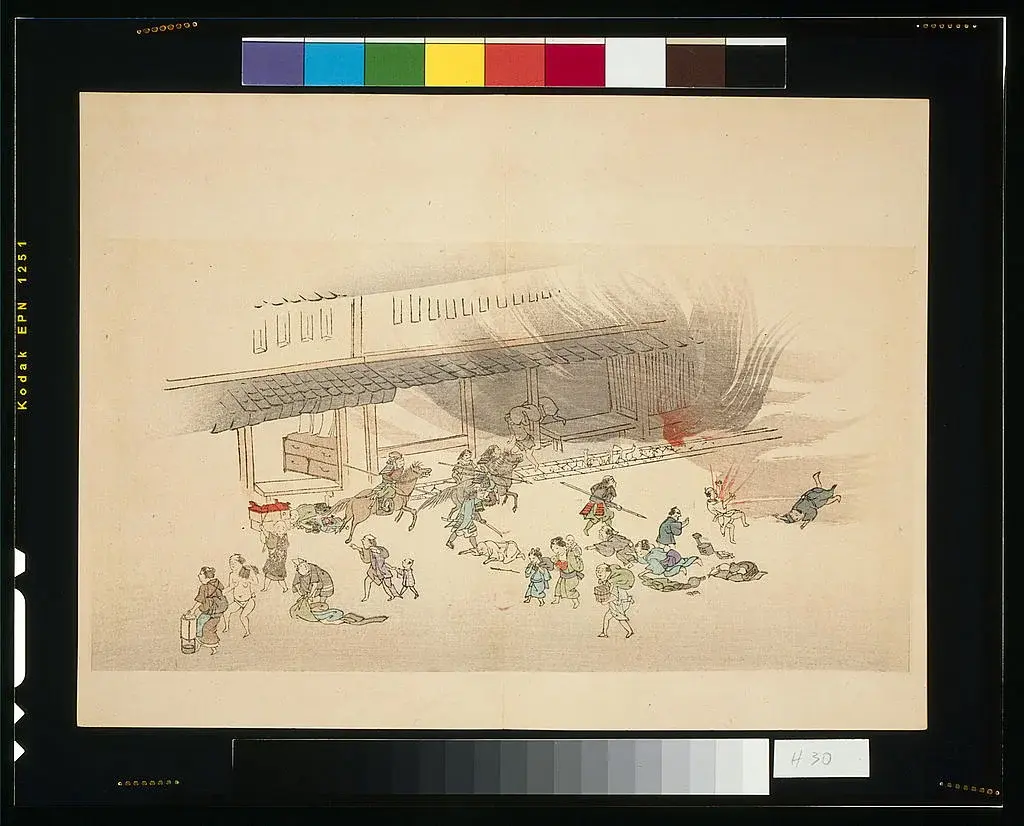
The shrine's history page puts numbers on it, and adds something the bureau's account does not. The decline did not start in 1869. In 1864, in the fighting at the Hamaguri Gate, the centre of the city burned: 811 blocks and more than 27,500 houses, in a fire the page says was known as the teppo-yake, the rifle burning. The page then says, on its own count, that the capital moved four years after that, and gives the population as falling from about 340,000 to about 230,000. It also records what was said about the place at the time: that it would end up a den for foxes and tanuki, the raccoon dogs.
What a city does about a decline on that scale is the rest of this article.
The Biwako Sosui Was the First Great Public Work Built by Japanese Hands Alone
What it did instead was dig.
In February of the fourteenth year of Meiji, 1881, Kitagaki Kunimichi was appointed governor of Kyoto Prefecture. The bureau's second chapter records that he looked to Lake Biwa, close to Kyoto and abundant in water, intending to open boat transport linking the lake and the Uji River while also using the water for power — water wheels — for irrigation, for firefighting and for other purposes, in order to promote Kyoto's industry.
It took about four years to get from that intention to permission. Among the problems the bureau lists were design changes, the increases in cost that followed from them, and compensation owed to Shiga Prefecture and Osaka Prefecture. The bureau records that the project finally received the government's construction licence on 29 January in the eighteenth year of Meiji, 1885, and began work in June of that year.
The dates that follow need separating carefully, because they are usually collapsed into one. Completion from Otsu to the confluence with the Kamo River came in March 1890. The completion ceremony was held on 9 April 1890, at the Ebisugawa boat pool a little east of that confluence. The stretch from there to Fushimi was a separate undertaking, begun in November 1892 and finished in September 1894. The canal was not one event.
The engineering figures are in the same chapter. The first canal carried 8.35 cubic metres per second. From the intake at Mihogasaki in Otsu it passes through a tunnel under Mount Nagara, skirts the foot of the hills in northern Yamashina, emerges at Keage, and drops about 36 metres by inclined railway — the Keage Incline — to reach the Kamo. Locks were built along the route for the boats.
The first tunnel, under Mount Nagara, was the longest in the country at the time, and the bureau writes that its success was widely doubted. Besides digging from both sides of the mountain, the engineers sank a vertical shaft from the top and worked outwards from the bottom of it — the first use of the shaft method in Japan.
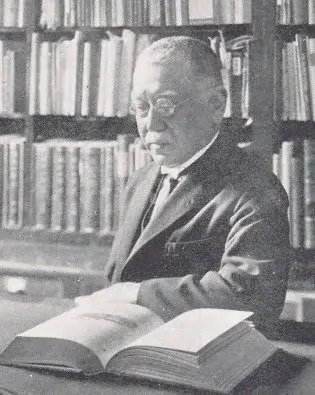
Two details in the first chapter are the ones we would put in front of anyone who thinks of Meiji public works as imported competence. At a time when every major engineering project in the country was entrusted to the design and supervision of foreign engineers, this was the first large civil engineering work in Japan carried out entirely by Japanese hands, from design through construction. And the chief engineer, chosen by Governor Kitagaki for a project the bureau describes as costing ten-odd times the city's annual budget, was Tanabe Sakuro, a young engineer freshly graduated from the Imperial College of Engineering, now the University of Tokyo, and twenty-one years old at the time of his appointment.
The working conditions are recorded in the same paragraph, and they are not romanticised. Apart from dynamite and cement, most materials were supplied by the project itself. Engineers were trained at night and put to work by day. The bureau calls this an accumulation of effort scarcely imaginable today. That is a municipal utility's way of saying the city built the thing partly by teaching people how to build it while they were building it.
One change mattered more than the rest, and it is why this article has a power station in it at all. The bureau writes that the plan was altered repeatedly before and during construction, and that the largest alteration came when Tanabe and others travelled to the United States to look at how water was being used, after which the project committed to putting hydroelectric power into practical service. A canal designed for boats, water wheels, irrigation, firefighting and other uses acquired a generating station because its engineers went abroad mid-build and changed their minds.
The money is itemised in the second chapter, and the interesting part is who paid. The bureau puts the cost of the canal work — the first canal from Otsu to the Kamo, together with the branch line — at more than 1.25 million yen. Among the sources it lists an industry foundation fund, national and prefectural subsidies and municipal bonds, and, on top of those, a special-purpose tax levied on every citizen. The bureau reads that last item as showing how much the citizens had riding on the work.
What the Water Was For: Spinning, Copper, Machinery, Tobacco
A canal dug to restore an economy has to be judged on whether it did.
The bureau gives its own answer, across two chapters. The first records that in the twenty-fourth year of Meiji, 1891, a hydroelectric station began operating at Keage, and says this left a large mark on the history of the country's civilisation. The second says where the power went: on top of the purposes the canal was begun for, mainly to industrial use, where it showed enormous capability in promoting new industries — and it names four of them — spinning, copper rolling, machinery and tobacco — with the list left open. It concludes that this became a major driving force in the development of the city of Kyoto.
Those are the four the bureau chose to name, and they are not the ones a visitor would guess: spinning, copper rolling, machinery, tobacco. The bureau does not say they replaced the court, and neither will we. What it says is that they became a major driving force in the development of the city, which is a claim about growth rather than substitution.
The canal is also still working. The bureau notes that although the uses have changed with history, the canal today supplies the water source for the tap water of about 1.47 million citizens, along with hydroelectric power and other purposes. We read that on 13 September 2026. It was not a monument even at the start, and it is not one now.
The Keage Incline and a Power Station Where First Comes With Limits
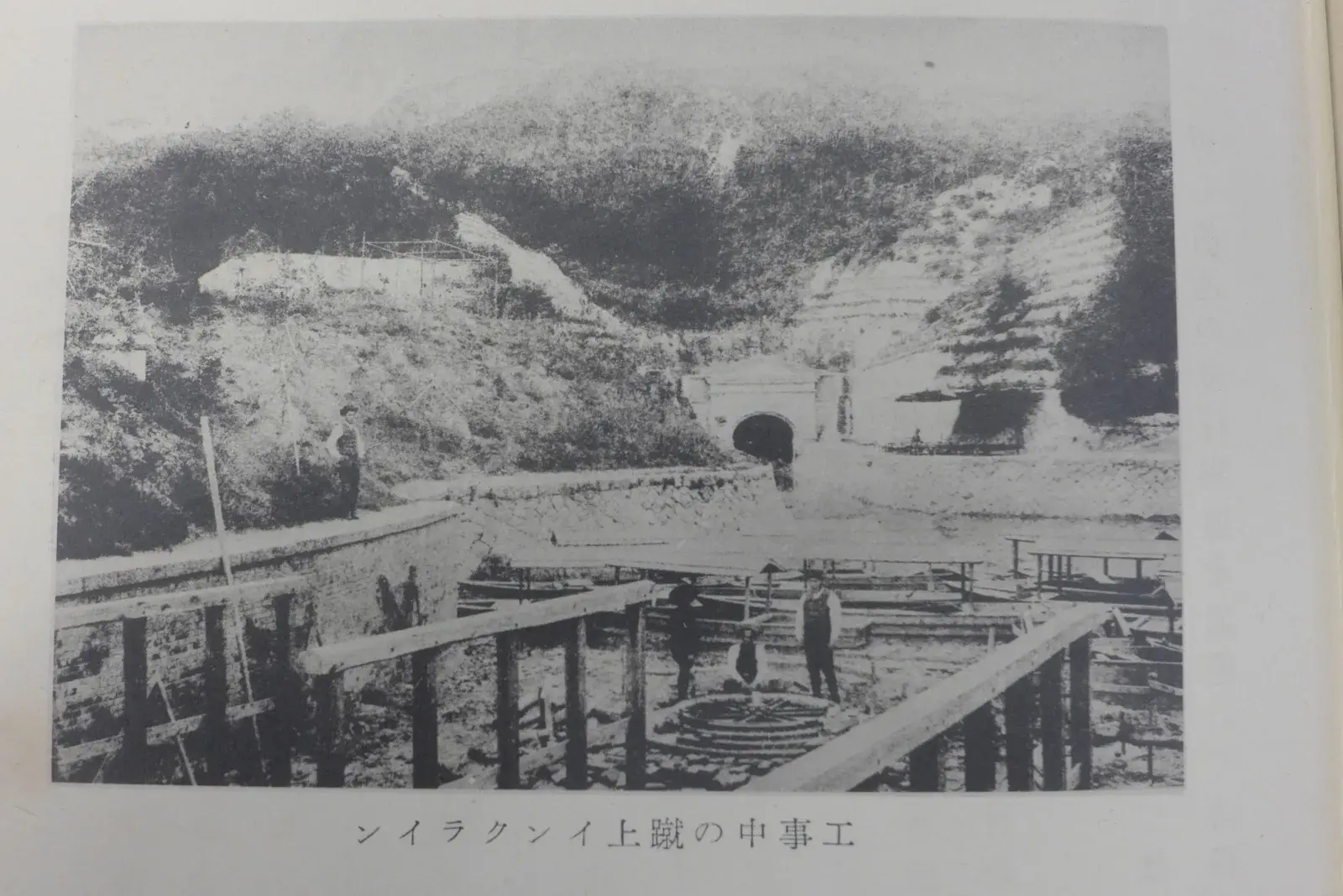
The generating station at Keage carries a claim that repays reading slowly. Two organisations describe it across three pages, and all three attach a limit to the word first, in three different wordings.
The heritage site for the canal, run by a council for the canal corridor on a City of Kyoto domain, says the Keage power station began operating in 1891 and calls it Japan's first hydroelectric station for general supply. Its English edition renders that as Japan's first hydroelectric power plant for utility services. The Waterworks Bureau's own history calls it Japan's first hydroelectric station for business use.
General supply, utility services, business use. We are not going to rule on whether these draw exactly the same line, because neither body defines itself against the other and we would be adjudicating a question nobody asked. What all three are doing is the same thing: qualifying the word first rather than using it plainly. Whatever each of them means by its qualifier, none of these three pages claims the plain, unqualified version. Another page does use it: the shrine's own chronology calls Keage simply the first hydroelectric station in Japan. We are not going to say which wording is right. The point is that the two bodies that publish and record the canal both qualify it.
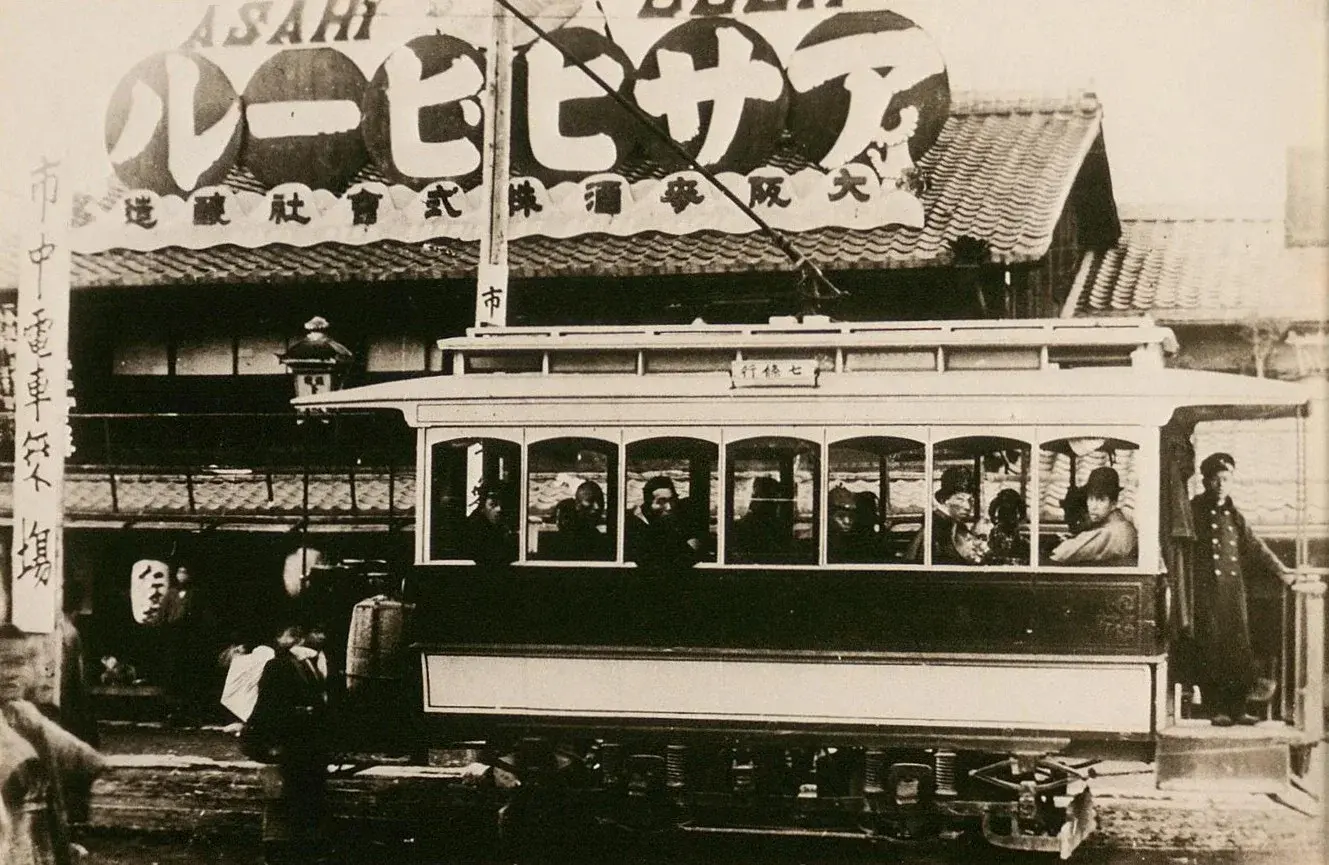
The heritage page also makes a connection the bureau only implies. It says the electricity generated at Keage was used by the electric railway that was the first in Japan to begin commercial operation — the Kyoto Electric Railway. The canal did not merely power factories. It powered the trams.
The incline itself is still there, a slope of rails climbing about 36 metres that once carried boats between two levels of water. The bureau's own caption, as we read it on 13 September 2026, describes it as being preserved in form, which is a different claim from being in use.
1895: Heian Jingu, a Tram and an Exhibition in One Year
Now put the twenty-eighth year of Meiji together.
In 1895 the country's first streetcar line opened, running from Kyoto Station to Fushimi; the bureau records this and places it alongside its account of the canal's power going to industrial use. In 1895 Heian Jingu was founded, for the eleven-hundredth anniversary of a capital that had left twenty-six years earlier. And in 1895 the Fourth National Industrial Exhibition ran in the city from 1 April to 31 July, on the shrine's own history page; the tourism agency describes it as a large industrial exhibition held to showcase new technologies and attract new industries.
Three things in one year, in a city that had spent the previous quarter century losing people. A tram, a shrine to the emperor who founded the old capital, and a trade fair for new industries, of the kind the bureau says its electricity promoted.
It is tempting to call that a coordinated programme, and on this the sources are more helpful than the usual telling suggests. The shrine's history page sets out the recovery measures as a series: sixty-four primary schools built across the city as an education measure, the digging of the Lake Biwa Canal as infrastructure, a power station using its water, an electric tramway using that electricity, and the Kyoto exhibitions as industrial promotion, among other measures. It then says that as the culmination of that series, the founding of Heian Jingu, the holding of the Fourth National Industrial Exhibition and the conduct of the eleven-hundredth anniversary rites were planned. So the plan exists, and it is written down by one of the things it produced.
Walking the Argument in One Morning
Three of the things this article has described — the shrine, the canal and the incline — are close enough together to see in sequence, unusual for a story this large.
The agency text places the shrine in the Okazaki area of Kyoto; the canal and the incline are in and around it. The tourism agency's commentary says the garden draws water from a nearby canal to create uncommonly large ponds, without naming which canal. The shrine's own history page names it: the pond water uses the Lake Biwa Canal. We read that page on 13 September 2026. So the water in front of you at Heian Jingu arrived through the recovery project, and the shrine says so itself.
Taken as three separate entries on a list of sights, that is a middling morning. Taken as one argument, it is a single walk with a single explanation, and it is the part of Kyoto a visitor can afterwards actually recount to somebody.
When to go and how busy it will be are outside this article. They are real questions with published answers, and the place to look is the sites of the four themselves. This one is about what the buildings are.
The Shrines That Explain the Rest
What Heian Shrine Is, and What It Is Not
The reflex when a famous building turns out to be younger than expected is to feel slightly cheated.
A five-to-eight scale model of a government compound, built in the 1890s by a city that had lost the function that defined it, is a stranger object than an old shrine. It tells you what the city thought was worth asserting at the moment it had the least reason for confidence. Our guide to ancient Japan visits a street it describes as an intentional reconstruction rather than an actual old town. Heian Jingu is the same move, made by a city, and the difference from a building that is the age it looks is the point.
No page we read rules on the question either way. None says the shrine counts for less because it is Meiji, and none says it counts for more as a symbol of recovery. What they say is what was built, when, by whom, at what cost, and why — and that is more than the building's appearance tells you on its own.
The part that is still moving is the recovery project itself, and it is moving in four distinct ways, not all of which are things a visitor can stand in front of.
The generating station is the first. The heritage page for the canal records that the second Keage station, completed in February 1912, survives as a building and that Kansai Electric Power holds public viewings of it periodically, and that the current third station is still generating today. We read that page on 13 September 2026. So the page describes two of the three stations at the site in the present tense: one preserved and periodically opened, one working. The same page records that in the 2016 financial year the station was recognised as an IEEE Milestone by the international body of electrical and electronic engineers, a designation awarded in the present about work done in 1891.
The garden is the second, and it is the strangest item in this article. The shrine writes that because the pond water was taken from the canal through a filter, the garden was spared the effect of non-native species, and that endangered species barely seen in the lake any more, the ichimonji-tanago among them, live there in numbers. That is the shrine's account of the garden as we read it on 13 September 2026. A piece of 1890s municipal plumbing, built to move boats and turn machines, feeds a garden the shrine says holds species that have all but gone from the lake. The shrine does not say this was intended.
The third is the least dramatic and the largest. On the bureau's account, quoted above and read on the same day, the canal still supplies the water source for about 1.47 million people, still generates power, and is still put to other uses besides. The recovery project outlived the emergency by well over a century and is currently doing the plainest job imaginable, which is water in taps — while quietly acquiring an engineering honour along the way. Of everything described here, that is what keeps changing, and it is also the part that does not photograph.
The fourth is the newest, and it closes the circle. On 7 March 2026 the shrine announced that restoration and relocation work on a Kyoto Electric Railway tram car, begun in February 2025, had been completed, and that from 1 April the car was expected to be viewable free of charge, from eight in the morning until four in the afternoon, in any season. Kyoto Electric Railway is the company the heritage page names as the first electric railway in Japan to begin commercial operation, running on power generated at Keage. So a carriage from the line the canal electrified now stands at the shrine the same recovery built. Whether the viewing began on the date announced is not something the shrine's pages told us when we looked on 13 September 2026. The canal, the current, the tram and the shrine are not separate subjects. They are one.

%20at%20Hananoiwaya%20Shrine%2c%20Kumano%20Kodo.webp)