Fushimi Inari is one of the most visited sites in Kyoto, and it is easy to leave having seen almost none of it. The visit it is easiest to have runs to midday arrival, twenty minutes into the tunnel of gates, a photograph, and out — which is the entrance to something that keeps going for another two hours uphill.
The decisions that actually shape a visit here are two: how far up the mountain to go, and what time to arrive. Everything else follows from those. This guide answers both with numbers, and explains the one thing about the gates that changes what you are looking at.
What Is Fushimi Inari Taisha?
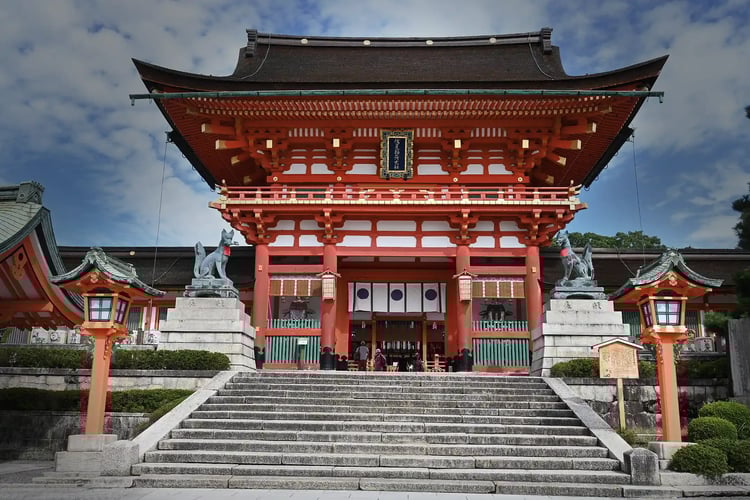
Fushimi Inari Taisha is the head shrine of Inari, the kami associated with rice, harvest, and — as commerce grew into the thing that fed people — with business prosperity. Around thirty thousand Inari shrines stand across Japan, and this is the head of all of them.
Three facts govern everything else about a visit, and all three are unusual enough to state plainly. Admission is free. The shrine is always open. There are no closing days.
Read that again, because it is doing more work than it appears to. There is no ticket to book, no last-entry time to plan around, and no Monday closure to check. You can walk through the gates at four in the morning if you want to, and the practical consequences of that run through the rest of this guide.
Getting there is equally uncomplicated. The shrine sits beside Inari Station, the second stop from Kyoto Station on the JR Nara Line — five minutes, 150 yen one way. There is no bus to miss and no walk to speak of; the main approach begins essentially at the platform.
The Senbon Torii: Who Pays for the Gates
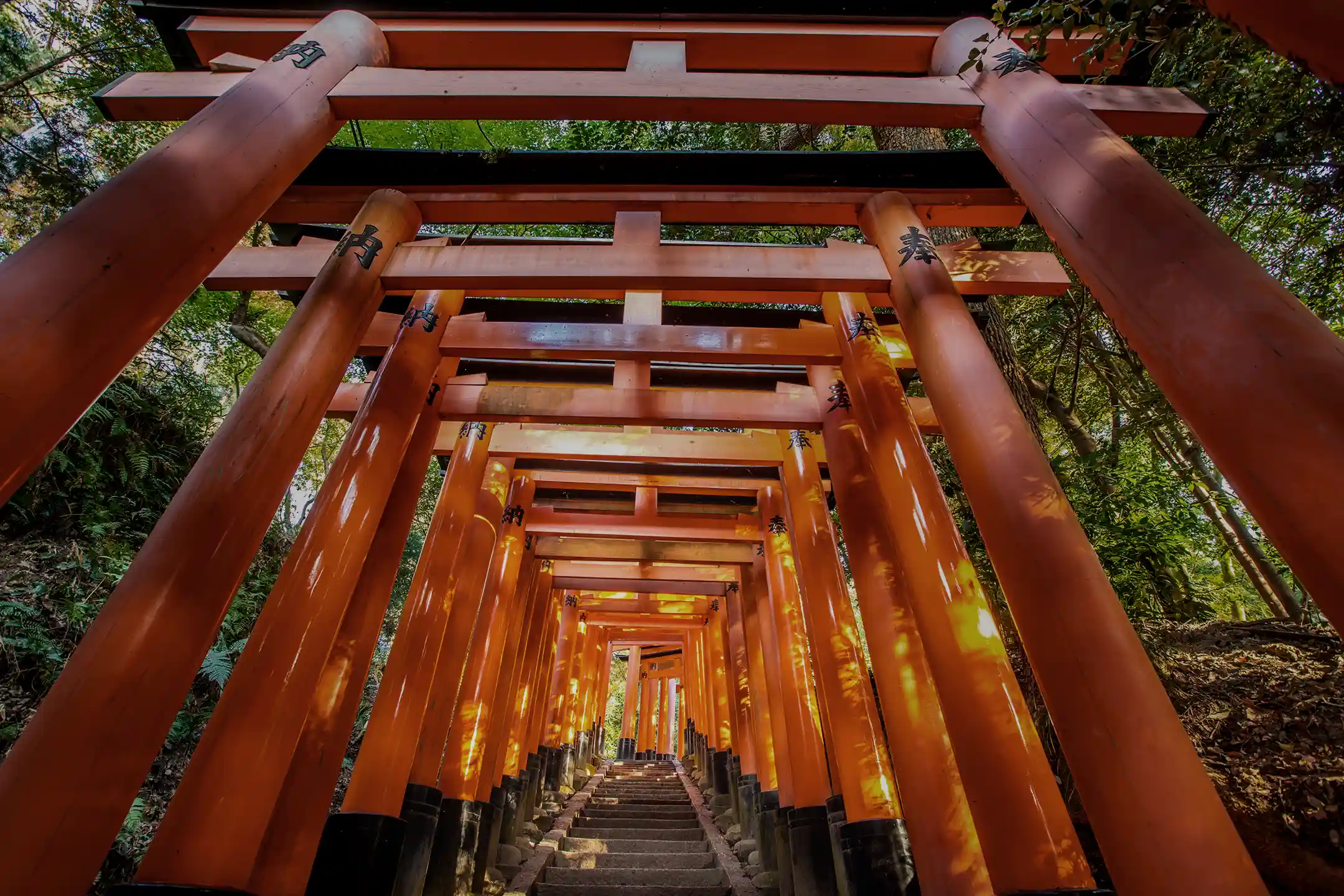
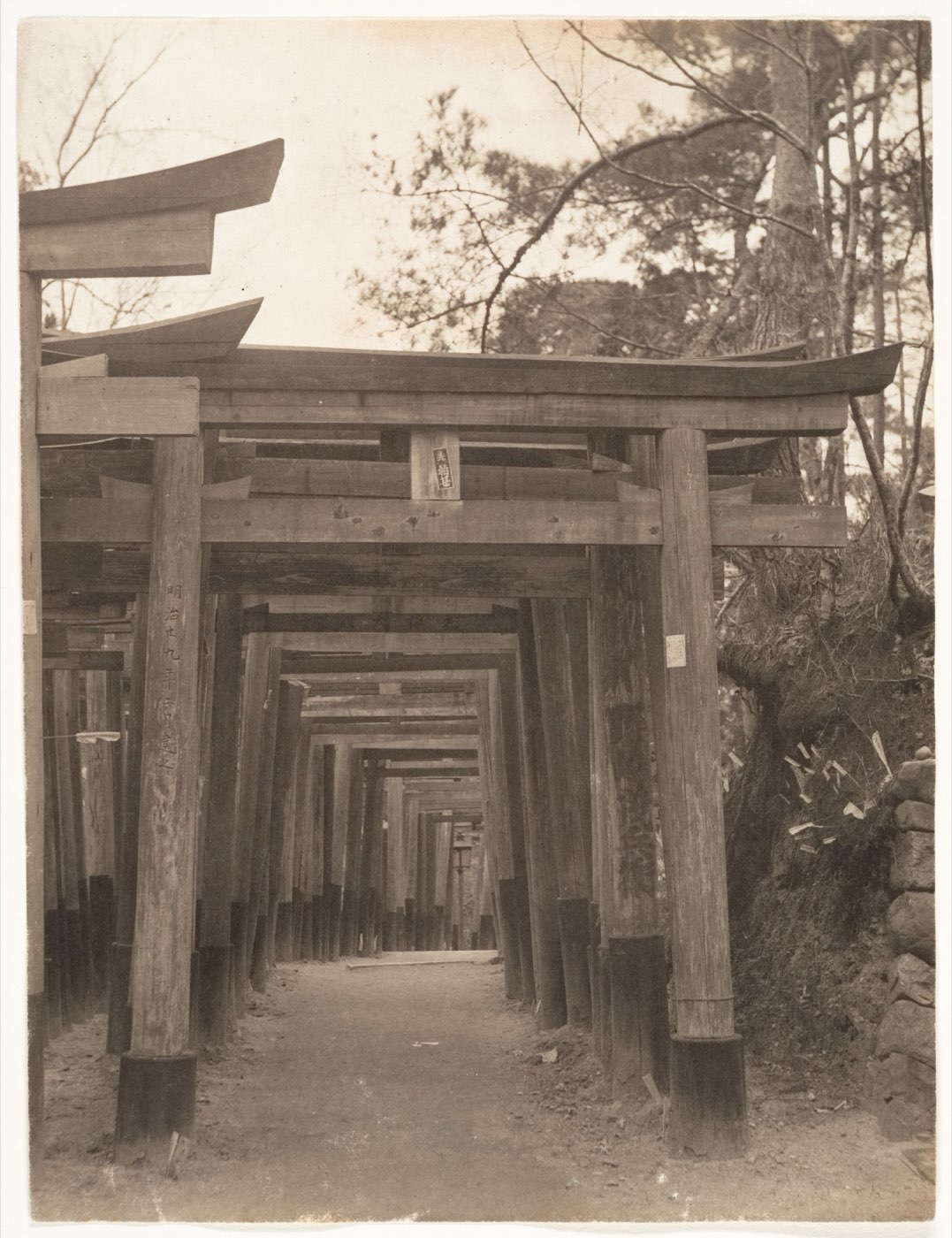
The senbon torii, the thousand gates, is the image that brings people here: two dense parallel corridors of vermilion running up behind the main shrine. What is not obvious while walking through it is that every gate is a receipt.
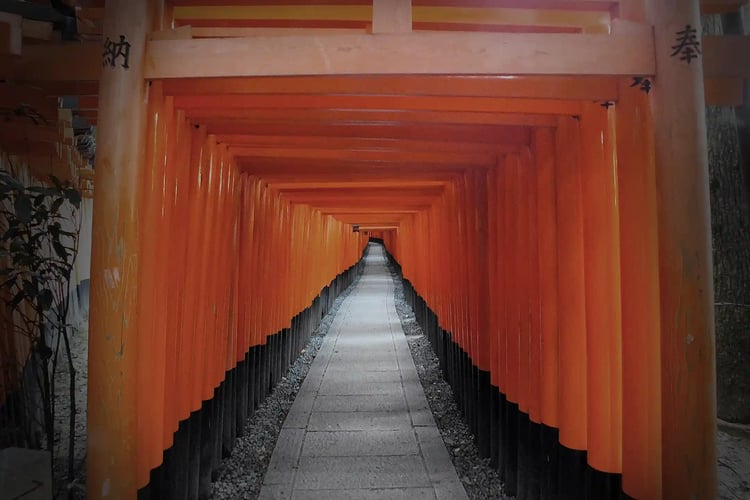
The gates are donated. They are not shrine architecture in the ordinary sense but individual offerings, each paid for by a person or a company in thanks for something that went right or in hope that something will. Turn around and look at the back of any gate: the black characters carry the donor's name and the date it was raised.
The shrine publishes what this costs. Its own guidance on torii donation lists the gates by size, from a No. 5 gate at 300,000 yen up through No. 8 at a million, No. 9 at 1,175,000, and No. 10 from 1,890,000 yen. Applications go to the shrine office, or through the tea houses on the mountain.
The torii gates are also maintained rather than merely erected. Cedar standing in a damp Kyoto valley does not last indefinitely, so gates are repainted and, in time, replaced, which is why a corridor that has existed for generations looks new. What you photograph is old as an institution and young as an object.
Now walk it again with those numbers in your head. The corridor you are photographing represents a sum of money that is genuinely difficult to hold in mind, contributed in three-hundred-thousand-yen increments, over decades, by a great many separate donors, and it is still growing — the mountain keeps absorbing gates because people keep buying them.
That is a different thing to look at than a pretty tunnel. It is a physical ledger of other people's gratitude, and you are walking through the middle of it. The symbolism of the torii form itself — why vermilion, what the gate marks — is a subject of its own, covered in our guide to the vermilion gates and what they mean.
How Far Up Should You Go? The Fushimi Inari Hike
This is the decision the visit turns on, and the layout of the place makes it easy to make without noticing.
Fushimi Inari is not a shrine with a photogenic corridor attached. It is a mountain — Mount Inari, 233 meters — with a trail running up it, lined the whole way with gates and small altars, and the shrine buildings at the bottom are the beginning rather than the destination. The full walk to the summit and back takes about two to three hours.
There are three honest stopping points, and they buy different things.
The end of the Senbon Torii — about twenty minutes. This is the conventional turning point, and it is a legitimate choice if the corridor is what you came for. You will have seen the photograph. You will not have seen the mountain, and you will have shared the whole of it with everyone who stopped where you did.
Yotsutsuji — thirty to forty-five minutes up. Roughly halfway, where the path opens out and gives you the view back over Kyoto, and where the trail divides into a loop around the summit. This is the best value in the whole visit, for a specific reason given below.
The summit — two to three hours round trip. Completeness rather than spectacle. Worth it if you want the whole thing, and worth knowing that the reward is not the gates.
Yotsutsuji, and Why It Is the Right Place to Stop
Yotsutsuji is the four-way intersection at the mid-point, and japan-guide is direct about why it functions as a natural turning point: beyond it, the trails do not vary much, and the density of gates decreases.
That second clause is the useful one. The gates are what you climbed for, and they thin out above Yotsutsuji. Combine that with the view over Kyoto that opens up at Yotsutsuji itself, and the mid-point turns out to offer both things at once.
So the mountain rewards the opposite of what the layout suggests. Do not stop at the end of the Senbon Torii, and do not assume the summit is the prize. Walk the thirty to forty-five minutes to Yotsutsuji, sit down at the tea house there, look at Kyoto, and then decide whether the loop is worth another hour to you. The stretch below that point holds the view, the tea house and the densest gates; the stretch above, by the same guide, offers less variation and fewer gates.
When to Arrive at Fushimi Inari
Here is where free admission and round-the-clock opening stop being trivia and start being a plan.
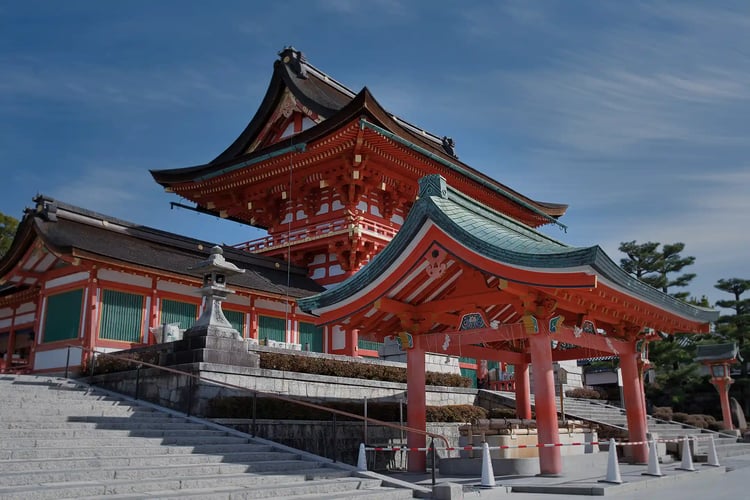
Every other major site in Kyoto has a gate that opens at a set hour, which means every visitor arrives inside the same window. Fushimi Inari does not, and the shrine is therefore the one place in the city where being early is unlimited rather than merely advisable. There is no first admission to queue for. There is only the hour you are willing to get up.
Before about eight in the morning, the Senbon Torii can be walked almost alone. By mid-morning the tour groups arrive from Kyoto Station, five minutes away, and the corridor becomes a slow-moving line. Late afternoon thins out again, and the shrine after dark is a genuinely different experience: the gates go from vermilion to something closer to black. Lighting on the mountain is not designed for walking, and it thins out as you climb, so treat an evening visit as the lower section only unless you have brought a torch and know the route.
The practical version, then. If you want the corridor empty, arrive at dawn and climb to Yotsutsuji as the light comes up. If you cannot face that, go in the evening instead of the middle of the day — the shrine never closes, so the daylight hours are a convention rather than a constraint.
Inari, the Foxes and the Vermilion
Inari worship is older than the shrine's tourist profile by a very long way, and the parts of it that are visible on the mountain repay a little explanation.
The deity is properly Inari Ōkami, and the shrine dates its own enshrinement to the first Day of the Horse in the second month of 711. This is a Shinto shrine, though the boundary has always been porous here — Inari is venerated at Buddhist temples too, and Toyokawa Inari in Aichi, pictured below, is one of them. What has shifted is the scope of what people ask for. The faith began in agriculture, with rice, and it now takes petitions for business prosperity, traffic safety, and whatever else an individual brings. That elasticity is the reason there are Inari shrines behind office buildings and beside factory gates all over Japan.
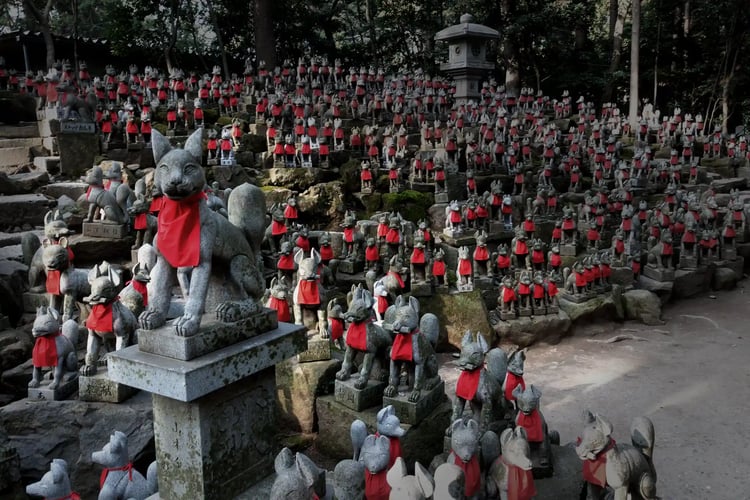
The foxes are what people ask about. They are not Inari, and the FAQ is unusually blunt on the point: Inari Ōkami is not a fox. They are the deity's messengers, and the ones venerated here are not the animals in the hills but white, unseen ones. In stone they are everywhere on the mountain, usually in pairs flanking an altar, frequently carrying something in their mouths — a key, a jewel, a sheaf of rice. Our guide to fox worship and Inari shrines goes into what each object means and why the association formed.
Then there is the color. The shrine's own FAQ gives three reasons for the vermilion, and they sit oddly together: it has long been held to be a color that works against malign force; it is, in the shrine's own gloss, the color of Inari's abundance; and the pigment preserved the timber. A corridor of wooden gates standing in a damp valley is a very large maintenance problem, and the color is part of the answer to it.
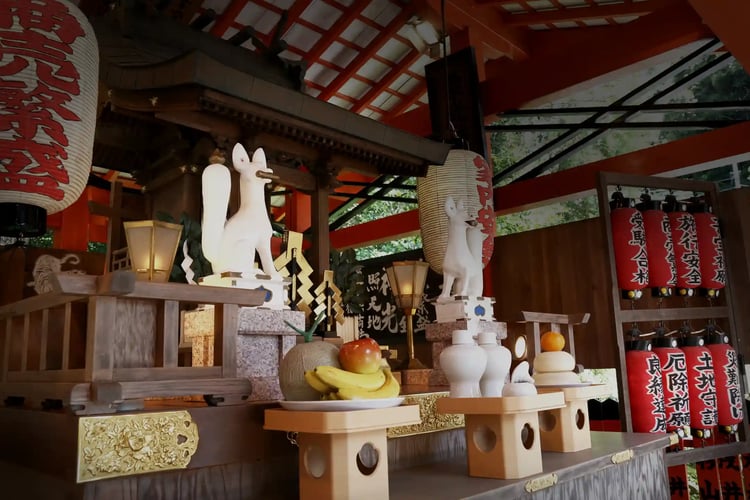
Less obvious is what is not a gate. Scattered along the trail, especially above the Senbon Torii, are hundreds of small private altars — miniature torii stacked in tiers, stone foxes, name plaques — set up by individuals and small groups. These are not part of the shrine's own architecture either. The whole mountain works this way: an official shrine at the bottom and an accumulation of private devotion above it, built up over centuries by people acting on their own account.
The Fushimi Doll, and the Last Kiln
One thing the mountain produced left it entirely. The account given is that around four hundred years ago pilgrims began carrying home earth from Mount Inari and scattering it on their fields for a good harvest, and that earth was also worked into clay figures. Those became the Fushimi doll. Pilgrims took them home from here, potters elsewhere copied what they had seen, and the craft publisher Nakagawa Masashichi records that clay-doll making spread to nearly a hundred production sites across Japan — which is why the Fushimi doll is described as the root of the entire Japanese clay-doll tradition.
One kiln still makes them. At the peak of the trade, in the closing decades of the Edo period, fifty to sixty workshops in Fushimi were producing these dolls. Today there is one. Tanka, founded around 1750 and now run by Ōnishi Sadayuki, the eighth generation of the same family, is the only workshop left producing and selling Fushimi dolls — fifty or sixty houses reduced to one, at the foot of the hill the clay came from.
If Kyoto's shrines as a whole interest you, our cultural guide to the city's shrines covers the wider set, and the conventions of visiting one properly are in our guide to visiting Japanese shrines.
.png)
A Wider Landscape Awaits
What you've read here is one entrance into a tradition of remarkable depth and quiet complexity. The Sacred Path Digital Guide moves beyond a single article — connecting shrine culture, Shinto spirituality, sacred geography, and the living rituals that still shape how Japan understands the world. It is a carefully shaped reading for those who want not just information, but genuine understanding.

Conclusion
Two numbers decide this visit. Thirty to forty-five minutes gets you to Yotsutsuji, which has the view, the tea house, and the last of the dense gates. And zero, which is both the admission price and the number of hours the shrine is closed, meaning the corridor can be walked at dawn by anyone prepared to set an alarm.
The gates themselves are worth one more thought on the way down. Three hundred thousand yen for the smallest of them, paid by someone who wanted to say thank you, multiplied by a corridor and then by a mountain. Whatever else Fushimi Inari is, it is a very large accumulation of small acts of gratitude, and it is still being added to while you walk through it.

.webp)