Japan labels packaged food for allergens by law. It is a good system, and the guidance you can read about it in English is guidance about packages — which is not what you were planning to eat.
This article sets out what the labelling system does and does not cover, which ingredients are worth asking about rather than assuming, and what has to be arranged before you fly rather than on arrival. It is not medical advice and it cannot tell you that anything is safe. Those judgements are yours and your doctor's, and nothing below replaces either.
The Consumer Affairs Agency and the regional bureau are quoted from their own English; neither page carries a date, so we give the day we read them. The Act is quoted from the government translation database, which states that its translations "are not official texts" and that "only the original Japanese texts of the laws and regulations have legal effect"; the version there is the 2018 one. All were read on 11 September 2026.
Our free guide to Japanese dining covers how a meal is composed — which is what you are asking a kitchen to change.
Food Allergy Labelling Covers Packages, Not Plates
Start with the correction that reorganises everything else, because it is easy to come away from travel writing on this topic with the impression of a protection that does not extend where you need it.
What the Allergen Label Guarantees
The Consumer Affairs Agency puts it plainly: "To prevent health hazards to consumers allergic to specific foods, it is mandatory to indicate the presence of specified ingredients in foods and additives based on the degree and frequency of past health hazards, etc."
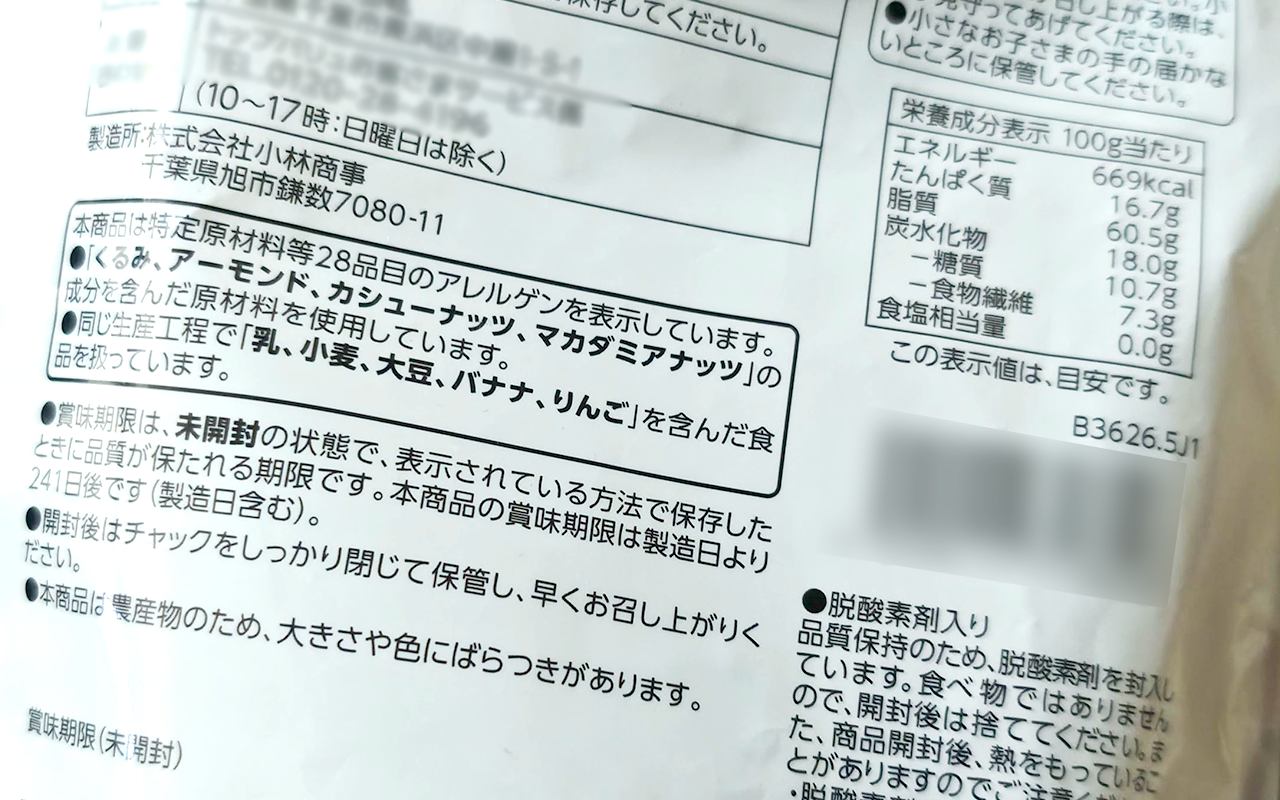
There are two tiers, and the difference between them matters. Labelling is mandatory for the specified ingredients: "Shrimp, crab, walnut, wheat, buckwheat, egg, dairy products, and peanut." Eight items, chosen as "items with high need for labelling based on the number of cases and severity."
Labelling is only recommended for a second, longer list the agency calls items equivalent to specified ingredients: "Almond, abalone, squid, salmon roe, orange, cashew nut, kiwi fruit, beef, sesame, salmon, mackerel, soybean, chicken, banana, pork, macadamia nut, peach, yam, apple, and Gelatin." Twenty items, described as having "a considerable number of cases and patients with severe symptoms on a continuous basis but not as much as the specified Ingredients."
If your allergen is on the second list, the absence of a warning on a package is not information. It is the absence of a requirement.
There is a second thing to know about how the label is written, and it catches people who read ingredient lists carefully. The agency's rule: "As a general rule, allergens must be listed individually. They may be listed collectively on an exceptional basis." The Consumer Affairs Agency describes two ways of writing it, and its own examples show the difference. Listed individually, the entry reads "ham (including egg and pork), mayonnaise (including egg and soybean)". Listed collectively, the allergens are gathered into one bracket at the end of the whole list: "(including egg, pork, soybean, beef, salmon, mackerel, and gelatin in part)".
So scanning for your allergen beside each ingredient can miss it entirely. On a collectively labelled package, the information you want is in one bracket at the end of the ingredient list.
Why a Restaurant Is a Different Situation for Food Allergies
Now the scope. The Food Labeling Act requires the Prime Minister to establish, "by Cabinet Office Order, standards for the labeling of food that is intended for sale" — standards set "for each category of food and of type of person engaged in food-related business, etc.", containing "among the following information, that considered necessary … for each of those categories", with the allergen named among that information.
Read the machinery in that. What must be labelled is decided category by category, for both the food and the kind of business, and the deciding is delegated to a Cabinet Office Order. That is the mechanism by which a requirement can sit differently on a factory and on a kitchen. What the Consumer Affairs Agency publishes in English is guidance on the labelling of "foods and additives". Every labelling example it gives is an ingredient statement of the kind printed on a package, which is why we read it as guidance about packages. It is not guidance on what appears in front of you at a table.
This article is not going to tell you that restaurants are legally exempt, because we have not found an English translation of the ordinance that draws that boundary, and we have not read it. What we can say is narrower and enough to plan around: the protection you can point at, in a language you can read, is a protection about packages. At a restaurant, you are relying on a conversation instead.
That is not a complaint about restaurants. It is a description of which tool you are holding. And it means the work moves earlier — from reading a label on the day to arranging something before you arrive.
Where an Allergen Hides
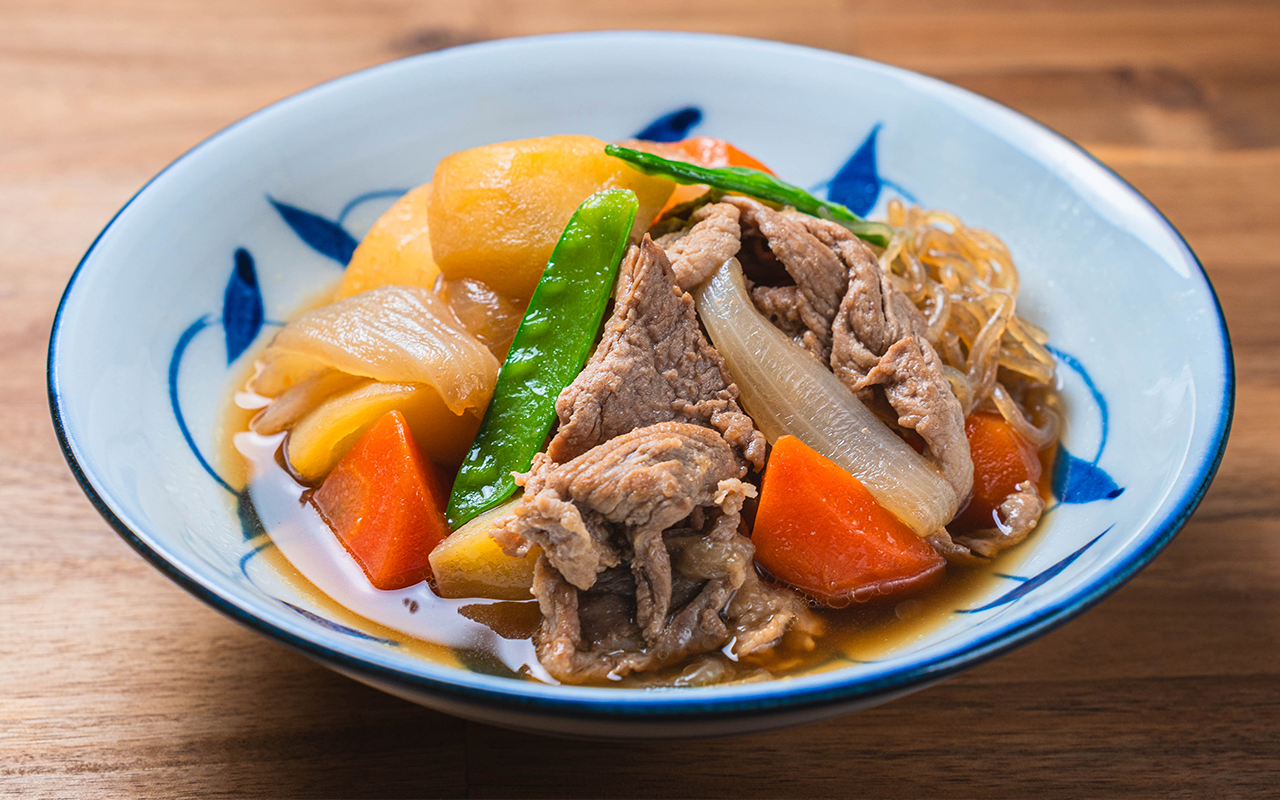
Three things worth naming — not as claims about what any dish contains, but as the things to raise when you ask.
Dashi Is in More Than Soup
Dashi is the stock underneath a great many Japanese dishes, and it is not confined to the bowl of soup where a visitor expects to meet it. It can be in the simmering liquid of a vegetable dish, in a dipping sauce, in a dressing, in the seasoning of rice.
Now apply this article's own logic to it. The aquatic items on the agency's two lists are salmon, mackerel, salmon roe, abalone and squid, all on the recommended tier; shrimp and crab are on the mandatory one. Katsuobushi (dried bonito) and niboshi (dried sardine) are on neither list — which, by the reasoning above, means the allergen-labelling requirement quoted earlier does not reach them. The ingredient list is a separate requirement — the Act lists "the name, allergen … ingredients, additives" among its separate items — and how an ingredient has to be written there is set by the same Cabinet Office Order we have not read. So it may name them, or it may not. That is what makes dashi a thing to ask about by name — and makes those two words worth carrying, in Japanese as well: 鰹節 and 煮干し — rather than a thing to deduce from a label or from a dish's description.
What you cannot do is infer. A dish being vegetable does not tell you what the vegetables were simmered in.
Soy, Wheat, and the Same Bottle
Wheat is on the mandatory list, and it is worth knowing that soy sauce is a product where wheat can be present, depending on how it was brewed. That is a question to ask, not a rule to assume in either direction — there are soy sauces made without wheat and soy sauces made with it, and the bottle on the table will not announce which is which.
Soybean itself sits on the recommended list, which means a package containing it may or may not say so. For a soy allergy in a cuisine built on soy, that combination — widely used, only recommended for labelling — is the one to take to your doctor before you plan meals around it.
Shared Equipment and Cross-Contact
The third question is not about ingredients at all. Frying oil, grills, knives and boards can be shared in a working kitchen, and the usual term for what that can do is cross-contact. Whether a particular kitchen can separate them is a question about that kitchen.
Nobody can answer it from outside, and this article will not try. What it can tell you is that the question exists and has to be asked explicitly, because "we can make it without wheat" and "we can make it away from wheat" are different answers to different questions, and a busy kitchen may hear the first one unless you ask the second.
The Counter Is Easier Than the Cafe
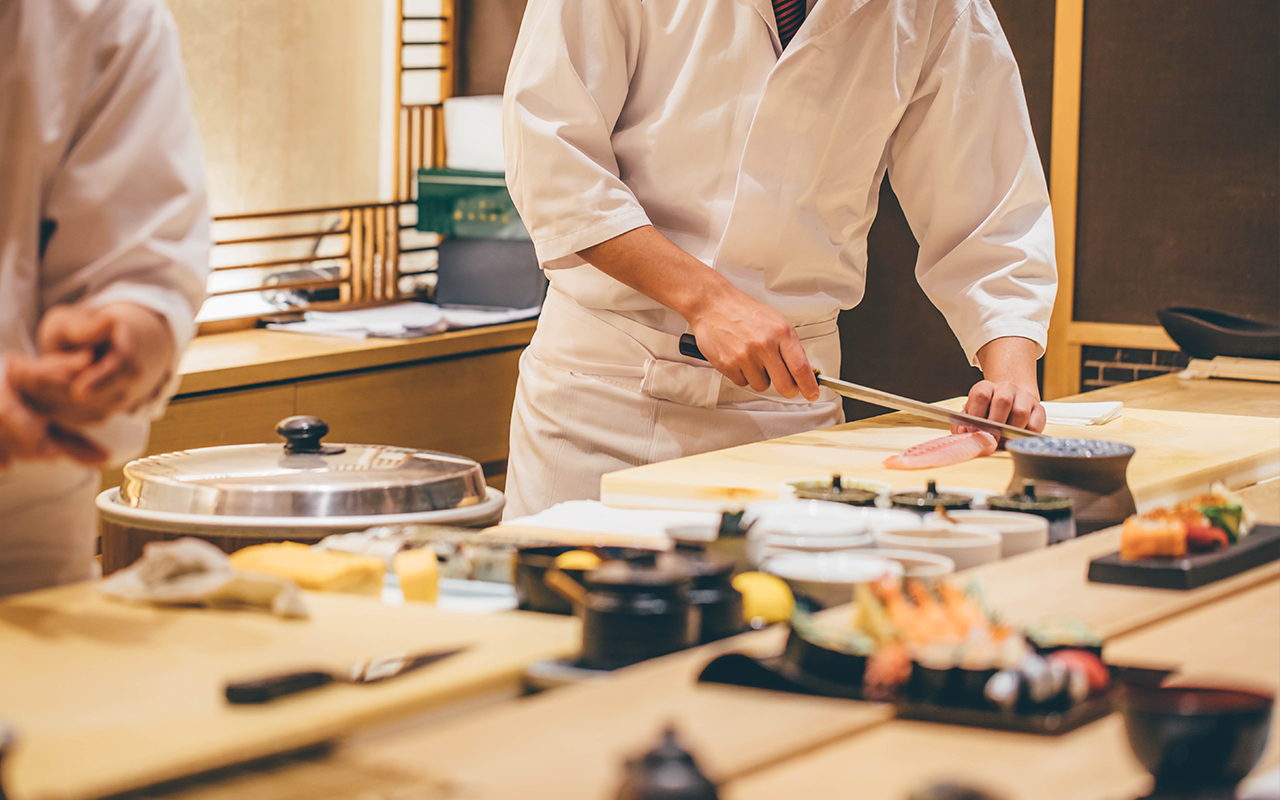
Here is the structural point that runs against intuition, and it is the most useful thing in this article for the kind of trip our readers plan.
Why a Set Menu Can Be Adjusted Away From an Allergen
A place that composes its menu each day has the person who decides the composition standing in front of you. A place that reheats a pre-made item has a supplier, a specification and a box, and nobody on the premises who can change what is in it.
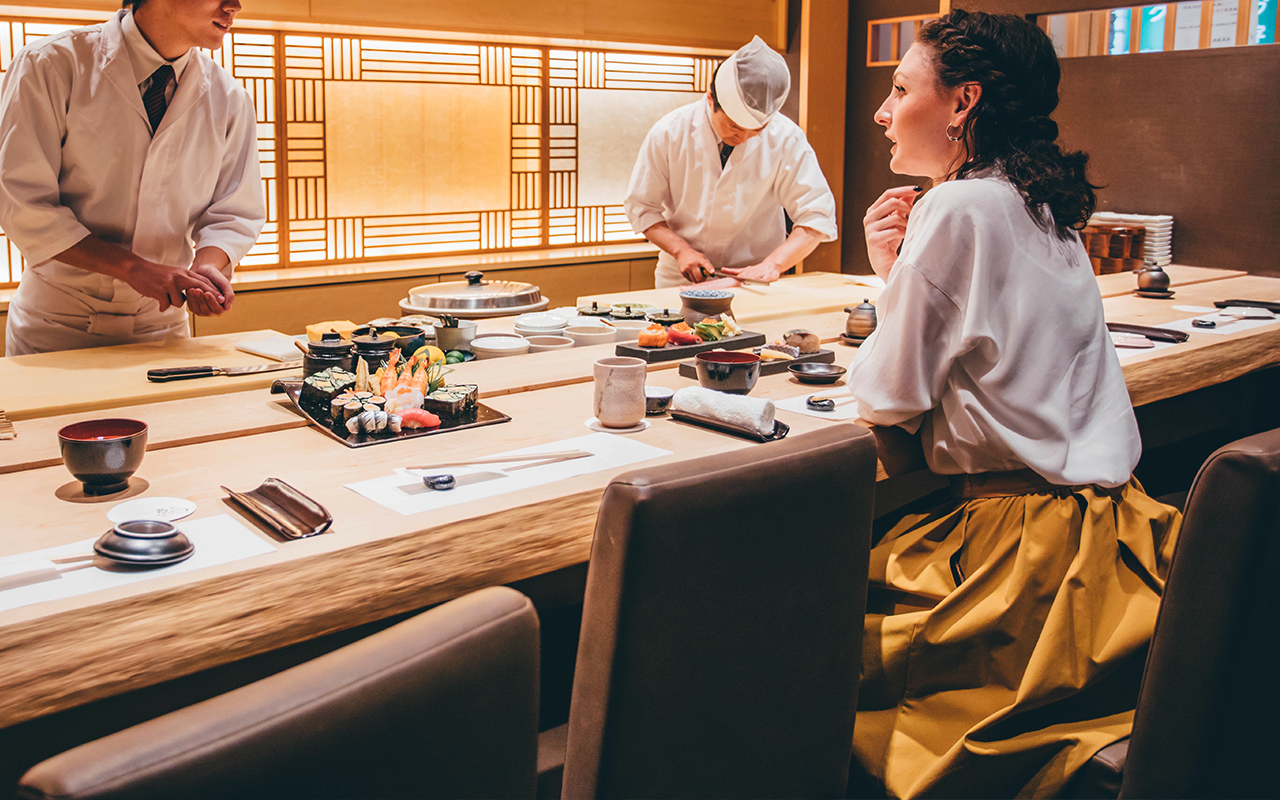
So the small counter where the day's courses are decided by one cook is, structurally, the easier conversation — not because it is more expensive or more attentive, but because the decision is local. Edomae sushi works this way: a sequence assembled in front of you, from components the chef selected that morning.
That is a claim about where the flexibility sits, not a claim that any given place can accommodate you. A kitchen with one cook and one stock pot may have less room to move, not more. The point is only that the question has somewhere to land.
But Only If You Say It Before You Book
The flexibility is in the composition, and the composition is decided before service. Raised at the table, the request arrives after the decisions it would have changed.
Say it when you reserve, in writing if the booking is in writing, and say the allergen rather than the dish. And be ready for the answer to be no: a restaurant that says it cannot do this safely is giving you good information, not poor service.
What to Arrange Before You Fly
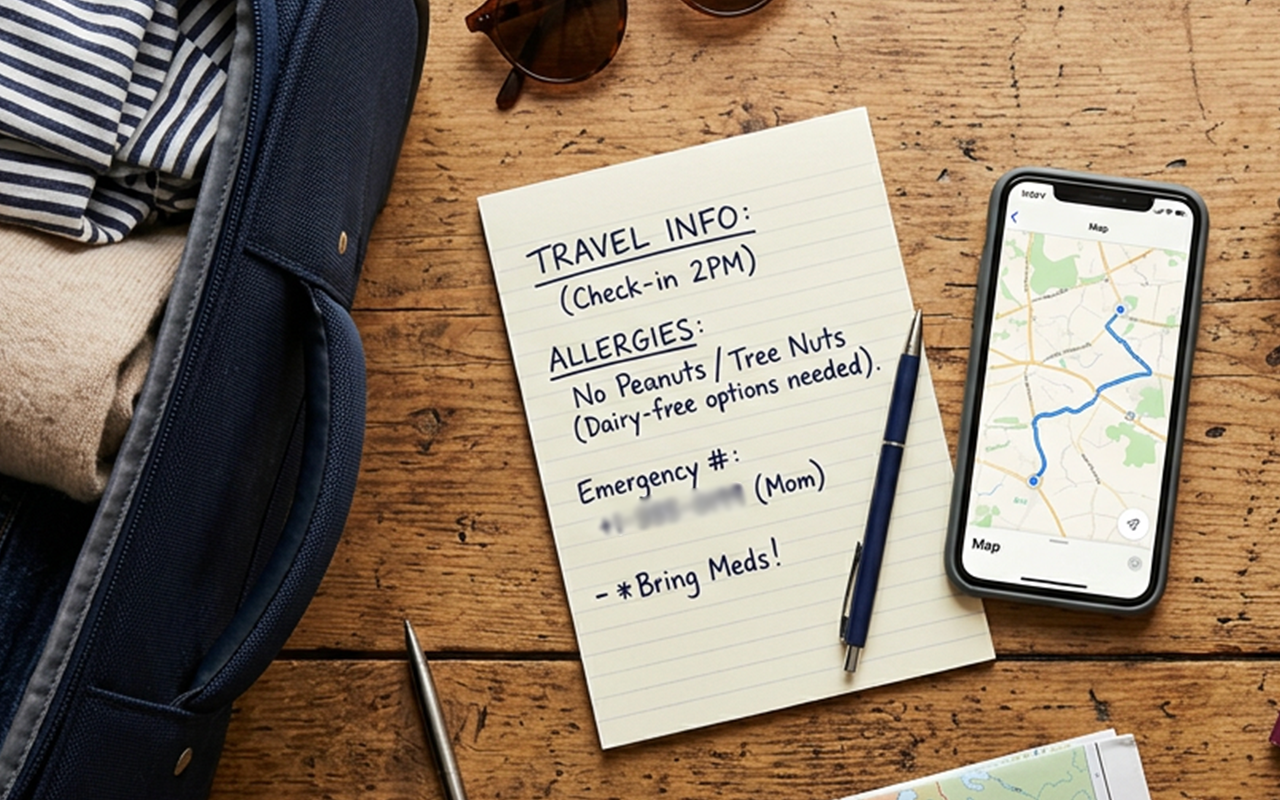
One of these has a lead time the official guidance measures in weeks, which is why it belongs at the planning stage rather than the packing stage.
Medication and the Yakkan Shoumei
This is the part where guessing has consequences, so here is the official wording, from a Ministry of Health, Labour and Welfare regional bureau Q and A published in English, read on 11 September 2026.
There is a route with no paperwork, and it has five conditions, all of which have to hold — and which one fails decides what you do next. You may bring prescription medicine "without any special procedure" where: "you bring it only for your own use"; "it is an oral or an external medicine, not an injection"; "it is not any prohibited drug such as Methamphetamine in Japan"; "it is not any especially controlled drug such as Narcotics in Japan"; "and its quantity is up to one month's supply."
What happens when one of those five does not hold depends on which one, and this is the part to get right. Two of the five have the import certificate as their route. Quantity is one: the bureau writes that you may bring "more than one month's supply of any prescription medicine, except prohibited drugs and especially controlled drugs, only for your own use into Japan with you, if you apply for a so-called 'Yakkan Shoumei' … and receive it before you leave home." Injections are the other, and that is the one to notice. The bureau's sentence about them is narrow — it covers "only a so-called 'Pre-filled Syringe' or 'Self-injection Kit' used under the direction of doctor" — but within that description condition two rules an injection out of the no-paperwork route whatever the quantity, so a single device well under a month's supply still belongs on the certificate.
That leaves three conditions, and they do not behave alike. Two of them — prohibited drugs and especially controlled drugs — are excluded by the quantity sentence itself, so the Yakkan Shoumei is not their route. The third is the one the document answers least. Both certificate routes are written for medicine you bring "only for your own use", and the injection answer adds "used under the direction of doctor". If what you carry is somebody else's — a child's device, a partner's prescription — this document does not set out a route for it, and the bureau is the only place to ask.
For the prohibited and the especially controlled drugs, the same document is blunt. Of stimulants: "Any medicine containing Methamphetamine or Amphetamine is defined as one of 'Prohibited Stimulants' and strictly restricted in Japan. Nobody can bring any medicine containing Methamphetamine or Amphetamine (Adderall and so on) into Japan." The same answer adds that if "you are found with any medicine containing Methamphetamine or Amphetamine illegally in Japan, you can be arrested as a criminal on the spot, immediately, without a warrant in principle." Of narcotics, the route is a different certificate: the Minister issues it and the application goes to the Narcotics Control Department — "a Special Certificate issued by the Minister for Health, Labour and Welfare to Narcotics Control Department, which is a Special Police for Narcotics" — and the consequence is stated in the same breath: if "you are found with Narcotics in Japan without a Special Certificate", then "you can be arrested as a criminal on the spot, immediately, without a warrant in principle." The same document adds that codeine phosphate above one percent counts as a narcotic in Japan, and that a medicine containing more than ten percent pseudoephedrine cannot be brought in at all. On codeine it tells you how to check: confirm the percentage "on the basis of the label or package", and "you may also consult with your doctor or the manufacturer".
So if what you carry is a prescribed stimulant or a narcotic, nothing in this article is your answer. The bureau is, and the question belongs in the weeks before you book rather than in the queue at the airport.
Injections are handled by a separate answer, and it is the one to read if you carry an adrenaline auto-injector — while noting that the document never uses that word. What it says is: "You can bring only a so-called 'Pre-filled Syringe' or 'Self-injection Kit' used under the direction of doctor into Japan with you, if you apply for a so-called 'Yakkan Shoumei' … and receive it before you leave home." Whether your own device falls inside those two descriptions is a question for the bureau, not for this article.
Two further points from the same document, because they catch people who did the paperwork. Quantity is on the application: among the required documents is a "Copy of Prescription or Direction for medicines with doctor's signature, by which the Pharmaceutical Inspector can confirm the name and the quantity of each medicine only for your own use clearly." And the certificate is checked against what you are actually carrying — it "will be valid only when your luggage contents are the same as indicated on the 'Yakkan Shoumei'", and "you have to take care never to correct the 'Yakkan Shoumei', or it becomes invalid."
Then the lead time, which is why this is a planning item. Applications go "by post". For applicants in "North America, Europe or Australia", the bureau writes that "it usually takes about two weeks totally to receive a 'Yakkan Shoumei' there, even if your application documents are complete." Where you post it depends on where you land: the document routes arrivals at Narita to the Kanto-Shin'etsu bureau and arrivals at Kansai or Chubu to the Kinki bureau. Those are the three airports it names. If you land anywhere else, Haneda included, it does not tell you which office is yours, and asking is the only way to find out.
Do not plan from this paragraph. Rules change, the bureau that handles your case depends on where you land, and the wording above is a snapshot of one page on one day. Take it as notice that a procedure exists and that it has a lead time, then confirm the current requirement with the bureau and with your own doctor before you book flights.
Allergen Cards That Say It for You
A printed card stating your allergen in Japanese is worth carrying, for the same reason the conversation has to happen at all: the label is not going to be there.
Two honest limits. This article does not recommend any particular card or service, and it cannot vouch for any translation — a card is only as good as the wording on it, and a wrong word on a card is worse than no card, because it will be believed. If you have the option, have the wording checked by someone who reads both languages and knows what you actually react to.
The card is also a supplement to the booking conversation rather than a substitute for it. It is the thing that survives a change of server, not the thing that gets the menu changed.
Gluten Free, Vegetarian and Allergy Are Three Different Requests
Worth separating, because three different things arrive at a kitchen in the same sentence, and the conflation costs whoever needs it most.
There is a medical allergy. There is a medical condition or intolerance that is not an allergy — coeliac disease is the clearest case, and it is not a preference. And there is a preference or an observance. All three can be phrased as "I cannot eat X", and only the first two carry clinical consequences.
Searching for vegetarian restaurants in Japan, or for gluten free options, will surface places used to the question — which is useful, and is not the same as a kitchen that can work around an allergen. Note too that gluten and the agency's mandatory item are not the same thing: the list says wheat. Vegetarian dishes may be made with fish stock, and a vegetarian request can be received as a question about visible ingredients rather than about what a sauce was built on. If your requirement is medical, whether allergy or coeliac, say so in those words and name what you react to.
The reverse also holds. If your requirement really is a preference, say that rather than borrowing the language of allergy, so that a kitchen can tell the difference when it counts. Eating your way through a city — or learning how a Japanese meal is put together — is a different exercise depending on whether your requirement is medical or a preference.
How a Japanese Meal Is Built
Food Allergies in Japan: What to Settle Before You Book
Three things, and then what is moving.
First, know which list your allergen is on. Eight are mandatory on packages: shrimp, crab, walnut, wheat, buckwheat, egg, dairy products, peanut. Twenty more are recommended only, and for those the silence of a package means nothing at all. And on a collectively labelled package, everything is in one bracket at the end.
Second, treat the restaurant as a conversation, not a label. Ask about dashi by name, ask about the soy sauce, and ask separately whether a dish can be made away from an allergen rather than merely without it. Say it when you book, not when you sit down.
Third, start the medication paperwork early. The no-paperwork route for prescription medicine has five conditions at once: your own use, oral or external rather than injection, not a prohibited drug, not an especially controlled drug, and up to one month's supply. Two of the five are solved by the Yakkan Shoumei: a quantity above one month's supply, and an injection of the two kinds the bureau names. Of the three that are left, prohibited and especially controlled drugs are excluded by the bureau's own quantity sentence, and "only for your own use" runs through both certificate routes — so medicine you are carrying for somebody else has no route described here either. A medicine containing methamphetamine or amphetamine is a flat no: "nobody can bring" it, in the bureau's words. A narcotic has its own route — a Special Certificate issued by the Minister for Health, Labour and Welfare, applied for at the Narcotics Control Department and received before departure. For any other prescribed stimulant, the bureau is the place to ask and this article is not. Stimulants and narcotics are worth asking about before anything else on this list — the consequence the bureau names there is arrest, not paperwork. Injections are covered by a separate answer that names two kinds of device, and whether yours is one of them is a question for the bureau. Quantity belongs on the application, and the certificate holds only while your luggage matches it. Confirm the current rule with the bureau and your doctor — this article is a prompt to check, not a clearance.
What moves is the list itself. The eight and the twenty are not fixed features of the cuisine. The mandatory standards are set by Cabinet Office Order under the Act, and the Act provides for changing them: the procedure for establishing them "appl[ies] mutatis mutandis to the change of standards for the labeling of food that is intended for sale …". For the recommended tier the agency does not say which instrument sets it. And the basis the Consumer Affairs Agency gives is itself a moving quantity: labelling is mandatory "based on the degree and frequency of past health hazards, etc." So this article carries a date, and an allergen you checked on a previous trip is worth checking again. The part that is published and translated is the part on the package. The part you will actually eat is still the part you have to ask about.
Which is the honest bottom line. None of this is a guarantee, and none of it is medical advice. It is a way of knowing which questions are yours to ask, and when.