%20of%20a%20Traditional%20Japanese%20Tea%20Room.webp)
When you first encounter the Japanese tea ceremony, what you most want to know is "what happens, and in what order?" The tea ceremony is both "an event for drinking matcha" and a total art form in which space, utensils, seasons, and human behavior are woven together as a single story. Let's first take a brief look at the overall picture of a tea gathering, then move on to the basic conduct expected of you as a guest, and finally explore why the Japanese tea ceremony steps follow this particular order—all laid out in an approachable way.
How Do the Japanese Tea Ceremony Steps Unfold? First, Get a Feel for the Overall Flow
When you first step into the world of tea, what you'll want to grasp before the finer points of etiquette is the bigger picture—"in what order does time progress?" A tea gathering is not simply a string of rituals; it has a structure that gradually attunes your heart and senses in stages, from the moment you walk the roji (garden path) to the moment you take your leave.
You leave daily life behind at the entrance, shift your awareness through purification, receive the day's theme at the tokonoma, and deepen your taste and focus through sweets and matcha—just by grasping this progression, the quality of your experience transforms dramatically. Rather than getting caught up in details, try taking in the overall "design of time" on which a tea gathering rests.
For short introductory sessions aimed at beginners, it's easiest to think of the Japanese tea ceremony steps as: "entering → purification → viewing → sweets → usucha → viewing → taking your leave." In a formal chaji, on the other hand, the flow becomes more elaborate, including the waiting room, kaiseki meal, intermission, koicha, and usucha (*1).
What to Prepare Before the Tea Gathering
Before entering the venue, set your inner clock to a slower pace. For peace of mind, check each venue's guidance in advance regarding punctuality, what to bring, and whether fragrance is permitted. In tatami-seated settings, you may be asked to wear white socks (*2).
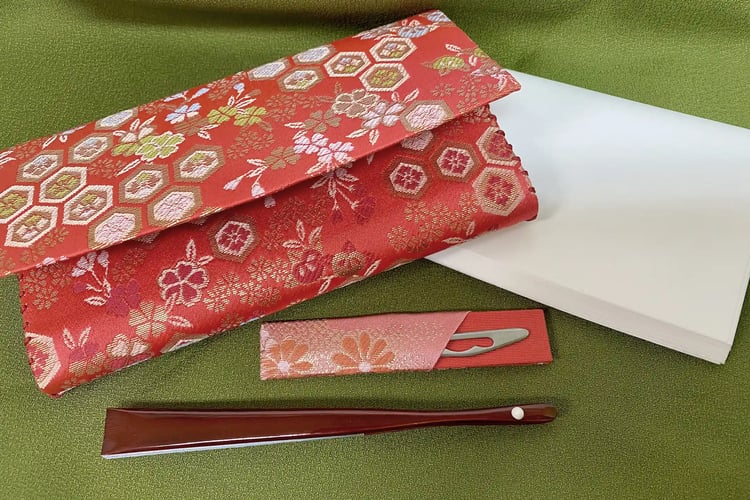
Since you'll be stepping onto tatami mats, having white socks on hand will put you at ease (*3). The essentials to bring are kaishi (paper for placing sweets on), a sensu (a folding fan used as a symbolic "boundary" during greetings), and a kashi-yōji (a pick for cutting sweets) (*3).
The Flow from Entry to Being Seated
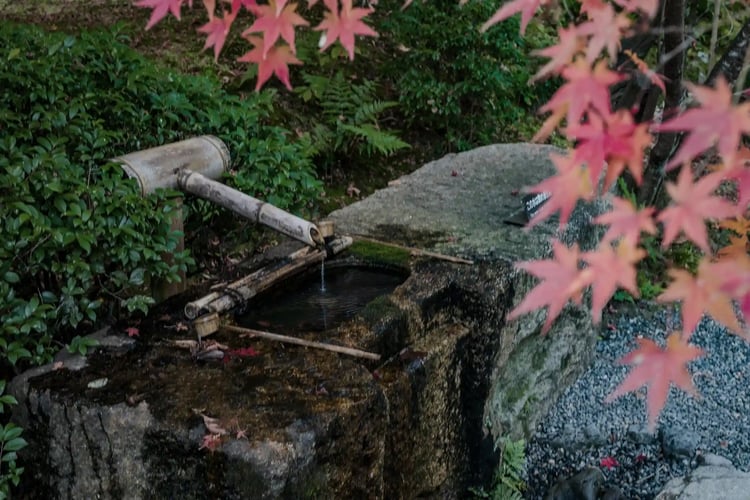
In formal settings, you'll walk along the roji (a small garden path leading to the tea room) and purify your hands and mouth at the tsukubai (a stone water basin). This is less about hygiene and more about a shift of mood—"shedding the dust of the everyday world so that everyone enters the gathering with the same mindset" (*4).
You may enter the tea room through a nijiriguchi (a small entrance you crouch to pass through), which is said to symbolize "leaving status behind." Once inside, you'll view the tokonoma (an alcove displaying a hanging scroll and flowers), take in the day's theme, and then take your seat (*1).
The Flow of Receiving Sweets and Matcha
You'll be served sweets before the matcha—the contrast between their sweetness and the tea's bitterness in your mouth brings the matcha's flavor to life (*5). Take the sweet onto your kaishi, and if it's an omogashi (fresh seasonal sweet), slice it with your sweet pick. When your usucha (thin matcha) arrives, rotate the bowl slightly to avoid drinking from its front, and after finishing, gently wipe the rim with your fingers, admire the bowl, and return it—this is the basic pattern (*1).
The Flow from Viewing the Utensils to Taking Your Leave
Toward the end, you'll view the tea bowl, the natsume (a container for matcha used in usucha), and other utensils, turning your attention to each piece's provenance and design. Conversation revolves not around idle chat but around your impressions of the chosen scroll, the utensils, and the seasonal atmosphere (*1). You'll exchange final greetings and take your leave quietly. Even in a short tourist-oriented session, honoring this "way of closing the lingering resonance" changes the quality of what you'll carry with you in memory (*6).
A Step-by-Step Walkthrough of the Japanese Tea Ceremony Steps|The Basic Flow When You Participate as a Guest
What's expected of you in a tea ceremony setting isn't a flawless reproduction of etiquette, but conduct grounded in care for the space and the people within it. To achieve this, it's far more effective to understand "which stage you're currently in" than to memorize individual gestures in isolation (*1).
This chapter walks you through the Japanese tea ceremony steps in chronological order from your perspective as a guest—preparing before the venue, walking the roji, viewing the tokonoma, receiving the sweets and matcha, and taking your leave. By following the flow along with your gaze and awareness, your gestures shift from something you "memorize" to something that "arises naturally."
1. Prepare Your Attire and Belongings Before the Gathering
Dress should be understated and composed. To help protect the tatami and utensils, bring white socks, and keep your sensu, kaishi, and sweet pick together so your movements stay uninterrupted (*2). A tea ceremony fan isn't a tool for fanning yourself—it's placed between you and the other person during greetings to create a respectful distance (*2).
2. Walk the Roji and Purify Yourself at the Tsukubai
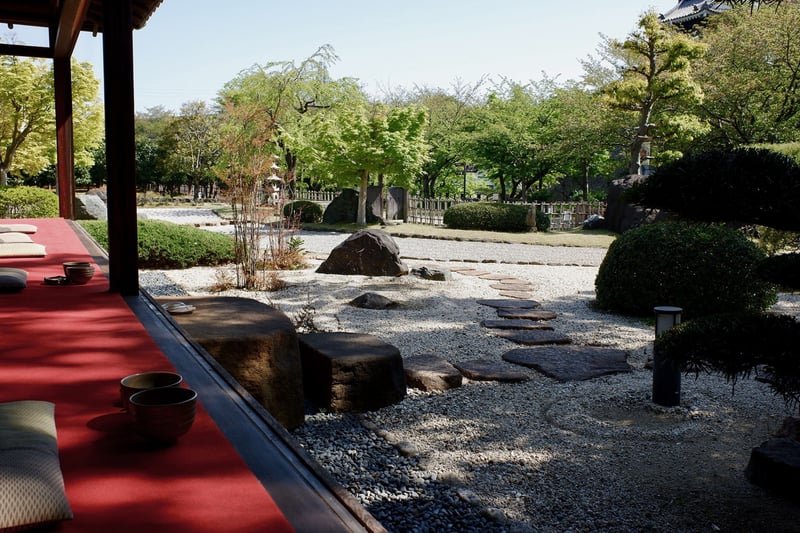
On the roji, take small steps so your footfalls stay soft, and let your gaze rest not only on the tobi-ishi (stepping stones) underfoot but also on the moss and dappled sunlight. The water at the tsukubai, where you cleanse your hands and mouth, has long been treated as a symbol of "purification," and it is customary for the host to sprinkle water on the roji before welcoming you (*3).
3. Enter the Tea Room and View the Tokonoma
When entering through a nijiriguchi, your head naturally lowers. This isn't forced deference so much as a device that adjusts your scale—"setting aside your titles and becoming simply one guest." Once inside, turn first to the tokonoma. If you think of the hanging scroll and the flowers as "a short poem" outlining the day's theme and season, your time of viewing becomes much richer (*4).
%20for%20Displaying%20Art%20and%20Flowers.webp?width=800&height=533&name=A%20Traditional%20Japanese%20Alcove%20(Tokonoma)%20for%20Displaying%20Art%20and%20Flowers.webp)
4. Take Your Seat and Exchange Greetings
During the gathering, the shōkyaku (the chief guest who represents the exchange with the host) takes the lead, and guests are seated in order starting from the position nearest the tokonoma. As an English speaker, you don't need to perfectly memorize set Japanese phrases. A nod or a bow that shows your willingness to "receive" is enough—in fact, speaking softly suits the space better (*1).
5. Receiving the Sweets
Sweets fall broadly into two categories: omogashi (fresh) and higashi (dry). In a formal chaji, omogashi are presented in a fuchidaka (a stacked tiered container), and you'll use a kuromoji (sweet pick) to enjoy them on your kaishi. This stage prepares the "foundation" of your palate, giving dimension to the bowl of tea that follows (*5).
%20Served%20with%20Traditional%20Japanese%20Tea.webp?width=800&height=533&name=Sakuramochi%20(Cherry%20Blossom%20Rice%20Cake)%20Served%20with%20Traditional%20Japanese%20Tea.webp)
6. Receiving the Matcha
When you accept the tea bowl, offer a bow to the next guest in a spirit of "after you," and show respect to the host as well (*6). Since the host will position the bowl's front (its most distinguishing face) toward you, the common pattern is to rotate it about twice to shift this front away before drinking (*7). After finishing, gently wipe the rim with your fingers, lightly press your fingertips onto your kaishi, and take in the bowl's "landscape"—the flow of its glaze, the shape of its foot—before returning it.
7. Viewing the Tea Bowl and Utensils
The viewing isn't an "appraisal session" but a moment of respect for the host's choices. Sometimes the utensil's origin, maker, or hakogaki (the inscription on its box) comes up in conversation, and you can deepen your grasp of the gathering's theme through your questions. If it's your first time, there's no need to force questions—short impressions such as "beautiful" or "I can feel the season" work just as well.
.webp?width=800&height=533&name=A%20Traditional%20Nezumi-Shino%20Matcha%20Tea%20Bowl%20(Chawan).webp)
8. Offer Closing Greetings and Take Your Leave
The final greeting is less about saying "I had a wonderful time" and more about expressing "gratitude for the time that was prepared for me." Bow deeply, and let your movements stay slow. Even after leaving, keep your voice low until you've left the roji—cherishing this "run-up" back to everyday pace turns the afterglow of the gathering into the heart of your journey.
The Host's Procedures and Preparation Behind the Tea Ceremony
If the guest is the one "experiencing" the gathering, the host is the one designing its flow from behind the scenes so that experience arises naturally. Hospitality in the tea ceremony isn't about adding grandeur—it's about quietly arranging conditions so you can fully focus on a single bowl of tea.
The moisture on the roji, the words of the tokonoma, the selection of utensils, the temperature of the water, the rhythm of conversation—each of these shapes the impression you'll carry away. Understanding the host's procedures is the key that moves you from "receiving" the gathering to truly "reading" it (*1).
Preparing the Tea Room, Roji, Utensils, and Sweets
The host's preparation begins long before you arrive. Sprinkling water on the roji, purifying the tea room, arranging the scroll and flowers in the tokonoma—these actions serve more than appearance alone. They are staged so that from the moment you pass through the gate, you begin to shed your everyday pace and move, little by little, into the time of chanoyu.
The same applies to choosing utensils, where selection considers the season, the weather, the theme of the gathering, and even the host's relationship with you. Even a single sweet may be chosen so its sweetness and design harmonize with that day's scroll and bowl. The host speaks through the entire environment before they speak through words (*2).
Understanding the Basic Flow of Temae
Temae is less the technical act of whisking matcha and more the comprehensive set of movements that shape the time leading up to when a bowl of tea is born before you. The host first carries the utensils to their prescribed positions, purifies the chashaku and natsume through fukusa-sabaki, and handles the water while checking the condition of the bowl and whisk (*3).
At a glance, these movements seem quiet and simple, but in this pared-down repetition, respect for the utensils and care for you as a guest are woven together. You receive not only the finished matcha but the very process that gives rise to it. That's why temae becomes not a task but a dialogue carried out in silence (*4).
Closing Greetings and Cleaning Up After the Gathering
A tea gathering doesn't end the instant the final bowl is served—it is completed when the lingering atmosphere is quietly brought to a close. As you view the utensils and exchange farewells, the host returns the tools to their places and gradually returns the space to the everyday. There's no rush in these movements, because even the cleaning up is part of the gathering.
The way used bowls, kettles, and natsume are handled with care shows that these utensils are not mere objects but companions that helped create a once-in-a-lifetime moment together. And because even the sense of being seen off is woven in, you leave carrying a genuine feeling of having been cared for. The more beautifully a gathering closes, the longer and more clearly it stays in your memory.
Essential Knowledge for Understanding the Tea Ceremony
You can grasp the surface of a tea ceremony's flow simply by following the sequence of steps. But once you see why they unfold in that order and why each small gesture is honored, every movement suddenly begins to take on meaning.
Chanoyu isn't a collection of manners—it's a culture that weaves space, utensils, seasons, and human relationships into a single bowl of tea. What you need as a beginner isn't to memorize everything precisely, but to first sense what kind of world the tea ceremony holds dear. With just that foundation, the view from your seat becomes astonishingly richer.
What Is the Japanese Tea Ceremony?
The tea ceremony is a total art form in which the act of preparing and drinking matcha is bound together with etiquette, spirituality, aesthetics, craft, architecture, and a feeling for the seasons (*2). From the outside, it looks like a quiet ritual, but in truth, behind each bowl lie layered currents of thought—respect for others, attunement to nature, the intellect behind choosing utensils, and a philosophy of how to make limited time deeply fulfilling.
Once you enter the tea room, words grow fewer, while the scroll, the flowers, the sweets, the vessels, and the sound of boiling water each begin to speak. Chanoyu isn't a culture that adds information—it's one that pares elements down and sharpens the senses. Within that simplicity lies a surprisingly deep intellectual pleasure (*3).
Why Procedure Matters So Much in the Tea Ceremony
The reason procedure is emphasized isn't that preserving form is an end in itself. Because there is a set pattern, neither you nor the host has to be distracted by unnecessary judgments, and both can focus on the bowl before you and on caring for each other.
.webp?width=2048&height=1365&name=The%20Host_s%20Preparation%20and%20Ritual%20Tea-Making%20Procedure%20(Temae).webp)
Practices like purifying utensils, rotating the bowl away from its front, and observing a particular order during viewing aren't personal preferences—they are "ways of carrying one's feelings" that have been refined over long stretches of time (*4). Because the form exists, no one is rushed, the space isn't disturbed, and intention flows even in silence. The Japanese tea ceremony steps are an exceptionally refined language for sharing courtesy and aesthetic sensibility through the body (*5).
Why Schools, Usucha, and Koicha Differ in Procedure
The tea ceremony isn't a culture that holds only one finished form—the fine details of conduct vary by school and by the purpose of the gathering. It's not that "there are multiple right answers," but rather that the aesthetic values and lineages of transmission each school honors are different.
Usucha and koicha also differ not only in taste but in how guests receive them and in the tension of the gathering. Usucha is relatively light and easy to approach even in a tourist setting, while koicha may involve sharing a single bowl, heightening the sense of unity among guests and the formality of the occasion. Knowing these differences helps you feel at ease, understanding that "variations in detail aren't mistakes." What you need as a beginner isn't knowledge to judge between schools, but an attitude of respect toward the context behind each difference.
Tea Ceremony Etiquette and Points Where Beginners Often Hesitate
The anxiety most people feel about the tea ceremony comes down to one thing: "What if I make a mistake and seem rude?" In reality, though, what matters far more than the exactness of your etiquette is preserving the quiet of the space and maintaining respect for others.
That's exactly why keeping a few points in mind beforehand will ease your nerves more than you'd expect. This chapter walks you through the stumbling blocks first-time participants often hit in practical terms—from preparation (clothing and what to bring) to how to handle the bowl, when to bow, and what to avoid. Use it as a guide so you can settle into the space with composure, without being overly tense.
Suitable Attire and Items for a Tea Gathering
Choose clothing that is simple, with minimal ornamentation, and comfortable when you're seated. At formal tea gatherings, hosts usually wear kimono, so leaning toward something formal on your side brings peace of mind (*1).
That said, at demonstrations designed for travelers, strict formal wear may not be required—the guidance varies. To be considerate to the tatami, prepare white socks, and organize your essentials—sensu, kaishi, and kashi-yōji (sweet pick)—into one set for greater ease (*2).
You can add things like a kobukusa as needed, but for your first time, rather than trying to gather "everything perfectly," it's safer to check with the venue beforehand about what is actually needed.
Which Way to Turn the Bowl and When to Bow
Common points of confusion are "which way do I turn the bowl?" and "when do I bow?" The basic flow is: bow before receiving the bowl, rotate it about twice to avoid the front, drink, wipe the rim with your fingers, and then view it (*3). At tourist-experience venues, however, instructors may walk you through a simplified version. If you're unsure, follow the movements of those around you and prioritize keeping quiet.
Behaviors to Avoid
Strong fragrances can dull the delicate scents of the tea and kō (incense woods burned or placed in the incense container during the gathering), so some events ask guests to refrain from wearing perfume (*4). Utensils are often valuable, delicate works of craftsmanship, so the rule is not to touch them without permission. Follow the venue's signage or staff instructions on whether photos are allowed, and when photographing people, check for permission first. Since the setting is a quiet one, it's wise to silence your smartphone as well.
The Meaning and Aesthetic Woven into Each Step of the Tea Ceremony
The charm of the tea ceremony lies not in how beautiful the movements are, but in the fact that the beauty itself carries meaning. Walking the roji, viewing the tokonoma, receiving the sweets first, rotating the bowl to avoid its front—these aren't arbitrary sequences but designs that gradually attune your senses and your heart.
That's why, without any flashy staging, a tea gathering can leave such a deep impression. Nothing is said beyond what's needed, nothing is adorned beyond what's needed. Within that restraint, surprisingly rich room for interpretation opens up. Once you understand the meanings carried in each procedure, the tea ceremony shifts from "a place of etiquette" to "a place for reading aesthetics."
Wabi, Sabi, and the Beauty of Simplicity
The kind of beauty prized in chanoyu is a little different from beauty that puts grandeur or rarity front and center. Here, what matters is how much lingering richness can arise from very little.
A tokonoma holding only a scroll and flowers, movements that stay soft in sound, conversation that refrains from over-explaining—this restraint opens your senses rather than closing them. The concepts of "wabi" and "sabi" spoken of in chanoyu are close but not identical.
Wabi leans toward simplicity, naturalness, and inner quality, while sabi is often explained as the aesthetic residing in the changes brought by time and the patina of age. Once you enter the tea room, dazzling information recedes, and in its place come steam, light, clay, paper, and the tactile feel of vessels. That simplicity isn't lack—it is intentional space created for your sensitivity (*1)(*2).
Why Ichigo Ichie Shows in Every Gesture
The phrase ichigo ichie is well known, but in the tea ceremony it is not just a motto—it appears in concrete actions. The host selects the day's scroll and utensils for you, and you respond by focusing fully on a single bowl, because everyone shares the awareness that "the time we gather, under these conditions, with these people, in this season, will never come again" (*3). That's why at a gathering, finishing quickly or moving efficiently is less important than not disturbing the moment.
The careful bows, the unhurried silence—these exist so time can be "savored" rather than "spent." The slowness of movement carries not sentimentality but a deep reverence for time (*4).
The Hospitality Held in Utensils, Tea Rooms, and Scrolls
Hospitality in the tea ceremony isn't about giving you a great deal—it's about arranging conditions so your senses can work at their best.
Choosing a bowl suited to the season, weaving a motif that honors the rain on a rainy day, entrusting the day's theme to a hanging scroll—these considerations are so quiet you might miss them without explanation, but the moment you notice, they bring a deep sense of understanding.
The tea room itself is part of this hospitality. Its smallness exists not for inconvenience but to keep your gaze and awareness undivided, and the tokonoma is placed not as decoration but as the spiritual center of the gathering. What you are receiving isn't just the matcha, but the precision of all these choices.
How to Learn the Japanese Tea Ceremony Steps in Japan
Once you've grasped the flow of the tea ceremony, most people next wonder, "where can I actually experience it?" What's important here is not to choose based on booking convenience alone. Tea ceremony experiences range widely—from short tourist-oriented programs, to small-group sessions with deep commentary, to something close to authentic practice.
Which format suits you depends on whether you'd like a casual introduction to the etiquette or a deeper cultural understanding. What you need on your first visit isn't to "learn everything perfectly" but to choose the entryway that suits you. That choice can turn the tea ceremony into either a one-off experience or a lifelong pursuit.
Points for Choosing a Beginner's Tea Ceremony Experience
When you are selecting your first experience, looking beyond price and location to "how much background explanation is provided" will deeply affect your satisfaction. There is a world of difference between an experience centered on whisking matcha and taking photos and one that explains the meanings of the roji, the tokonoma, and the utensils (*1).
It's also worth considering whether seiza is required, whether chair seating is offered, whether English support is available, and whether the group size is manageable. The smaller the gathering, the easier it becomes to ask questions and to connect each gesture's meaning to your own senses. If you'd rather take in the tea ceremony as "time spent touching culture" than consume it as "just another event," it's wise to choose an experience rich in explanation—even if it is short (*2)(*3).
For Ongoing Study, Look to Practice or Cultural Courses
Once a single experience awakens you to the tea ceremony's appeal, your interest naturally turns to more continuous learning. In practice, you don't just learn how to whisk matcha—you expand into the surrounding culture that supports chanoyu: the names of utensils, seasonal combinations, the words of hanging scrolls, and the meanings of flowers and sweets (*4). It is this breadth that distinguishes the tea ceremony as a whole system of cultivation rather than mere training in etiquette.
Cultural courses and introductory practice serve less as places of strict discipline and more as gateways through which you can deepen your intellectual interest on a daily basis. For anyone who doesn't want to leave the inspiration of a trip as a single moment—but rather let it grow within their own sensibility—continued study is an utterly natural next step (*5).
Points of Concern Worth Checking Before Your Experience
The anxieties most first-time participants feel are the strain of seiza, not having the right items, and the nervousness of making etiquette mistakes. In reality, though, most beginner-friendly experiences are designed with exactly these concerns in mind. What matters is confirming in advance whether chair seating is available, what you need to bring, whether photos are allowed, and any notes on attire, so you can choose a venue that suits both your condition and your intent.
And if you are lost during the session, you don't have to pretend to know. What's valued in the tea ceremony is not perfection but the attitude of trying to learn while respecting the space (*6). Quietly asking about what you don't understand isn't rude—it is received, instead, as a sign of respect toward the culture.
Closing Summary
The Japanese tea ceremony steps aren't meant for memorization. Composing your heart on the roji, receiving the theme at the tokonoma, opening your palate with the sweets, focusing on the present through the matcha, and exchanging intellect and sensibility through viewing—that very sequence is a design that leads your senses "quietly and deeply."
At your first gathering, the greatest etiquette isn't perfect form but preserving stillness and respect. If, within a single bowl of tea, you begin to see how craft, architecture, poetry, and seasonal wisdom fold together, your journey has already advanced to its next stage. The gathering you visit next won't feel like "one more time"—it will feel like the next "once-in-a-lifetime."
Author Bio

Shohei Toguri