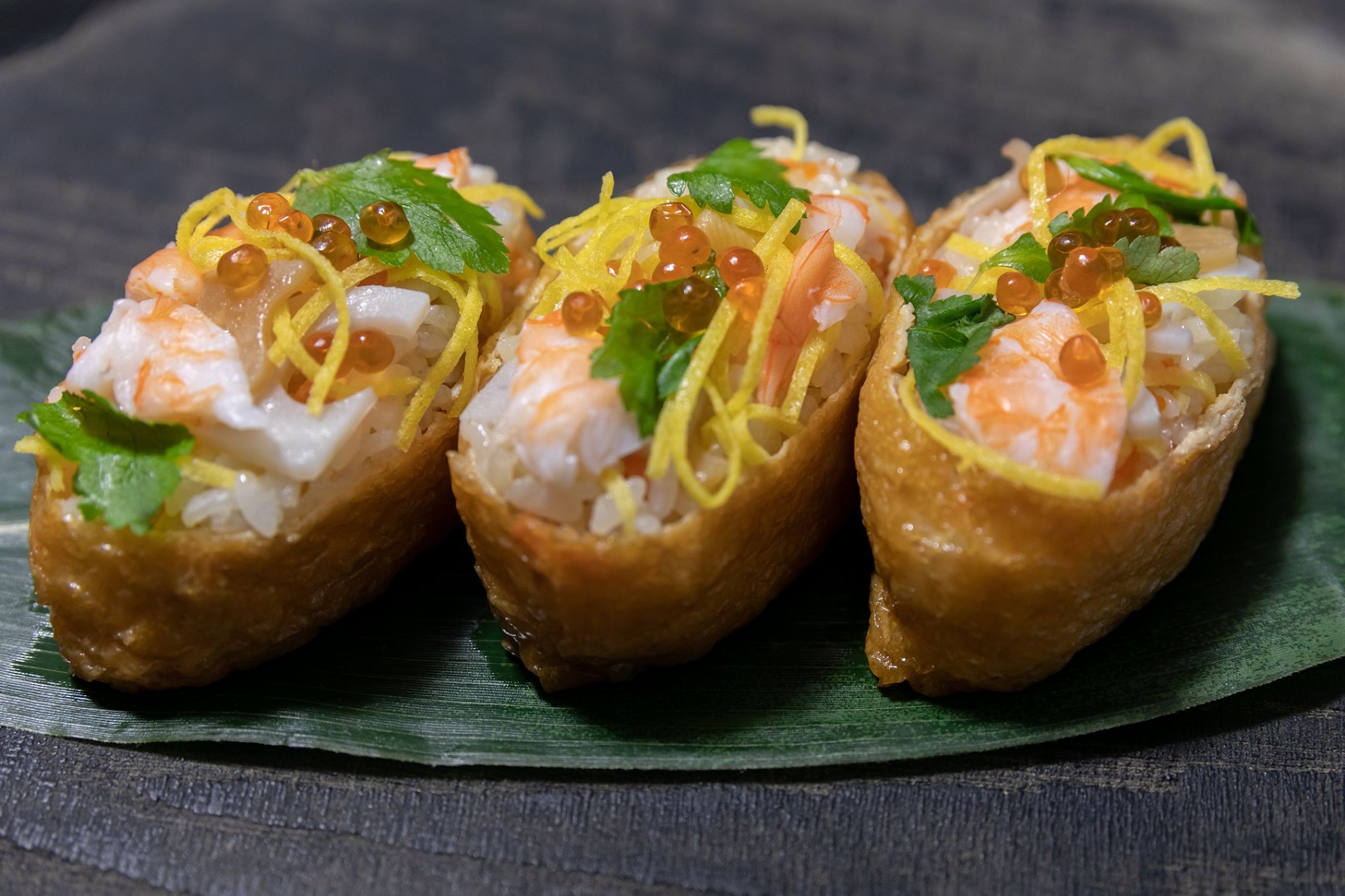
At its most basic, inari sushi is vinegared rice tucked into sweet-simmered aburaage. In one compact bite, it brings together sweetness, acidity, aroma, and the hand-held practicality that runs through much of Japanese food culture.
In this article, we answer the questions readers most often ask—what inari sushi is, which inari sushi fillings are most common, where it came from, and how it changes by region—in the following order: definition → fillings → how to choose → history → regional variations → travel experiences. Even if you are only beginning to explore Japanese food, by the end you should be able to notice those differences for yourself.
What Is Inari Sushi? The Characteristics of Sushi Wrapped in Aburaage
Let’s begin with the basic definition. Inari sushi is a type of sushi made by opening sweet-simmered aburaage (thin sheets of deep-fried tofu) into a pouch and filling it with vinegared rice (sumeshi, or sushi rice seasoned with vinegar, salt, sugar, and related seasonings) (*1). It is often shaped like a tawara, or rice bale, and has long been loved as an easy-to-carry form of “wrapped sushi” (*2).
The Definition of Inari Sushi and How It Differs from Other Sushi (Nigiri, Rolls, Pressed Sushi)
“Sushi” is a broad family. Nigiri sushi is built by placing toppings over vinegared rice and is known for having spread as Edo street food (*5). Rolled sushi wraps vinegared rice and fillings in nori, with kanpyo rolls offering a classic example in which sweet-savory simmered strips sit at the center (*6). Pressed sushi, including box sushi, is shaped by pressing vinegar-seasoned rice and toppings in a mold, with Kansai-style box sushi often introduced as a representative example (*7).
Inari sushi, by contrast, does not top, roll, or press. It wraps. The aburaage becomes both container and seasoning, holding sweetness, umami, and fragrance close until the moment you pick it up.
Why Is It Wrapped in Aburaage?
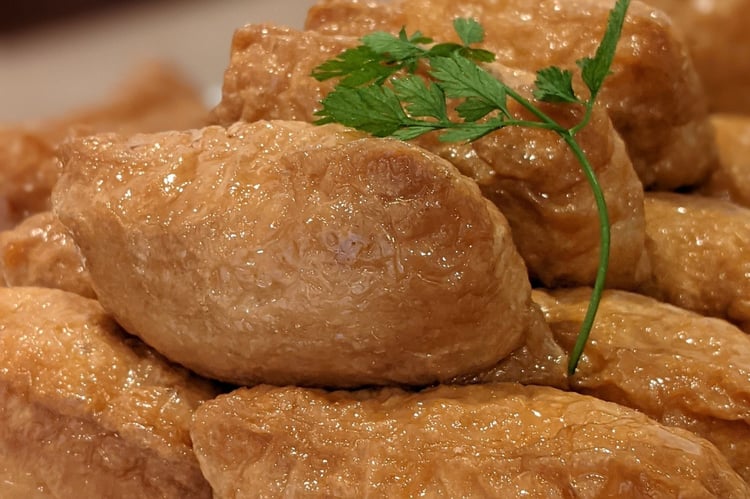
Aburaage is more functional than it looks. In production, tofu is puffed through a two-stage frying process—first at lower heat, then at higher heat—creating air pockets inside and making it especially receptive to dashi and simmering liquid (*3). In short, aburaage is built to absorb flavor.
The vinegared rice matters just as much. Vinegar’s main component, acetic acid, has antimicrobial properties, and the use of acidic rice in sushi has long supported preservation as well as flavor (*4). MAFF’s description of Tochigi-style inari sushi likewise notes that vinegared rice is less prone to spoilage than plain rice, which helped make it suitable for outings and excursions (*2).
We will return later to its relationship with faith, but even before that, aburaage × vinegared rice is a remarkably rational food design: it absorbs seasoning, can be eaten neatly by hand, and keeps comparatively well. Those three strengths meet in one compact form.
The Basic Structure That Determines Deliciousness
At its simplest, the deliciousness of inari sushi rests on three layers: the way the aburaage absorbs broth, the balance of the vinegared rice, and the choice of aroma.
Aburaage becomes the star when it fully holds a sweet-savory simmering liquid. If that liquid leans more toward sugar, the result is rounder and gentler; if it leans more toward dashi, the finish is cleaner and more savory. Even within the same region, the seasoning can vary from household to household and from shop to shop.
For the vinegared rice, temperature and grain definition matter. The rice should settle slightly from just-cooked heat, then the seasoned vinegar should be folded in with a slicing motion—a technique that belongs to the broader culture of hayazushi, or “quick sushi,” in which rice is seasoned directly with vinegar. If the rice is too warm, the aburaage loses structure; if it is too cold, the acidity can feel sharp. Leave the grains distinct enough to loosen in the mouth, and they will balance the sweetness of the aburaage with clarity and restraint (*7).
Aroma is not a garnish added at the end; it is part of the design. The roasted scent of sesame, the lift of citrus peel, and the cool freshness of ginger can all sharpen the finish. Add too many strong aromas, however, and the elegance disappears. A useful rule is simple: let one aroma lead and let the others remain in the background (*1).
How to Recognize High-Quality Inari Sushi
If you feel unsure at a department store counter or while traveling, check four points.
First, the texture. Does the aburaage soften on the tongue and release its simmering liquid naturally? Second, the sweet-savory finish. Even if sweetness arrives first, do the outlines of dashi or soy sauce return at the end? Third, the edge of the rice’s acidity. Does the acid fade together with the aroma, rather than jutting out sharply? Fourth, the refinement of the aroma. Sesame or condiments should support the experience, not dominate it. In a well-made inari sushi, the real stars remain the rice and the aburaage.
Inari Sushi Fillings: Classic Ingredients and Popular Variations
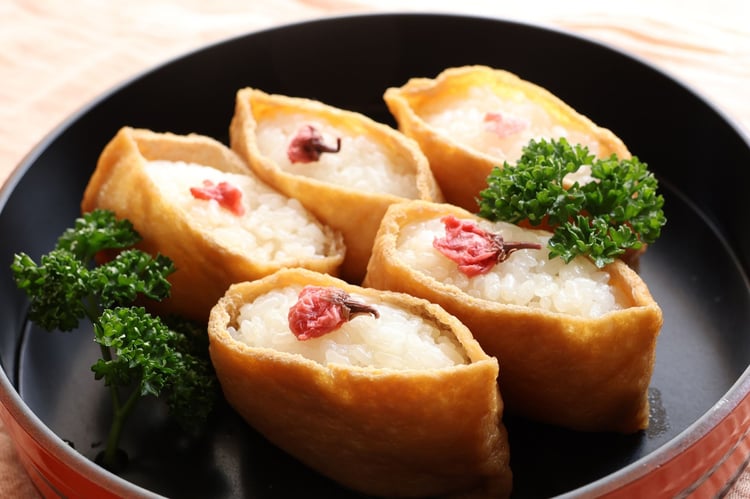
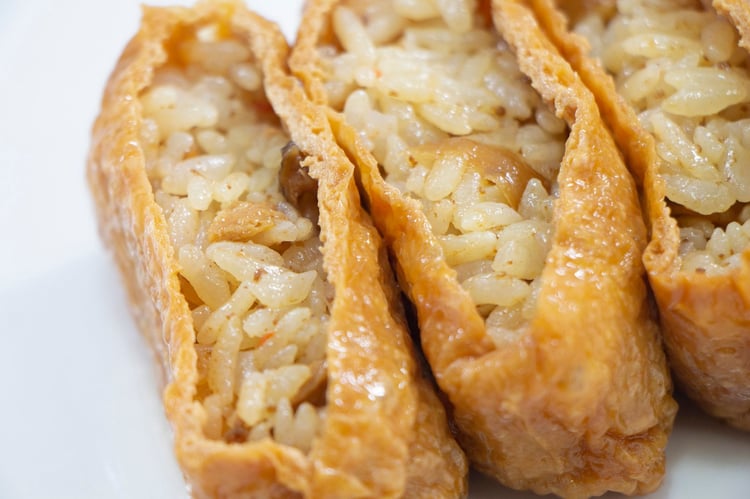
Here is the short answer. The classic filling is vinegared rice (*1). The best-known inari sushi fillings then build on that base with accents such as sesame, ginger, or shiso, while gomoku inari mixes in ingredients like shiitake, kanpyo, carrot, and lotus root for extra texture and umami.
The Basic Filling Is Vinegared Rice + Aromatic Accents
Inari sushi is beautiful partly because it does not need many additions. Rice, vinegar, and aburaage are enough to create sweetness, acidity, umami, and aroma. If you are new to it, the most reliable first step is usually not to add more ingredients, but to understand the base clearly.
For example, if you limit the aromatic accent to sesame, the sequence becomes easy to read from the first bite: nuttiness → sweet-savory depth → a clean fading edge of acidity. That space is exactly what makes the aftertaste so important in Japanese taste culture (*2).
Classic Inari Sushi Fillings: White Sesame / Black Sesame / Finely Chopped Ginger / Green Shiso
Sesame adds aroma and a light granular texture that tightens the sweet-savory character of the aburaage. White sesame feels gentler; black sesame brings deeper nuttiness and more richness. Ginger threads a cool brightness behind the sweetness, while green shiso (oba) lightens the aftertaste with a fresh, herb-like note that is especially welcome in warmer seasons (*2).
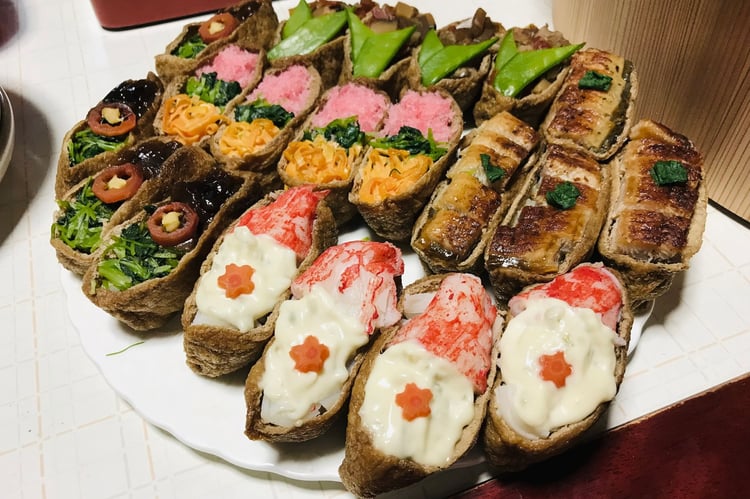
What’s Inside Gomoku Inari Sushi: Shiitake, Kanpyo, Carrot, Lotus Root, and More
The key to gomoku inari is how well the fillings take on dashi. Shiitake and kanpyo develop umami and fragrance when simmered sweet-savory, while carrot and lotus root create rhythm through texture. If everything is softened too much, the bite becomes flat.
One thing to watch is balance. Because the aburaage itself is already sweet-savory, aggressively seasoned fillings can create a traffic jam of sweetness. Let the fillings lean more on dashi and less on sugar, and the richness of the aburaage will return clearly with each bite (*2).
Contemporary Variations: Yuzu, Sansho, Seafood, Egg, Cheese
What matters in modern variations is not simple addition for its own sake. The best versions usually work through two small decisions: one clear aromatic accent and one clear point of texture.
Yuzu tends to work best when peel fragrance leads rather than juice. Even a small amount tightens the whole profile. Sansho is powerful in both aroma and numbing spice, so it can easily overwhelm the rice if the base is too delicate. Richer fillings such as seafood, egg, or cheese often work better at the edge than at the center—mixed into only part of the rice or added as a small finishing accent. The core principle is classic Japanese cooking: decide on the star, then let the supporting elements stay in proportion (*2).
Accommodating Dietary Restrictions: What to Check About Dashi, Sweeteners, and Allergens
The more carefully you plan the experience, the easier it is to handle dietary needs gracefully. With inari sushi, three points are especially worth checking in advance.
First, dashi. The simmering liquid for the aburaage, or for gomoku-style fillings, may contain fish-based stock such as katsuobushi. Second, sweeteners. Alongside sugar, ingredients such as mirin may be used (*2). Third, allergens. Aburaage is soy-based, and sesame is also common. In Japan’s food-labeling system, sesame and soybeans are included in the recommended allergen-labeling category rather than the mandatory one, so when buying from a restaurant or specialty shop, it is wise to confirm ingredients directly rather than relying on assumptions alone (*3).
How to Compare Inari Sushi: Choosing by Flavor, Fillings, and Aroma
What makes inari sushi so interesting is that the experience can change even when the outside looks similar. Sweet-savory yet light, rich yet clean—the key to understanding that apparent contradiction is to taste the first bite with a few points of comparison in mind.
Three Axes for Comparison: How the Aburaage Holds Flavor / The Temperature of the Vinegared Rice / The Design of the Filling
Here are three checkpoints even a beginner can use.
First, how the aburaage holds flavor. The sponge-like structure created by double frying makes aburaage especially good at absorbing seasoning, and the more fully it takes in dashi or simmering liquid, the juicier it feels (*2). If it holds too much, however, the sweetness can linger. Look for clarity: the liquid should bloom when you bite, then disappear cleanly (*2)(*3).
Second, the temperature of the vinegared rice. In hayazushi-style thinking, acidity is designed into the grain itself. If the rice is too cold, the acid feels sharp; if it is too warm, aroma escapes. Notice whether the temperature feels right for the place and moment in which you are eating it (*1).
Third, the design of the filling. Is it minimal, gomoku-style, or aroma-led? The fewer ingredients a shop puts inside, the more clearly you can usually read its intentions (*3).
How to Choose Well for a Gift
The basic rule for a good gift is simple: it should still hold together after cooling, and its aroma should not be overly assertive. As with other styles of sushi, vinegared rice benefits from acidity, but that does not mean it can be left at room temperature indefinitely (*1)(*4).
Once purchased, it should be eaten as soon as possible, and in summer, cool storage is essential.
If you are choosing for other people, a style whose aburaage still leaves a clear outline of dashi or soy sauce is usually safer than one driven by heavy sweetness alone. Strongly aromatic yuzu or sansho versions can divide opinion, so for business gifts or shared meals, a straightforward sesame version is often the most considerate choice (*3).
Smart Ways to Ask Questions at a Shop
Keep your questions short and specific. MAFF guidance on inbound restaurant support also emphasizes preparing menu and allergy information in forms that are easier for overseas visitors to understand, so there is no need to hesitate about asking (*6).
・Flavor profile: “Is it sweeter, or more restrained?”
・Dashi: “What kind of dashi do you use? Is it kombu only?”
・Rice: “Is the rice plain vinegared rice, or mixed rice (gomoku style)?”
・Allergens: “Does it contain sesame, soy, egg, or fish-based dashi?”
The Origins and History of Inari Sushi: From Inari Worship to Edo Food Culture
Behind inari sushi lies a layered history of religion, urban food culture, and distribution. Rather than leaning on a single romantic origin story, this section separates what appears well supported from what remains a matter of multiple theories (*8).
Origins Remain Debated: A Way of Reading That Does Not Fixate on a Single Birthplace
The first step is not to force a single birthplace. It is certainly reasonable to say that inari sushi spread nationwide through popularity in Edo (*8), but traditions also remain in which it developed around centers of Inari worship and temple-town communities (*5)(*6). Your understanding deepens more by asking under what conditions it took root, and when, than by asking only where it was first made (*8).
A useful way to read the evidence is to compare three things: traces of popularity in written sources, stories preserved locally, and patterns of commercial sale. The more those three overlap in one place, the more persuasive the historical picture becomes (*8).
The Origin of the Name and Inari Worship
Inari worship is not a single uniform tradition. Kokugakuin University explains it as a layered phenomenon that includes lineages centered on Fushimi Inari Taisha, shrines established independently around Japan without direct ties to Fushimi, and lineages linked to Buddhist elements such as Dakiniten (*1). That complexity helps explain why different regions associate Inari with slightly different images—foxes, business prosperity, or abundant harvests.
As for why aburaage is offered to Inari, the National Diet Library’s reference service presents several explanations, including the idea that fried tofu was treated as a favorite food of foxes, and deliberately avoids fixing a single answer. The safest reading, then, is that inari sushi emerged where religious associations—offerings, pilgrimage, shrine approaches—met everyday food logic: it could be wrapped, carried, and seasoned reliably (*4)(*8).
Edo to Modernity: The Spread of Aburaage and Street-Stall / Dining-Out Culture
Edo food culture valued food that could be eaten with one hand, served quickly, and carried away easily. MAFF’s account of nigiri sushi notes that it developed as street-stall food (*7). Under the same urban conditions, it is not hard to see why a wrapped sushi built from rice and seasoned aburaage would also have found a strong audience.
As for aburaage itself, one scholarly view holds that while tofu production was linked to temples and other religious institutions, aburaage became widely popular during the Edo period, and records such as the 1697 Honcho shokkan praised it highly (*2). Only after tofu culture became firmly established could inari sushi move from a special offering-related food into something ordinary people could buy and carry (*2)(*8).
Why It Spread Through Temple Towns, Ekiben, and Souvenirs
The temple-town route is especially easy to see in Toyokawa inari sushi. In the Agency for Cultural Affairs’ “100-Year Food” project, the inari sushi culture that flourished around Toyokawa Inari is presented as something loved by worshippers and refined through the ingenuity of individual shops (*6).
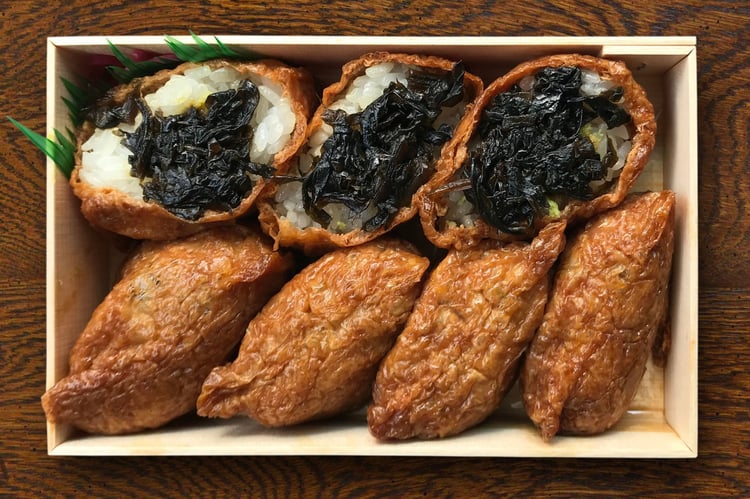
Mobility culture matters too. Research on bento culture notes that ekiben became part of the pleasure of travel through regional ingredients and local specialties. Inari sushi circulated effectively as station food and souvenirs precisely because it held its shape well and could be eaten neatly by hand (*9)(*8).
Contemporary Reappraisal: Specialty Shops, Gifts, and Course Meals
Today, inari sushi is valued not only for nostalgia but also for craftsmanship and regional identity. The Toyokawa example includes not only traditional versions but also newer styles topped with miso-katsu or eel (*5)(*6). UNESCO continues to list washoku as Intangible Cultural Heritage, which makes it easier to see inari sushi not as “just a snack,” but as an entry point into regional history, industry, and faith (*10).
Inari Sushi by Region: Differences in Shape, Flavor, and Name
Inari sushi may look like a nationally shared light meal, but it is one of the foods that reveals regional differences with unusual clarity. Shape, seasoning, and the places where you encounter it all change the experience of eating it (*1).
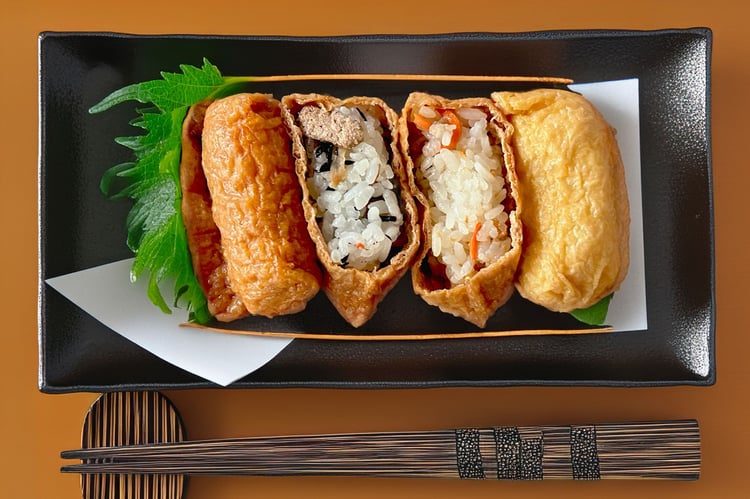
Differences in Shape: Tawara Shape / Triangle / Open-Faced / Rolled
The clearest east-west difference is shape. A Niigata City food-education resource explains that inari sushi is often rectangular in eastern Japan and triangular in western Japan (*1). The reasons offered vary, but simply noticing the shape on your travels already opens a useful line of comparison.
There are also highly local forms. In Tochigi Prefecture, inari sushi is closely tied to kanpyo culture and is introduced as a regional dish suited to outings (*2). In Menuma, Saitama, detailed accounts describe a long, slender form associated with Edo-period styles and reinforced with strips of kanpyo (*4). Even within something called “inari,” shape alone can surface local history (*4).
Differences in Flavor: The Strength of the Aburaage / The Acidity of the Vinegared Rice / Condiments
Differences in flavor often reflect a shop’s philosophy as much as a region. In MAFF’s introduction to the Aichi version, the seasoning of the aburaage is described as varying by household, and the vinegared rice may also include mixed-in ingredients (*3). That is a useful reminder not to flatten every variation into a simple regional stereotype.
When you travel, look less for “strong” or “light” and more for where the center of gravity lies. At shops where the aburaage is the star, the sweet-savory note is fuller and the rice is more restrained. Where the rice leads, the acidity is clearer and the tofu supports with lighter seasoning. Condiments act as the bridge between the two (*3).
Where You Encounter It Changes the Impression: Festivals, Temple Approaches, Stations, Department Stores
Your impression of inari sushi changes with context. In a temple town, the mood of pilgrimage sharpens your sense of ritual and local story, while at a station or airport, the rhythm of movement makes each bite feel lighter and more practical (*5).
In the basement food halls of department stores, packaging and portioning are refined until inari sushi starts to function as a language of gift-giving.
Where you eat it shapes what you learn from it. Eat it along a shrine approach, and you step into faith and folkways. Eat it at a station, and you touch distribution and modernity. Buy it at home or in a department store, and you encounter urban life and gift culture. Inari sushi is a dish that lets you choose your point of entry according to the theme of your journey (*3)(*5).
Experiencing Inari Sushi on Your Travels: Shrines, Specialty Shops, and the People Who Make It
From here, let’s focus only on information you can act on. Inari sushi is perfect for walking and snacking, but the more you understand its background, the richer your stay becomes. Think of four doors into the experience: shrines, specialty shops, makers, and hands-on learning (*1).
Connecting a Visit to an Inari Shrine with a Food Experience
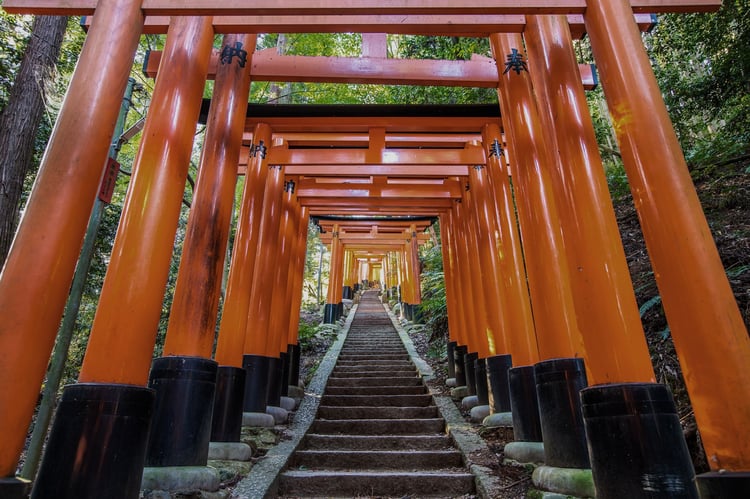
Fushimi Inari Taisha, widely known as the head shrine of Inari worship, is famous for its mountain paths lined with vermilion torii. JNTO’s official introduction highlights its long history and the iconic approach up Mount Inari (*1).
The Senbon Torii in particular are explained on the shrine’s official site as donations that multiplied over time as the custom of dedicating torii spread during the Edo period (*2). The National Diet Library also introduces the broader background of the gates and notes that the mountain as a whole contains far more torii than the name “one thousand torii” suggests (*3).
If you want to connect pilgrimage with the ritual calendar, focus on Hatsuuma. Official explanations from Fushimi Inari Taisha describe Hatsuuma Taisai as the anniversary of the shrine’s establishment and one of its major festivals (*4). The basics for avoiding crowds are simple: go early, choose a weekday when possible, and do not automatically avoid light drizzle. Moisture deepens the red of the gates, and both photographs and memory often keep a softer finish.
How to Enjoy a Tasting at a Specialty Shop
Tasting inari sushi works like tasting wine in one important respect: order matters. A practical sequence is minimal style → gomoku → aroma-led styles.
Start with the simplest version, made with vinegared rice and perhaps only a little sesame. The way the aburaage holds its broth is the shop’s signature.
Next, move to gomoku. The amount of information increases through the cut of the ingredients and the way dashi has been absorbed.
Finish with a strongly aromatic style using yuzu or sansho. Saving it for last keeps the earlier flavors clear in memory. A tasting comparison may feel indulgent, but it is also a form of learning. In just a few bites, the shop’s priorities become visible (*5).
Visiting Tofu Shops and the People Who Make Aburaage
Once you approach inari sushi through its main ingredient rather than only the finished dish, the perspective of the journey changes. Aburaage is defined by a two-stage frying process that causes it to expand, and its interior structure depends on how those temperature zones are managed.
There is also a form called inari-age, prepared specifically for inari sushi. If you visit makers, pay attention to the soybeans and water, the frying oil, and temperature control. Because hygiene and workflow often limit factory visits, appointments should be arranged in advance. If you approach the visit with respect for the maker’s time, the conversation is usually richer (*6).
Learning Through Cooking Classes and Workshops
The most direct way to understand it is to make it yourself. The process usually unfolds in four stages—dashi, simmering, vinegared rice, and wrapping—and each choice changes the result (*5)(*6).
In settings with overseas participants, explanations around allergies and food practices become especially important. Practical MAFF guidance notes the value of sharing allergy information and food-custom information in multiple languages to reduce anxiety (*7).
UNESCO continues to list washoku as Intangible Cultural Heritage. Seen in that light, learning to make inari sushi brings you closer to cultural transmission rather than simple consumption (*8).
At the end of your trip, try inari sushi one more time. What first felt only “sweet” and “easy to eat” may now register as the outline of the dashi, the grain of the rice, and the design of the aroma. That shift is one of the real pleasures of traveling through food culture.