Dango are the rice dumplings you see threaded onto a bamboo skewer at temple gates, in market arcades and beside cherry trees in April. They are among the most photographed sweets in Japan and among the least explained. Most English-language pages about them are recipes, which is useful if you are standing in your own kitchen and beside the point if you are standing in front of a tea house in Kyoto trying to work out what to order.
This guide answers the questions a traveler actually has: what dango is, how it differs from mochi, what it tastes like, which kinds you will meet, when in the year each appears, and where the difference between an excellent skewer and an ordinary one shows.
This article opens one doorway into Japan's sweets culture. The Digital Guide gathers the tea houses, the seasonal wagashi and the quiet rituals that surround them into a single, connected reading.
What Is Dango?
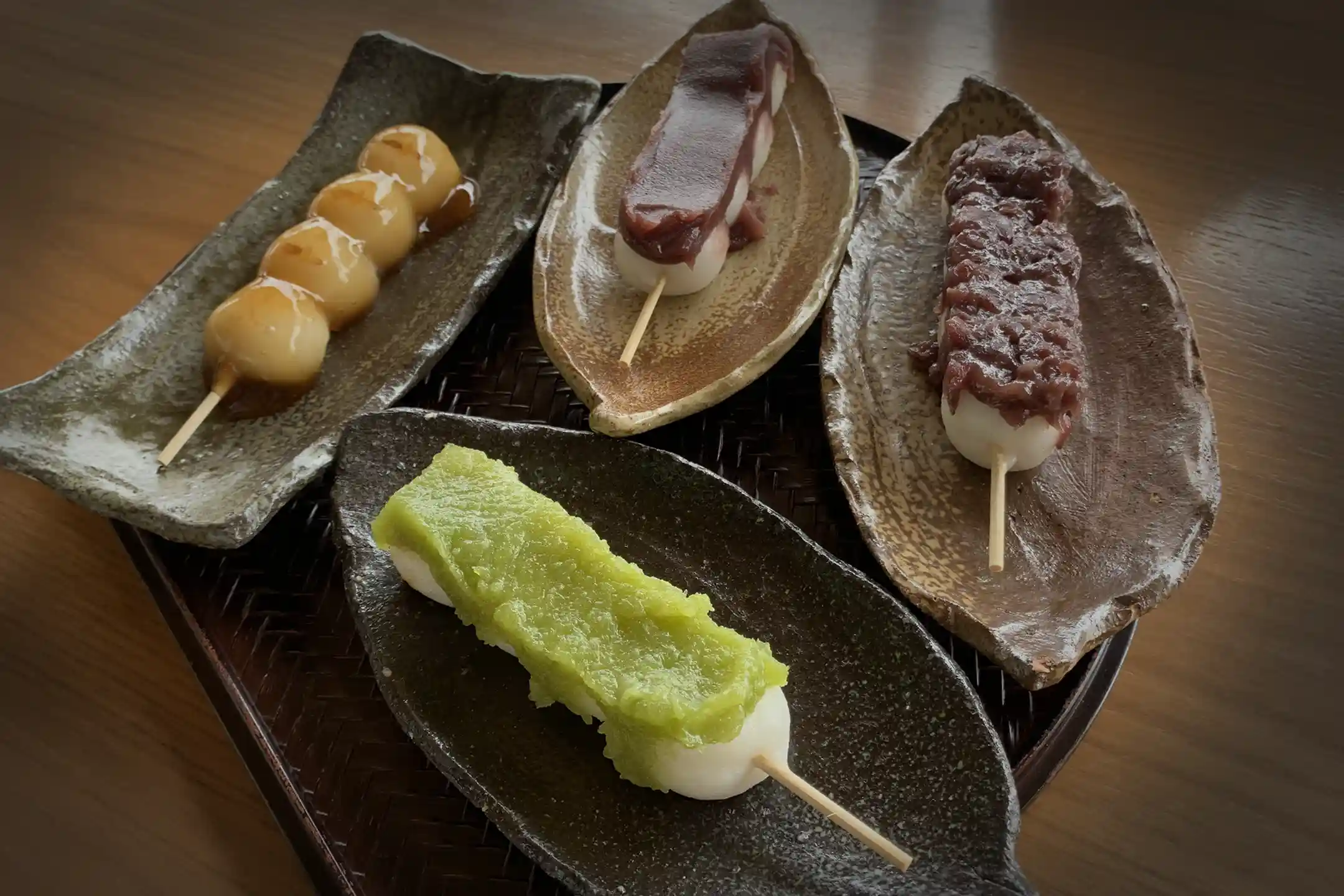
Dango is a dumpling made from rice flour, worked with water into a dough, formed into balls and cooked. It is usually served three to five on a skewer, and it is sold everywhere from wagashi specialists with two centuries of history to convenience-store chillers.
The word itself is plainer than it looks. Written with two characters — the first meaning a round lump, the second the diminutive Japanese attaches to small objects — dango names the object and nothing else: a small ball of dough. English renders it as rice dumpling, which is accurate and slightly misleading, since an English dumpling is usually savory and usually boiled in something. Japanese uses the word the same way outside the kitchen too, for anything clustered into a knot — hair tied in a bun, a crowd packed tight. Nothing in the name promises sweetness, and the sweet does not deliver any.
The dough itself carries almost no sugar. That single fact explains most of what surprises first-time eaters: the sweetness in a skewer of dango comes from what goes on top of it or around it, not from the dumpling. A plain dango is closer to a bread roll than to a dessert, and the whole construction is built to carry a glaze, a paste or a dusted powder.
Texture is where the shops separate. A dango made and sold the same morning has a yielding, faintly springy bite. Rice-flour dough hardens as it cools and sits, which is why a skewer bought at a tea house beside a shrine and a skewer bought from a chiller cabinet can be made from the same ingredients and eat like different foods.
The flour is the other variable, and it has names a traveler can use. Joshinko, milled from ordinary short-grain rice, gives a firmer, cleaner bite. Shiratamako, milled from glutinous rice, gives a softer and stickier one. Many shops blend the two, and household kitchens buy the blend ready-made as dangoko. The proportion is a house decision that nobody advertises, so you cannot read it off a label — but you can taste it, and you can ask.
The sources do not fully agree here, which is itself worth knowing. Kyoto Journal calls the flour mochiko, the glutinous one; Japanese shops in practice work with joshinko or a blend. The flour is the variable nobody prints on the packet and nobody quite settles.
What Does Dango Taste Like?
The dumpling tastes of rice, mildly, with a clean finish and a texture between chewy and soft. It is not sweet on its own.
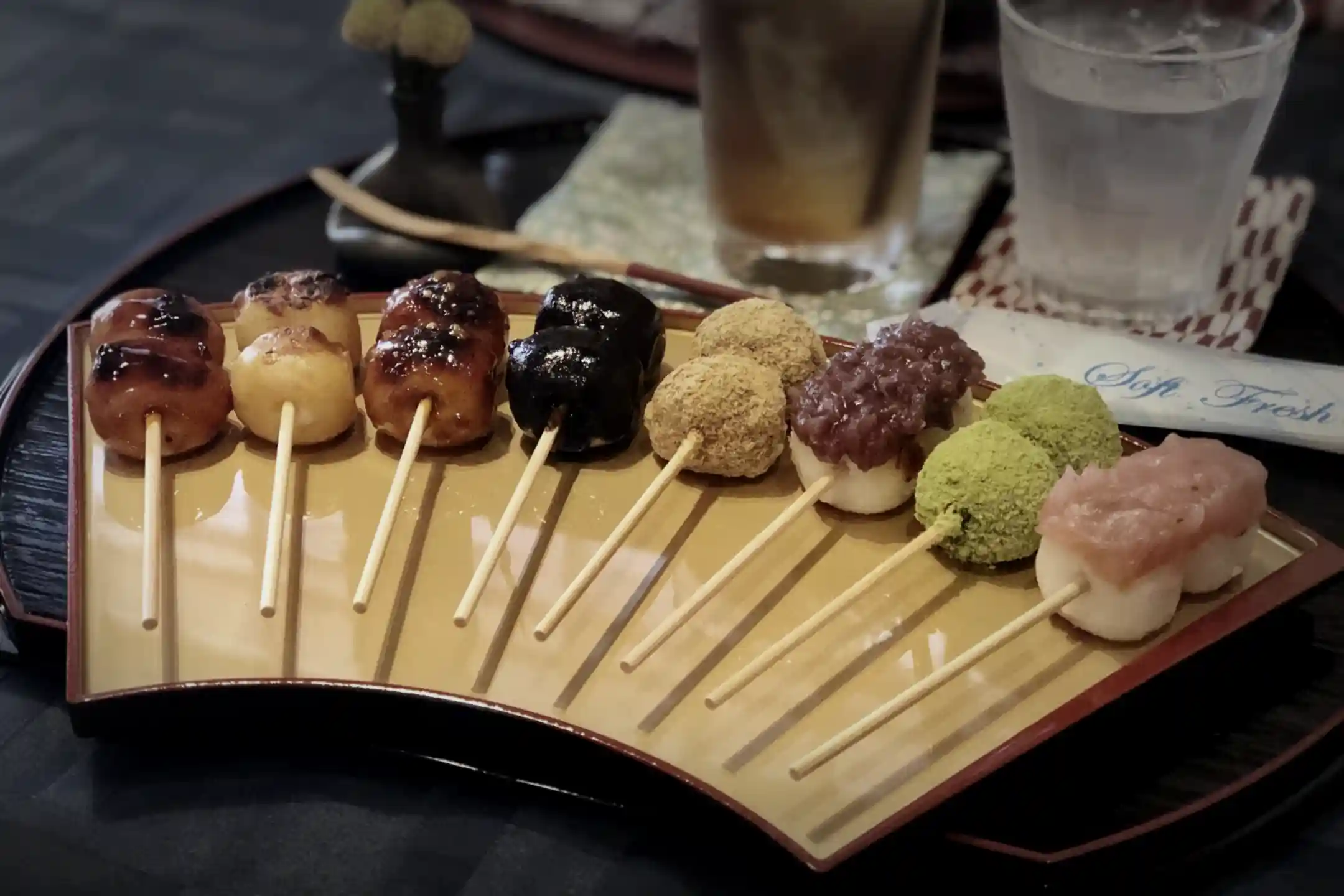
What you actually taste is the treatment. A mitarashi glaze is salty-sweet and slightly burnt at the edges from the grill. Kinako, roasted soybean flour, is nutty and dry and dusts the mouth. Anko, sweet red bean paste, is the sweetest of the common treatments and the heaviest. Yomogi, Japanese mugwort, is kneaded into the dough itself and turns it green and faintly bitter, closer to a herb than to a flavoring.
If you want to understand a shop in one purchase, buy a plain or kinako skewer rather than a heavily glazed one. The glaze is generous and forgiving; the naked dumpling is not, and it tells you how recently the dough was made.
Is Dango Just Mochi? How Dango Differs from Mochi and Daifuku
This is the question search engines get asked most about dango, and the answer is a genuine distinction rather than a quibble over names. The difference is in the process, not the ingredient list.
As Kyoto Journal puts it, dango are "not to be confused with mochi, which are made from steamed glutinous rice that is then pounded; dango is made with rice flour, called mochiko." Mochi begins as whole cooked grains that are hammered into a mass. Dango begins as flour that is mixed with water into a dough, the way you would begin a bread.
The eating difference follows from that. Pounded mochi is long and elastic, and it stretches when you pull it. Dango is shorter in the bite, denser, and it breaks rather than stretches. Neither is a lesser version of the other.
Daifuku is a third thing again: a mochi skin wrapped around a filling, usually sweet bean paste, served as a single soft round.
The quickest test is the process, not the shape. If it started as flour and water, it is dango, whether it arrives on a skewer or stacked on a stand. If it started as whole grains under a pounding mallet, it is mochi. If it is a soft mochi parcel with something inside, it is daifuku.
Mitarashi, Hanami and the Main Kinds of Dango
Dango is a category, not a single sweet. Three kinds account for most of what a visitor will encounter.
Mitarashi Dango: The Soy Glaze and Its Kyoto Origin
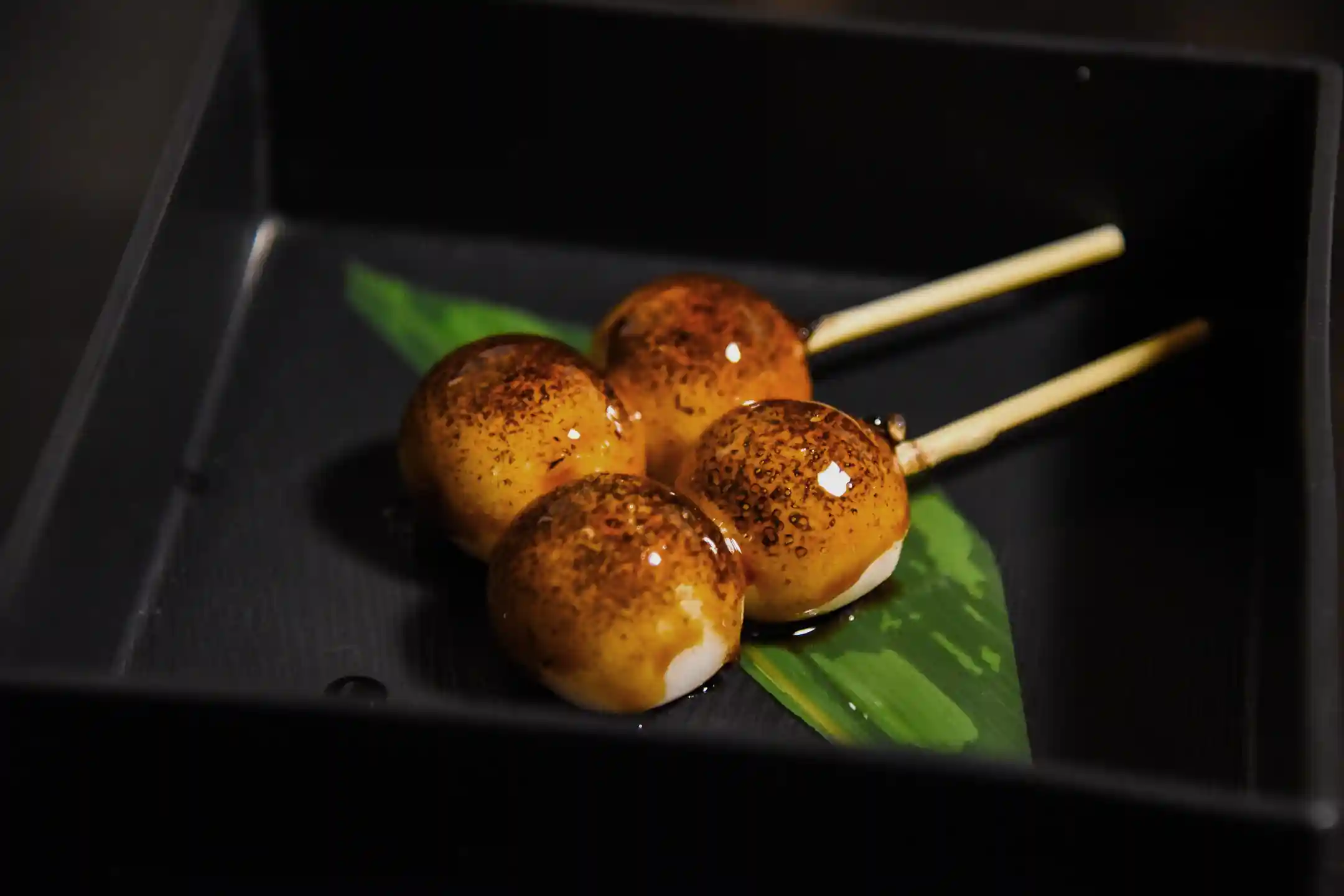
Mitarashi is the savory-sweet one: dumplings grilled until they catch a little color, then coated in a translucent glaze of soy sauce, sugar and starch. It is the version most often photographed and the one most likely to change a visitor's mind about what a Japanese sweet can taste like.
The name is Kyoto's. According to The Kyoto Project, mitarashi dango takes its name from the Mitarashi Festival held at Shimogamo Shrine, and it was originally served five to a skewer. Two explanations circulate for that number, and the source is careful to present both as theories rather than as established fact: one holds that the arrangement follows bubbles rising in the shrine's Mitarashi pond, where a single bubble surfaced and four more followed; the other reads the five as a human figure, four for the body and one for the head.
The five-piece skewer is the older form. What reduced the count elsewhere had nothing to do with taste. The Edo-Tokyo Museum's reference desk cites Edo-period sources reporting that in Edo, around the Horeki and Meiwa eras, a skewer sold for five mon and carried five dumplings, and that after a four-mon coin was minted in 1768 the skewer is said to have become four at four mon. That was Edo's arithmetic and not Kyoto's, which is part of why four-piece skewers became ordinary across much of Japan while a five-piece mitarashi skewer near Shimogamo still reads as the older survival. The three-piece packs in convenience-store chillers are more recent still. If you want to see what the sweet was, look for a five-piece skewer near the shrine that named it.
Kyoto Journal notes that brown sugar entered the mitarashi glaze in the Taisho era, which places the sweet you eat today closer to the twentieth century than its medieval name suggests.
Hanami Dango: Why Three Colors
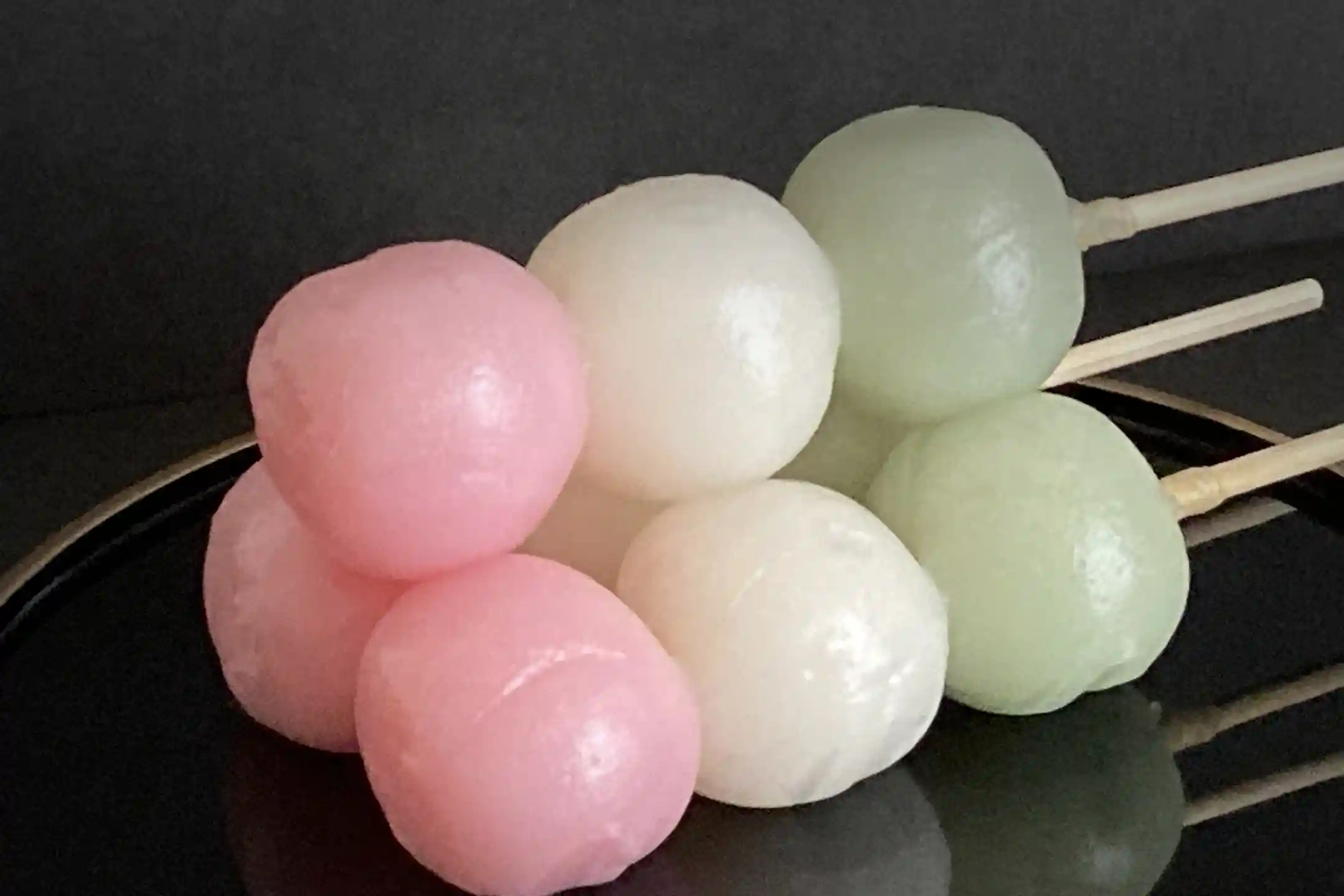
Hanami dango is the pink, white and green skewer that appears in March and disappears by May. It is the most recognizable dango in Japan and the most seasonal.
The colors are read in more than one way, and the honest position is that no single reading is authoritative. Kyoto Journal gives two: pink, white and green as blooming cherry, white sake and mugwort; or as cherry blossom, the last of the snow and new grass. The Global Japanese Tea Association sets out the same three-part reading, with pink for the blossom, white for the retreating snow and green for new growth. Both readings describe the same movement out of winter.
The date is firmer than the symbolism. Kyoto Journal places the sweet's introduction at the Daigo no Hanami, the cherry-viewing banquet Toyotomi Hideyoshi held at Daigo-ji in 1598 — the most famous blossom party in Japanese history, and the reason the sweet is bound so tightly to the season.
Kinako, Anko and the Everyday Kinds
Away from the two famous versions sit the everyday ones. Kinako dango is dusted with roasted soybean flour and is the driest and nuttiest of the common kinds. Anko dango carries sweet red bean paste and is the closest to what a Western palate reads as a dessert. Kusa dango, sometimes called yomogi dango, has mugwort worked into the dough, which colors it green and gives it a herbal edge that the other kinds do not have.
These are the skewers a Japanese customer is most likely to buy for themselves. They are also the ones that reward a good shop most visibly, because there is no glaze to hide behind.
Two regional kinds are worth recognizing if you travel outside the main cities. Sasa dango, which Kyoto Journal describes as mugwort-infused dango wrapped in sasa bamboo leaves, belongs to Niigata and the snow country, and the leaf is more than decoration: sasa was the material chosen for wrapping food that had to keep. Kibi dango is the Okayama version, and Kyoto Journal notes that its only flavorings are sugar and a dusting of millet flour; the same source records that Emperor Meiji praised the kibi dango of Kibitsu Shrine in 1892. The name carries a pun most visitors miss, since the syllables read as millet and also as Kibi, the old name of the province. It is the dumpling the folk hero Momotaro carries in the story, which is why it fills the souvenir shelves in Kurashiki and across Okayama.
How Dango Marks the Japanese Year
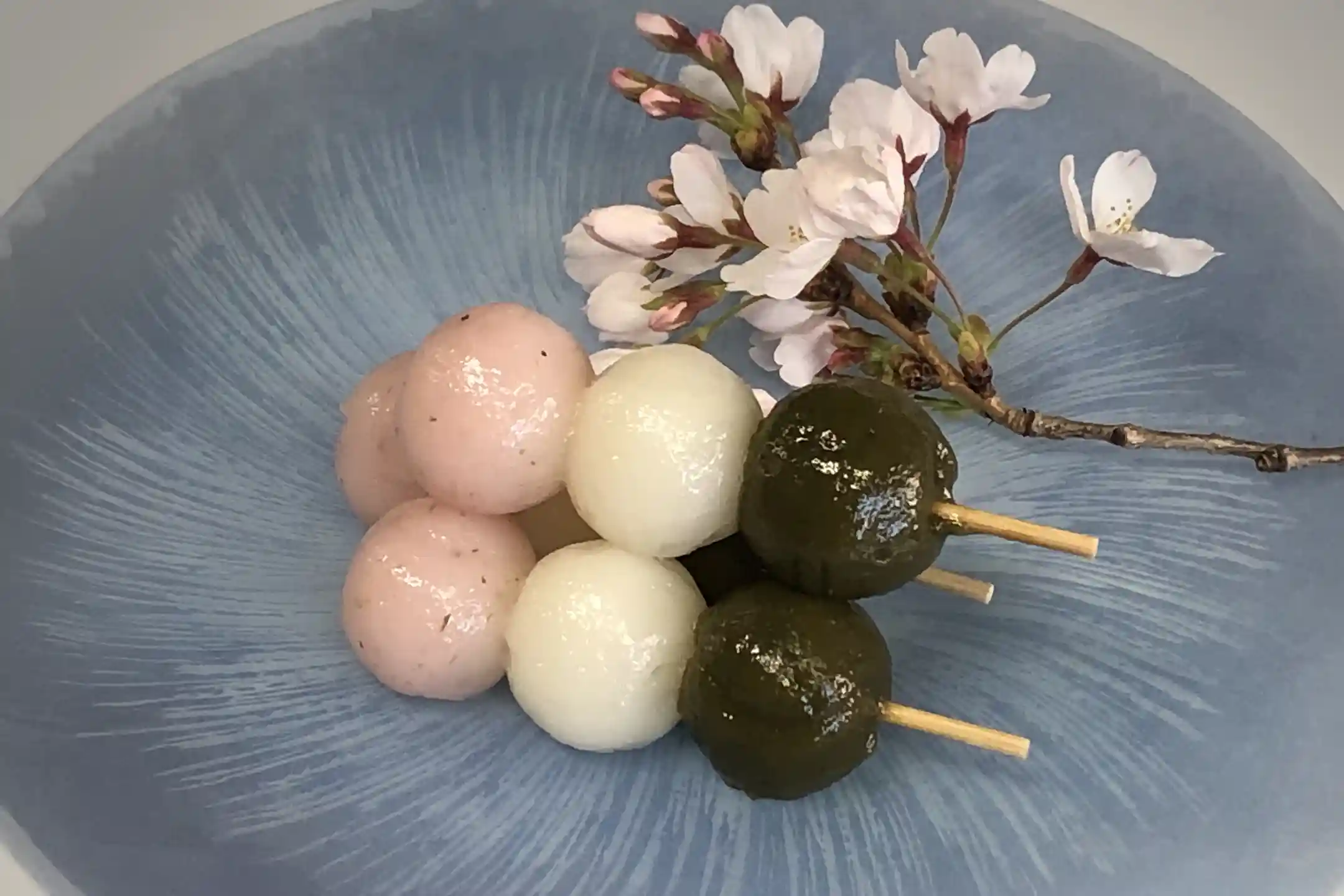
Dango is one of the clearest examples of a Japanese food that is tied to a date. Knowing the calendar tells you what will be in the case when you arrive.
Spring belongs to hanami dango, which appears with the blossom forecast and vanishes with it. The pairing is old enough to have produced a proverb, hana yori dango — dumplings over flowers — used of someone who came for the food and stayed for the food. It is usually said with affection, and it is worth knowing because it tells you how the sweet is regarded: as the practical pleasure that outlasts the view.
Autumn belongs to tsukimi dango, plain white spheres stacked in a pyramid on a wooden stand and set out for the harvest moon. Kyoto Journal describes them as round white spheres resembling the full autumn moon, and traces the moon-viewing custom to China, arriving in Japan in the Heian period as an aristocratic pastime and spreading among ordinary people only during the Edo period. The sweet followed the custom down the social ladder, which is why it is now sold boxed in supermarkets. The custom is why you will see pampas grass in Japanese shop windows in September beside a plate of white dumplings.
The stacking is not decorative. The dumplings are piled into a pyramid on a small wooden stand and set where the moon can be seen, traditionally with pampas grass beside them, and the count usually follows the night: fifteen for the fifteenth night of the eighth lunar month, which is the night the festival is named for. Shops sell them boxed and ready to stack for a few days on either side of the date and then stop, which is as sharp a seasonal cutoff as you will find.
Winter has its own form, further north. In parts of Tohoku the Little New Year in mid-January is marked with dangosashi, in which small colored dumplings are pushed onto the bare branches of a mizuki tree and stood indoors as a prayer for the year's harvest, so that a leafless branch carries what looks like blossom in the middle of the snow. Here the dumpling is not food at all until the decoration comes down.
The pattern to notice is that the oldest kinds were offerings before they were snacks. Kyoto Journal records mitarashi dango coming to prominence as an offering at Shimogamo Shrine during the Aoi Matsuri, and tsukimi dango being set out alongside vegetables from the autumn harvest. Hanami dango is the exception that proves it: it enters the record at a warlord's party, not at an altar, and it is the one kind that was always simply a pleasure. The stacked tsukimi pyramid is still a shape for presenting to something, not for eating from, and the association survives even where the religious meaning has thinned. It is the same logic that puts a specific sweet in a specific week rather than on a permanent menu, and it is worth planning around: arriving in Kyoto in late March and in late September gives you two entirely different cases of sweets to choose from.
Where to Eat Dango in Japan

It is worth being clear about where dango sits in the wider world of Japanese sweets, because visitors often expect it to belong to the tea ceremony and it does not. The sweets served at a formal tea gathering are chosen to prepare the palate for a specific bowl of tea: omogashi, moist confections shaped to the season, for thick tea; higashi, dry ones, for thin. They are made for a room, a guest list and a date. Dango belongs to the other tradition entirely, the one that grew up along pilgrimage roads and outside shrine gates, where the sweet had to be cheap, portable and eaten standing. Both traditions use the same ingredients and the same seasonal vocabulary. Only one of them was ever meant to be eaten while walking.
That difference is why dango repays a traveler more than its price suggests. A tea gathering is something you arrange; a skewer of dango is something you encounter, and the encounter tells you what the neighborhood eats on an ordinary Tuesday.
Dango is sold in four quite different settings, and the difference between them is larger than the price gap suggests.
Tea houses at shrine and temple approaches are the oldest form and the best case. The shop grills to order, the skewer arrives warm, and the dumpling has not had time to firm up. These are also the places where a five-piece mitarashi skewer still exists. The approach roads to major Kyoto shrines are the reliable hunting ground, and a walk through the older districts will pass several without looking for them; our guide to walking Kyoto's old town covers those routes.
Wagashi specialists are the second setting and a different proposition. Here dango sits alongside seasonal confections made to a standard set by the tea ceremony, and the interest is in comparison: what a house that makes namagashi for tea does with something as plain as a rice dumpling. If the tea side of that world interests you, our guide to tea ceremony experiences in Tokyo is the companion piece, and our article on Japan's tea and dango café culture covers where the two are served together.
Covered market arcades are the third. Nishiki Market in Kyoto sells dango among a great deal else, and the quality is real, but the setting is a walking street and the skewer is usually eaten standing.
Convenience stores are the fourth, and they are not a mistake. The chilled three-piece packs are consistent and cheap, and they are a legitimate way to try a kind you have not met. What they cannot give you is the texture of a dumpling made an hour ago, which is the whole argument for the tea house.
What to look for is the same in all four settings. A shop that grills to order will have a grill working and a queue that moves; a shop that grills in advance will have a tray of finished skewers under a lamp. Both exist on the same street and cost about the same. Ask for the skewer to be grilled if you are not sure, since the request is ordinary and the difference is not subtle.
Prices are low enough that comparison costs nothing, which is unusual among the things worth being fussy about in Japan. A single skewer sits in the range of a cup of vending-machine coffee, so buying one from two shops to taste the difference is a reasonable way to spend twenty minutes rather than an indulgence.
One practical note that applies everywhere: most dango is at its best on the day it is made and does not travel, which is why the fresh kinds are a rare sight in airport souvenir cases. Kibi dango, made to keep, is the exception you will see boxed. The rest is a sweet you eat where you buy it.
Stay a little longer with Japan's tea and sweets tradition

Conclusion
Dango rewards a small amount of knowledge more than most Japanese sweets. Know that the dough is unsweetened and you understand why the glaze matters. Know that dango is dough and mochi is pounded grain and you will never confuse them again. Know the calendar and you will know what is in the case before you look. And buy from a shop that grills to order, because the difference between that skewer and a chilled one is the entire distance between a snack and a reason to stop walking.