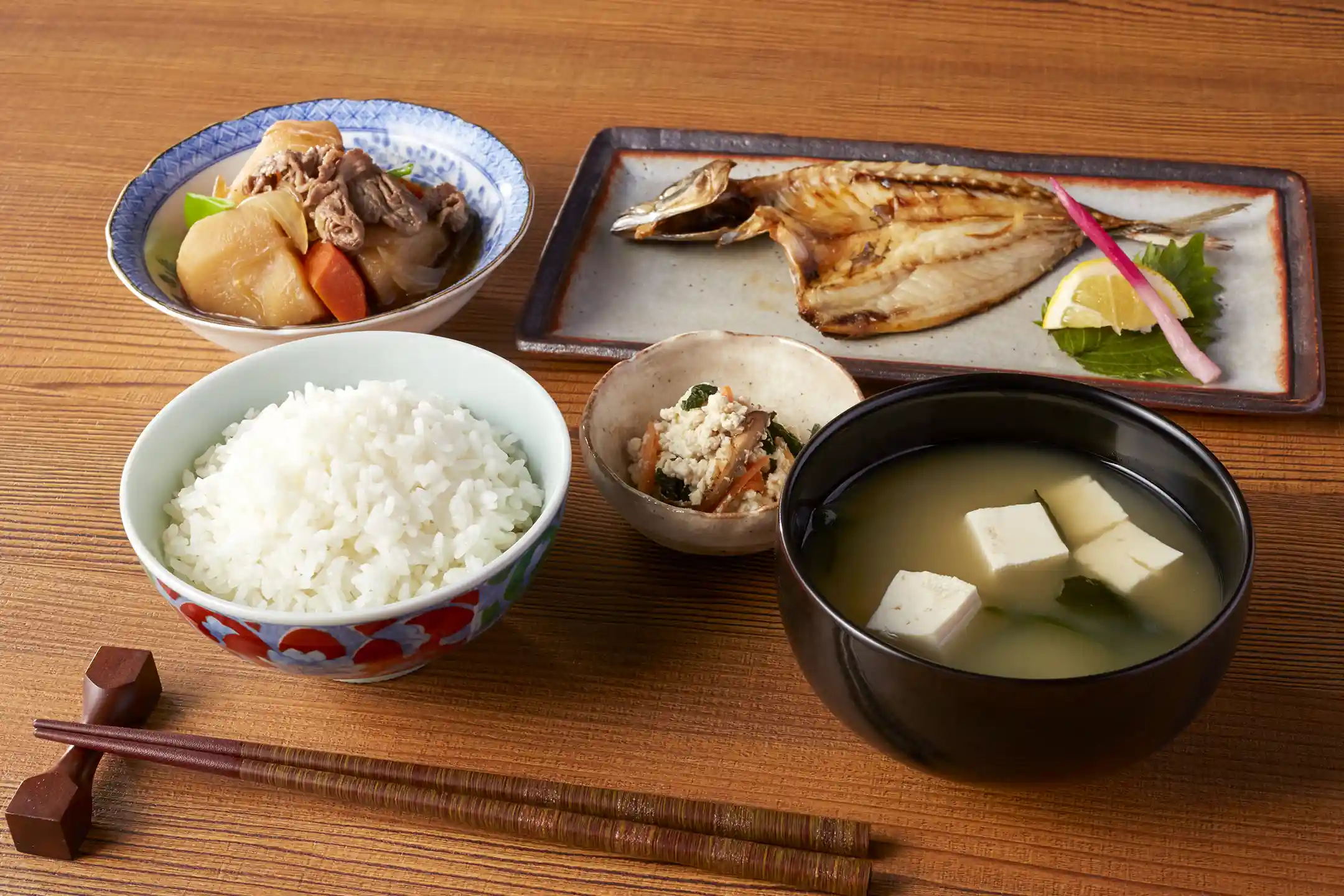
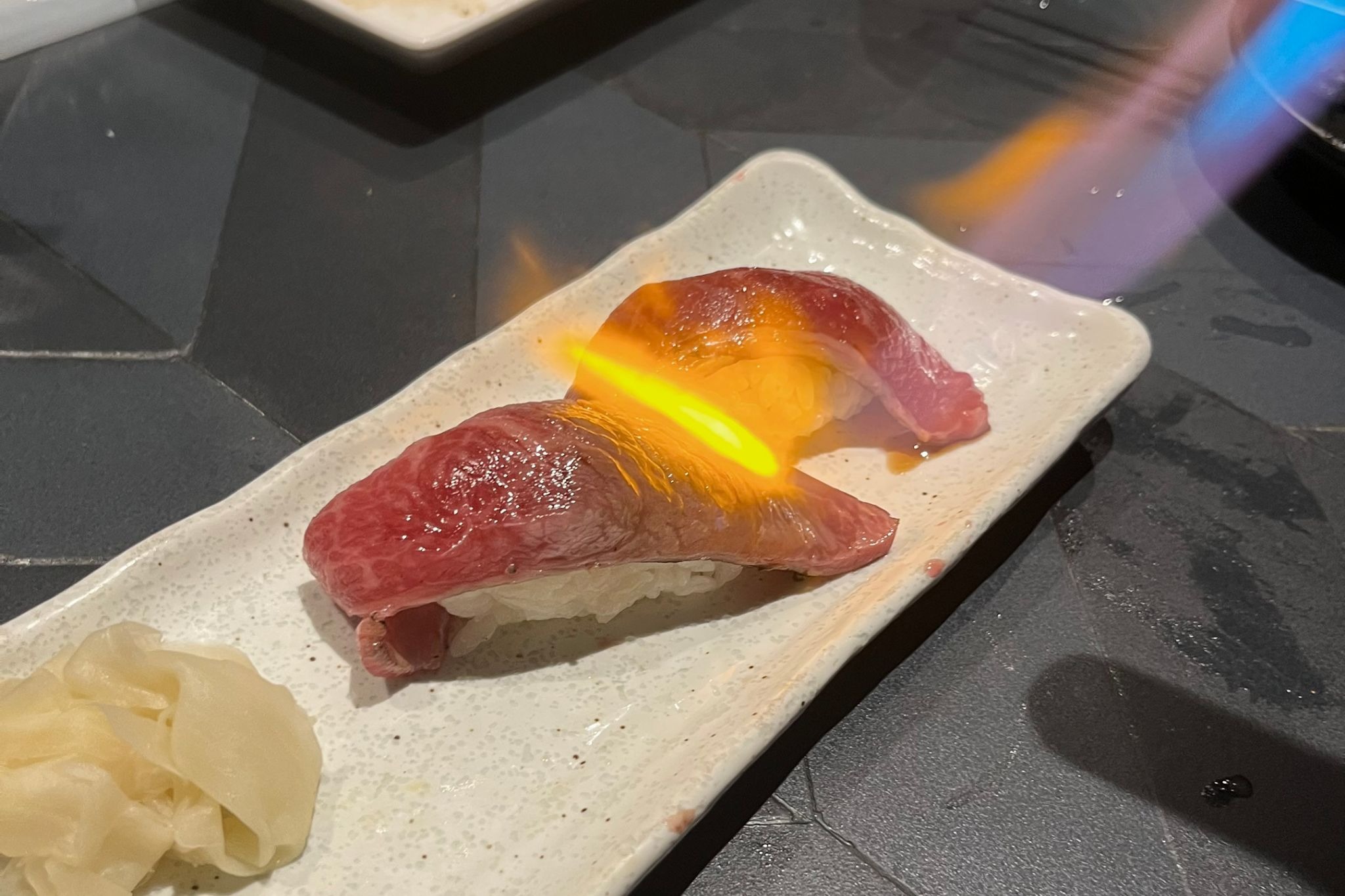
If you searched for viral sushi bake, you are probably responding to the same appeal that makes aburi sushi so compelling: heat, sheen, aroma, and instant visual drama. But for an anniversary in Japan, the more refined choice is not a casserole-style trend or social-media spectacle for its own sake. It is the brief flare of flame, the fragrant surface, the tender center, and the feeling that the room has quietly narrowed to the two of you.
In this guide, we lay out a framework you can return to: how to choose exceptional aburi sushi without getting pulled around by trends, how to word your reservation, and how to build anniversary-friendly itineraries in Tokyo, Kyoto, and Hokkaido. We will also clarify the difference between viral sushi bake and viral aburi sushi, so your search leads to the experience you actually want rather than the one that simply looks the loudest online.
The Bottom Line|Three Fail-Safe Ways to Choose Viral Aburi Sushi — For Busy Readers
When you are short on time, do not start by collecting restaurant names. Start with three criteria that determine whether the experience will actually feel special. The appeal of aburi sushi lies less in the visible flame or decorative extras than in the instant the aroma rises, the way the fat loosens, and how the temperatures are layered in the mouth. In principle, heat helps generate aroma and also changes how aroma is released and perceived(*1)(*2). If this is your first time, omakase—leaving the progression to the chef—usually makes the experience smoother. Sushi etiquette is also simpler than many visitors expect, but a few small choices, such as how you use soy sauce and how long you pause for photos, help preserve the beauty of the meal(*3).
Point One: Choose by Aroma and Temperature Contrast, Not by Looks Alone
Social media makes the flame look like the main event, but satisfaction usually comes from aroma and temperature contrast. Aburi adds heat to the surface to create a toasted fragrance, while keeping the center delicate. The result is a peak moment built from the warm surface, the slightly cooler center, and the shari—the sushi rice—served close to body temperature. If you are comparing options, prioritize restaurants whose reviews or descriptions mention words such as “aroma,” “temperature,” “shari,” and “melt,” not just “wow” moments or flashy visuals. The more specifically a restaurant can talk about aroma, the more likely it is that the chef can articulate—and repeat—the flavor design behind each piece(*2).
Point Two: For an Anniversary, Choose by Experience Type — Private Room / Counter / Hotel
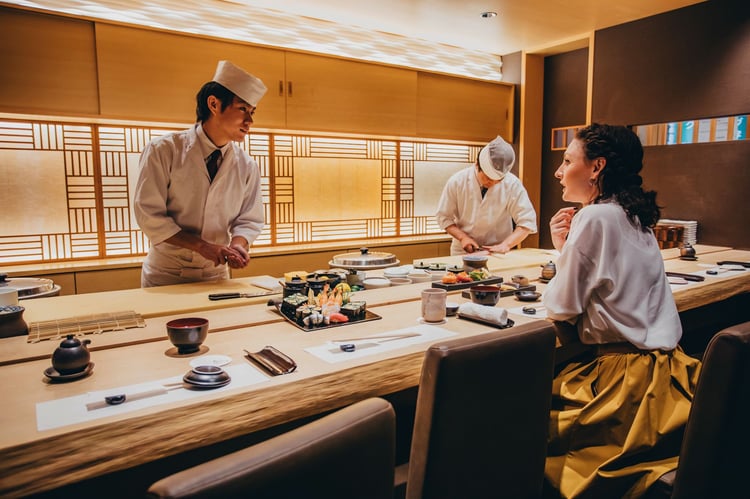
For an anniversary, the real question is not only which famous restaurant you book, but what kind of experience the room creates. At a counter, you can watch the chef’s movements at close range, so conversation begins to flow with the meal and nervousness often turns into excitement. A private room gives you more quiet and privacy, which is helpful for a bouquet, a message plate, a gift handoff, or discreet photos. Sushi inside a hotel reduces the friction of moving around the city and makes it easy to extend the night into a view, a bar, or a spa. Whichever format you choose, the key is the same: do not choose a setting that merely shows off the aburi—choose one that protects your time together.
Point Three: Before You Book, Add One Brief Note About Requests, Dislikes, and Photography
The more refined the restaurant, the more valuable advance information becomes. The point is not to send a long note. Briefly and politely mention ① ingredients you dislike or are allergic to, ② that you are celebrating an anniversary, and ③ whether photography is allowed(for example, no flash or hands-only photos). A note such as, “We are celebrating an anniversary. One of us cannot eat shellfish. May we also ask whether photos are allowed?” is more than enough. With aburi sushi, the temperature immediately after service is part of the taste itself, so not letting photography slow the meal is also part of dining well(*2)(*3).
From Viral Sushi Bake to Viral Aburi Sushi|Why Seared Sushi Spreads on Social Media
Something goes viral not only because it looks dramatic, but because it creates a fast emotional reaction. Research suggests that people are more likely to share content that evokes high-arousal emotions such as surprise, awe, or excitement(*1). That helps explain why both viral sushi bake videos and flame-seared sushi clips travel so well online.
A burst of flame, glossy fat, and the suggestion of warmth are exactly the kind of cues that raise expectation in an instant. On top of that, the appearance and presentation of food can shape how people evaluate the dining experience itself(*2). Once you add a memorable story and repeatable quality, buzz starts to feel credible rather than accidental.
That is why, for an anniversary, the best target is not a place that is only photogenic for three seconds. It is a place whose online popularity is supported by context, craft, and consistency. In travel, user-generated content can also influence destination image and visit intention, which makes social media a reasonable place to begin your search—as long as you know how to read the signals(*3).
The Three Drivers of Virality: Visuals, Story, and Consistency
First, visuals. Flame, sheen, and that just-melting look work powerfully in short-form video, and they encourage the brain to decide “this must be delicious” before the first bite. Second, story. Details such as the origin of the fish, the aging method, the chef’s preferred heat source, or the reason a piece is served at a specific point in the course give people something to remember and retell. Third, consistency. A reservation is not impossibly confusing, the service feels steady, and the experience can be repeated across visits. When these three conditions align, posts lead to more posts. Research also suggests that visually striking presentation can elevate evaluations(*2), so this is not an argument against beautiful plating. It is simply a reminder that, for an anniversary, visual impact should support taste rather than outrun it.
The Difference Between Viral Sushi Bake, Viral Sushi, and Viral Aburi Sushi
Viral sushi bake usually refers to a warm, baked, shareable dish inspired by sushi flavors. Viral sushi is the broader internet category that includes oversized cuts, unusual toppings, or novelty presentation. Viral aburi sushi is more specific. Its value comes from a chef briefly searing the surface of a topping to release aroma while keeping the center delicate. That difference matters on an anniversary. Sushi bake is comforting and casual; aburi sushi is about timing, atmosphere, and a scent that exists for only a few seconds. Restaurants that can design that fleeting moment are the ones most likely to turn social-media attention into real satisfaction at the table.
Aburi Sushi Basics|The Toppings, Condiments, and Ordering Sequence You Should Know First
To eat sushi in Japan is not only to order a dish, but to step into a living food culture. One reason Washoku, Japanese food culture, was recognized by UNESCO as Intangible Cultural Heritage is that it reflects a shared respect for seasons and for nature through food(*1).
That said, there is no reason for first-timers to feel intimidated. The Japan National Tourism Organization also makes clear that sushi etiquette is fundamentally simple and that a few basics are enough to help you move naturally through the meal(*3). Rather than trying to “act like an insider,” the goal here is to give you just enough knowledge to feel relaxed and refined.
What Is Aburi Sushi? The Balance of Raw Delicacy and Seared Aroma
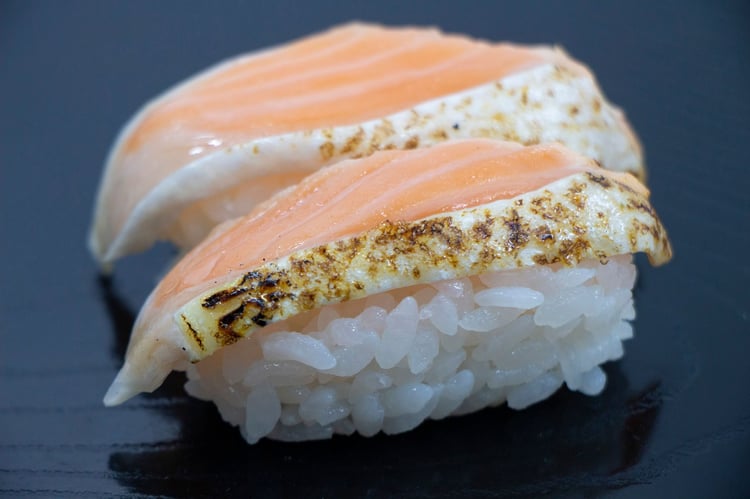
Aburi sushi is a technique in which only the surface of the topping is exposed to heat for a few seconds, adding savory fragrance while leaving the center rare or lightly warmed. Its beauty lies in letting the delicacy of sashimi coexist with the aromatic lift of heat. As a result, anticipation often rises through smell before the bite even reaches your mouth(*4). In English-language sushi settings, “aburi” is widely used as a menu term precisely because this lightly seared style has become recognizable in its own right(*5).
A Guide to the Popular Toppings That Tend to Go Viral
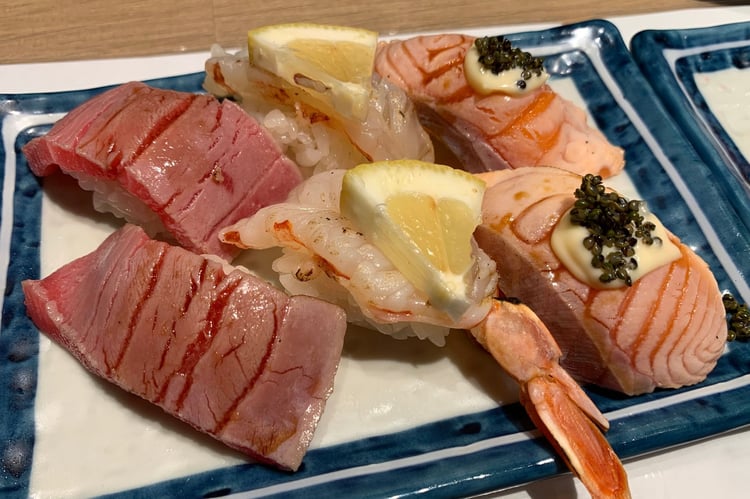
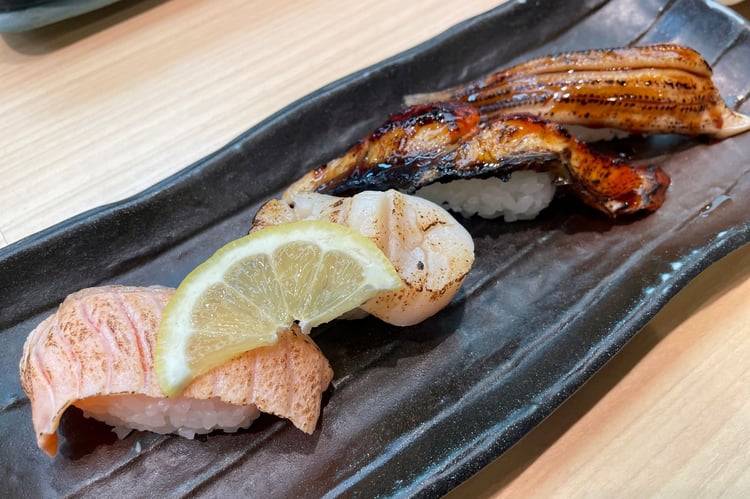
For first-timers, the easiest toppings to order—and the ones that best demonstrate what aburi can do—are usually the fattier or sweeter ones. A simple way to compare them is by four points: aroma, richness, melt-in-the-mouth feel, and how clearly the effect of searing comes through.
Salmon: Sweet fat and an easy-to-recognize lift in aroma when seared.
Engawa: A springy, fatty texture paired with a distinct toasted note.
Chutoro: Fat that loosens quickly, making temperature control especially important.
Scallop: A gentle contrast between a lightly seared surface and a naturally sweet center.
Anago: When simmered conger eel is lightly seared, the sauce becomes more fragrant and the finish feels elegant.
If terms such as “engawa” or “omakase” are unfamiliar, that is completely fine. Comfort matters more than memorizing vocabulary(*3).
Condiments and Topping Pairings That Elevate the Experience
What suits an anniversary is not excess, but layering. Yuzu adds a bright top note over rich fat. Salt sharpens the outline and lets the savory character of the topping stand out more clearly. Lemon can lighten the aftertaste of shellfish or white fish and carry you gently into the next piece. Herbs are more divisive, so if you are new to the style, start with only a small amount. Stronger aromas such as truffle can feel luxurious when the balance is right, but because they dominate easily, they are usually better placed in the middle or later stages of a course rather than on the first piece(*4).
Your First Ordering Sequence: Light → Aromatic → Rich
Order is the narrative arc of a sushi course. If you are unsure, think in terms of white fish → shellfish → aburi → richer tuna cuts → finish. White fish clears the palate, shellfish brings sweetness, aburi creates the aromatic peak, richer tuna adds fullness, and a final turn toward anago or a roll closes the meal quietly. Omakase is still the easiest route, but if there are ingredients you dislike, saying so at the start is basic courtesy(*3). Shari, meanwhile, is seasoned not only for flavor but also for balance, and matching the temperature of the topping to the rice is part of the chef’s craft as well(*6).
Why Is It So Good? The Science and Craft of Aroma, Fat, and Temperature That Make Aburi Sushi So Memorable
When you choose premium sushi for an anniversary, you want more than a high price tag—you want to understand why it feels moving. Aburi compresses several sources of pleasure into a very short span of time. Heat helps create aroma(*1), temperature changes how aroma is released and perceived(*2), and as fat loosens, the mouthfeel changes as well(*3).
Then there is the shari, which acts as the base that receives both acidity and aroma(*4), while the chef ties everything together through the timing of the sear and the timing of service. The point here is not to become technical. It is to give you a clearer language for what you are tasting, so the experience feels more intentional and memorable.
What Creates That Toasted Aroma
The toasted aroma of aburi can be understood largely through reactions in which amino acids and sugars respond to heat, creating new aroma compounds and color(*5). That is one reason aburi can feel delicious before it even reaches your mouth. The nose arrives first. Because aroma strongly shapes flavor perception, the opening seconds of aburi are especially dramatic. On an anniversary, a room with calm lighting and limited noise can make that aromatic lift feel even more vivid.
The Moment Fat Begins to Loosen
The fattier the topping, the more its texture changes the moment warmth reaches it. Fish oils contain substantial amounts of unsaturated fatty acids, and research suggests that phase changes can occur even at relatively low temperatures(*3). That is why a very brief sear can move sweetness and a melting sensation forward so quickly. The goal is not to melt everything away, but to land on the point where the fat has only just begun to loosen. Too much heat and you lose delicacy. Too little and the aromatic peak never arrives. Great restaurants are distinguished by how precisely they control those few seconds.
The Temperature Contrast with the Shari
Sushi is never complete through the topping alone. The acidity of the shari—vinegared rice—acts as the foundation that receives both aroma and fat. It has been reported that adding vinegar to sushi rice lowers pH, which relates to both preservation and sensory evaluation(*4). But at the table, what matters most is not the number itself. It is the way the grains release in the mouth. When a warm-surfaced topping meets shari that opens softly, the same piece can move from “simply delicious” to “hard to forget”(*2).
.webp?width=750&height=500&name=Sushi%20Chef%20(Sushi%20Shokunin).webp)
How Flavor Changes with the Searing Method
Even when everything is called aburi, the aroma changes with the heat source. A burner gives the chef precise, immediate heat at a specific point. Charcoal or straw can add layers of smoke, including aromatic compounds such as phenols(*6). At the same time, there is also discussion of undesirable compounds such as PAHs increasing under certain smoking conditions, which is why careful heat control and ventilation matter(*7). As a simple way to describe your preference, it helps to think in two directions: “clean and toasty” for burner-style searing, or “smoky and aromatic” for charcoal- or straw-led styles.
A Way to Enjoy It with Peace of Mind
As a basic rule, “lightly seared” does not automatically mean “risk-free.” Anisakis, for example, can cause food poisoning when raw or insufficiently frozen or heated seafood is eaten, which is why freshness control, visual inspection, proper freezing, and appropriate heating are emphasized as preventive measures(*8). There are also warnings that vinegar, salt, soy sauce, and wasabi do not kill it(*9). High-end restaurants often invest heavily in sourcing and hygiene, but your part matters too: do not force yourself to eat raw food when you are not feeling well, and ask in advance if you have any concerns. Three simple signs of trust are ① clear explanations of origin and technique, ② a room and staff movement that feel clean and composed, and ③ reviews that mention not only “taste,” but also “care” and “responsiveness”(*10).
Choosing a Restaurant That Elevates Your Anniversary
Where you eat matters, but on an anniversary, how the time unfolds matters even more. Even if a restaurant is popular on social media, the distance between seats, the way sound carries, the lighting, how easy it is to take a discreet photo, and the timing and presence of the staff can all change how the experience stays with you.
The goal here is to use high-quality buzz to your advantage without confusing attention with reliability. Social media and review platforms are mixed by nature, but user-generated content does affect decision-making, which is why the way you read it makes the difference(*1). It has also been shown that review format—text, images, and video—and the amount of information included can shape how helpful a review feels(*2).
.webp?width=750&height=500&name=The%20Art%20and%20Craftsmanship%20of%20a%20Sushi%20Chef%20(Sushi%20Chef_s%20Skill).webp)
Tips for Searching on Social Media
When searching on social media, check the quality of the language before the number of saves. In posts about genuinely high-end experiences, people tend to describe “aroma,” “temperature,” “service,” “quiet,” or “how easy it was to talk.” If the reaction is only short praise or emoji-level excitement, the place may be popular without being reliably good. It also helps to see whether multiple posts about the same restaurant tell a similar story. Consistency across posts is often more useful than one spectacular clip. And if the poster says who they went with, pay attention. Strong anniversary restaurants tend to inspire comments not only about the food, but about pacing, seating, and how the restaurant made time for two feel complete(*1).
Tips for Searching on Maps and Review Sites
On review sites, specificity matters more than score. Research suggests that the specificity and format of reviews influence perceived usefulness(*2). “The salmon was good” tells you very little. “Conversation stopped when the aroma rose,” or “each piece arrived at a different temperature,” tells you much more. Those are descriptions of experience, not generic approval. It also helps to scan the photos for consistency. Similar lighting, plating, and quality across many uploads often suggest that the restaurant is winning through repeatable design, not a one-off stunt. If only one flamboyant piece keeps appearing, separately confirm the quality of the full course.
By Experience Type
Counter: You are close to the chef, and sound, aroma, and movement all become part of the experience. Even if it is your first time, being able to see what is happening often feels reassuring(*3). Just go easy on perfume.
Private room: You have more freedom for conversation, surprises, and calmer photography, but still be careful not to slow the pace of the meal.
Hotel: You reduce transit stress and can carry the afterglow directly into a bar, lounge, or spa. It is a classic format for a special occasion.
These criteria keep working even when trends shift, which is exactly what makes them useful over time.
Interactive Experiences That Deepen Your Bond
The power of an interactive experience lies in being surprised together. The searing happens in front of you, aroma rises, and the chef adds a brief explanation. In that instant, your memory timelines sync. Psychology research suggests that high-arousal emotions are more likely to be shared(*4), and aburi fits that condition beautifully. Decorative extras such as gold leaf or dry ice can divide opinion, so for an anniversary, restraint usually ages better than excess. A layer of yuzu over the sear or a few crystals of salt can stay with you much longer than louder theatrics.
Model Plans to Build Into Your Itinerary|Optimized for a Special-Occasion Experience in Tokyo, Kyoto, and Hokkaido
The difference between a memorable sushi dinner and a memorable trip is what happens around the meal. Let sushi be the emotional peak, use the first half of the day to settle your mood, and leave the second half spacious enough for the afterglow. Social media can help with inspiration, but combining it with official tourism information is a smarter way to avoid mistakes in transit planning, timing, or crowd expectations(*1)(*2)(*3). Rather than locking you into restaurant names that may change, the following model plans are designed to be reused as flexible templates.
Shared Rules Across the Model Plans: Reservation Time, Transit, a Second Stop, and Breathing Room the Next Morning
The satisfaction of aburi sushi is shaped less by hunger than by tempo. A dinner starting no later than the 8 p.m. hour is usually easiest to enjoy. After check-in, pause once, then reset the mood with a sunset view, a short walk, or quiet tea before heading to the restaurant. For a second stop, choose not somewhere loud, but a small bar or hotel lounge so the aromatic afterglow remains intact. The next morning, do not overpack the schedule. Leave room for a spa, a morning bath, or an unhurried walk. If you are visiting an onsen area, check the rules in advance—including tattoo policies, which vary by facility—and review the basic etiquette so the stay feels smooth rather than uncertain(*4).
Tokyo|Arrival → Hotel → Sunset → Omakase → Bar → Spa the Next Morning
Tokyo rewards route efficiency. After arriving, go straight to the hotel and put down both your luggage and your mental clutter. For sunset, choose an observation deck or high-rise lounge and let the city shift colors slowly before dinner. At night, use omakase as the peak of the day’s temperature and aroma design. Tokyo also offers flexible pre-dinner options, including free views such as the Tokyo Metropolitan Government Building observation deck(*1). After dinner, keep it to one quiet drink. The next morning, let a spa, sauna, or short walk absorb the afterglow gently into real life.

Kyoto|Avoid the Crowds × Use the Seasons to Create Quietly Beautiful Photos
In Kyoto, quiet itself becomes part of the luxury. The easiest way to get it is through timing: early morning or evening. Some shrines and temples open from the morning hours, and visiting when the city is less crowded changes the atmosphere completely(*2). Before dinner, take a short seasonal walk—along a river, through stone-paved lanes, or past softly lit storefronts—to settle your breathing and your attention. For dinner, choose an area slightly removed from the densest sightseeing zones and conversation will usually deepen on its own. For photos, let quiet do the work. Avoid flash, keep the frame discreet, and use existing light rather than fighting it.
Hokkaido|A Special-Occasion Design Built Around Bold Ingredients, Ending with an Onsen
In Hokkaido, the ingredients themselves become part of the story. Seafood changes by region and season, so looking through official information such as a seasonal sushi calendar before the trip gives your conversation more depth at the table(*5). Let dinner turn origin into flavor, then close the evening with an onsen. The Japan National Tourism Organization also offers itinerary ideas that combine hot springs and nature in Hokkaido, which can be useful when choosing the right area(*3). Hot springs soften the body, and with that, conversation often becomes gentler too. At the end of an anniversary, that is often enough staging.