
%20Gunkan%20Maki%20Sushi.webp)
What makes uni gunkan delicious is not only the quality of the uni itself—its variety, season, and storage—but also the aroma released by the nori, the temperature and gentle sweetness of the shari (vinegared rice), and even the restraint of using soy sauce sparingly. All of these shape the quality of a single bite.
If you're curious about uni sushi taste, this guide will help you describe what you are tasting, order with confidence, and enjoy each piece at its peak. It also turns that knowledge into something practical: how to choose the right restaurant for a special occasion, and what to mention when you make your reservation so you are less likely to be disappointed.
What Is Uni Gunkan? Why It’s Served as Gunkan-Maki, and How It Differs from Uni Nigiri
If you want a clear starting point for understanding uni (sea urchin) as sushi, begin with uni gunkan. Because uni is soft and easily loses its shape, gunkan-maki—where nori forms a small edible vessel—is an elegant solution. Compared with uni nigiri, the aroma, the way it melts, and the timing with which the uni meets the shari all change. Even when the uni itself is the same, the experience can feel surprisingly different. Once you know that baseline, a single piece you find on your travels becomes easier to judge and remember.
A Gentle Explanation of the Structure of Gunkan-Maki
Gunkan-maki is a style of sushi in which a bite-sized mound of vinegared rice is wrapped around the sides with nori, and the topping is then placed on top. Because the nori rises like a wall, it can securely hold delicate toppings such as ikura or uni.
The name is said to come from the way the black outline of the nori, viewed from the side, resembles a warship, or gunkan (*1). If you're new to sushi, just remember two words: “shari” means vinegared rice, and “neta” refers to the topping. Those two terms alone make conversations at a sushi counter much easier. In English, shari is often described as “vinegared rice”—the softly tangy rice that gives sushi its structure.
Why Uni Works So Well as Gunkan: Its Fragility, Aroma, and Melt-in-the-Mouth Texture
For all its visual beauty, uni is remarkably fragile. Historical material from a long-established sushi restaurant explains that gunkan-maki was created as a way to serve soft, delicate uni beautifully and deliciously by supporting it with a vessel of nori (*2).
But the appeal of gunkan is not only that it keeps the topping stable. The aroma of the nori overlaps with the marine fragrance of the uni, creating a more layered impression the moment it reaches your mouth (*3). It does not overpower the uni; it gives it shape. That restraint is part of what makes gunkan-maki feel quietly luxurious.
.webp?width=750&height=500&name=Sea%20Urchin%20(Uni).webp)
The Difference Between Uni Gunkan and Uni Nigiri: How the Presence of Nori Changes the Flavor Experience
With uni nigiri, the uni and shari touch directly, so they come together faster on your tongue and deliver the uni’s sweetness and the rice’s acidity more directly. Uni gunkan, by contrast, places nori between them, which makes the aromatic outline feel clearer. Visually, the rim of nori also works like a frame, making the color of the uni stand out more vividly.
That said, uni gunkan also has a shorter ideal window for eating. Once the nori absorbs moisture, its texture changes quickly, so satisfaction is usually highest when you eat it soon after it is served (*3). We’ll look more closely in the “How to Eat It” section at how to use soy sauce and how to take it in one bite.
For Travelers: How to Spot It on a Menu and Understand Variant Spellings
On menus, you may see the kanji 雲丹, the hiragana うに, the katakana ウニ, or the romanized “uni.” Gunkan may also appear as 軍艦, 軍艦巻き, “gunkan,” or “gunkan-maki.” If there is a photo menu, look for the black rim of nori standing upright around the topping (*1).
If you’re unsure, a simple “Uni gunkan, please” is more than enough to be understood. More than perfect pronunciation, pointing politely and smiling will usually do the job. The more refined the restaurant, the more it tends to value courtesy over language skills.
(*1 Source: Japan Delicatessen and Prepared Foods Association, “Gunkan-Maki” https://www.nsouzai-kyoukai.or.jp/gunkan-sushi/)
(*2 Source: Ginza Kyubey, “The History of Kyubey (The Original Creation of Gunkan-Maki)” https://www.kyubey.jp/history/)
(*3 Source: Nippon Communications Foundation, “Wrap, Sprinkle, and Roll: Many Ways to Enjoy Nori Seaweed” https://www.nippon.com/en/japan-topics/c153240/)
What Does Uni Gunkan Taste Like? Putting Its Flavor into Words
The appeal of uni gunkan cannot be captured by the single word “rich.” If you are trying to picture uni sushi taste in plain language, think creamy, sweet-savory, oceanic, and long on the finish. Good uni gunkan is defined by the balance of its first impression, the tension between sweetness and salinity, the layered depth of its umami, and the quiet aftertaste that lingers. The flavor is not complete until the aroma of the nori and the temperature of the shari join the experience. Being able to describe those elements turns the bite from a vague luxury into something you can actually judge and remember. Below, we’ll break that structure down one part at a time.
The First Impression Is Creamy: Mouthfeel, Melt, and Temperature
For many people, the first impression of uni gunkan is “creamy.” That sensation comes not only from fat, but also from how quickly the uni loosens on the warmth of your tongue and from the temperature contrast created by the shari. Research on sushi rice reports that rice in the 30–40°C range becomes easier to shape into nigiri, which shows how directly temperature affects handling and texture (*1).
Uni is also highly sensitive to freshness, and its quality can decline easily during storage. One study found that adjusting storage conditions with artificial seawater could extend the usable life of sea urchin gonads by four to five days (*2). That is why even at the same restaurant, some days feel noticeably better than others. On an anniversary or another special occasion, there is real value in choosing a place that is likely to have especially good uni on that day.
The Balance of Sweetness and Saltiness Determines Its Elegance
The sweetness of uni is not sugary sweetness; it depends heavily on the composition of its free amino acids. Research has reported that glycine and alanine contribute to sweetness in sea urchin flavor, while valine may be involved in bitterness (*3).
There is also strong support for the view that the taste of sea urchin is shaped largely by its free amino acid composition (*4). In other words, even when the menu simply says “uni,” some days the sweetness leads, while on others the salinity or a faint bitterness arrives first. Uni gunkan feels especially elegant when the sweetness is clearly outlined and the saltiness stays in the background. If it already tastes saline enough, the best move is not to add soy sauce and pile extra salt on top of it.
The Source of Umami and Richness Lies in Layers and Finish
The umami of uni is less about a single compound than about a layered effect created when multiple amino acids and nucleotide-based taste compounds overlap. More broadly, it has been shown that glutamate and nucleotides such as 5′-inosinate produce a stronger umami sensation together than either does alone (*5).
What makes uni gunkan memorable in the middle of a course is not that the umami feels heavy, but that it lingers. If you encounter uni that feels deep yet not weighty, it may be more accurate to describe it as a long-finishing style rather than simply a rich one. That distinction often captures the experience better.
%20and%20Snow%20Crab%20(Zuwai-gani).webp?width=750&height=500&name=Nigiri%20Sushi%20topped%20with%20Sea%20Urchin%20(Uni)%20and%20Snow%20Crab%20(Zuwai-gani).webp)
Aroma Is Not Completed by Uni Alone: The Roles of Nori and Shari
Nori is an essential part of the aroma, not a mere wrapper. Research on dried and roasted nori has identified aroma-active compounds in both forms and found that roasting increases the number of aromatic compounds, strengthening roasted and marine notes (*6).
The sushi vinegar blended into shari shapes not only taste but aroma, and lowering pH is also understood to help preservation (*1). That is why the flavor feels complete only when the uni, nori, and shari enter your mouth together. If you want a photo, take it quickly and without flash so you do not miss the peak of the aroma.
The Factors That Shape the Flavor of Uni Gunkan
Even when two pieces are both called “uni gunkan,” the experience can vary far more than many people expect. That difference is not random. Four layers shape the final quality of a single piece: variety, season, storage, and the chef’s design. What matters is not simply whether a restaurant is expensive, but whether the conditions are in place. Which type is best today? Is the uni at a good moment in its seasonal cycle? Has it been stored carefully? Are the shari and nori in peak condition? Once you understand those questions, choosing a restaurant becomes less guesswork and more strategy. In the next section, we’ll look at each factor one by one.
How the Variety of Uni Changes Flavor Tendencies
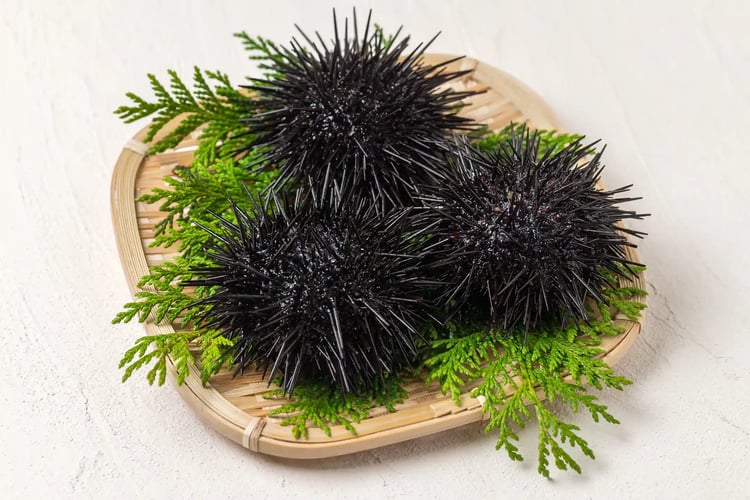
There are several edible sea urchin species, and among the ones you are most likely to encounter in Japan are bafun uni, murasaki uni, and kita-murasaki uni.
That said, it is risky to claim that one variety is always “rich” or always “delicate.” Research has reported that even within the same species, free amino acid composition shifts with sex and maturity, which can change how the flavor appears (*1). That is why, while traveling, one of the smartest questions you can ask is what the restaurant recommends that day. If a shop offers a tasting comparison, ordering from richer styles to more delicate ones helps the differences stay vivid in memory.
%20and%20Purple%20Sea%20Urchin%20(Murasaki%20Uni).webp?width=750&height=500&name=A%20Comparison%20of%20Short-Spine%20Sea%20Urchin%20(Bahun%20Uni)%20and%20Purple%20Sea%20Urchin%20(Murasaki%20Uni).webp)
Flavor Changes with the Season and Sea Conditions: How to Use That in Travel Planning
The season for uni is not fixed neatly by a single calendar. It changes with sea conditions, feed, and stage of maturity. In fact, free amino acids in sea urchin—especially glycine and alanine—have been reported to vary significantly by season and to affect taste evaluation (*2).
From a travel-planning perspective, it makes sense to check the fishing season in the area you are visiting and line up your trip with the timing when that region is known for good uni (*3). The less familiar you are with uni, the more useful it is to prioritize timing over the fame of a production area alone.
Why You Might Taste Bitterness or a Fishy Note: Freshness Is Not the Only Explanation
“A little bitter.” “Medicinal.” “An ammonia-like note.” These impressions cannot always be explained by freshness alone. In addition to reports connecting certain amino acids, such as valine, with bitterness (*4), there are also studies showing that bitter-tasting gonads can appear during the fishing season and that specific bitter amino acids may be involved (*5).
At the same time, it is widely understood that rising volatile basic nitrogen compounds during storage, including ammonia, are associated with declining freshness in seafood, so temperature control and pre-treatment matter too (*6). If you meet a disappointing piece, it may be worth questioning the day’s conditions before deciding that uni itself is not for you.
Whether Alum Is Used, and the Importance of Storage Conditions
Some uni is treated with alum (potassium aluminum sulfate) to help it keep its shape. A report from Fukuoka City, citing a Tokyo Metropolitan Government report, explains that shell-on sea urchin gonads naturally contain a low background level of aluminum and that much higher levels can suggest alum treatment (*7).
Another report on processing methods notes that astringency can appear depending on treatment conditions such as concentration, temperature, and time, so keeping those within an appropriate range is important (*8). In other words, this is not a simple case of “alum equals bad”; what matters is whether its effect shows up in the taste.
When choosing a restaurant or placing an order, a polished way to ask is: “If possible, do you have uni without alum, or saltwater-packed uni?” “Additive-free” is not a universal guarantee, but the more you care about delicacy—especially on a special occasion—the more worthwhile it becomes to ask.
Craftsmanship Determines the Final Quality: Shari Temperature, Nori Aroma, and Presentation
The quality of uni gunkan depends not only on the uni itself but also on the condition of the shari and nori. With shari, aroma and texture change with temperature, moisture, and the balance of seasoned vinegar, while aroma, texture, and the sweet-sour balance are cited as key quality indicators (*9).
With nori, humidity quickly dulls both aroma and texture. Take a brief photo after it is served, then eat it without delay. That is the simplest way to experience the chef’s design as intended (*10).
.webp?width=750&height=500&name=Sea%20Urchin%20Rice%20Bowl%20(Uni-don).webp)
How to Eat Uni Gunkan at Its Most Delicious
The true value of uni gunkan is shaped not only by the ingredients but also by the way you eat it. There is no need to feel tense at a high-end sushi restaurant. In fact, a small amount of knowledge can quietly but clearly improve the experience. The amount of soy sauce, the angle at which you lift it, the brief pause in which you register the aroma, and even the drink you choose all matter. None of these are difficult rules of etiquette. They simply help you follow the chef’s design more closely. If you care more about essence than performance, that mindset will feel especially meaningful. From here, let’s organize the practical habits that help you enjoy uni gunkan with confidence, even on a special occasion.
What About Soy Sauce? The Basics of How to Use It and Each Restaurant’s Approach
The most common mistake with uni gunkan is using too much soy sauce. Official guidance explains the basic rule clearly: do not dip the shari into soy sauce; touch only the topping side lightly (*1). Because gunkan toppings are soft and exposed, even more so, a very small amount is enough.
If you’re unsure, simply ask, “How do you recommend eating this?” At refined restaurants, that one sentence often gets you the best answer immediately.
The Basic Rule Is One Bite, Without Breaking It Apart, So You Don’t Lose the Aroma
Sushi is best when the balance of aroma and temperature is still intact. Travel guidance also notes that sushi may be eaten with your hands, especially in more traditional or higher-end settings (*1). With uni gunkan, eating it in one bite is usually the best way to preserve that balance.
Because the uni can shift if you tilt it too much, steady it lightly with your chopsticks and bring it to your mouth as level as possible. Once it is in your mouth, resist biting down too quickly. First notice the aroma rising through your nose. That is where the quiet luxury of the bite begins.
Let Garnishes and Toppings Support, Not Erase, the Star: Wasabi, Yuzu, Salt, and Lemon
Wasabi is often already placed in the proper amount between the topping and the shari, and adding more can easily cover the uni’s delicate sweetness. Official etiquette guidance also notes that wasabi should not be dissolved into soy sauce (*2).
If the restaurant suggests yuzu, lemon, or salt, treat that as part of the chef’s design and keep your own improvisation to a minimum. Uni can feel powerful aromatically, but it is surprisingly easy to overwrite.
Extend the Finish with Drink Pairings: Sake, White Wine, Champagne, and Tea
When thinking about pairings, three simple criteria help: do not interfere with the aroma, refresh the palate, and draw out sweetness. Those alone make mismatches easier to avoid.
For sake, studies report that amino acids and other compounds contribute to umami and depth, and that the way they are perceived changes with temperature (*3). With uni gunkan, a dry to medium-dry style that is not overly aromatic, served cool but not ice-cold, often lets the finish stretch more beautifully.
With white wine or Champagne, acidity is the key variable. Research also suggests that the organic acids in wine may work in a way that weakens the lingering umami of food (*4), so richer uni is often easier to balance with a style that is not sharply acidic. Tea is another strong option: catechin-derived astringency can change the feel of the mouth (*5), which makes tea useful when you want to reset your palate and move comfortably to the next piece.
%20Paired%20with%20Japanese%20Sake.webp?width=750&height=500&name=Fresh%20Sea%20Urchin%20in%20Saltwater%20(Ensu%C3%AD%20Uni)%20Paired%20with%20Japanese%20Sake.webp)
Choosing Uni Gunkan for a Special Occasion: Restaurant Selection and Experience Design
If you are choosing uni gunkan for a special occasion, what matters even more than finding a good restaurant is designing the experience well. Uni is delicate, and its condition changes dramatically with the season and the day’s sourcing. That is exactly why it helps to look beyond ratings or buzz and think more broadly: how the restaurant approaches that day’s ingredients, how the course is paced, and what kind of atmosphere the room creates. A single sentence at the time of booking can change the entire flow of the evening, and even your choice of seating can shape the memory you take home. The question is not only how to enjoy uni gunkan as one dish, but how to make it one of the highlights of the occasion. From here, we’ll organize the most useful ways to do that.
How to Think About the Course: When Uni Gunkan Has the Most Impact
“Omakase” is a style of dining in which you leave the flow of the meal to the chef. Guides on the subject explain it as putting yourself in the chef’s hands so the meal can be built around the best possible experience in that moment (*1).
For a special occasion, omakase is usually the safest choice. If you plan to add uni gunkan as an à la carte item, it tends to make the strongest impression not at the very beginning—when lighter white fish may still be appearing—but from the middle to the later part of the course, when flavor density naturally increases. If you want uni to be one of the stars of the evening, the most polished move is to mention at the time of booking that you love uni and would be delighted if it could be included in the course (*2).
What Helps to Share at the Time of Booking: Budget, Dislikes, Photos, and the Reason for the Celebration
At refined restaurants, the experience is often shaped less by what happens on the day than by what is shared in advance. Guides also emphasize how important it is to communicate dislikes and dietary restrictions at the time of booking (*2). Tokyo’s official dining guidance likewise notes that punctuality matters and that, if you will be late, you should contact the restaurant as early as possible (*3).
The best way to say it is briefly and specifically. In either English or Japanese, something like the following feels polished:
“We’ll be visiting for a special occasion. Our budget is around ¥◯◯ per person, and we do not eat ◯◯. Would it be all right to take just one photo, without flash? If possible, we love uni, so we’d be delighted to visit on a day when especially good uni is available.” If you present these as preferences rather than demands, it becomes much easier for the restaurant to shape the experience beautifully.
How to Choose Between the Counter and a Private Room: Comfort, Distance, and Conversation
The counter is a live experience—you can watch the chef’s hands at work directly in front of you. Guides to Japanese hotel restaurants also describe sushi counters as places where guests can observe craftsmanship up close (*4). Other restaurant guides note that some shops let guests choose between counter seating and more private tables or rooms (*5).
A private room, by contrast, suits couples who want conversation to be the center of the evening. Lighting, volume, and the ease of taking a discreet photo usually feel more stable there. If you expect to feel nervous on a first visit to a high-end sushi restaurant, a private or semi-private room can feel calmer. If you want the performance and immediacy of the meal itself, choose the counter.