
The world of teamLab is a one‑of‑a‑kind realm where contemporary art and cutting‑edge technology merge into a seamless experience. This guide is designed to help you enjoy that world in the most efficient, stress‑free way possible, without missing what truly matters.
If you love art and have a curious mind—or if you’ve simply searched “teamlab japan” and wondered which museum to choose—you’ll find here an overview of teamLab’s philosophy, its relationship with Japanese culture, the characteristics of each venue, and practical tips on tickets and how to avoid crowds.
We weave together intellectual background, emotionally resonant charm, and the light, inspiring tone of a travel magazine so that you can plan a truly refined digital art journey that fits your interests, travel style, and time in Japan.
This article is one way in — a single experience held up to the light. The Japan Immersive Art Digital Guide gathers the artists, the spaces they build, and the ideas behind them into one connected reading.
What Is teamLab Japan? The Intersection of Art, Technology, and Japanese Culture
teamLab is an art collective founded in Tokyo in 2001. It is made up of programmers, engineers, architects, CG animators, mathematicians, and many other specialists, and describes itself as an “ultra‑technologist” group exploring the intersection of art and science, technology and nature. Through digital technology, teamLab pursues a unique philosophy: using art to search for new relationships between human beings and the world around them.
One of its best‑known ideas is the concept of a “museum without boundaries.” Instead of separating works from one another—or separating them from the people viewing them—teamLab creates a continuous experience in which everything is interconnected.
If you are used to Western museum culture, where paintings are framed and viewed from a distance, this may feel very different. At teamLab, you are invited not just to look at works, but to step inside them and feel as though you are melting into the world of the art itself.
This way of thinking is deeply rooted in Japanese aesthetics. In traditional Japanese arts, it has always been important to express reverence for nature and the subtle transitions of the seasons. In teamLab’s works, motifs such as seasonal flowers, water, and cosmic space are used to express Japanese themes like “impermanence” and “harmony” through digital technology.
The installations also resonate with the Japanese appreciation of ma (間)—the meaningful space or pause that leaves a lingering aftertaste in silence—and yohaku (余白), the beauty of intentional emptiness. The contrast between light and darkness and the sense of spaciousness carry a distinctly Japanese sensibility that you can feel with your own body as you walk through the spaces.
Japan also has a long tradition in which text (calligraphy) and painting were not separate but formed a single art form. In many teamLab works, flowing, calligraphic characters appear, and the letters themselves dissolve into the space as art. This revives the tradition of Japanese art in which image and words were not divided, but experienced as one continuous world.(*1)
Keywords for Experiencing the Works
Immersion –
In teamLab’s spaces, you experience the feeling of literally stepping into the artwork. Digital imagery expands around you 360 degrees—from your feet to overhead—so that you feel as though you have entered a dreamlike, otherworldly landscape.
You do not just stand and look. You might lie down on the floor, walk barefoot through water, or simply drift at your own pace, engaging all five senses. This immersive quality captivates visitors from Japan and abroad alike; many people come specifically to “immerse their whole bodies in the work” and feel that thrill in person.(*2)
.webp?width=800&height=533&name=TeamLab_Borderless%2c_Odaiba%2c_Tokyo%2c_Japan_(49070106808).webp)
Embodiment –
In many teamLab works, your body itself becomes the medium of appreciation. The sound of your footsteps in the dark, the movement of your hands as you reach out, the way you shift your weight—all of these trigger changes in the work.
For example, in a piece where flowers are projected on the surface of water, walking slowly sends ripples outward, and the flowers near you scatter and disappear. Your movements directly influence the artwork. Rather than standing in front of a work, you feel as if your whole body is part of it—almost like a fusion of art and sport.
Co‑Creation –
“Co‑Creation with Others” is a core theme for teamLab. The art in front of you is not a finished object; it becomes complete only as you and the people around you interact with it.
Many works respond differently when more people are present: reactions are amplified, or unexpected phenomena occur. Visitors end up collaborating with one another, often without saying a word.
For instance, in an installation where countless carp swim across a projected surface, the fish transform into flowers and scatter when touched by people. The individual movements of each visitor ripple outward, and the entire space changes shape from moment to moment. You become acutely aware of others, and can feel a sense of unity—like everyone in the venue is raising a single artwork together.
Resonance with Nature –
Nature is a crucial source of inspiration for teamLab. Blossoms that bloom and fall with the seasons, the flow of waterfalls and rivers, the stars in the sky—such natural phenomena are not only recreated in digital form, but also respond to the presence and behavior of people.
Imagine a beautiful forest that would simply remain quietly there if no one entered it; once a person walks through, digital flowers of light bloom along their path. Again and again, you encounter scenes where humans and nature seem to resonate with each other.
This reflects a very Japanese worldview: people and nature cannot be separated. Think of the first moment you notice a rainbow; you feel that you and nature are somehow continuous, and your heart is moved by its beauty. In the same way, when you merge with nature in a teamLab space, you may find your sense of the world becoming more tender and full of affection.
.webp?width=2160&height=1440&name=Tokyo%2c_Japan%2c_December_2018_IMG_2294_(48438598926).webp)
teamLab in Japan: Venues and How to Choose Them(Urban, Garden, Permanent, Seasonal)
You can experience teamLab’s works all over Japan, in a variety of formats: large‑scale permanent museums, outdoor garden‑based installations, and seasonal events held for a limited time.
In this section, you will find an introduction to Japan’s main teamLab venues, along with their key features and how to choose the one that best suits you.
Depending on your interests and travel style, you can think about “Which venue should I visit?” and “In what order should I go to get the most out of it?”
If this is your very first teamLab experience in Japan, we recommend starting with the large permanent exhibition that relocated from Odaiba to central Tokyo, and the unique immersive venue in Toyosu. After that, you might extend your trip to Kansai or Kyushu, or time your visit to coincide with a seasonal project. That way, you can explore the many different worlds that make up the broader “teamlab japan” experience.
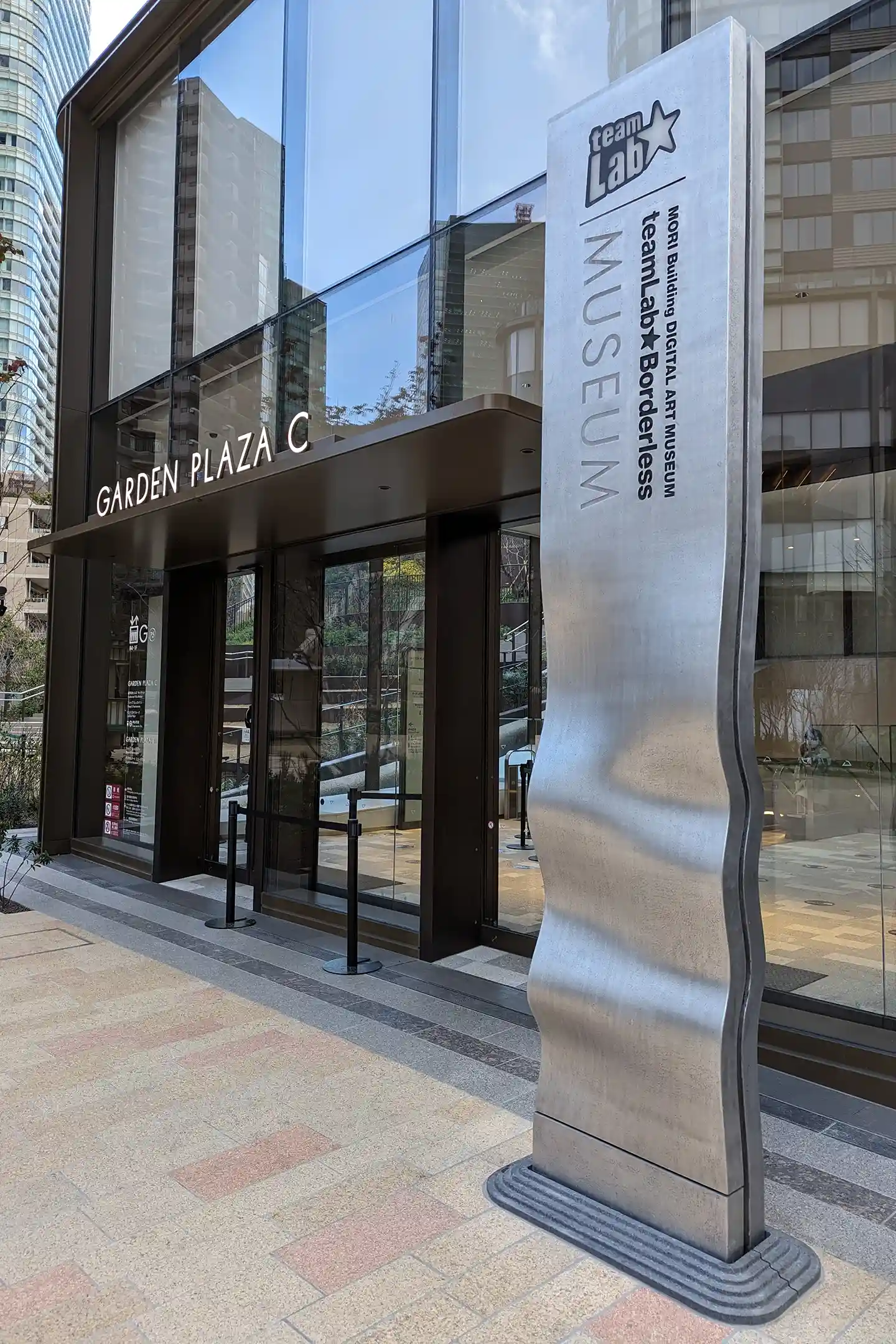
teamLab Borderless Tokyo
Opened in February 2024 in Azabudai Hills, Tokyo, teamLab Borderless Tokyo is a flagship permanent digital art museum. As of January 2025, it features more than 75 large‑scale works, embodying the concept of a “museum without a map.”
There are no preset routes and no strict divisions between rooms. Each artwork moves freely beyond the boundaries of individual spaces and interacts with the others.
As you wander through the darkness, you feel almost as if you have lost your way inside the art, and the act of exploring and discovering becomes part of the pleasure.
To get the most out of Borderless Tokyo, it helps to give yourself enough time to walk through every corner. Art is hidden all over the expansive space—not only on the walls and floors but sometimes suddenly appearing just behind you as light.
Rather than simply following the flow of people, try walking against the current or daring to step into quiet, darkened areas. That is often how you encounter a piece that feels like a personal discovery.
Inside the museum, there are also calmer spots where you can sit and take your time. For instance, in the paid “tea room,” you can enjoy a bowl of matcha while delicate digital flowers bloom inside your teacup. This quiet oasis, away from the bustle, is a perfect place to pause during a long visit.
If you are coming for the first time, starting with Borderless is a good way to grasp the overall picture of teamLab’s universe. Once you have that whole view, you will find it even easier to enjoy the distinct personalities of Planets and the other venues introduced below.

teamLab Planets TOKYO
Located in Toyosu, Tokyo, teamLab Planets is a limited‑time museum (currently scheduled to run until the end of 2027) centered on the theme of “immersing your entire body.”
Its defining feature is that you enter barefoot and walk through water as part of the art. After entering, you first remove your shoes and roll up your clothing to at least knee height.
There are areas where the water reaches about knee‑deep even for adults. If you wear skinny jeans or tights that cannot be rolled up, they may get wet.(*2)
It is best to visit in clothes you can move in easily and that will not be a problem if they get slightly damp. Inside, there are changing spaces, and you can borrow shorts if you need them. If you are wearing a skirt, you can also borrow opaque shorts to wear underneath, so you can relax and enjoy the experience.
Large bags are stored in free lockers before you enter, so you can move around the space with your hands free.
At Planets, sharpening your five senses is key. Let yourself notice the chill of the water, the texture under your feet, the scent of flowers drifting past, and the music filling the space—each work invites you into a slightly different sensory world.
For example, in one piece, countless colorful carp swim across a shallow body of water. As you move forward, the carp circle around you, and their paths trace luminous lines across the surface. When they collide with you, they transform into flowers and scatter, their petals briefly blooming at your feet.
Moments like this—when your movements directly reshape the work—are the essence of Planets.
Plan for about two to two and a half hours, or even longer if you want to take your time and photograph everything.(*2) You are free to use your smartphone to take pictures inside, but do take care not to drop it in the water. A waterproof pouch worn around your neck can be reassuring.
Some areas also have mirror floors, so it is wise to think about your outfit and how you move.
teamLab Botanical Garden Osaka
Held at night in Nagai Botanical Garden in Osaka City, teamLab Botanical Garden Osaka is an outdoor permanent exhibition where you can enjoy the fusion of garden landscape and digital art.
By day, the grounds are a regular botanical garden. After sunset, the same expansive space transforms into a fantastical world of artworks.
Trees, ponds, and flower fields across the garden are illuminated in vivid colors. The installations react in real time to the wind and rain, as well as to the movements of visiting birds and people, creating an ever‑changing, interactive environment.
When a breeze passes, the patterns of light projected on the trees tremble. When you approach, the projected plants at your feet suddenly glow. Art, nature, and people seem to flow into one another without boundaries, and you may feel as though the past, present, and future are layered on top of each other in the same space.
The great appeal of Botanical Garden Osaka lies in the interplay between art and the changing seasons. In spring, you may walk among cherry blossoms and tulips; in summer, fresh green leaves and fireflies; in autumn, fiery foliage; in winter, clear, crisp air and bare branches.
Because the garden’s scenery itself transforms with the season, the mood of the artworks shifts along with it. In summer, for example, projections of a vast sunflower field may appear as a seasonal feature.
There is always something new to discover, which is why the venue has many repeat visitors.
Since you will be walking outside, comfortable shoes are essential. Do not forget insect repellent and a light layer to put on in cooler weather. There are not many high‑end restaurants in the immediate vicinity, but the Nagai area hides some excellent spots, such as “Matasaburō,” a local favorite famous for dry‑aged steak.
After your visit, you might extend your evening just a little, savor good food, and let the conversation naturally turn to what you just experienced in the art.
teamLab Forest Fukuoka
teamLab Forest Fukuoka is located inside the entertainment complex BOSS E・ZO FUKUOKA in Fukuoka City. It is a hands‑on “museum of play and learning” packed with activities for both children and adults. Opened in 2020, it is one of the newer teamLab venues.
The space is broadly divided into two main areas:
“Catching and Collecting Forest”
“Athletic Forest”
Each has its own character. The first is more focused on learning—catching and observing digital creatures in a virtual forest—while the second emphasizes physical play in an immersive environment.
In the Catching and Collecting Forest, you explore a digital jungle with your smartphone in hand. Using bows and nets, you “catch” various animals and build your own collection in a personal illustrated encyclopedia. You may even encounter imaginary creatures you have never seen before.
If you download the dedicated app in advance, you can jump into the experience immediately.
In the Athletic Forest, you step into spaces covered in glowing balls, run up slanted slopes, and navigate areas that feel like asoft black hole. It is like an enormous digital adventure playground.
Balancing in a cushioned room that sinks beneath your weight is fun not only for children but also for adults, who often find themselves playing with the same excitement they had as kids.
To enjoy teamLab Forest Fukuoka efficiently, a recommended route is to stimulate curiosity first in the Catching and Collecting Forest, then move on to burn off energy in the Athletic Forest. With this order, even young children can stay engaged right to the end.
Weekdays tend to be calmer, while weekends and school holidays can be busy with families. If you can, choose an early morning slot or come later in the afternoon or early evening, when visitors are more spread out and it is easier to move around at your own pace.
Strollers cannot be taken inside the exhibition. You leave them at the stroller parking area near the entrance and enter carrying your child or holding hands. The entire venue is indoors and unaffected by weather, making it an excellent option for rainy‑day sightseeing.
This thoughtful and active space is perfect for creating shared memories through cooperative play between parents and children.
.webp?width=800&height=533&name=TeamLab_Borderless%2c_Odaiba%2c_Tokyo%2c_Japan_(49070641776).webp)
Other Domestic Exhibitions and Seasonal Events
Beyond the main venues above, teamLab also stages limited‑time art projects in various locations around Japan.
These seasonal exhibitions allow you to experience artworks created in collaboration with local nature and culture—something particularly rewarding if you are traveling to a specific region.
Information about such events is announced on teamLab’s official “Exhibitions” page and on local tourism websites. When planning your trip, it is worth checking these in advance.
Outdoor events are especially common from summer through autumn. Many require advance reservations or date‑specific tickets, so early research and ticket booking are crucial.
One representative event was the “Festival of Light in Tadasu no Mori,” held at Shimogamo Shrine, a UNESCO World Heritage Site in Kyoto. The sacred primeval forest, which has existed since the Jōmon period, was bathed in ethereal digital light.
Under the concept of “Digitized Nature”—nature itself becoming art through digital technology—the forest turned into an art space. As visitors moved through it, the light on the trees changed in response, creating a breathtaking scene.(*1)
In this way, teamLab actively collaborates with historic buildings and famous scenic spots, using its works to communicate the cultural value of each site in a fresh and memorable form.
Another well‑known project is “Forest Where Gods Live” at Mifuneyama Rakuen in Takeo, Saga Prefecture, held every summer. Countless light installations are dotted across the vast garden, and a mysterious world emerges in the mountains.
In Ibaraki Prefecture’s Kairakuen, teamLab has created a night exhibition in which the plum grove becomes the stage: blooming ume blossoms and digital art come together to create an elegant, otherworldly evening.
When you attend seasonal outdoor events, keep a few practical points in mind.
Because paths can be dark, wear sneakers or other stable footwear. In summer, bring insect repellent and water; in winter, be sure to dress warmly. Preparing properly will make your time in the artworks far more comfortable.
Since these exhibitions are held in natural environments, they may be altered or canceled in case of rain. It is wise to check official information just before you head out.
Although seasonal events run only for limited periods, they offer the chance to encounter versions of teamLab that you can experience nowhere else.
Visit Planning Guide(Tickets, Reservations, Prices, Access, Avoiding Crowds)
To fully enjoy any teamLab venue, it helps to prepare in advance and think through your visit on the day.
Here you will find guidance on how to get tickets, the basic pricing system, how to choose less crowded time slots, what to wear and bring, and key points regarding accessibility and visiting with children.
Since this is a special, high‑quality art experience, you will want your time there to feel smooth and stress‑free. Use the tips below to design your plan.
Ticket Basics
For the main venues, tickets are generally sold in advance with date and time specified. At popular sites like teamLab Borderless and Planets, you choose your visit date and entry time slot via the official website or major ticket platforms.
Especially at Borderless Tokyo, some days sell out quickly. Once you know when you want to visit, it is wise to secure your ticket as early as possible. On some days, tickets may be sold at the counter on site, but those are often more expensive and may already be sold out.
If you decide on your date and the number of people ahead of time and purchase online, you need only show the QR code on your smartphone on the day to enter smoothly.
.webp?width=800&height=533&name=TeamLab_Borderless%2c_Odaiba%2c_Tokyo%2c_Japan_(49070853862).webp)
Avoiding Crowds and Choosing the Best Time Slot
Popular teamLab venues are lively almost every day, but you can reduce crowding by choosing your day and time carefully. In general, weekday mornings and the hours near closing time tend to be quieter and are recommended.(*3)
In contrast, weekend and holiday afternoons are the busiest, and some works may have lines to enter.
For example, at Borderless Tokyo, visitors report that even on weekdays, the 1–3 p.m. window is often crowded, while the first slots right after opening and the evening hours feel more relaxed.
There is a report from a Friday afternoon visit describing the venue as “reasonably busy but far from packed,” with relatively few people appearing in photos. Such accounts suggest that weekdays, especially early in the day or in the evening, are good choices if your schedule allows.
If you are traveling and only have weekend days free, you can still improve your experience by booking the earliest time slot. Aim to arrive a little before opening so that you can be among the first inside.
When visiting with children, it helps to see the main works in the quieter morning hours, before they get tired from the crowds.
Weather is another factor. Indoor venues like Borderless and Planets tend to attract more visitors on rainy days, while outdoor events are often quieter or may be canceled.
Checking Google Maps’ “Popular times” feature or recent posts on social media can also be useful. On X (formerly Twitter), a quick search for “チームラボ 混雑” (“teamLab crowding”) may reveal up‑to‑date reports on how busy things are.
Use these hints to choose a time slot that lets you enjoy the art with as little stress as possible.
What to Bring, What to Wear, and Photography Rules
The key point for clothing is simple: comfortable and easy to move in. You will walk quite a lot inside the venues, so wear shoes that you are used to. High heels and loose sandals are best avoided, as they can make it easier to trip or slip.
At Borderless, some rooms have mirrored floors, and at Planets you will roll your pants up above your knees to walk through water. Because of this, trousers are generally more practical than skirts, and if you wear tights, choose something you can easily take on and off if needed.
At Planets, free lockers are provided before you enter, and you will deposit your shoes and large bags there. At Borderless Tokyo, large items cannot be brought into the exhibition area either, partly because of the dark corridors and level changes.
There are many free coin lockers (with armband keys) near the entrance. Store most of your belongings and walk the exhibition as lightly as possible.
In winter, consider leaving bulky coats in the locker and wearing lighter layers that make it easier to move around.
Photography is generally permitted. You are encouraged to capture the beautiful scenes in photos and videos and share them on social media. However, basic rules and manners are important.
Flash photography is prohibited. Some works become hard to see when exposed to strong light, and in most cases you will find that there is plenty of ambient light for clear photos without flash.
Monopods, tripods, and selfie sticks are not allowed. In crowded spaces, using such equipment can easily inconvenience or endanger others.
When you stop to shoot, be mindful of where you are standing and make sure you are not blocking walkways. If everyone gives way just a little, everyone can enjoy both taking photos and viewing the pieces.
In some works, you are allowed to touch the installations; in others, you are not. Follow any instructions from staff, and avoid actions that could damage equipment or structures.
In the dark, it is easy to lose track of your surroundings when you are absorbed in photographing. Check that no one is directly behind or beside you before moving or stepping back, and enjoy your shoot safely.
.webp?width=800&height=533&name=Tokyo%2c_Japan%2c_December_2018_IMG_2383_(48438588236).webp)
Accessibility and Family‑Friendly Features
teamLab venues are designed with accessibility in mind so that people of different ages and needs can enjoy them as much as possible.
Wheelchair users can enter both Borderless and Planets. At Planets, staff explain the viewing routes and any precautions for each work carefully.(*1)
Multipurpose restrooms are available, and there are elevator routes that accommodate wheelchairs. At the same time, for safety reasons, some works cannot be accessed by wheelchair users.
For example, at Planets, the sloped installation “Waterfall on the Hill” and the sinking‑floor work “Soft Black Hole” are structurally difficult to navigate, so you will be guided to alternative routes. Even so, there are many other works you can fully enjoy, so follow staff guidance and choose what feels comfortable for you.
If you have visual or hearing impairments, you will still find many ways to appreciate the diverse sensory stimulation. Each person can discover their own way to engage with the space.
As for strollers, they cannot be used inside the main exhibition areas. At Borderless and Planets, you leave them at the designated stroller parking near the entrance before going inside.
If you are visiting with a young child, consider using a baby carrier or holding hands as you walk. In the dark, children can feel anxious more easily, so staying close and talking to them frequently can be very reassuring.
There are not many benches or formal rest areas inside the venues, but some works are designed to be enjoyed while sitting or lying on the floor.
For instance, in the dome space at Planets where flowers bloom all around you, you are encouraged to lie down and gaze upwards. Using spaces like this cleverly allows your child to rest while still taking in the art.
It also helps to think about what different age groups might particularly enjoy.
For toddlers and early elementary school children, the bright colors and character‑like animations strongly spark curiosity. Some venues have “Sketch Aquarium”‑style areas where children can draw their own creatures, scan the drawings, and watch them swim across the walls. This kind of participatory corner is almost guaranteed to be a hit for family visits.
Older children—upper elementary to high school—may enjoy talking about the concepts behind the works. You could ask questions such as, “Why do the flowers have to fall?” or “Why does the flow of the waterfall change when someone stands there?” These simple questions can open the door to deeper thinking about art and science.
Set your viewing time to match your child’s stamina and focus. For younger children, one hour can be enough; for teenagers and adults, two hours or more might feel just right for a deeper exploration.
Beforehand, it is reassuring to check the locations of multipurpose restrooms and nursing rooms.
Borderless Tokyo has a baby care room inside the venue. If you ask a staff member, they will direct you to it. With such facilities in place, you can feel confident about visiting as a family and letting everyone immerse themselves in the digital art.
Understanding the Context of the Works: Signature Motifs and How to Read Them
To savor teamLab’s works more deeply, it helps to understand the motifs and the connections between technology and art history.
Flowers, waterfalls, the universe, and calligraphy are recurring themes, each carrying its own meanings and messages in teamLab’s interpretation. This chapter offers hints on how to read the works through these motifs.
You will also find perspectives on how the algorithms behind digital art connect with traditional aesthetics, adding another layer to your experience. Instead of stopping at “That was beautiful” or “That was impressive,” you can step into the ideas behind the works.
Nature and Generation: Infinite Change Created by Algorithms
One major feature of teamLab’s art is that the visuals are constantly generated in real time. Unlike conventional video works that play back pre‑recorded loops, teamLab’s installations use algorithms that are always calculating, producing images that never repeat in exactly the same way.
Take one of their representative works, “Flowers and People, Cannot be Controlled but Live Together.”
In this piece, seasonal flowers bloom and fall in endless cycles, but the timing and positions are completely unpredictable. The scene you see in this moment will never appear again in precisely the same form.(*1)
The piece mirrors the ecology of the natural world, portraying both the fragility and the constant renewal of life.
Behind this is sophisticated mathematical programming that simulates the growth and withering of flowers. When you approach, petals scatter; when you touch the projection, the flowers in that area may wilt more quickly. These are all expressions enabled by real‑time computation.
To appreciate generative art like this, try simply standing still for a few minutes and watching carefully. At first the changes may feel subtle, but before you know it, you may notice that the entire scene around you has transformed.
As petals fall, you might feel a sense of wabi‑sabi, the Japanese appreciation for transient beauty; watching the paths of the stars, you might imagine the endlessness of the universe. Your own imagination becomes part of the work.
Although everything is produced digitally, the art changes like a living organism and is, in a sense, “created” together with you in that moment. This way of thinking is close to that of traditional Japanese gardens.
The view of a garden is always in flux, never exactly the same twice. With the latest technology, teamLab gives concrete form to this philosophy.
If you keep in mind that algorithms are quietly at work behind the scenes, you might find yourself wondering, “Why do I never see the same pattern again?” and feel a new kind of excitement that blends technical curiosity with aesthetic pleasure.
The Body as Medium: Works Transformed by Participation
In traditional art appreciation, whether painting or sculpture, you stand in front of a work and quietly look at it. You observe but do not interfere.
teamLab, however, pursues interactive art in which human behavior becomes part of the artwork itself. In other words, the work is only truly complete when you participate.
Some installations increase the number of flowers on screen as more people gather, or make them fall more easily. Others fall silent and still when no one is there. The presence of people in that exact place and time shapes the world of the work.
Behind this design lies a desire “to dissolve the boundaries between people through art.”
Even strangers can feel a sense of togetherness when they share the same space, subtly influencing each other through the artwork. teamLab’s installations are stages for this kind of gentle co‑creation.
When you visit, try to be conscious of the fact that you are contributing to the work.
In a piece where glowing balls are scattered across the floor, go ahead and push or bounce them. The ball you touch will change color and sound, and that change will ripple out into the other balls. Watching your action spread across the entire space is exhilarating—you are both viewer and performer.
Also pay attention to what other visitors are doing. You might notice that the scenery near you changes because someone on the other side of the room has touched the installation. In that moment, a subtle connection is created between you through the work, even without words.
In pieces that use motifs of calligraphy and line, your movements trigger countless drawn lines that race through the space. It can feel as though you have stepped into a gigantic calligraphy performance, echoing the Japanese tradition of treating writing and painting as one unified art.
teamLab fills the space with digital brushstrokes—letters and lines that stretch out in all directions—and lets them transform as if alive in response to people’s movements. When you move, the strokes might gain speed and force; when you pause, ink‑like shapes may suddenly bleed and spread.
In front of works like these, there is no need to hold back. Try moving your body freely and simply enjoying the reactions. Some visuals and sounds appear only when you take action. By participating, you raise the value of the work and make the experience your own.
Learning and Private Uses of the Experience
Experiencing teamLab is not only about enjoyment; it can also be a rich opportunity for learning and personal growth.
From family‑friendly ways to nurture children’s creativity and aesthetic sense, to efficient pre‑visit study for adults who want deeper understanding, and even options for private tours—this section gathers ideas on how to make the most of what teamLab offers.
If you treat the encounter with art as part of family education or self‑development, and, when necessary, draw on the support of professionals, your experience can become even more fulfilling.
Nurturing a Sense of Aesthetics as a Family
For young children, teamLab’s exhibitions are both playgrounds for the senses and gateways to rich aesthetic experiences.
The collective itself has expressed a desire “to provide children with learning experiences beyond desk‑based study,” creating many works that stimulate both body and brain.(*1)
If you visit as a family, consider the trip as a chance to nurture your child’s sense of beauty and creativity.
Knowing what different age groups tend to enjoy will help you draw out your child’s interest without overtaxing them.
Preschoolers and early elementary school students often respond directly to color and sound without needing explanations. They simply enjoy the changing images.
For instance, the “Sketch Aquarium”‑style corners, where children draw pictures that are then scanned and projected onto the walls to move around, are ideal for curious kids. They get a strong sense of accomplishment seeing “their” creature swim in the shared world.
If you draw alongside them, you can share the joy of creating something together.
From upper elementary through middle school, you might start touching on the concepts behind the works.
You could say, “These flowers will eventually fall, just like real ones,” or “When someone stands there, the waterfall changes its flow.” As you talk through the mechanisms and ideas, your child may begin to think more deeply—even if they do not use technical words.
By high school age, you may be able to discuss broader themes: the relationship between digital art and Japanese culture, or teamLab’s philosophy of a “world without boundaries.” After the visit, try setting aside time to talk as a family about what everyone felt.
Sharing impressions of beauty and strangeness helps sharpen both sensitivity and the ability to put feelings into words. It can be a valuable opportunity for growth.
When planning your family visit, set a realistic duration that matches your child’s concentration and energy. Even if you as an adult would like to stay longer, children sometimes suddenly decide, “I’m done, I want to go home.”
Instead of trying to see every single work, leave some for “next time” and say, “We’ll come back again.” That sense of openness keeps the experience positive.
The simple fact of spending time in teamLab’s spaces plants seeds of aesthetic sense. The colors and forms your child takes in, and the strange sensations they feel in their body, may become fuel for creativity later in life.
The surprise and wonder you share as a family will remain a treasure. Try visiting teamLab together, and feel how aesthetic awareness can grow naturally through play.
Short, Effective Pre‑Visit Learning
If your time is limited but you want to deepen your teamLab experience, a bit of “micro‑study” before your visit can make a huge difference. Even a small amount of background knowledge about the works and concepts can greatly enhance your understanding and emotional response on the day.
The easiest starting point is the official website and pamphlets. teamLab’s site offers explanations of each work, its concept, and technical aspects in both Japanese and English. Some terms may be challenging, but you can still grasp the essentials—why they aim for a world without boundaries, or what meaning lies behind a particular motif.
The official YouTube channel is also well worth watching. You can see highlight videos of past exhibitions and interviews with founder Toshiyuki Inoko, which help you visualize what to expect.
If you know even just the titles and themes of a few pieces beforehand, you can move through the venue with a sense of purpose: “Let us try to find that work next.” You are also more likely to notice the subtle intentions behind each piece.
If you want to go further, books and long‑form interviews are recommended. Inoko’s own book, teamLab and a World Without Boundaries, explains how the collective was founded and what drives its thinking—an excellent guide to understanding their works.
Art critics have also published essays and academic papers about teamLab in recent years. If you are interested in art history or theory, such materials offer another rich layer of interpretation.
Magazines like Forbes JAPAN, Nikkei ARTS, and the design and art magazine AXIS have featured teamLab in special articles, discussing its social significance and global strategy. If you read such pieces in advance, you can enjoy the exhibitions not only as art, but also as phenomena that show “why this is resonating with the world right now.”
The official website has a well‑developed English version, and staff at the venues can handle basic English. If needed, you can also use translation apps on your smartphone to display explanations in English on the spot.
If you are still worried about language barriers, one option is to join an English‑guided tour. Some travel agencies offer private tours that combine transportation and teamLab admission, with English‑speaking guides who can explain the works. This does cost more, but it can be reassuring if you want deeper understanding in a limited time.
Finally, about private experiences: teamLab is usually enjoyed in the presence of many others, but the collective has experience arranging corporate events and special private bookings. If you have the budget and connections, it is not impossible to reserve the space and take your time in a fully private setting.
Even without a full buyout, choosing the latest time slots at night can sometimes give you a surprisingly “private” feeling, with fewer people around.
In any case, if you treat your teamLab visit not merely as a one‑off attraction but as a chance to expand your knowledge and sensibility, what you gain will multiply many times over. The more you learn, the more fascinating the experience becomes—that is the depth of teamLab and the core appeal behind “teamlab japan” as a destination.
Beyond a single room

In Closing
This guide has offered an overall look at the allure of teamLab and the practical points for planning your visit.
The world of teamLab—where digital art and Japanese culture blend—is powerful and moving even if you go in completely unprepared. Yet with a bit of prior knowledge and a few thoughtful choices, you can elevate the experience even further.
Use this article as a reference when planning a refined digital art journey that suits you, whether you are building a full “teamlab japan” itinerary or just adding one venue into a wider trip.
The time you spend surrendering yourself to a boundary‑less, beautiful world will almost certainly bring new inspiration back into your everyday life.
Plan efficiently, dive in fully, and savor it to your heart’s content—may you create exactly that kind of luxurious teamLab experience for yourself.

.webp)