Osaka is not an onsen town, and pretending otherwise is why most guides to this subject are useless. The city sits on no famous spring; it has no hot-spring quarter the way Hakone or Kinosaki does. And yet a private onsen in Osaka is one of the things visitors look for most, because Osaka is where they are staying and a private bath is what they want.
The good news is that the answer is real, specific, and easy to book once you know what you are actually choosing between. The bad news is that it is three different answers, and the guides tend to blur them together.
This guide separates them, covers the two questions the search engines record most about private baths—whether you can use one without staying the night, and what you are allowed to wear—and explains the reason a great many foreign visitors need a private bath in the first place. The accompanying Digital Guide places all of it in the wider culture of the Japanese bath.
What a Private Onsen in Osaka Actually Means: Kashikiri-buro, Explained
Three quite different things travel under this phrase, and choosing the wrong one is the most common way this plan goes wrong.
A private bath inside a day-use bathing complex. Osaka's large bathing facilities rent out individually bookable outdoor baths by the time slot. You do not stay the night; you turn up, bathe privately for a fixed period, and leave. This is the option that fits most city itineraries, and the one least well described in English.
A room with an open air bath in a city hotel. Several Osaka hotels advertise a genuine hot spring and offer rooms or suites with a private tub fed from it. You are in the middle of the city, with everything that implies about views and noise, and you can bathe at two in the morning if you like.
An actual onsen district within an hour of the city. This is the honest one. North of the city, Nose Onsen puts itself at sixty minutes by car from central Osaka, and the Minoh valley beyond it is a half-day of waterfall and forest that the city's own tourism board publishes as a model course. South, the Senshu coast and the area around Kansai Airport have their own springs, which is useful on a departure day. And over the prefectural line into Hyogo lies Arima, one of the oldest named hot springs in the country. Any of these costs you a travel day and repays it in kind.
That last option is the one people talk themselves out of. Osaka to a real spring town is roughly the time you would spend crossing a large Western city for dinner. The reason to skip it is a full itinerary, not distance.
These three answer different questions. With four nights and a full itinerary, a booked ninety-minute slot in the city is the version that fits. If the bath is the point of the trip, go to a spring town. If you want both, take the third option for one night and come back.
One more thing worth knowing before you plan: the phrase you will see in Japanese is kashikiri-buro, literally a "chartered bath." It means the bath is reserved for your party alone for a set period. It is not a synonym for an outdoor bath—an rotenburo—or for a bath attached to a room. Both of those can be private or not. The word to look for on a booking page is the one about exclusivity, not the one about the view.
Tennen Onsen or Not: Is a Couple Onsen Osaka Books Real Spring Water?
Two distinctions decide this, and Japanese booking pages state both if you know the terms.
The first is whether the water is a natural hot spring at all. Japan's Hot Spring Law sets out what may be called onsen—broadly, water from underground that meets a temperature threshold or contains one of a list of designated mineral constituents at a defined concentration. A city hotel advertising a tennen onsen, a natural hot spring, is claiming its water meets that bar. A facility that says only spa or daiyokujo, a large communal bath, is not making that claim.
Here is the part that surprises people, and it is the single most useful thing to know about hot springs in a city like Osaka: the water does not have to come from under the building. It can be hakobiyu, carried water. The Onyado Nono in Yodoyabashi, to take a hotel that says so openly, tankers its radon spring water in daily from Mount Ikoma, the 642-metre peak on the Osaka–Nara border. That is a legitimate natural hot spring and it is also a truck. Nobody is being deceived; the label describes the water, not the plumbing under your feet, and a good number of central Osaka hotel baths work this way.
The second distinction sits above it. Gensen kakenagashi means the bath is fed continuously from the source and the water leaves rather than recirculating; junkan filters and reheats. Free-flowing is prized and uncommon in cities, for the obvious reason that the volume has to come from somewhere. In an urban private bath you are usually in circulated water.
Japanese springs are classified by mineral type and those classifications carry traditional indications, but a ninety-minute soak is a ninety-minute soak. Book it for the ninety minutes.
Private Onsen Osaka Day Use, or an Overnight Room With Open Air Bath
The single most useful thing to know about private onsen in Osaka is that you do not have to stay anywhere to use one. Day-use private bathing is a mature, ordinary, bookable product here, and it is priced by the room rather than by the person.
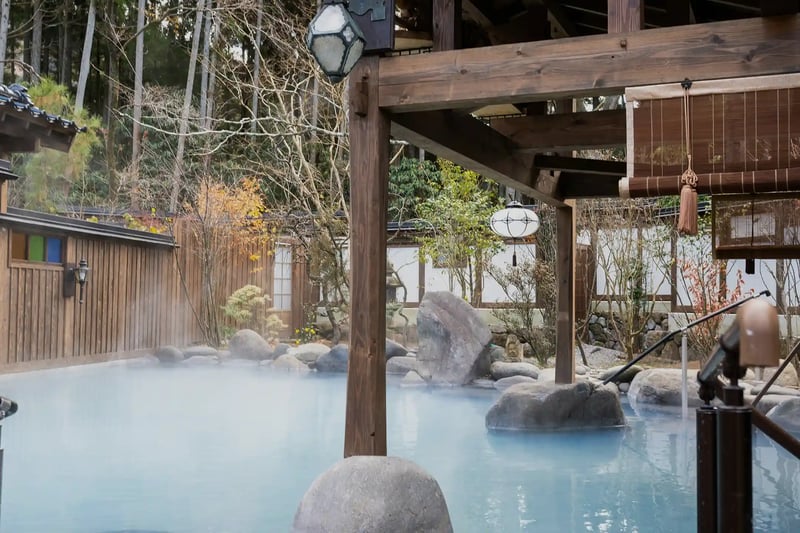
The clearest example is Solaniwa Onsen at Osaka Bay Tower, which is the facility nearly every English-language discussion of this topic ends up naming. Its own booking page lists ten fully private outdoor baths: seven standard rooms for one to four people, two deluxe tatami rooms for four to six, and one western-style room with a tent sauna. Standard rooms start at ¥8,800 for ninety minutes, the tatami rooms at ¥12,100, and the sauna room at ¥15,400, with thirty-minute extensions from ¥2,750. The baths run from 11 a.m. to 10 p.m., with last entry at 8 p.m.
Read the next line before you budget, because it is the one every English-language write-up of this place omits. The private bath price does not include admission to the facility. Entry runs ¥2,310 to ¥3,630 per adult depending on the date—the pricing moves on a published calendar—and Osaka adds a ¥150 municipal bathing tax to any adult admission of ¥1,501 or more. For two people that is roughly ¥4,900 to ¥7,600 on top of the room.
So the real figure for a couple in a standard room is about ¥13,700 on a cheap date and ¥16,400 on an expensive one. That is still a room price rather than a per-seat price in the part that matters—the ¥8,800 does not double for two—but the admission does, and a guide that quotes only the room fee is quoting about sixty percent of what you will pay. Ninety minutes is long enough to bathe twice with a rest between, which is how a Japanese bather uses it, and short enough to slot into an afternoon.
Set that against the overnight version. A room with a private bath in a good Osaka hotel is a several-times-larger commitment, and what you buy with the difference is time rather than water—the two in the morning option, the bathe-before-breakfast option, the not-having-to-leave option. They are not competing on the same axis, and a guide that lists them together as "options" is not helping you choose.
Osaka Private Onsen on a Departure Day
One case deserves its own paragraph because it solves a problem nobody plans for: the last morning, bags packed, hours to kill, and a long flight ahead.
The Kansai Airport area has hot springs, and one of them has private baths. Kanku Onsen Garden Palace pairs its hot spring with a barrel sauna and a cold plunge fed from an 18°C source, bookable privately. Bathing before a twelve-hour flight is one of those small decisions that changes the whole day, and it costs you nothing in itinerary because you were going to be near the airport anyway.
Two cautions. Confirm the private booking rather than assuming it, because early opening and private hire are administered separately almost everywhere. And note that hotels near the airport advertising early bathing plans are usually selling those to arriving guests before check-in, not to departing ones—the 7 a.m. plan at Henn na Hotel Kansai Airport is an accommodation package of that kind. On a departure morning what you want is a day-use ticket, which is a different product and cheaper.
The practical rule is this. Book day use when the bath is an event inside a trip that is about something else. Book the room when the bath is the reason you are going. If you are still unsure, the day-use booking is the reversible one.
Tattoos, Clothing, and the Rules That Change Behind a Locked Door
Here is the part that most guides leave out, and it is the reason a large number of foreign visitors are searching for a private bath rather than a bath.
Public bathing spaces in Japan have long refused entry to people with tattoos. The position has loosened at some facilities and not at others, and it is not predictable from outside. For a visitor with visible ink, this turns a simple plan into a research project.
Booking a private bath solves part of the problem and not the part people assume. It removes the question of who else is in the water with you. It does not necessarily get you through the door, because many facilities apply their tattoo policy to the building rather than to the bath.
Solaniwa, the facility named above, is exactly this case and makes a useful worked example. Its published policy is that as a general rule guests with tattoos or other body art are not admitted, with one route in: if the tattoos are fully covered by stickers the facility itself sells, you may enter and bathe. There is no private-bath exemption. Book the private room and you still meet the rule at reception.
So the reliable move is to ask the specific place before you pay, and to ask whether the policy applies to the private bath rather than assuming that privacy suspends it. Those are different questions with different answers, and the second one is the one that decides your evening.
The clothing question has a cleaner answer, and the reason behind it is not the one most visitors assume. In a Japanese bath you bathe with nothing on. Solaniwa states the reason plainly on its own FAQ—swimsuits are not allowed for hygiene reasons—and a hygiene rule does not stop applying because the room is yours. Do not assume a private booking makes swimwear acceptable; ask, and expect the answer to be no.
There is one exception that Japan has made deliberately, and it is worth knowing. Since 2011 the Ministry of Health, Labour and Welfare has asked bathing facilities and inns to accommodate nyuyokugi, purpose-made bathing wear for people with surgical scars, particularly after breast surgery. Some chains supply it free. If that applies to you or to someone you are traveling with, the provision exists and asking about it is normal.
What does not change in any of these cases is the washing rule. You wash and rinse completely at the shower station before you get into the water, in a private bath exactly as in a public one, because the bathwater is for soaking and not for cleaning. Getting that wrong is the one thing that reads as genuinely rude.
Two smaller points that come up constantly. Long hair goes up, out of the water. And the small towel does not go in the bath—it rests on the side, or folded on your head, which is where the image everyone has of a Japanese bather comes from.
A few more matter more in a private room than a public one. Hydrate before and after, because ninety minutes is long enough to matter and nobody is watching you. Do not bathe drunk—alcohol is a well-established risk factor in bathing accidents, and a private room is precisely where nobody is outside to notice. And come out before you want to—the Japanese habit of bathing in two or three shorter immersions with rests between them is not ceremony, it is how you stay in a hot bath for ninety minutes without ending it early.
For the full etiquette in a ryokan setting, our guide to onsen and wellness travel covers the sequence in more detail.
Private Onsen for Couples: Osaka Booking, Slot by Slot
A private onsen for couples in Osaka is the most common version of this plan, and the mechanics deserve spelling out, because they are not intuitive from a Western hotel-booking background. A couple onsen Osaka listing will normally be sold the same way whether it sits in a day-use complex or a hotel.
Check Who Is Allowed to Book It
Start here, because it is the thing most likely to derail the plan and it appears in no English guide to this subject. Solaniwa states that private bath use is limited to families—spouses, parents and children, siblings—to relatives by blood, or to same-sex individuals, and attributes the restriction to Osaka city regulations rather than to house preference.
Read that carefully if you are an unmarried couple planning an anniversary, because on the face of it you are not in the list. The rule exists in the context of public morals regulation of mixed bathing, it is administered facility by facility, and how it is applied in practice is not something a guide can tell you from outside. What we can tell you is what to do about it: ask the specific facility, in advance, whether your party qualifies. Ask before you build an evening around it, and ask in writing if you can.
The wider point is that this is a municipal rule and not one venue's quirk, so expect to meet it elsewhere in the city. It is also a good reason to look at the hotel-room option, where a room with its own bath is simply a room you have both booked.
Private baths are sold in slots, not in nights. You choose a start time and a length—ninety minutes is the common unit—and the room is held for your party alone. Because inventory is a handful of rooms rather than a floor of them, weekend evenings and the hour before closing go first, and they go earlier than hotel rooms do. A same-day booking on a Saturday is optimistic, and a specific slot on a specific evening deserves as much notice as you can give it.
Anniversary travel adds a wrinkle. The best slots—dusk, when an outdoor bath is lit and the sky still has color—move by an hour or more between summer and winter. If the timing matters, work backward from sunset for your dates rather than booking a round number.
Two things about how the pricing works. First, the room fee does not scale with the number of bathers even though the admission does, which is why the larger tatami rooms exist and why there is no saving in going alone. Second, extensions are sold in thirty-minute blocks but depend on the slot after yours being free—if it is taken, you leave on time. Book the longer slot if you know you are slow.
If you would rather have the bath attached to a room and the whole evening around it, the anniversary version of this is a different article and a different budget; ours on choosing an onsen ryokan for an anniversary covers how to read a ryokan's room descriptions, and our guide to private onsen in Kyoto covers the same ground an hour up the line, where the ryokan options are considerably deeper.
Stay a little longer in Osaka

Conclusion: Which of the Three to Book
Osaka has no hot-spring quarter, and the useful response to that is not to lower your expectations but to pick the right one of three things.
A booked slot in a day-use facility is the option that fits a city trip, costs from around ¥8,800 for ninety minutes for the room rather than the person, and needs a few days' notice rather than none. A hotel room with its own bath buys time instead of water. An hour on a train buys the real thing, and costs a day.
If you have tattoos, the private booking is not a luxury but the practical route into a Japanese bath, and it is worth asking each facility directly rather than assuming either way. Whatever you book, wash before you get in, keep the towel out of the water, and give yourself the ninety minutes rather than the sixty.
Author Bio
Shohei Toguri

%20Gunkan%20Maki%20Sushi.webp)