The Noto Peninsula is the long arm of Ishikawa Prefecture that reaches into the Sea of Japan, and many descriptions of it still show a place that has since changed shape. On January 1, 2024, a magnitude 7.6 earthquake raised parts of its coast and set off the fire that burned Wajima's morning market district. That September, heavy rain struck Wajima and Suzu again. The peninsula's lacquer, festivals and temples have not gone, but visiting them now takes more preparation and asks more of a traveler.
This guide answers two questions: what can you reach today, and why was Noto worth crossing Japan for in the first place? The status notes below draw on sources dated up to September 2026, and they will keep changing, so treat them as a starting point for your own checks. Most journeys to the peninsula begin in Kanazawa, and the Kanazawa Unveiled Digital Guide gathers that city's craft traditions, gardens, historic districts and culinary culture into one connected reading.
The Noto Peninsula After the 2024 Earthquake
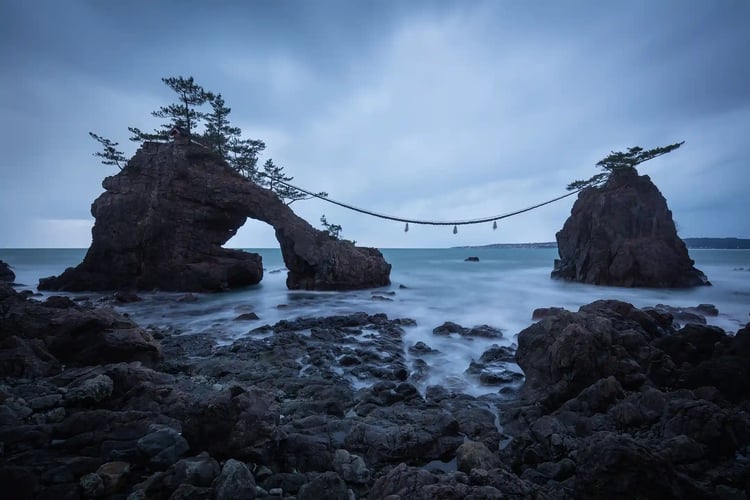
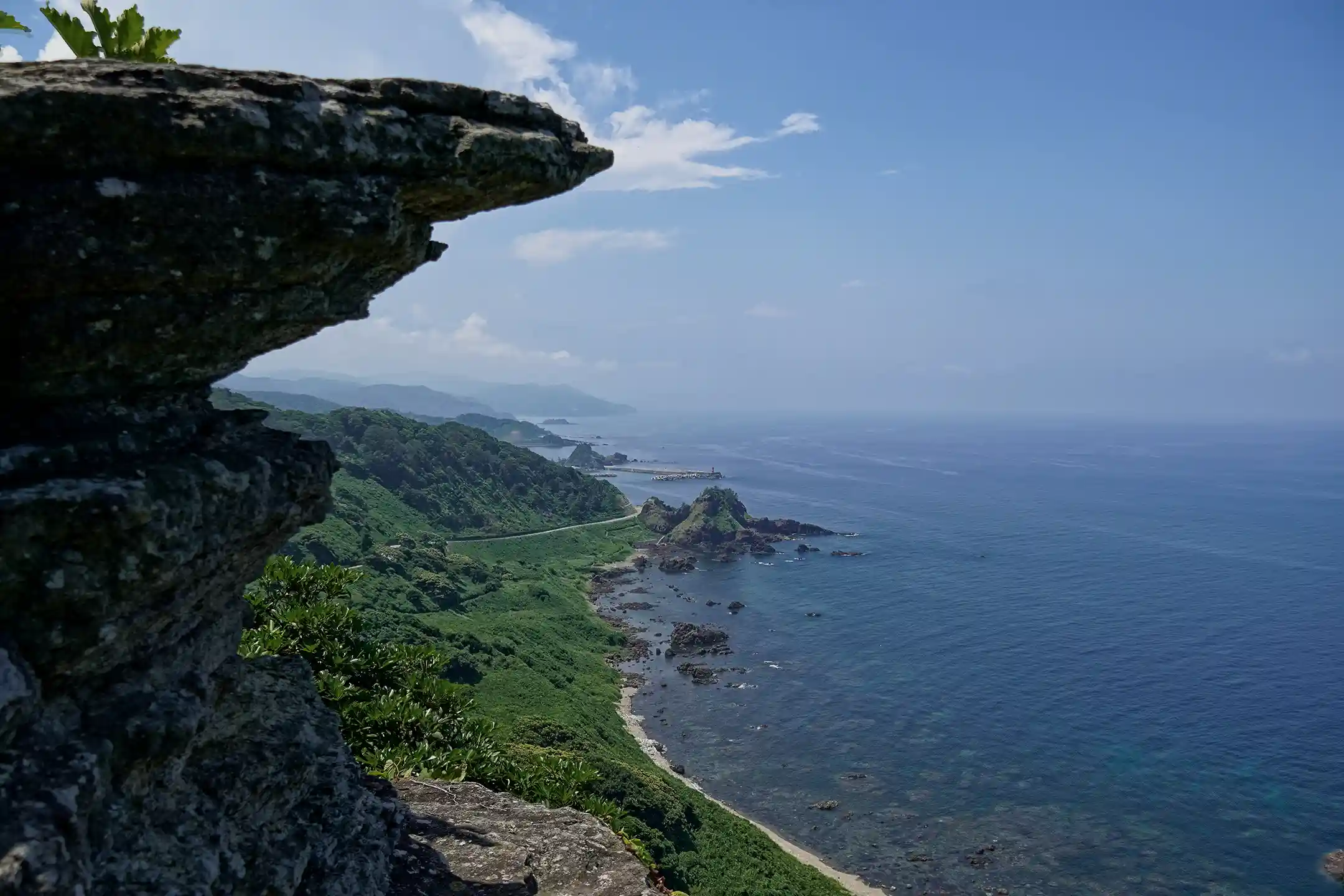
Damage on the peninsula is uneven, and that is the first thing to understand when planning. Kanazawa's official tourism guide, current as of August 2026, describes the Hakui and Nakanoto area as having minimal damage and Oku-Noto in the north as suffering particularly severe damage. Damage does not sort neatly by region, however. The guide reports seismic intensity 7 and extensive damage in Shika Town, yet no significant damage at Ganmon or at Hatago-iwa, the rocks in the photograph above, in the same town. Madoiwa, a rock on the Sozogi coast farther north, lost the window that gave it its name.
A Coast That Moved
The most lasting change is to the land itself. The Sea Map Project, run by the Japan Hydrographic Association, reported in 2025 that the seabed near Saruyama Cape in Wajima rose 5.2 meters, above the early estimate of up to 4 meters. Near Wajima Port, it rose about 1.5 to 2 meters. The Kanazawa guide adds that Mitsuke Island changed shape when it collapsed, and that a temporary road now follows the raised shore along part of the outer coast.
The people who feel this most directly are those who work the water. Wajima's ama divers, whose technique is an Important Intangible Folk Cultural Property, spent their days after the disasters surveying a changed seabed. Until the project's new map, they told Nippon.com, they had used blank charts with no depth contours and could not tell sand from rock.
What Is Open on the Noto Peninsula in 2026
Driving north from Kanazawa, you meet the Chirihama Nagisa Driveway, open weather permitting. The Kanazawa guide also lists Keta Taisha Shrine and Myojo-ji in Hakui; the prefectural site says Myojo-ji requires a reservation and cannot receive visitors during memorial services. At Noto Kongo, the sightseeing boat damaged by the tsunami resumed regular service in July 2024 and runs from mid-March to mid-November, weather permitting. Notojima Aquarium, which took significant damage, has fully reopened, with its dolphin shows back since March 2025.
Wakura Onsen shows how slowly the rebuilding moves. HotelBank, citing the Hokkoku Shimbun, counted 11 of the 19 inns in the town's cooperative open again by July 16, 2026. Kagaya, formerly the town's largest ryokan, broke ground on August 25, 2026 on a new seven-story building targeted for the end of fiscal 2028. It will have 33 rooms, against 233 before the earthquake. A traveler who reads about the old Kagaya in an older guide should not expect the same inn.
Wajima's morning market has not returned to its old street as a regular market. The fire destroyed about 240 buildings across roughly 49,000 square meters, and road building began on March 26, 2026, with the city aiming to complete infrastructure by fiscal 2028; at that point some shops were operating on the grounds of nearby commercial facilities. On September 13, 2026, about 30 stalls gathered near the old street for a "revival beginnings" market, the first stalls set up around the street since the earthquake, the Chugoku Shimbun reported. A regional tourism association told TTG Asia that it expects more developments in 2027, including the resumption of the market and Hotel Mercato Wajima.
Farther north, the picture is one of partial returns. The Kanazawa guide reports rice growing again at the Shiroyone Senmaida terraces, whose adjacent shops open on Fridays, weekends and holidays; NOTOMORI, a temporary food court in operation since November 2024; and the Suzu Theater Museum, reopened in July 2026. It also lists Soji-ji Soin and Wajima Kobo Nagaya, the craft workshop complex, among places to visit in Wajima, though the prefectural tourism site shows the workshops as only partly open. The Oku-Noto Triennale, held in Suzu since 2017, will not take place in 2026, but its outdoor works can still be seen around the city.
Getting to Noto From Kanazawa
The tip of the peninsula lies about 110 kilometers from Kanazawa in a straight line, and the Noto Satoyama Kaido highway connects Kanazawa with Noto. The Kanazawa guide puts Notojima at about 1.5 hours by car and a loop around the tip at more than 300 kilometers, warns of bumps and alternating one-way traffic, and says travel times in Oku-Noto have largely returned to pre-disaster levels. By rail, the JR Nanao Line and Noto Railway reach Anamizu in just under 3 hours, and beyond that you depend on buses, with some local routes suspended or rerouted. The Noto Desk at Kanazawa Station has English-speaking staff from 9:00 to 15:00.
Kanazawa also makes a sensible base for shorter trips. Our guides to food in Kanazawa and private onsen around the city cover the days on either side of a drive north.
Why the Noto Peninsula Was Less Remote Than It Looks
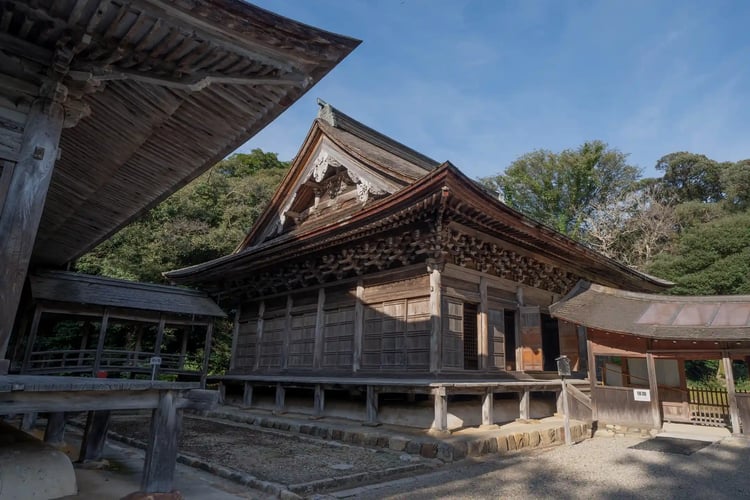
Noto is often sold as a remote corner of Japan. That description fits a traveler coming by train from Tokyo. It fits the peninsula's history less well. Ishikawa Prefecture's Japan Heritage summary calls it a hub of exchange in Sea of Japan culture, while also crediting its geography with sparing the festivals from the rough waves of modernization, so isolation is part of the story too. Political power still reached it. Myojo-ji, the temple above, dates to 1294, and its ten Important Cultural Property buildings were raised over five generations of the Maeda lords of Kaga; the third, Toshitsune, built its main hall, founder's hall and five-story pagoda as a memorial site for his birth mother. Three stories show this connected past, and each includes a break.
Suzu Ware: Nearly Five Centuries Gone, Then Broken Twice
Suzu ware began in the latter half of the 12th century and, according to the Japanese government's Kizuna magazine, was distributed widely across Japan before largely disappearing in the late 15th century. The memory went with it. The Japan Tourism Agency's text on Suzu ware says the pottery was largely forgotten until an urn was excavated in 1951; later digs found 40 kilns around Suzu. In 1972, the potter Gen Onodera began experimenting with Suzu clay to restore the old methods.
What to look at is the surface. Early Suzu ware was fired in tunnel-shaped anagama kilns, where temperatures could reach over 1,200°C, and sealing the kiln to limit oxygen gave it a grayish-black color and a natural glaze. Kizuna notes that modern gas kilns offer easier temperature control, though the potter Takashi Shinohara still prefers wood firing, so it is fair to ask whether a piece was wood-fired.
The revival has now been tested. Shinohara, chair of the Suzu ware association, lost his kiln to a tremor in 2023 and spent five months rebuilding it. The January 2024 earthquake destroyed it again before he had fired a single piece. He told Kizuna in April 2024 that this time he had no thought of closing, because the kiln had been built with help from others who wanted to keep wood-fired Suzu ware alive, and that younger potters did not want to stop either.
Kuroshima: A Shipowners' Village With No Harbor
Kuroshima, on the peninsula's west coast, grew rich on the kitamae-bune, the merchant ships of the Sea of Japan trade, without being able to receive them. Wajima's Board of Education records that the village had no harbor those ships could enter, so it developed as a home for shipowners, captains and crew. When that trade faded, the village's economy stalled. It then found a second life at sea: a town history published in 1970 records 58 percent of its households making their living as sailors, on oil tankers, whaling ships and other vessels. Those years saw a peak in building large houses, with the black roof tiles, clapboard and lattice that defined its streets. In Premium Japan in March 2024, the lacquer artist Yukiko Akiyama reported that the former Kadoumi house, once a representative shipping merchant's building there, had collapsed with no plans to rebuild, and that only a handful of residents remained. We could not confirm the district's present state.
Soji-ji Soin: The Head Temple That Left for Yokohama
Soji-ji in Monzen was established in 1321 by the Zen master Keizan Jokin. After fire destroyed most of its buildings in 1898, the Soto school moved its base to Tsurumi in Yokohama, and the temple in Noto was rebuilt on the old ground as Soji-ji Soin. The institution left, and the site stayed.
The recent record is harsher. After damage in the 2007 Noto earthquake, the temple spent 14 years rebuilding, finished in 2021 and declared its recovery with the city that April. The 2024 earthquake then damaged all 17 of its registered cultural properties. That October, a national council recommended 16 buildings for Important Cultural Property status, and the Agency for Cultural Affairs' database now lists buildings at the temple under that designation. We could not confirm which areas visitors can enter today.
Wajima Lacquer and What the Fire Took
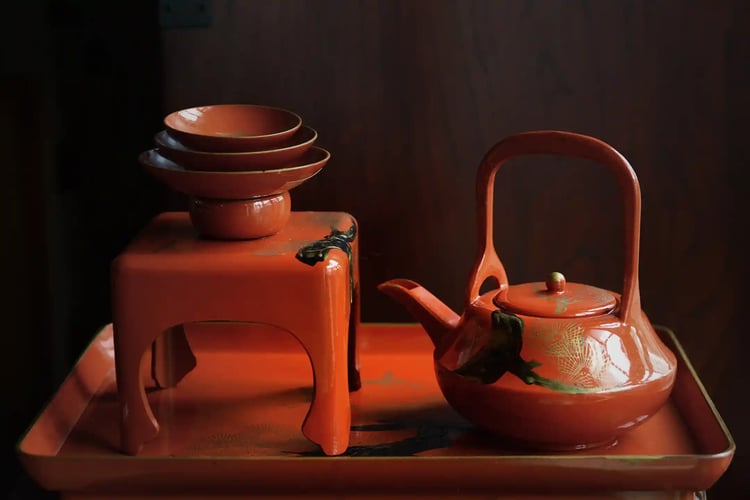
Wajima-nuri is Noto's best-known craft, and its origins remain unsettled. The prefectural tourism site notes that opinion is divided, and gives as the leading theory a monk from Negoro-ji who came to Wajima around 1400 and lacquered trays and bowls. The Japan Tourism Agency's text on the Wajima Lacquer Museum, established by a cooperative of lacquer artisans, is more cautious, saying only that some pieces date back to the 16th century.
How to Judge Wajima Lacquer
The quality of Wajima lacquer lies largely in what you cannot see. The base coat mixes urushi with jinoko, a local diatomaceous earth, and makers reinforce weak points such as thin rims with cloth. Up to 30 layers may go on top, each hand-applied and dried for about 24 hours in a dust-free room, and one piece takes more than 100 steps. Before the earthquake, the museum showed 133 bowls in sequence, one stage at a time; we could not confirm whether it is open now. Two pieces with an equal gloss can differ greatly beneath it, so ask how the base was made and whether the rim was reinforced. A maker or dealer who works with the material should be able to answer in detail.
The other question concerns who organized the work. Wajima's makers split production into separate specialties, which let them meet demand from Kyoto and Osaka in volume and at competitive prices. The nushiya, the Japan Tourism Agency's text explains, acts as a project manager, consulting the client, commissioning other artisans and delivering the finished piece. A collector used to following one maker's hand, as with a studio potter, should ask here which nushiya stands behind the piece and which specialists did the decoration, whether in chinkin gold inlay or maki-e.
Where the Craft Went After the Fire
That division of labor also leaves the craft exposed. Wallpaper reported in January 2024 that reviving this chain of specialists was a key challenge, with local government figures putting as many as 1,100 of Wajima's roughly 20,000 people in the industry. Masanori Oji, branding director and product designer for Aizawa Wood Works, which makes wooden bases and whose factory was widely damaged, told the magazine: "Without the wooden base, making lacquer products is not possible."
Some of the craft moved. The World reported in June 2024 that some displaced artisans had gone to Yamanaka Onsen, a woodworking town in southern Ishikawa. Among them were Ayano Konishi, a maki-e artist whose family shop, about 250 years old, burned, and Kazuya Shirota, a maki-e artisan in his 70s who chose to keep working over moving in with his son. Konishi said she hopes to go back to Wajima. A piece by a displaced Wajima artisan may have been made far from Wajima, so where it was made is worth asking.
Kiriko, Aenokoto and Salt: Noto Traditions Outside the Museum
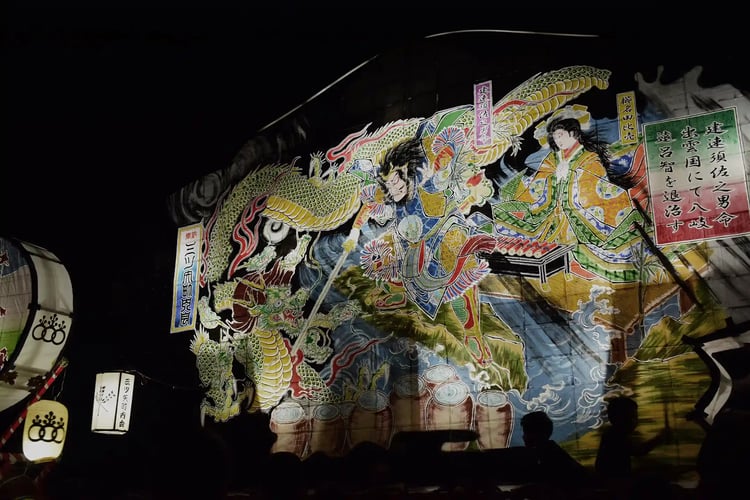
Several of Noto's most distinctive traditions take place in streets, fields and homes, which makes them harder to schedule than a temple visit.
Kiriko Festivals in About 200 Districts
Kiriko are huge lantern floats, and they belong to a family of festivals, not one event. The prefecture's 2015 Japan Heritage summary describes them being held over three summer months in about 200 districts, in three cities and three towns, with lanterns weighing up to 2 tons and standing up to 15 meters tall, carried alongside portable shrines. It traces them to Gion worship and summer purification rites, and says they took their particular form as districts competed with one another in vigor. That rivalry is the thing to watch for. The same summary names the Abare Festival in Noto Town, Ishizaki Hoto in Nanao and the Wajima Taisai among the examples. These figures predate the earthquake.
Aenokoto: A Rice Deity as a Houseguest
UNESCO, which inscribed the ritual in 2009, describes Oku-Noto's Aenokoto as a farmer inviting the deity of the rice field into his home. In December, he summons it by pounding rice cakes, greets it in formal clothes with a lantern, helps it to a bath and serves it rice, beans and fish. Because the deity is said to have poor eyesight, the host describes the meal as he serves it. A similar ritual comes in February, before planting.
Aenokoto is one strand of what the UN Food and Agriculture Organization recognized in 2011 as Noto's Satoyama and Satoumi, the managed landscapes of woodland, paddy and shore. The FAO sees the decline and aging of the farm workforce as a serious threat to biodiversity, and warns separately that local culture and customs are also in danger.
Agehama Salt at Suzu
Salt making is one tradition a visitor may be able to join. At Suzu, workers spray seawater over sand, let the sun evaporate it, rake up the salty sand and wash it into a strong brine, then boil that in iron cauldrons over days of round-the-clock work. The Japan Tourism Agency's text for the site dates the method on the peninsula to at least 1596, and describes a shortened two-hour experience by reservation. The text was written before the earthquake, and the roadside station there reopened in March 2025, so ask whether the experience is running. The national cultural heritage database lists the technique as an Important Intangible Folk Cultural Property.
The fuller landscape of Kanazawa

How to Visit the Noto Peninsula as a Guest
Is the Noto Peninsula worth visiting now? Yes, if you want to see a living culture in the middle of rebuilding and are willing to plan around gaps. If you want a seamless itinerary of grand ryokan and a famous market, it may be better to wait. Access falls into three layers.
Anyone can see the first layer: the Chirihama drive, Ganmon and the coast. The second depends on knowing when to come and whom to ask. The Kiriko festivals run in summer, Myojo-ji and the salt experience need a reservation, the shops at Shiroyone keep limited days, and the two-and-a-half-to-three-hour Reboot Suzu recovery tour runs in Japanese only. Meals fall here too, because they are partly a matter of finding who has reopened: NOTOMORI's food court, Shiosai Restaurant since May 2025, and Ika no Eki Tsuku Mall, where ika means squid. In Wakura, look to the inns that have reopened; our guide to Japanese ryokan covers general criteria for choosing one. At Wajima Kobo Nagaya, the Japan Tourism Agency's text describes visitors entering some workshops, talking with artisans and trying maki-e or chinkin on lacquered wood or chopsticks, but it was written before the earthquake and the site is now partly open, so ask what is running.
The third layer, in our view, needs an introduction. Beyond public-facing sites such as Kobo Nagaya, a working studio is a place of work first. In August 2024, Time Out reported, Kodai Taya of Taya Lacquerware Store, a local lacquer company, guided eight executives from abroad through Wajima, with a live chinkin demonstration and a visit to Soji-ji Soin. Aenokoto, as UNESCO describes it, takes place in a farmer's home, which is a different thing from a public event.
Whichever layer you reach, collapsed houses and empty lots belong to people who may be nearby, so ask before you photograph them. The Kanazawa guide says it matters to take home what you felt on seeing Oku-Noto as it is now. Noto was shaped by ships, kilns and lacquer specialists long before the earthquake, and much of what you can see today is the work of people deciding, again, to carry that on.