The case for staying on Miyajima is a timetable, not a mood.
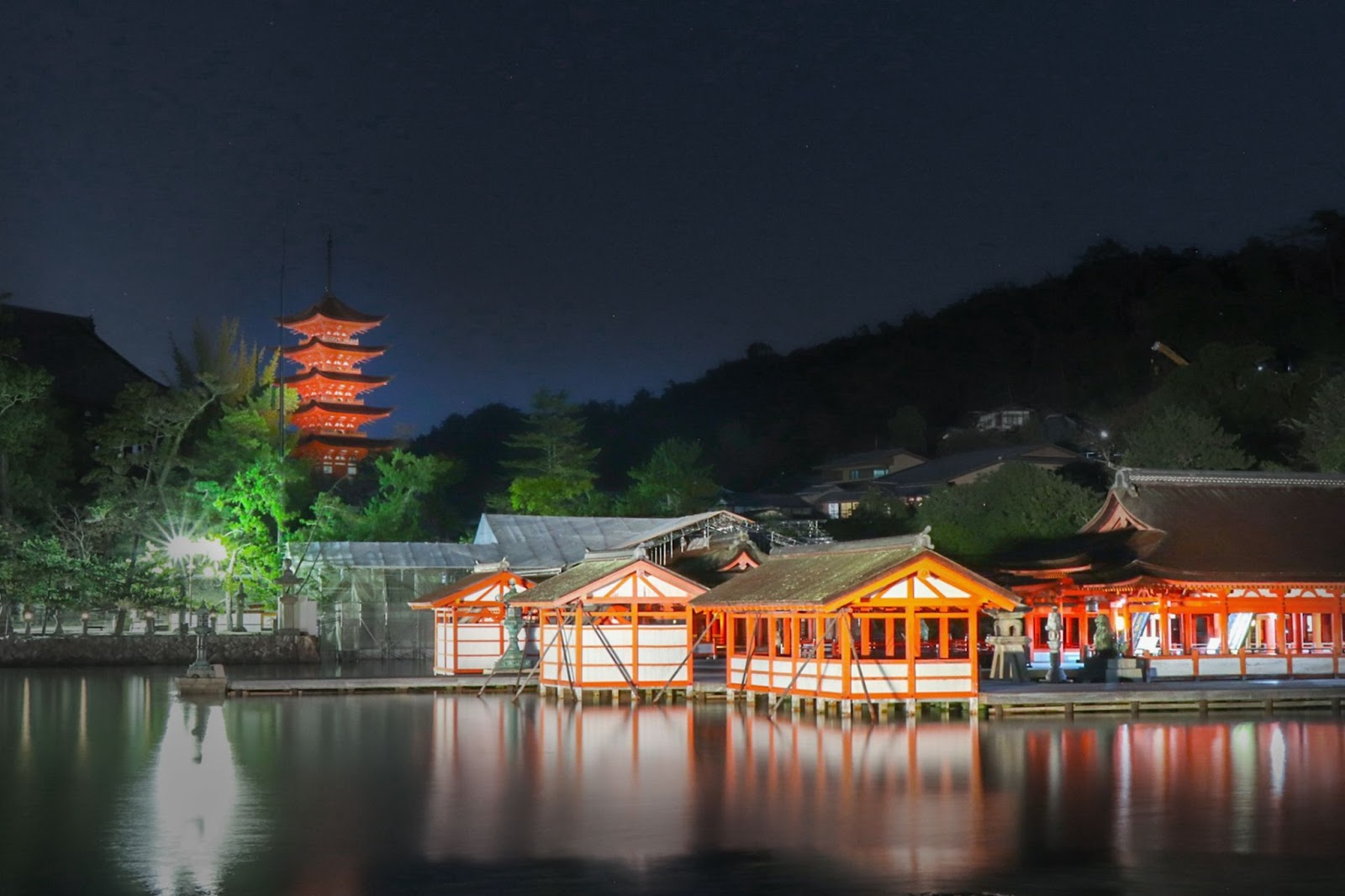
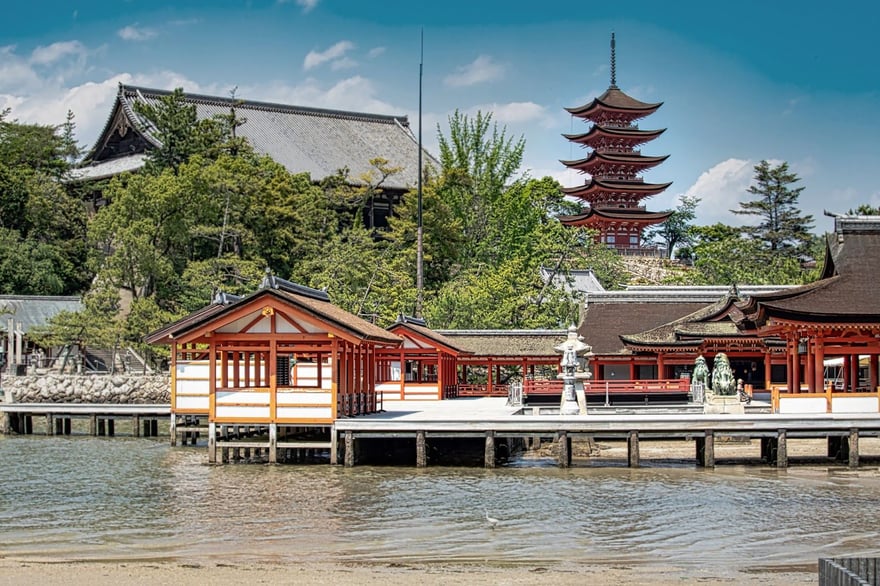
The shrine, the Great Torii, the five-storey pagoda and the two-storey pagoda are lit every night until 23:00, bar a cancellation once or twice a year for a rite. The last ferry off the island leaves at 22:14. A day-tripper cannot see the illumination end; they have to walk away from it to catch a boat. That single gap is what an overnight buys, and everything else follows from it.
This guide covers where to stay on the island, what the tourism association's own register says about each inn, the accessibility problem nobody mentions, and the visitor tax you now pay to arrive.
Why Miyajima Accommodation Beats a Day Trip
Most visitors give the island two to three hours — that is the figure the Miyajima Tourism Association gives as the commonest length of stay, and its three-hour model course runs pier, Mikasahama beach, Itsukushima Shrine, Daigan-ji, the treasure hall, Daishō-in, the pagoda, Senjōkaku. That is a competent day. It is also a day spent inside the busiest window the island has.
Miyajima Accommodation and the 22:14 Last Ferry
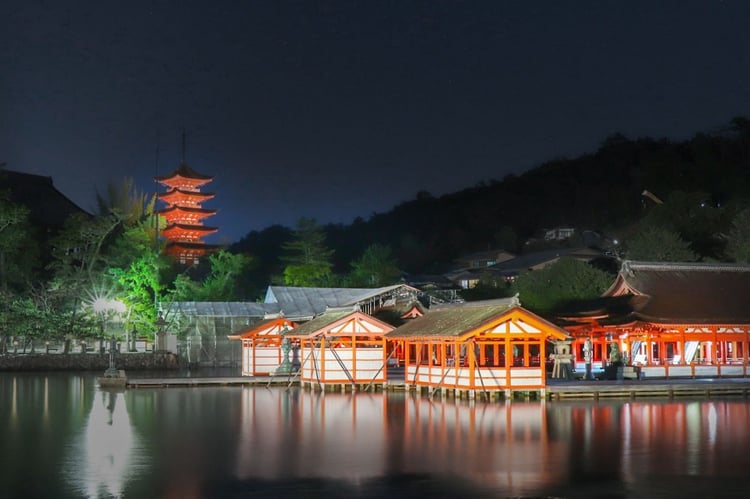
The association's own answer on lighting is precise: the Great Torii, the shrine buildings, the five-storey pagoda and the two-storey pagoda are lit from thirty minutes after sunset until 23:00, every day, with one or two cancellations a year for rites or events.
Against that, the JR West Miyajima Ferry timetable puts the last sailing from the island at 22:14 and the first at 05:45, with the crossing taking about ten minutes. So the lit hours run to 23:00 and the escape route closes at 22:14. Anyone not staying spends the best part of the evening watching the clock.
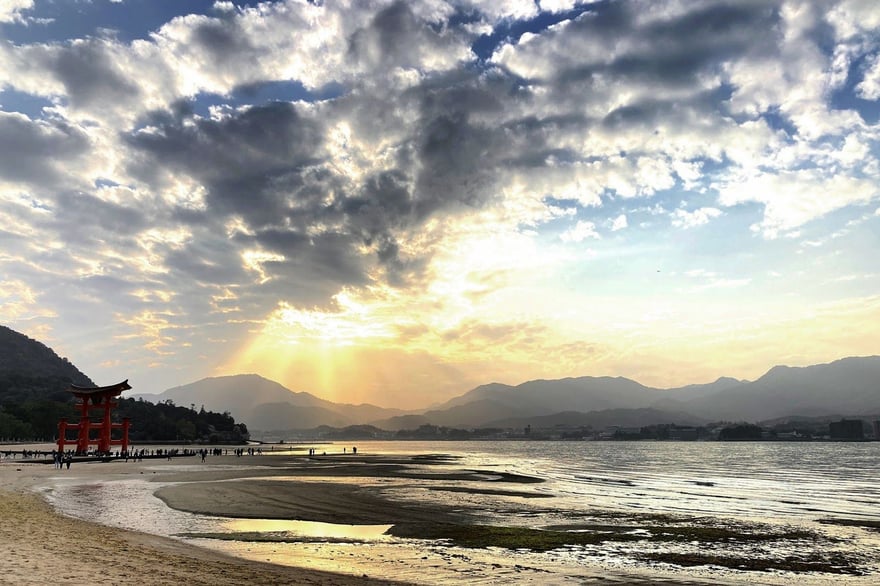
Staying also improves your odds on the tide, and the association is unusually blunt about how this works. Its tide page states in terms that "high tide means the shrine floats" is misinformation, and so is "low tide means you can walk to the torii". The real thresholds are numbers: the shrine reads as floating above a tide of 250 cm, and you can walk out to the Great Torii below 100 cm. Plenty of days never cross one line or the other.
So this is a thing to check rather than assume. The association publishes hourly tide levels by date for the year ahead and marks the window for each state. On a spring-tide day both windows can fall in daylight; on other days neither may. Staying gives you more hours in which a window can land — it does not guarantee you both, and no booking does.
The Itsukushima Opening at 6:30
Itsukushima Shrine opens its gate at 06:30 every day of the year. Closing moves with the season, and the shrine's published table is worth reading before you plan an afternoon: 18:00 from 1 March to 14 October, 17:30 from 15 October to 30 November and again from 4 January to the end of February, and 17:00 through December. On 1 January the gate opens at midnight.
The morning is the part that argues for staying. The first ferry from the mainland leaves Miyajimaguchi at 06:25 and takes about ten minutes, so the earliest possible day visitor walks in a few minutes after opening, alongside everyone else on that boat. Someone staying walks over from the inn.
Admission is 300 yen for the shrine and 300 for the treasure hall, or 500 for both. One practical note from the same page that nobody repeats: the corridors are built with gaps between the boards to let storm surges through, and the shrine asks visitors to consider their footwear, because heels catch.
The same logic applies above the town. Mount Misen rises behind the shrine, and the summit trails and the observation deck are among the things the island's visitor tax now funds. A climb is a morning's work, and a morning is the thing a day trip is shortest of.
Where to Stay in Miyajima: Island or Mainland
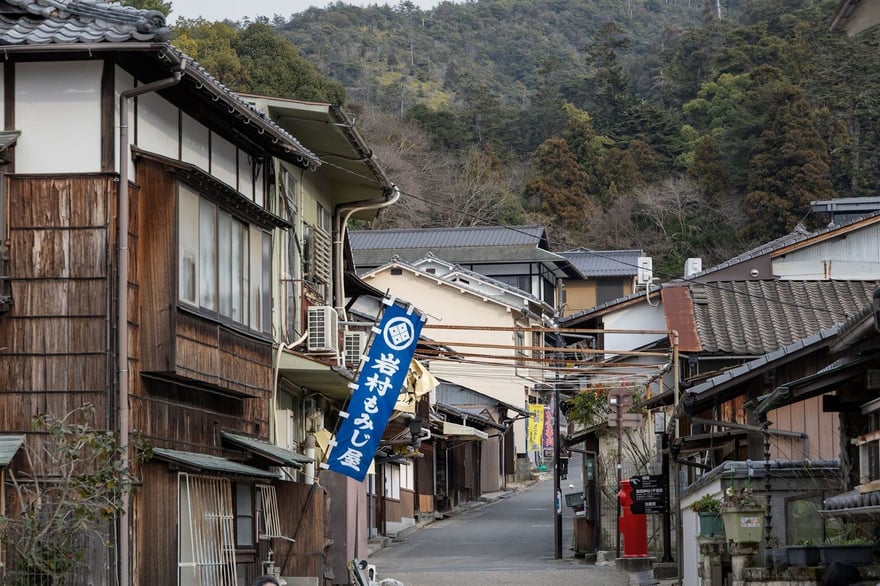
The first thing to settle is whether a property is actually on the island, because several of the best-known names are not, and the marketing rarely makes it obvious.
Aki Grand Hotel, for instance, appears on the tourism association's own register of member inns — at Miyajimaguchi-nishi 1-1-17, which is the mainland ferry terminal side. Sekitei, the garden ryokan often folded into Miyajima lists, describes itself in its own first line as "the inn across from Miyajima," at Miyahama Onsen. Neither is a bad place to stay. But neither solves the 22:14 problem either, because when the lights are on you are still on the wrong side of the water.
Ōtorii-bin: The Ferry Past the Great Torii
One detail worth planning around even for a single crossing. JR West runs its Miyajimaguchi departures between 09:10 and 16:10 as Ōtorii-bin — sailings that swing close to the Great Torii on the way in, at no extra fare and no extra time. Outside those hours the boat takes the direct line, and tidal conditions can cancel the detour altogether.
Iwaso: 170 Years in Momijidani
Iwaso sits in Momijidani, the maple valley behind the shrine, and it is the island's landmark inn. Its own site dates the founding to 1854 and counts 170 years; the association's register lists 38 rooms for about 135 guests, check-in at 15:00 and check-out at 10:00, with foreign-language service available. The inn describes itself as the only Japanese ryokan on Miyajima to hold a Michelin star, and as the venue for the G7 working dinners in 2016 and 2023.
It also claims the origin of momiji-manjū: around 1906 the then-proprietress had a maple-leaf-shaped cake of sponge and bean paste made to a design she wanted for her guests, and the confectioner she commissioned took it from there. Every shop on the arcade now sells it.
One thing to plan for: Iwaso is a fifteen-minute walk from the ferry pier, uphill into the valley — the inn says so on its own page, but it reads differently once you are carrying a case.
Miyajima Hotels and Ryokan in the Association's Register
The association's member list is the most useful page on the island's web, because it publishes the things booking sites bury: address, room count, capacity, check-in and check-out, credit cards, foreign-language service and step-free status, inn by inn.
What it shows, read across: Kinsuikan at Miyajima-chō 1133, 39 rooms for 146, which states that 80 per cent of the ingredients in its dinner and breakfast come from within Hiroshima Prefecture. Kikunoya at Miyajima-chō 335, 24 rooms for 82, beside Momijidani Park, with sea-side rooms looking to the shrine and the Great Torii. Kurayado Iroha at Miyajima-chō 589-4, on the shore, capacity 70. Gansokuya at Miyajima-chō 580, with a late 11:00 check-out.
The register also corrects an assumption. The island is not only small ryokan: Hotel Miyarikyu lists 71 rooms for 250 guests, three minutes from the pier and seven from the shrine; Miyajima Grand Hotel Arimoto 55 rooms for 298; Miyajima Hotel Makoto 50 rooms for 300; Hotel Miyajima Villa 42 for 105; Miyajima Seaside Hotel 40 for 120; Miyajima Mori no Yado 30 rooms for 220 at Ōmoto Park. At the other end, Suihasō has five rooms for fifteen people and Kikugawa eight rooms for twenty-three.
Kurayado Iroha's register entry gives its business hours as 07:00 to 22:00. That is the inn's operating window rather than a stated check-in deadline, but it is a fair signal of the island's rhythm if you are arriving on a late boat.
The useful generalisation is not that the inns are tiny — several are not — but that the island's bed count is finite and fixed, on a site that cannot expand. Add the register's capacities and the on-island total is in the region of two thousand beds, for a World Heritage site that receives millions of visitors a year. On the two peak weeks below, that is what binds, not price.
Step-Free Miyajima Accommodation Is the Hard Part
Here the register is blunt in a way that matters, and the answer is not the one you would guess.
The shrine is the accessible part. The association states plainly that Itsukushima Shrine is barrier-free, and that wheelchairs are lent from the Miyajima Tourist Information Centre free of charge, 09:00 to 17:30, about fifteen chairs, same-day only with no advance booking — and that guests staying on the island may borrow one for the length of a one- or two-night stay.
The inns divide, and the register says which is which. Two on-island properties are marked fully barrier-free with the reasons given: Miyajima Grand Hotel Arimoto lists a lift, beds in Western and Japanese-Western rooms, dining at a chair rather than on the floor, and handrails in the large bath; Hotel Miyajima Villa lists ramps and a barrier-free toilet inside. Suihasō is barrier-free on its ground floor, and Kikugawa is barrier-free apart from stairs. Hotel Miyarikyu and Miyajima Seaside Hotel are partial — ramps at the entrance and where needed.
The historic ryokan are the ones that cannot. Iwaso is listed as not barrier-free, so is Kinsuikan, and so is Miyajima Mori no Yado; Kurayado Iroha is barrier-free in one room only, with English as its sole foreign language; Kikunoya is partial. These are old wooden buildings on a hillside, and the register does not pretend otherwise.
So the answer is not that the island is difficult — it is that the choice runs the opposite way to the romance. The World Heritage shrine takes a wheelchair; the 170-year-old ryokan does not; the modern hotels do. Read the register entry rather than a booking platform's icon, check the association's Miyajima Anshin Guide Map, and ask the specific inn.
Before You Book Miyajima Accommodation
There is now a visitor tax. Since 1 October 2023, Hatsukaichi City has levied the Miyajima Visitor Tax on people arriving by boat. It is 100 yen per person per visit, collected by the ferry operators with your fare — added at the ticket window, and deducted automatically at the IC-card gates on both JR West and Miyajima Matsudai. Anyone expecting to come repeatedly can instead register for an annual rate of 500 yen per person, arranged in advance at the city office or the Miyajima or Ōno branch, or through the city's official LINE account. Pre-school children are exempt, as are school parties carrying a certificate from the head teacher, and holders of a disability certificate on presentation. The city says the money goes to visitor facilities, to conserving cultural properties and the Mount Misen trails and observation deck, and to ecotourism, including water-refill points. The same page sets out the island's standing: within Setonaikai National Park, a UNESCO World Cultural Heritage site since 1996, holder of a four-ministry ecotourism certification, and registered by the Ministry of the Environment as a Zero Carbon Park.
Dogs are allowed; the cabin is not. The association confirms you may bring a dog to the island, but on both the JR West and Miyajima Matsudai ferries dogs travel on deck rather than in the passenger cabin.
Baby-changing and feeding rooms are limited to four places on the whole island — the ferry terminal, the TOTO Miyajima Omotenashi Toilet, the aquarium and the shrine — and the association warns they get crowded. Feed before you sail.
Guides must be booked in advance. Official Miyajima guides are available on the date and time you choose, but only by prior application; there is no turning up and hiring one.
For dates, the association gives the two peaks: cherry blossom around the beginning of April, and maple colour around 20 November. Those are the two weeks when the small room stock above becomes the binding constraint.
Eating and Buying on the Island
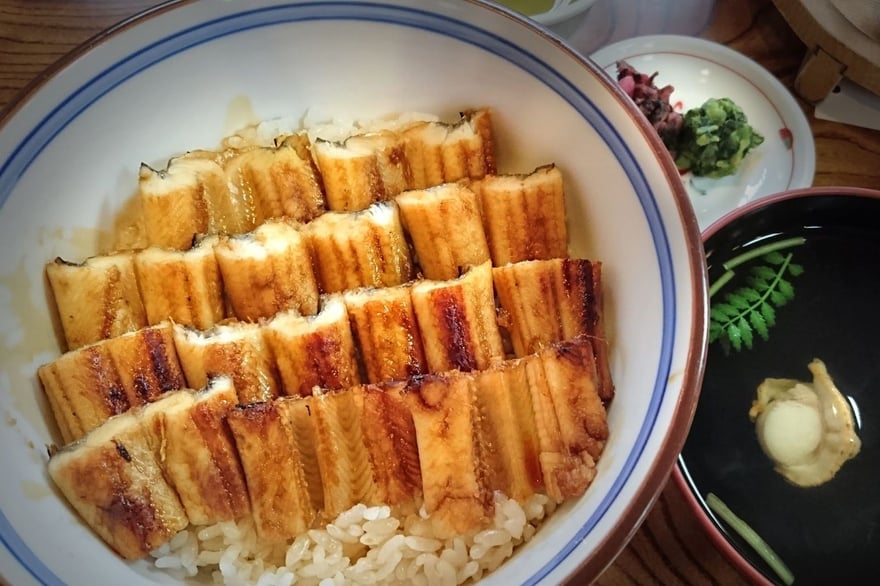
Anago-meshi — conger eel grilled and laid over rice — is the local dish, eaten on both sides of the water. Staying changes the timing rather than the menu: the arcade's kitchens are built around the day-trip peak, so the quiet sitting is the late one.
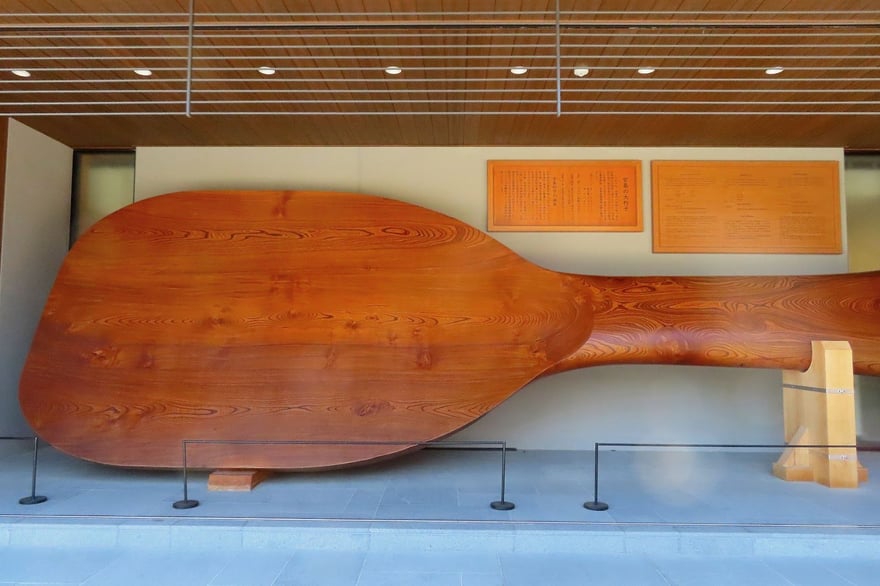
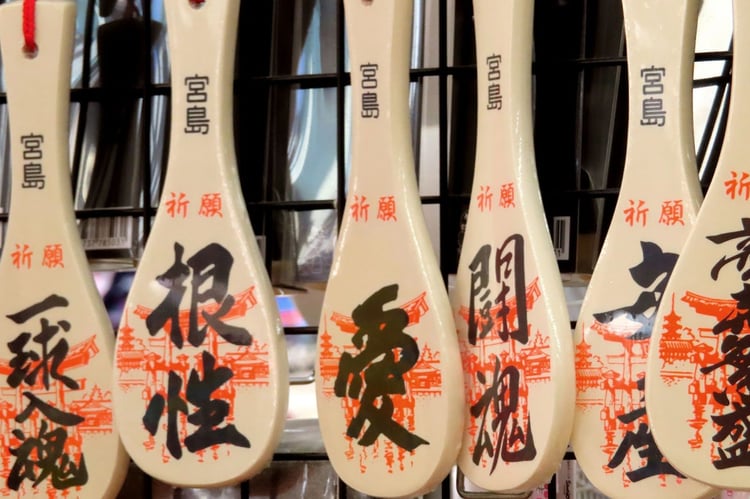
The shamoji, the wooden rice paddle, is Miyajima's craft. The shops sell them painted with characters and phrases — 愛, 根性, 一球入魂 — and the island also keeps an outsized ceremonial one on public display, cut from a single piece of timber. It is the one souvenir here with a local origin rather than a national one.
.png)
Stay a little longer, in the half-light
This article steps into a single site, in a single moment of light. The Japan of Dusk and Dawn Digital Guide draws Nikko, Koyasan, and Miyajima together into one connected reading — three World Heritage places as they reveal themselves beyond daylight, in the hours most travellers never see.

In closing
Miyajima rewards an overnight for a reason you can put a number on. The lights go off at 23:00 and the last boat leaves at 22:14; the shrine opens at 06:30 and the first arrival from the mainland is later than that. Between those two facts sits everything a day trip cannot reach.
Book early for a small island of small inns, ask the specific question about steps if it matters to you, budget for the visitor tax, and read the association's register rather than a booking page. Then the rest of it — the tide, the deer, the quiet street at ten at night — takes care of itself. If you are weighing this against the mainland, our guides to choosing a ryokan and to visiting Itsukushima Shrine cover the two halves of the decision, and Hiroshima's bonsai culture is the reason to give the mainland a day of its own.
.webp)