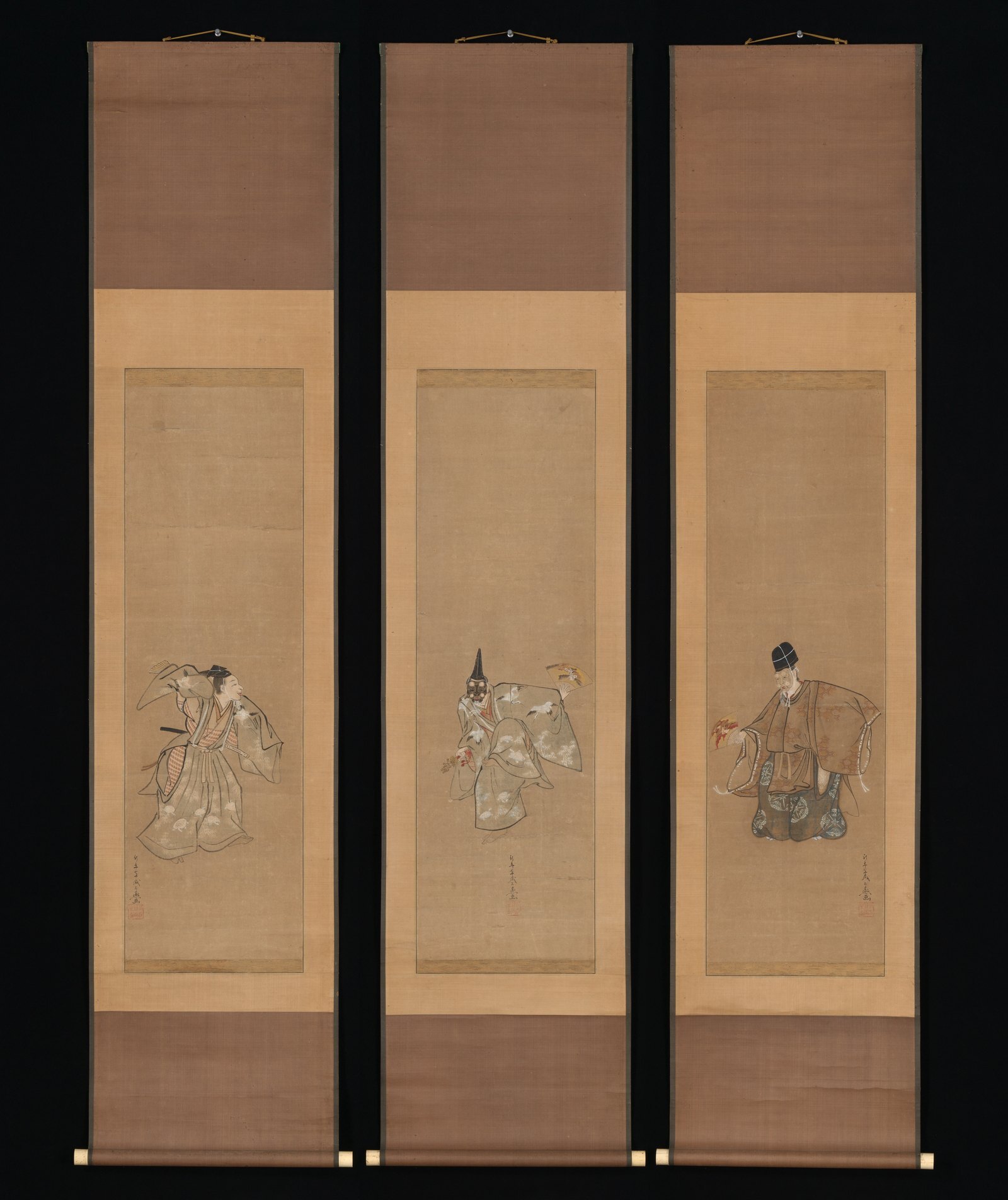
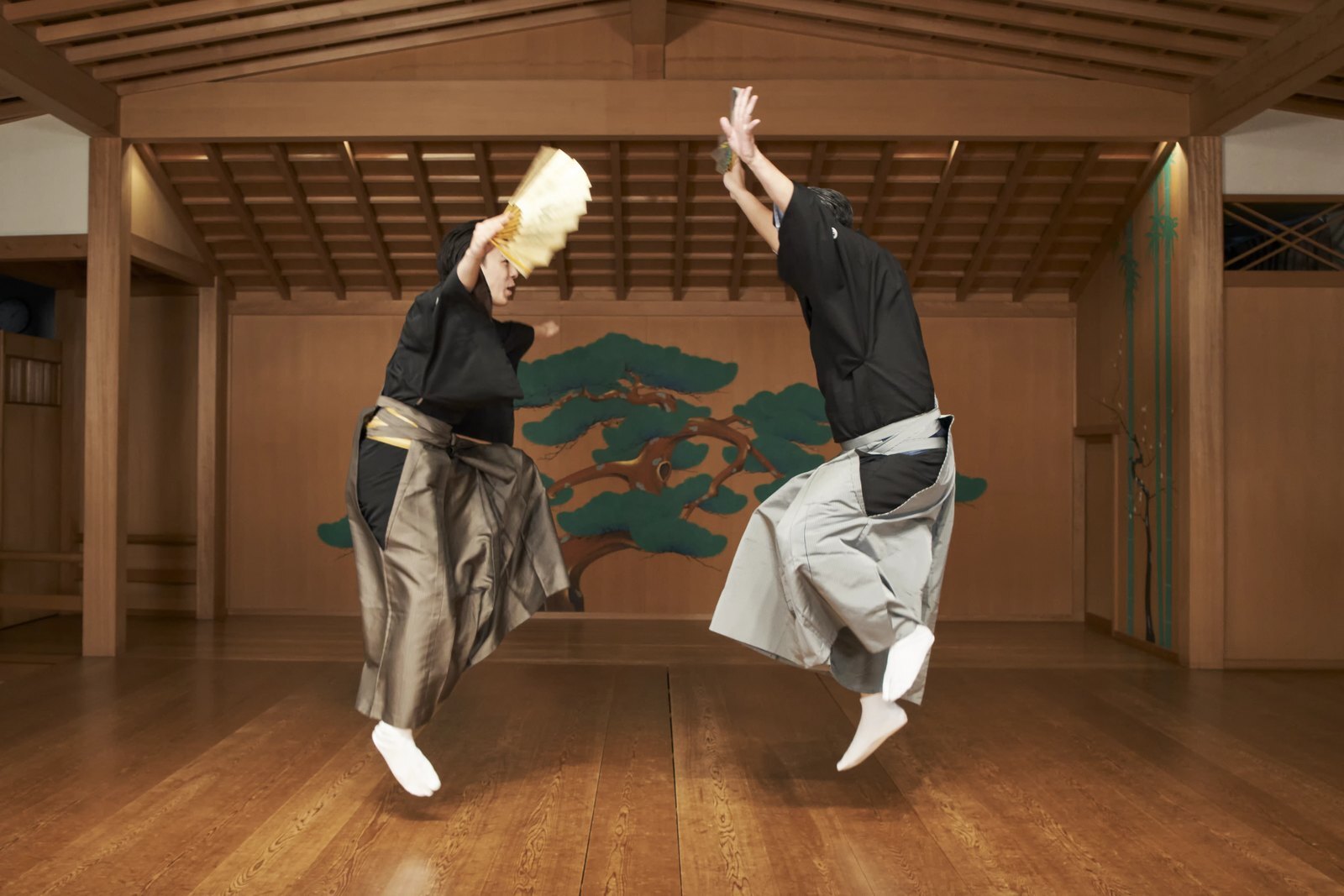
You are most likely to meet kyogen without looking for it. It sits on the same programme as a long, slow, masked noh play — and the listing may describe it only as a traditional Japanese comedy. Then it starts, and people around you laugh at things you did not notice, in a language that is not modern Japanese.
The confusion is reasonable, because two different things are called kyogen and because the discipline behind it works against what a visitor expects from comedy. This article covers three questions: where kyogen sits inside Japan's performing arts, why one performer was taught never to chase a laugh, and where you can watch it.
Kyogen Is the Spoken Half of Nogaku, Not an Interval in Noh
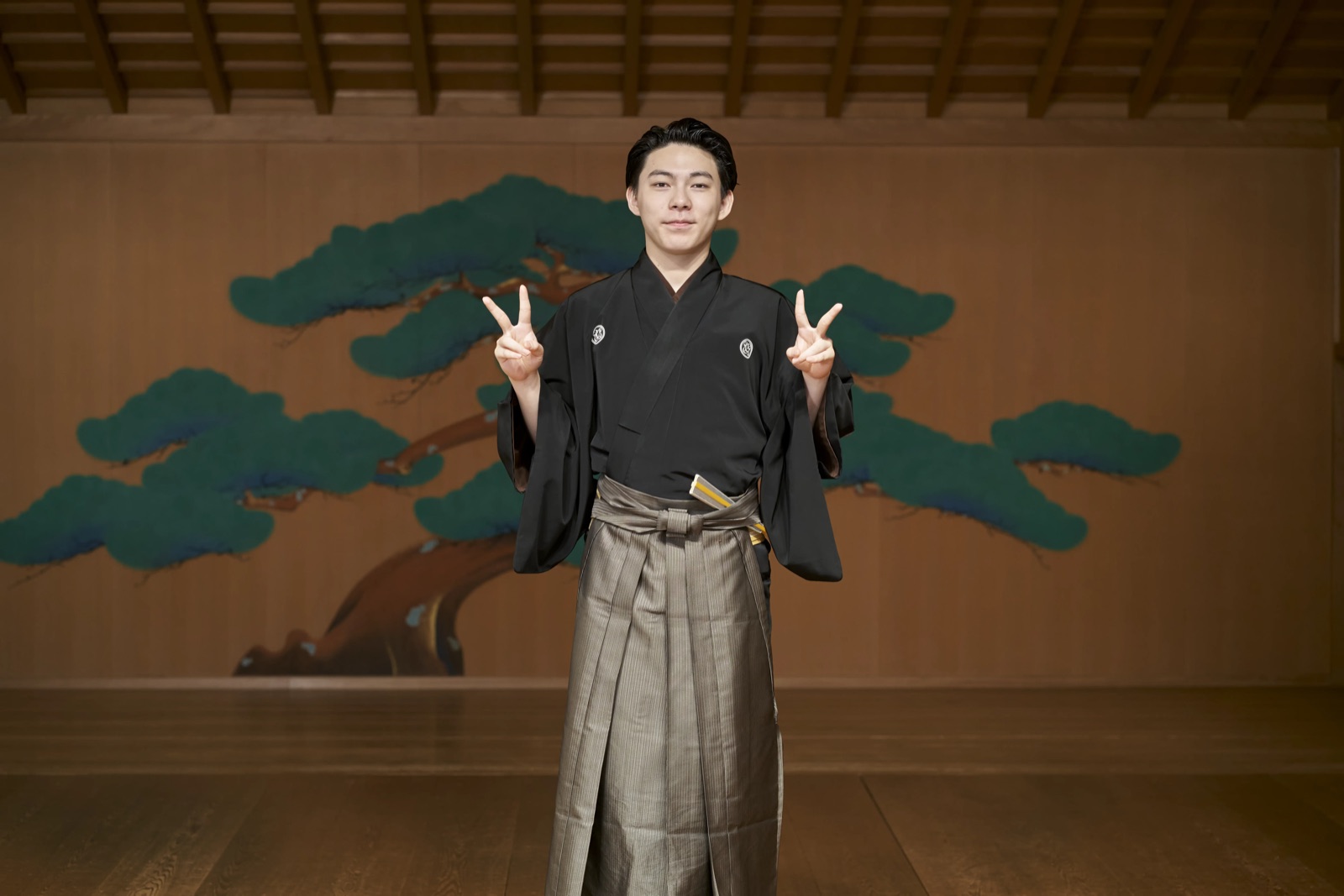
Noh and kyogen are not a main event and its interval. They are the two halves of a single form, nogaku, which grew up together over some seven hundred years and is performed on the same stage of solid hinoki cypress. UNESCO, which inscribed Nôgaku theatre on its Representative List in 2008, describes it as encompassing "two types of theatre: Noh and Kyôgen, which are performed in the same space." Noh carries its meaning in chant and dance. Kyogen carries it in spoken dialogue.
Hon-kyogen and Ai-kyogen: Two Different Things Called Kyogen
Hon-kyogen is a self-contained comic play with its own title, cast and ending. It is what is listed on the programme alongside a noh play, and it is what people mean when they say they went to see kyogen.
Ai-kyogen is different. It is a passage performed by a kyogen actor inside a noh play, while the principal figure is offstage, often explaining in plain speech what the noh has been conveying in chant. The Nohgaku Performers' Association describes the role: kyogen actors "also appear as characters within nō plays, where they have the role of 'ai' or 'ai-kyōgen'," and "a great number of nō have an interlude between the exit of the shite in the first act and the entrance of the shite in the second during which the ai takes center place." Very often the ai is "a local man who appears in front of the waki, a priest, and retells the story of the shite of the first act." It is not filler; it is a structural part of the noh play it belongs to.
If you have seen "a kyogen" and found it not funny, you may have been watching ai-kyogen while expecting hon-kyogen.
No Microphones, and a Floor of Solid Cypress
The stage is shared and unforgiving. It is solid cypress. And as Ohkura Motonari, a kyogen performer of the Ohkura school, points out, there are no microphones. A kyogen performer works in the bare, unamplified voice.
Why Kyogen Is Played Bare-Faced, and What the Masks Are For
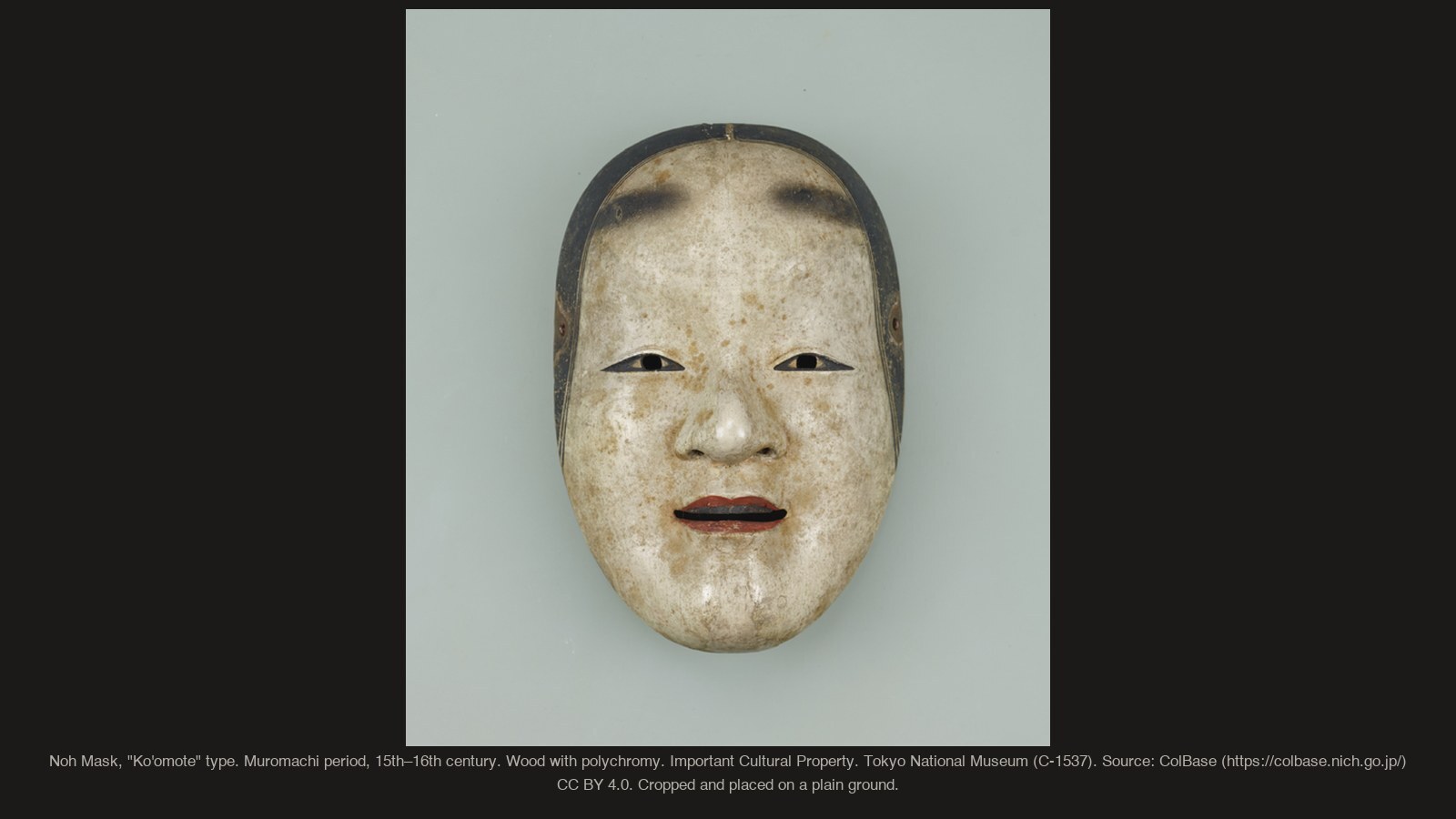
Noh is the masked half. Kyogen is performed largely with the bare face, and the association is specific about the main exceptions: "roles of demons, gods, animals, and spirits require masks." Everything else is played on the performer's own face.
When we visited Ohkura Motonari of the Seisho-kai, he arrived carrying several masks, seated in the car with the seatbelt fastened across them. He explains why: "If the car were rear-ended from behind, it would be crushed, so I always place it on the seat and fasten the seatbelt." "The men, the mask, is the most precious thing to us, so of course I carry it — always by hand. I never put it in a trunk," he said. "The valuable ones can be masks from centuries ago, and those really can't be restored anymore."
Of the masks he brought, he described two to us. The kokushikijō is worn by the Sanbasō role in the shikisanban — a piece Ohkura says is held to belong to neither kyogen nor noh — and it is the black counterpart to the white hakushikijō that Okina wears. The Buaku is a demon mask whose name puns on fu-aku, "not evil"; it is used, he says, for demons and for the thunder god.
Kata: The Rule Ohkura Inherited Against Chasing the Laugh
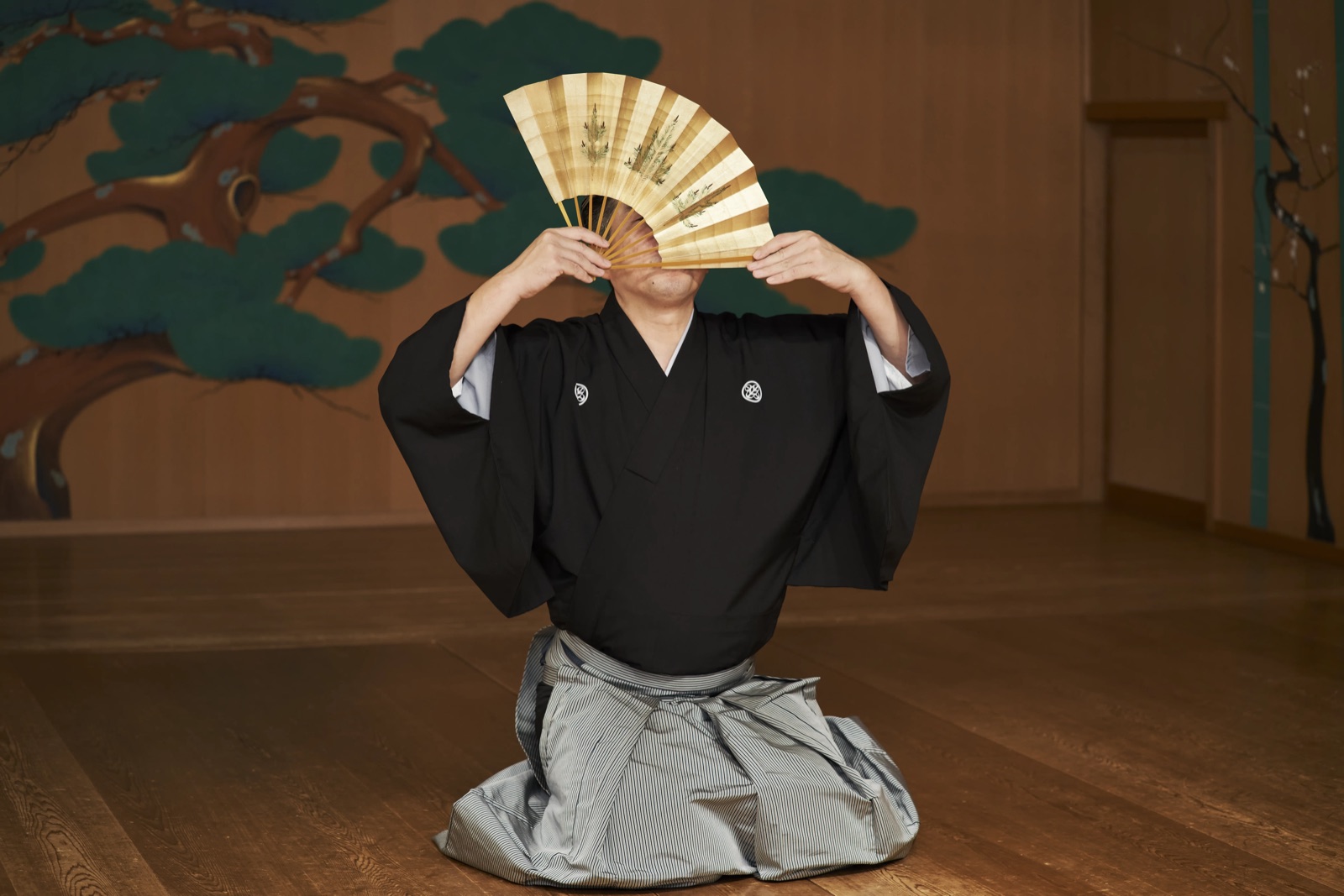
Here is the part that makes kyogen worth watching closely, and the part an introduction to it rarely mentions: Ohkura does not try to make you laugh out loud, and says so plainly.
Don't Chase the Laugh in the Room
Ohkura received the rule from his grandfather, and quotes it as a sentence: "Don't chase the laugh in the room."
The reasoning is about what the art is for. "Art that goes after the audience's big, roaring laughs on the spot becomes a very unseemly kind of art," he told us. "What we show is not so much our own art as the art that history has carried here." What his grandfather told him to aim for instead is specific, and much harder: "the kind of laugh where the audience gets into bed, remembers it a little, and lets out a small laugh."
What holds the rule in place is kata — the fixed forms of movement, intonation and staging, transmitted intact rather than remade. "Because we're who we are, if I go after the laugh, thinking 'this would be funny if I did it this way,' the kata will surely start to change, and I'll fall into the shape of today's humor," Ohkura said. The kata is not decoration. What he describes is a seven-hundred-year-old sensibility being quietly replaced by this year's, and the kata is what he holds against it.
Why the Days That Feel Best on Stage Are the Ones Judged Worst
Ohkura describes the trap from the inside. "Curiously, there are times the audience really carries you," he said. "You get carried, and the performance grows broad, exaggerated. Then it becomes fun for you too — 'today's stage was a great one.' But in fact that feeling is mistaken. It's precisely then that the people around you say, 'No, today was no good.'"
The inverse holds as well. "On the days when I've done it in a flat, 'I've got no drive today, I'll just go by the kata' state — those are exactly the days when they say, 'Today was good.'"
He does not present this as a settled rule, and neither should we. "You really can't tell," he said. "That's what makes it interesting." The open question he puts next to it is the one worth carrying into a theatre: "Is it really more interesting to make yourself nothing and go strictly by the kata? How to hold that balance is perhaps something I can only consider now."
What a spectator can take from this is not a verdict but a thing to watch: whether the delivery stays the same size when the room invites it to grow.
Busu, and Why the Joke Still Lands
The plays themselves are not complicated. "Kyogen is extremely simple in the content of its stories," Ohkura said. "There isn't some especially clever twist; many of the pieces treat, in earnest, the kind of story that could happen anywhere."
His example is Busu, in which someone told by his master is warned that something must not be looked at and absolutely not touched. "Someone touches the very thing the master told him, 'Don't look at it, absolutely don't touch it' — it strikes at human psychology," he said. "There's still that kind of humor now, where being told 'absolutely don't press it' means you have to press it the second time round; it's much the same."
His description of why that survives is the sentence a first-time viewer can most use: "The point of resonance is extremely thin, but anyone can share in it."
From Sangaku to a Nayose of 180 Plays: How One House's Repertoire Was Fixed
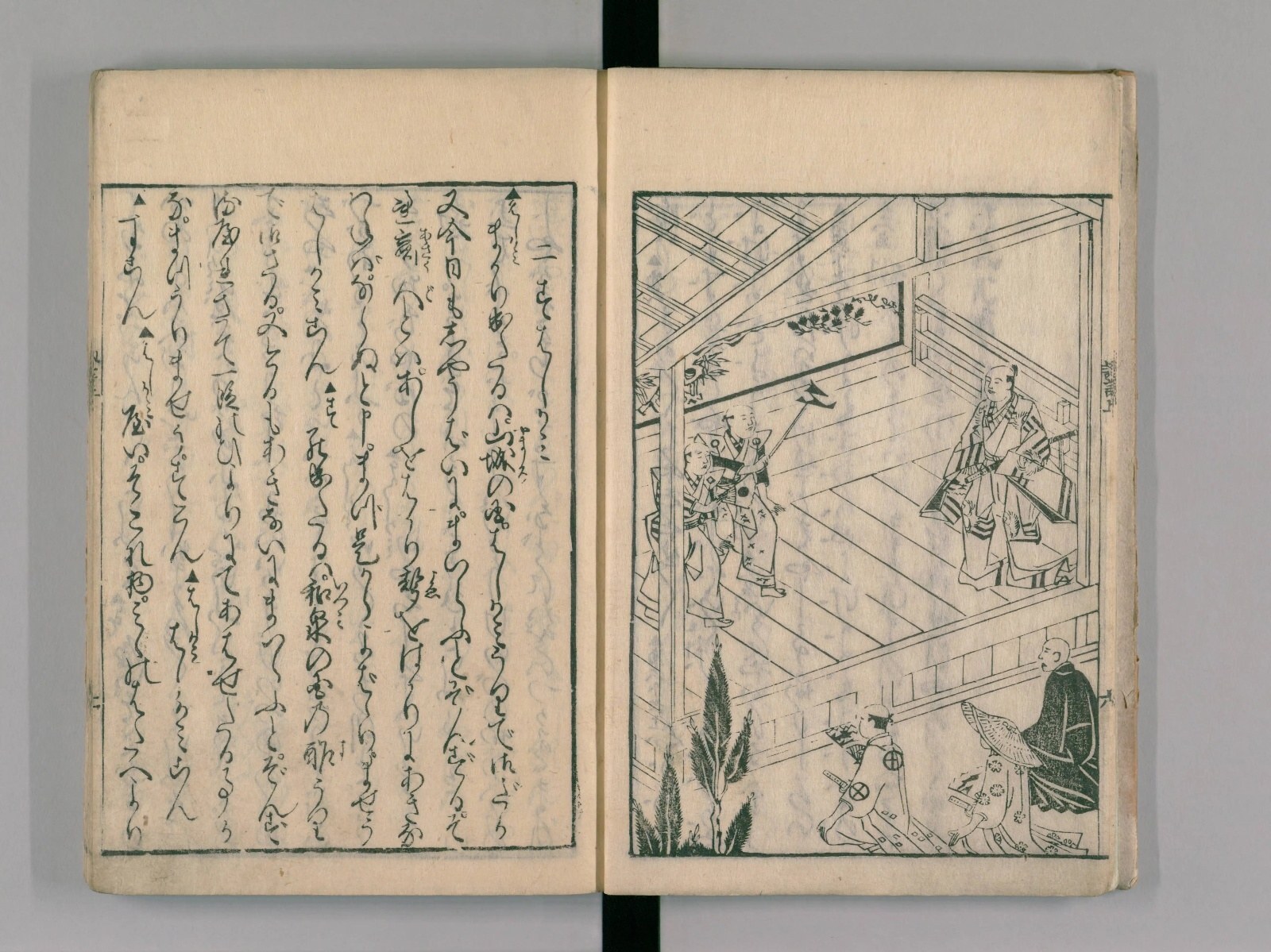
Ohkura's repertoire has a number attached to it, and the number is not an accident of taste. It is the result of a government asking his house a question.
Sangaku, Sarugaku, and the Troupe Based in Nara
"Kyogen is a theatre handed down from about seven hundred years ago, from what in Japan we call the Muromachi period," Ohkura said. "It grew together with noh and became the genre called nogaku — but originally it was called sarugaku, the medieval performing art from which both noh and kyogen descend."
Before that came sangaku, a performing art transmitted from the continent that spread through the provinces. UNESCO dates that transmission to the eighth century, and describes kyogen as relying "less on the use of masks" and as being "derived from the humorous plays of the Sangaku." "These came together, it's said, and sarugaku was born," he told us. "In the old days people spoke of Yamato sarugaku and Ōmi sarugaku, and there were sarugaku troupes in many places." His own house was based in Nara and belonged, as a resident troupe, to the Enmai-za within Yamato sarugaku — the lineage that is now the Konparu-ryū.
The Gen'e Hōin Story, and What It Is Said to Explain
There is an account of why the form was made at all, and Ohkura is careful about how he gives it. "Kyogen is said to have been created originally by a man named Gen'e Hōin, who is also said to have been a scholar-monk of Mt. Hiei, and who I've heard served as tutor to Emperor Go-Daigo," he said. "In a world of war, in order to convey how a person ought to conduct themselves — to pass on a kind of morality — Gen'e Hōin is said to have created kyogen."
Note the hedging in his own telling: said to have been, I've heard. This is transmitted attribution rather than documented fact, and it is worth carrying that way. What the story fits, whatever its status, is the shape of the plays themselves: that the plays turn on how people behave rather than on jokes — the association describes "everyday encounters between master and servant, priest and layman, husband and wife, swindler and country bumpkin" that are "full of bungling mistakes that lead to misunderstandings," where "human failures lead to ironic twists, not catastrophe".
The Nayose: Why the Ohkura Number Is Exactly 180
The repertoire was fixed by administration. "Our house served each shogun, generation after generation," Ohkura said. "When the Edo period came, the shogunate said, in effect, 'How many pieces can your house do?' — and you had to draw up a menu."
That menu is the nayose: the family's official list of plays submitted to the shogunate, the works they were bound to perform on command. "Our house submitted a repertoire of one hundred and eighty plays — 'these we can do.' So today, one hundred and eighty plays are what has been handed down."
The transmission itself changed in the same period. It had been kuden, oral, father to child to grandchild. Then the thirteenth head of the house, Ohkura Toraakira, wrote it down — and what he set out, including the text known as Waranbe-gusa, is what the house still transmits today.
The Sagi-ryū That Died With the Shogunate
What a state can fix, the end of a state can destroy. Kyogen has two surviving schools, the Ohkura and the Izumi. "In the old days there was also the Sagi-ryū," Ohkura said. "When the shogunate collapsed with the Meiji Restoration, the Sagi-ryū died out along with it."
He adds the qualification himself: "Even so, a preservation society in Yamaguchi still keeps it alive."
What the collapse took away was a salary. "They'd long been kept by the daimyō, kept by the shogun, drawing a salary and performing their art — so after the shogunate collapsed, they met with mass layoffs, in effect," he said. "I've heard that people let go of books and costumes to cover living costs." Patronage returned from the zaibatsu, the great financial houses, and, in Ohkura's telling, "I hear that being able to chant noh became a mark of status."
Protection eventually came from the state again, in a different form: in 1957 the Japanese government designated nogaku an Important Intangible Cultural Property, which as UNESCO notes affords "a degree of legal protection" to the tradition as well as its most accomplished practitioners.
His summary of the present is not reassuring and not despairing: "As for kyogen, the two ryū are unlikely to increase, and may decrease — but everyone works so that they don't."
Who Keeps Kyogen Now: Two Schools, Five Houses, and a Second Son
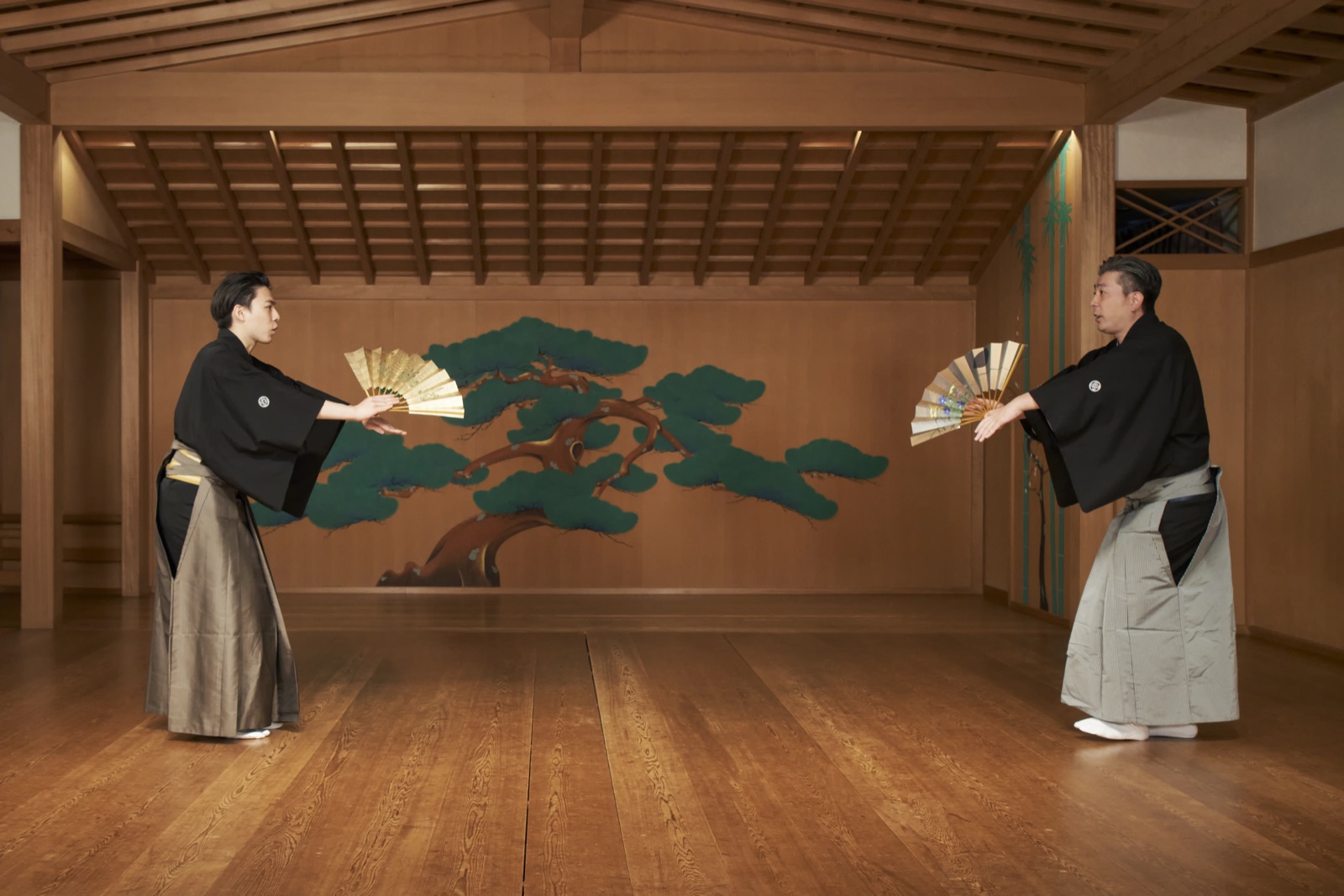
The people who keep this form are a countable number, and it is worth knowing how one of them arrived at the position.
Ohkura-ryū and Izumi-ryū, and the Five Houses Inside One School
Two schools survive, and inside the Ohkura school five houses remain. They are his own Ohkura Yaemon family, the Zenchiku family, the Yamamoto Tōjirō family, and two Shigeyama houses. "These five houses keep kyogen, each with its own origins," he said. "The pieces are the same one hundred and eighty for all of us. What is transmitted is the same; only the staging, the kata, or some of the words differ here and there."
Ohkura Motonari belongs to the Ohkura school, and to the Ohkura Yaemon family, which served the shogunal house throughout the Edo period. He first went on stage at four years and eight months old. At the time of our interview his career ran to forty-two years — which in this world still counts as mid-career; he notes that there are senior performers in their nineties above him.
The Advantage of Being Second
Ohkura is a second son, and describes that position as an advantage rather than a consolation.
He puts it first. "The one who practices first is your brother, isn't it. And your brother gets scolded. You watch that happen, so the second son can practice in a way that avoids being scolded," he said. "But because of it, the habit of watching — of watching what's around me — set in very deeply."
Then the disadvantage. "You do end up buried behind your brother, in a way. Becoming the figure in your brother's shadow — that's the second son's position in this world, I think. But at some point you find you can no longer stay in the shadow."
What resolved it was another sentence from his mother's father, adapted from a saying about swords. "There's a saying: 'Once you take up the sword, there is no master and no disciple.' He turned it into the fan for me — 'Once you take up the fan, there is no master and no disciple.'" Ohkura's gloss is the point: "On stage, there is no master and no disciple. To the audience watching, there is no elder brother and no younger brother. They watch one performer's art."
Seisho-kai, 2005: Building the People Who Would Support Him
In 2005 he set up a practice space and took on disciples. The idea came from the same grandfather — "to make the people who would support me, the companions who would build things up with me" — and so did the name. Seisho-kai takes the character 誠 from his own name and joins it with 翔, "to take flight."
The scale is worth stating plainly. There are amateur disciples as well, and, as he puts it, "four of us are able to work professionally, my son included." That is what "keeping kyogen" looks like at the level of one house.
Watching Kyogen: What to Look For When the Stage Explains Nothing
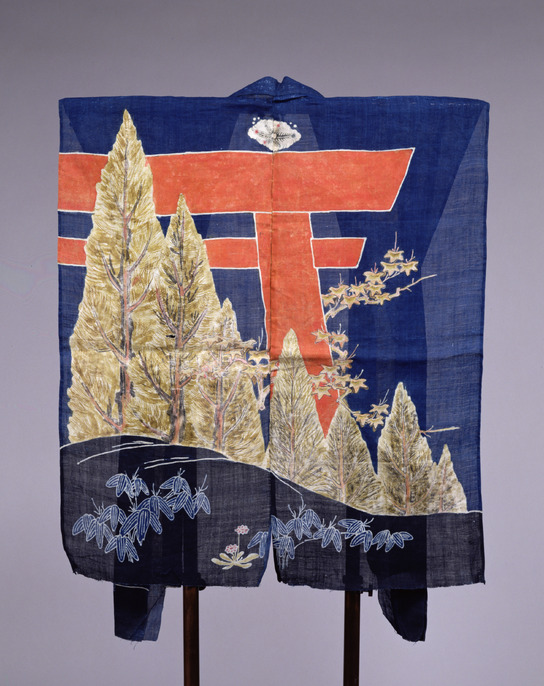
The play itself will explain nothing to you, and the language will not be modern. Some programmes are built around commentary and some are not. That is manageable if you know what the form gives you to hold on to.
Taro Kaja and the Cast of Recurring Characters
Kyogen works from a small set of recurring role types rather than from new characters each time. Tarōkaja appears, the association says, "in a great number of kyōgen plays as the servant of a master or manor lord" — a figure who "defies his master at times, being armed with ready wit and stubborn arguments," and who can equally "be taken in by a swindler, or mess up plans due to his love of sake."
The repetition is what makes judgement possible. Because the same roles come round, and because you may see the same play more than once in a lifetime of watching, the differences you notice are differences between performers rather than between stories.
The Language Is Not Modern Japanese, and It Does Not Have to Be
The texts preserve an older spoken Japanese — UNESCO describes the text as "written in ancient language" and as vividly describing "the ordinary people of the twelfth to sixteenth centuries." The association's description of the acting explains why that is workable rather than fatal: kyogen actions "are immediately understandable to the audience, as they are exaggeratedly large renditions of realistic movements and often accompanied by onomatopoeic sounds."
Practically: check what a given venue offers by way of English support before you book, because it varies by theatre and by programme, and read the play's outline in advance. Knowing what happens costs you nothing here — the interest was never in the surprise.
The Laugh You Notice in Bed
Which returns to the rule at the centre of this article. If you sit through a kyogen play and do not laugh out loud, nothing has gone wrong. Ohkura was taught not to aim at the laugh in the room, and says he holds to it.
The test is later — whether something comes back to you that evening and makes you smile on your own. Ohkura calls that the difficult thing his grandfather asked of him. It is also, conveniently, the thing a visitor is best placed to notice.
Where to See Kyogen in Japan, and What Needs Arranging
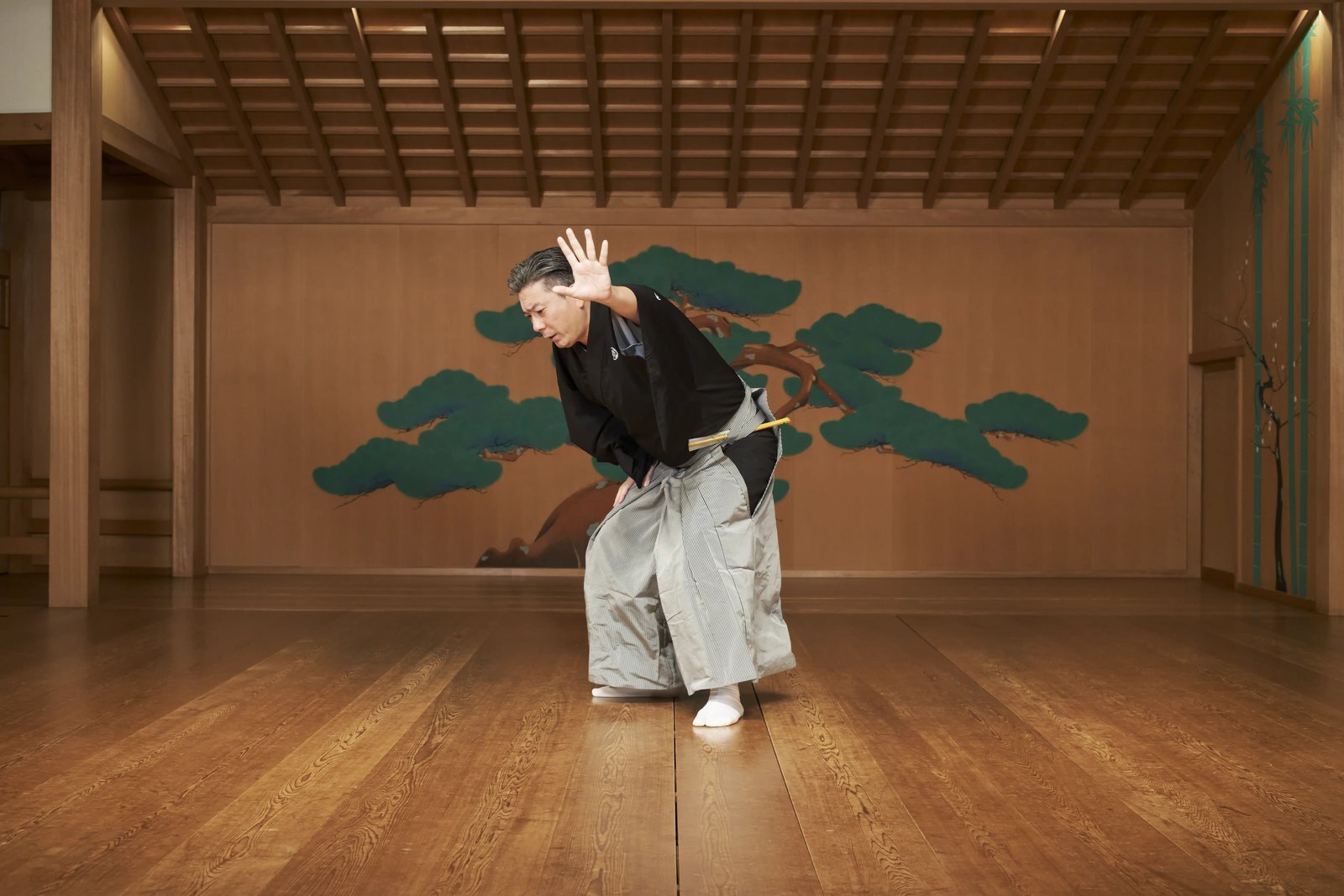
Kyogen is visible at three depths, and they differ by how much you need to know and how far in advance you have to arrange them.
Anyone Can Go: Nogaku Programmes Where Kyogen Shares the Bill
The reliable layer is a regular nogaku programme, where a hon-kyogen play is billed with a noh play — at the National Noh Theatre, every programme we checked listed the kyogen first. Tickets are sold publicly and no introduction is needed, which makes it easy to fit around the rest of a day in Tokyo. The National Noh Theatre in Tokyo programmes these through the year, and also runs Discover Noh & Kyogen, an appreciation class aimed at visitors from abroad. The Japan Arts Council's English-language site is the easiest entry point if you do not read Japanese.
If you are building a quieter route through Tokyo, this is the layer that fits an itinerary without special arrangement.
If You Know: Independent Kyogen Programmes and Regional Preservation
The second layer is a programme of kyogen alone, without noh around it — a school's own recital, a house's annual performance, a themed evening. These are announced through the performers and their organisations rather than through the large theatres, and they are where you see several plays by the same house in one sitting, which is where a house's kata becomes visible.
The same layer includes regional preservation societies. The Sagi school no longer exists as a professional lineage, but the preservation society in Yamaguchi that Ohkura mentions still keeps it alive. Schedules for this layer are irregular and mostly in Japanese.
Arranged in Advance: Standing on the Stage Yourself
The third layer is not a seat. It is the stage itself. Ohkura's company runs a session in which visitors step onto a noh stage and are taken through the basics, and there is an order to it: the experience begins with stepping onto the stage, kneeling in seiza, bowing, and making sound. From there, in his words: "First we start from the basics — how to sit in seiza, how to bow, movements like that. Then chanting utai, dancing mai. Also having them echo the words back, parrot-fashion."
What he wants people to leave with is not a skill. "What I'd like them to take home is, after all, carefulness. The carefulness in how you bow, the carefulness in how you sit. On stage, we carry things out carefully. And that's not only on stage but in the dressing room too — backstage, the way you handle a mask, the way you handle a kimono."
He described one visit in particular. "A Romanian couple once came for the experience. It was some anniversary of their marriage, and since they happened to be in Japan, they wanted to touch Japanese culture. Standing on the noh stage, they could barely manage seiza — they'd never done it. Wearing tabi, split-toe socks, was a first experience too. There they chanted utai in a big voice, echoed the words back." What they said afterwards is the part worth carrying: they felt they had touched "not the surface samurai culture, but the inner samurai culture."
The reason this layer changes what the other two look like is specific. A short session will not make anyone good at kyogen. But once you are handed, one by one, how to correct your seiza, how to hold the fan, and the reason for the direction you turn, every movement on stage starts to look like something decided, with a reason. That particular reason is worth having: "You turn in the direction that doesn't put your back to the audience — that is, to the shogun." Ohkura says a reaction he hears often is "wait, you think about it that far?" That is the layer the audience seats can hardly see at first — and it is the difference between watching a comedy and watching a form.