Walk into almost any Japanese cemetery and the impression is of great age: dark polished stone, family names cut deep, moss in the joints, incense holders worn smooth. The arrangement looks like something that has always been done this way.
Most of it is about a hundred and twenty years old. The upright family gravestone carrying a single surname — the form nearly every Japanese cemetery is now built from — is a product of the Meiji period, and the country is currently dismantling it faster than it built it. That is the more interesting story, and it is the one this guide follows.
What a Japanese Gravestone Is Actually Telling You
A standard modern grave is a vertical stone on a stepped base, inscribed with a family name — most often in the form 〇〇家之墓, "the grave of the such-and-such family." Around it sit a water basin, flower holders, an incense stand, and often a narrow rack of thin wooden tablets called sotoba, added at memorial services and left to weather.
The critical thing to understand is what the stone contains. It is not one person. Beneath the base is a chamber holding the cremated remains of a whole line of people, added to over generations. The modern Japanese family grave is a container for a household rather than a marker for one person — which is why the surname is larger than any personal name, and why the personal names, when they appear at all, are usually on a separate side slab.
And those names are usually not the ones the people used. What is carved is the kaimyō, a posthumous Buddhist name granted at the funeral — a different name, in different characters, for the person in their new status. Reading a Japanese tombstone therefore tells you less about who is inside it than a Western headstone does, and more about their standing with the temple.
That is not a figure of speech. In most Buddhist schools a kaimyō carries a rank, ascending from shinshi and shinnyo through koji and daishi to names prefixed with an ingō, a temple-name honorific. The rank is granted by the temple and comes with a donation. Guidance published by the funeral industry puts shinshi and shinnyo names in the range of ¥300,000 to ¥500,000 depending on the school, koji and daishi at ¥500,000 to ¥700,000, and names carrying an ingō above ¥1,000,000 — and states plainly that a sufficiently large donation can secure a high rank for anyone. Jōdo Shinshū, the largest school in Japan, sits outside this entirely: it grants a hōmyō rather than a kaimyō and does not rank them.
None of this is secret — the figures are published openly in Japanese — but foreign visitors almost never encounter it, and it changes what a row of grave markers is. The stones are not only a record of who died. They are also a record of what each household could give.
The Family Grave Is Younger Than It Looks
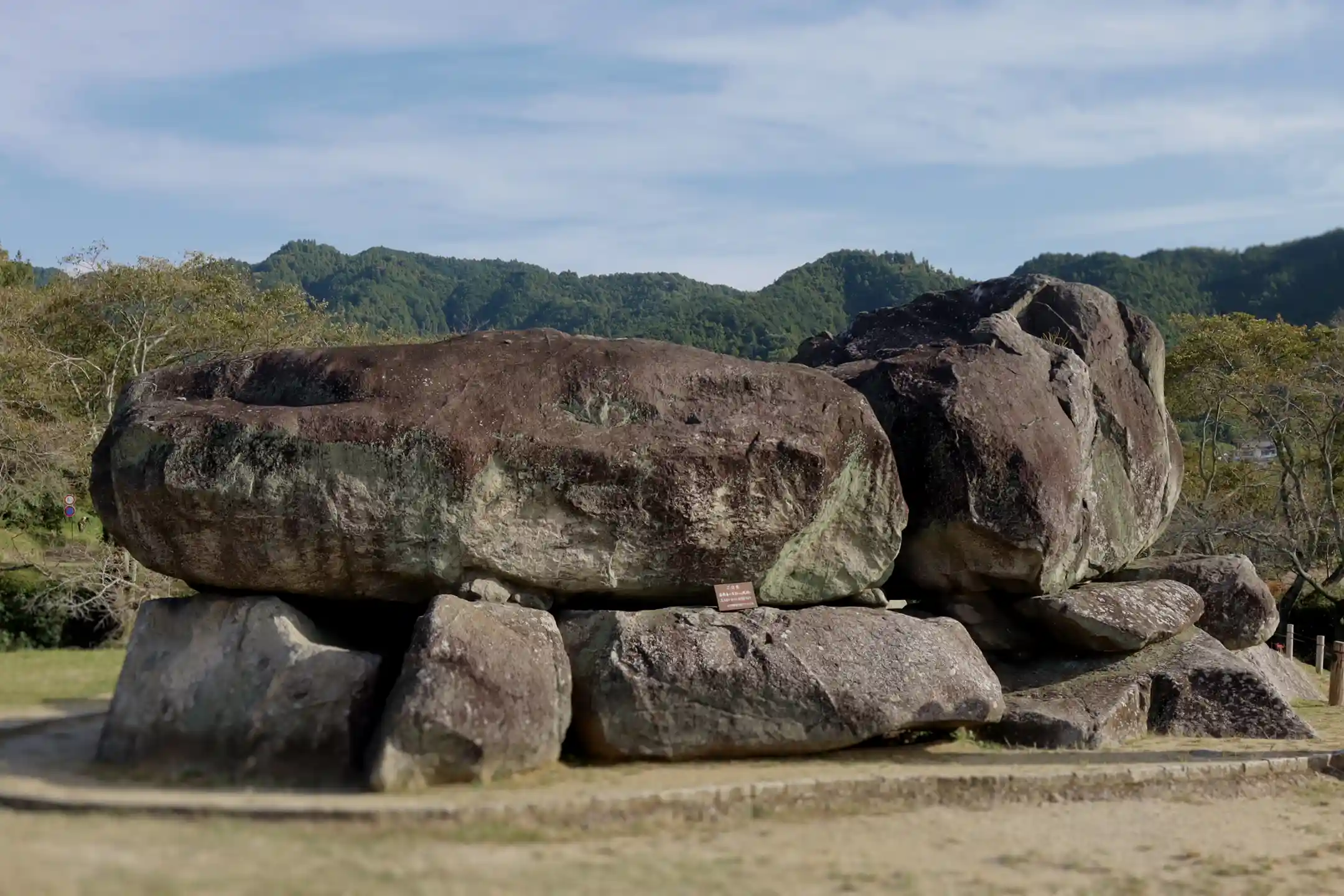
Japan marked its dead long before it used gravestones. From the Yayoi period into the kofun era, the elite were buried under engineered earth mounds, and where the mound has eroded away the structure inside is left standing — Ishibutai in Asuka, a chamber of megaliths weighing many tons, traditionally attributed to Soga no Umako, is the most exposed example. Nothing about it resembles the stones in a modern cemetery, which is the point: the vertical polished family marker is one recent form in a long sequence, not the culmination of it.
Before the Meiji period, graves in Japan were far more often made for individuals. Wealthy townspeople and large farming households began cutting "such-and-such family" and "generations of ancestors" into stone from the middle and later Edo period, but that was a prestige practice rather than the norm.
What made it universal was law and technology arriving together. The Meiji Civil Code of 1898 built the household — the ie — into the legal structure of the country, with a head of household and a single register, and property in ritual passing down that line. Cremation then did the physical work, though more slowly than the law: the national cremation rate was around 29 percent in 1900, passed half in 1940, and only reached 91 percent by 1980. As it climbed, a household's dead could fit into a single stone chamber instead of requiring separate plots, and the family grave became the practical default rather than a prestige choice.
So the cemetery that reads as timeless is the physical residue of a specific legal reform. The household system it was designed around was itself abolished after the war. The graves outlasted the law that produced them by about eighty years, which is roughly where the present difficulty begins.
Reading the Shapes — Gorintō and the Five Elements
Older monuments do not look like the modern upright at all. The most distinctive is the gorintō, the five-ring pagoda: a cube at the bottom, then a sphere, a pyramid, a hemisphere, and a jewel-like finial at the top. The five shapes stand for earth, water, fire, wind, and void — the elements of esoteric Buddhist cosmology — stacked in ascending order of subtlety.
%20at%20Chojiji%20Temple%2c%20Hyogo%20Prefecture.webp?width=750&height=500&name=Gorinto%20(Five-Ring%20Pagoda)%20at%20Chojiji%20Temple%2c%20Hyogo%20Prefecture.webp)
Once you can read the sequence, the form stops being decorative. A gorintō is a diagram of what a body is made of and what it returns to, built in the order it dissolves. Where you see them clustered — temple precincts, old pilgrimage routes, the approach at Okunoin — you are looking at the medieval layer of this practice, underneath the Meiji one.
The Japanese Grave as a Piece of Design
Japanese gravestones are unusually consistent in proportion and unusually varied in surface, and both facts come from the material. A Japanese grave stone is almost always granite, chosen for hardness and for how it takes a polish, and the differences a stonemason cares about — grain size, the density of black mica, whether the stone will hold a mirror finish for a century — are invisible to most visitors and decisive in price.
Stone, and Where It Comes From
Japan has three historic stone districts: Makabe in Ibaraki, Okazaki in Aichi, and Aji in Kagawa. Okazaki has been carving for some four hundred years — the castle lord brought stonemasons in from Kawachi and Izumi in 1590 — and supplies much of the country's stone lantern and garden work. Ibaraki quarries the pale, even-grained granites used at volume.
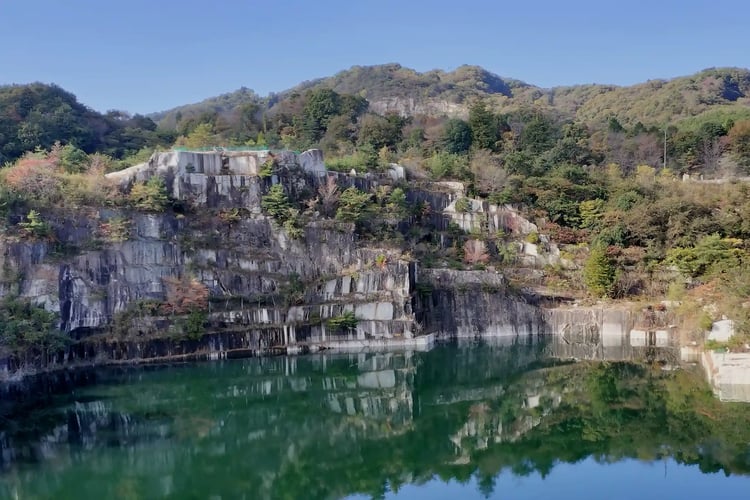
Aji stone, from the Takamatsu area, is the one that carries a nickname: the diamond of granite. Its crystals are exceptionally fine and dense, and it carries a faint mottling from black mica that no other Japanese granite reproduces. It is the most expensive domestic stone and is used where the stone itself is the point — premium graves, sculpture, lanterns.
This is the practical judgment criterion if you ever find yourself looking at prices: you are not paying for size. You are paying for the quarry, and for whether the polish will still be there in eighty years. A cheap imported granite and an Aji stone can look identical on the day of installation and completely different two decades later.
Regional Difference: Okinawan Tombs and Mainland Japanese Graves
The most dramatic break in the country is Okinawa, where the tomb is not a stone but a building. The kamekōbaka — turtleback tomb — is a substantial masonry structure with a curved roof set into a hillside, large enough to enter, and it houses an extended family rather than a nuclear one. The form arrived from southern China rather than from mainland Japan, which is a reminder that Okinawa was a kingdom with its own trading relationships long before it was a prefecture.
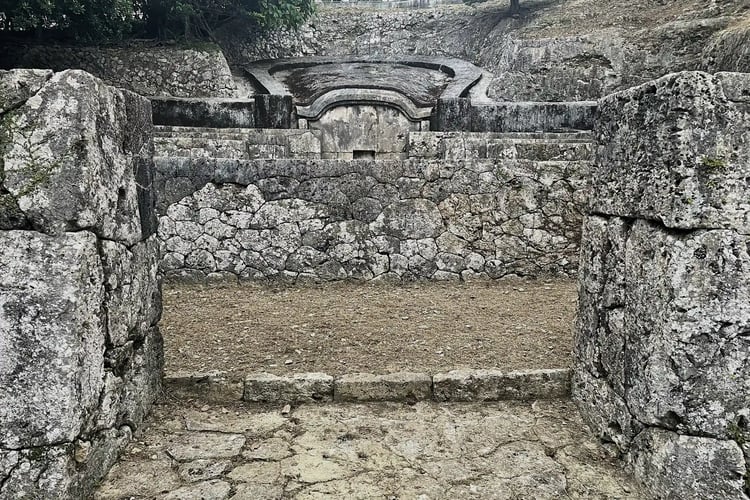
The scale follows from the practice. Historically Okinawa did not cremate; the dead were placed in the tomb, and after some years the bones were washed and moved to a jar — a rite called senkotsu — which requires a room, not a chamber. And the relationship with the tomb is different in kind: at shīmī, the spring memorial festival, families gather at the tomb and eat together in front of it. Families bring stacked lacquer boxes of food and a bottle of awamori, spread mats in the open court in front of the tomb, and spend the afternoon there with the ancestors treated as present company rather than as an audience. A picnic at a grave reads as irreverent almost anywhere else in Japan. In Okinawa it is the observance, and it is the clearest single illustration of how far the island's practice sits from the mainland's.
Kyoto, and the Zen Temple Cemeteries
At the other extreme are the sub-temple cemeteries of Kyoto's Zen complexes — Myōshin-ji among them — where the graves sit in small walled plots among moss and clipped pine, and the aesthetic restraint is doing theological work rather than decorative work.
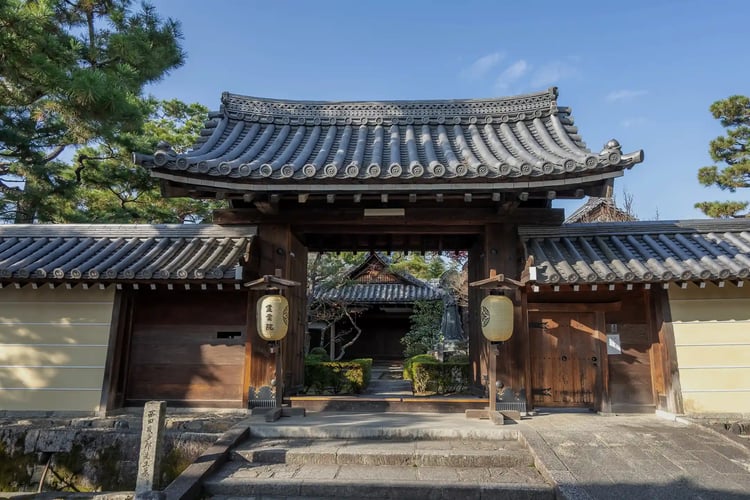
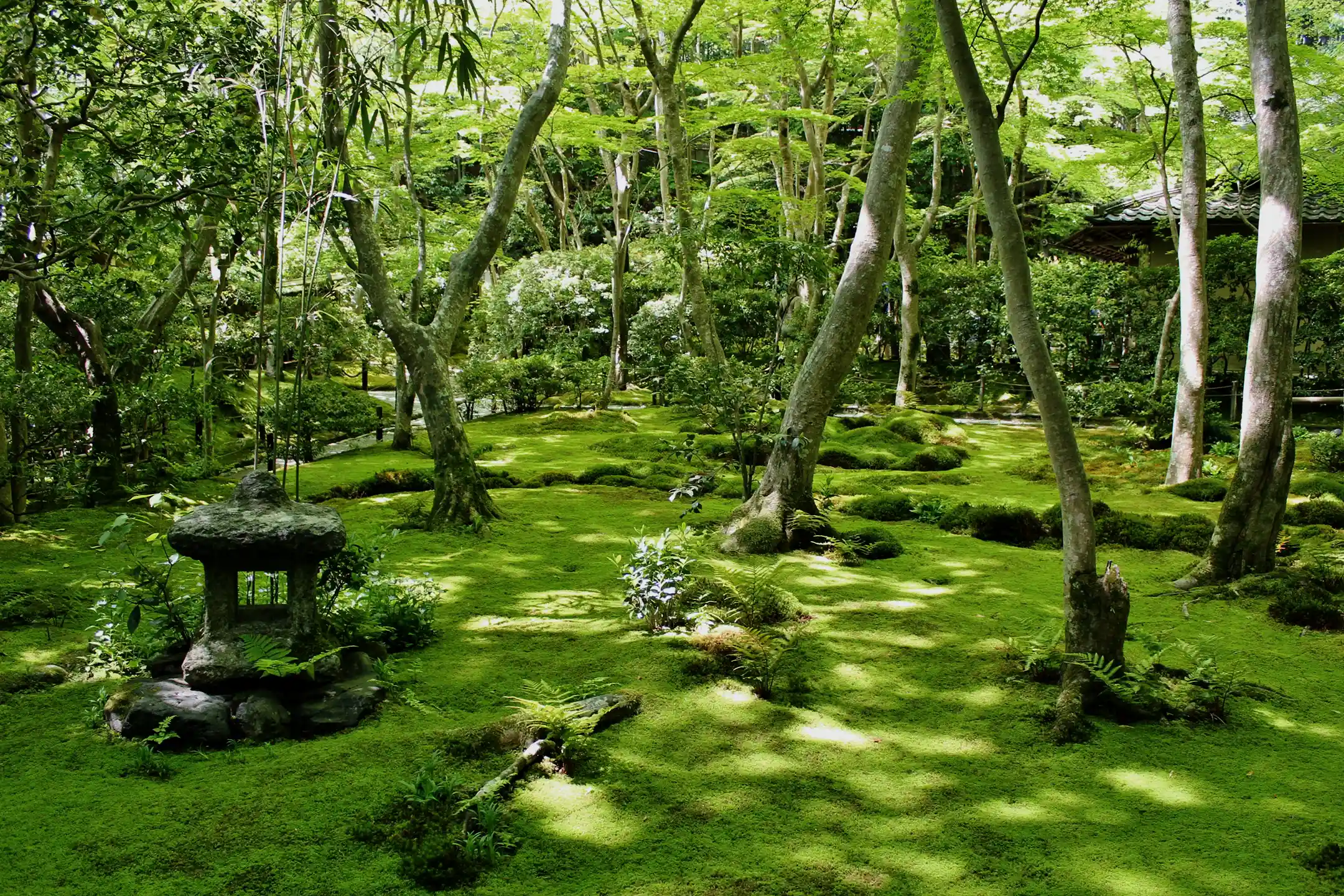
The moss matters here in a way it does not in a Western churchyard. It is not neglect and it is not usually removed. A stone that has taken moss is a stone that has been in place long enough to belong to the ground, and the surrounding garden is maintained to let that happen at a controlled rate.
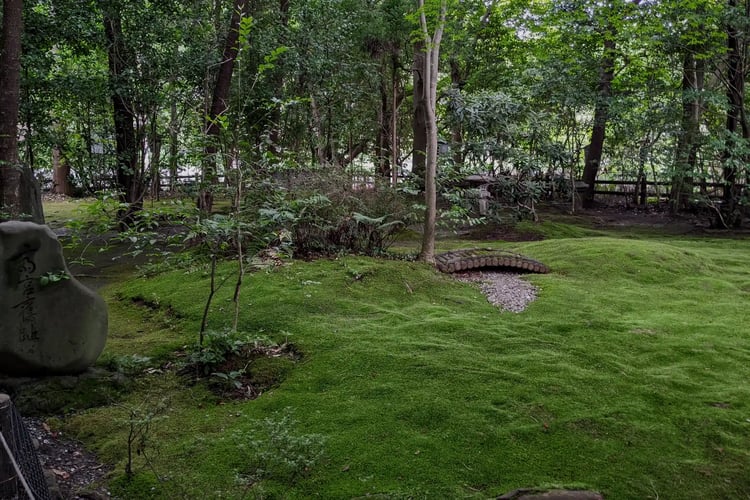
Kyoto also holds the grave that best shows what a writer can do with the form. At Hōnen-in, on the Philosopher's Path, the Tanizaki plot is two low stones rather than one upright, cut with 寂, stillness, and 空, emptiness, both characters in Jun'ichirō Tanizaki's own hand. The first is his own grave, shared with his wife Matsuko; the second belongs to Matsuko's younger sister and her husband, so the pair is still a household arrangement, just an unusually elegant one. He chose the temple in the spring of 1961 and planted the weeping cherry that stands over them. In a country where the default inscription is a surname, being commemorated by a single character is a considerable statement.
Where to See Japanese Graves as a Visitor
Cemeteries in Japan are not closed to outsiders, and several are among the most atmospheric places in the country. The obvious one is Okunoin on Mount Koya, where the approach runs for around two kilometers beneath enormous cedars, past monuments ranging from medieval gorintō to corporate memorials, toward the mausoleum of Kōbō Daishi. Walking it at dusk, with the lanterns coming on, is the single best introduction to the subject there is.
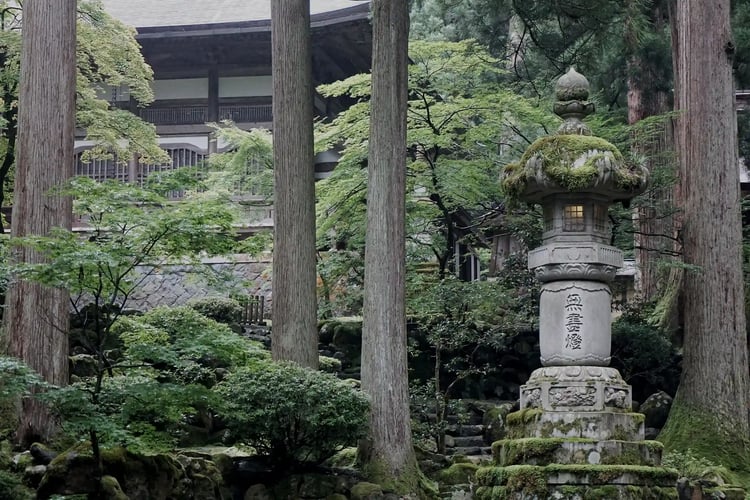
Okunoin is also the place where the premise of the whole practice is stated most plainly. Kūkai is not regarded as dead. He is held to have entered eternal meditation in the ninth century and to be continuing it inside the mausoleum, and the community acts on that: twice every day, monks prepare a meal and carry it to him. Wakayama Prefecture's own account of the ritual describes the sequence — the food is offered first to the Ajimi Jizō to be tasted, then borne in white boxes across the Gobyō Bridge by two monks with a priest leading — and notes that it has been kept up for some twelve hundred years.
Visitors who happen to be at the approach when the procession passes may see it from before the Gobyō Bridge; beyond the bridge, photography is not permitted, and the appropriate thing is to remove your hat and let it go by. It is not a performance and there is no viewing area. But it does make the working assumption behind a Japanese cemetery unusually visible: the dead are not gone, they are somewhere specific, and someone is responsible for them.
Mount Koya rewards a night rather than a day trip, and staying in temple lodgings puts you there for the early morning service as well as the evening walk — our guides to Koyasan as a whole and to what a temple stay actually involves cover the practicalities.
Etiquette at a Japanese Gravestone
First, timing. Japanese cemeteries have a calendar. The heaviest periods are Obon in mid-August, when the dead are received back at the household, and the weeks around the spring and autumn equinoxes. Plan a visit outside those windows. They are the times when families are actually at the graves, and a cemetery full of people tending their own dead is not somewhere to bring a camera or an itinerary. If you do find yourself there during one, keep to the main paths, give every occupied plot a wide berth, and do not photograph.
The rules themselves are few and worth following exactly, because a cemetery is a working place of mourning rather than a monument.
Photograph the setting rather than individual graves, and never photograph a family who is visiting. Do not step onto or over a plot to get a better angle — the low kerb marks a boundary that means something. Keep your voice down. If you are visiting a specific grave, the sequence is to clean the stone first and pour water over it, then set flowers and incense, then join your hands; the cleaning is not preparation for the visit, it is the visit. And leave nothing behind, including the food offerings that are conventionally taken away again after a short time.
Small stone figures wearing red bibs and knitted caps appear throughout Japanese cemeteries and temple grounds; these are Jizō, and the ones dressed by hand are usually memorials for children. They are covered in our guide to Jizō and the culture around these statues. They are the part of a Japanese cemetery visitors most often photograph without knowing what they are looking at.
What Is Happening to Japanese Gravestones Now
The family grave depends on there being a family to maintain it — someone in the next generation living close enough to visit, clean, and pay the temple. Depopulation in the countryside, migration to the cities, and smaller families have removed that assumption across large parts of Japan.
The result is measurable, and it is measurable for a specific reason. Under the postwar Cemetery and Burial Act, remains in Japan may only be interred in a licensed cemetery, and moving them out of one requires a permit from the municipality. That permit is called kaisō. Every closure of a family plot generates one, so the permit count is the closest thing Japan has to a national measure of the trend — with the caveat that it is an upper bound rather than a tally of closures, because a family moving its remains to a newer cemetery files exactly the same paperwork.
The health ministry's annual public health administration survey reports those permits. In fiscal 1997 there were 69,862. In fiscal 2024 there were 176,105. Roughly two and a half times as many, in under three decades, and the figure has been climbing almost every year.
The Meiji household system produced a form of grave that assumes continuity, and in a great many places the continuity has run out faster than the granite has worn. The quiet end of that is the unclaimed grave — a stone with no surviving family to move it, eventually cleared by the cemetery itself.
Haka-jimai, Tree Burial and Scattering
Closing a grave is called haka-jimai, and it is now a normal family decision rather than a failure. The remains are removed, the stone is dismantled, the plot is returned to the temple or cemetery, and the ashes go somewhere that does not require a successor.
What they go into is where the change is visible. Tree burial places ashes under or beside a planted tree in a managed woodland. Ossuaries — often indoor, sometimes automated, with a card that brings the family's urn to a viewing bay — have multiplied in cities where land is impossible. Scattering at sea has moved from marginal to unremarkable — and it works precisely because it falls outside the Cemetery and Burial Act rather than inside it: scattering ashes is not interment, so the licensed-cemetery requirement never applies. All of these share one design principle: perpetual care by an institution instead of perpetual care by descendants.
Whether that is a loss depends on what you think the stone was for. If it was for the ancestors, the new forms serve them adequately. If it was for binding a family across generations into one physical place, then what is being dismantled is exactly the thing it was built to do. Japan is having that argument now, at kitchen tables rather than in public, and the cemeteries are where the outcome shows up first.
For how these observances fit into the wider ritual year, our guide to Japanese customs and religious rituals sets out the calendar they belong to.
.webp)