On a special evening, you may think the topping is the star of the table. But just as often, it is the nori that shapes the experience: the aroma in the first bite, the crisp snap at your fingertips, and the savory depth that lingers after the rice and filling. When the nori is right, even homemade sushi feels polished and memorable.
That is especially true when you want to recreate at home the aroma and texture you remember from a great sushi counter. If you are shopping for seaweed sheets for sushi, this guide brings the essentials together in one place: basic terms, sheet sizes, quality cues, origin and brand tendencies, how to match nori to different sushi styles, storage and handling, and where to buy it or choose it as a gift.
What Are Seaweed Sheets for Sushi? Basic Nori Terms to Know First
Nori for sushi usually means roasted nori. It may look like simple dried seaweed, but it is made through a process in which the raw material is washed, chopped, formed into sheets, and dried in a way often compared with papermaking (*1)(*2).
The terms you will see from here on—such as “dried nori,” “heat treatment,” and “roasting”—are best understood not as labels for stronger or weaker flavor, but as clues to the aroma, texture, and finish you can expect.
Nori Is Not Just “Seaweed as It Is” but an Ingredient Completed Through Processing
The raw material for nori does not become a flat sheet right after harvest. It is washed, finely cut, mixed with water, spread thinly onto a screen, and dried into what is called dried nori (*1).
This process is often described as being inspired by traditional papermaking, and the more evenly and thinly the sheet is finished, the better its appearance and melt-in-the-mouth texture tend to be (*1).
The Difference Between Roasted Nori, Raw Nori, and Seasoned Nori—and Which One Works for Sushi
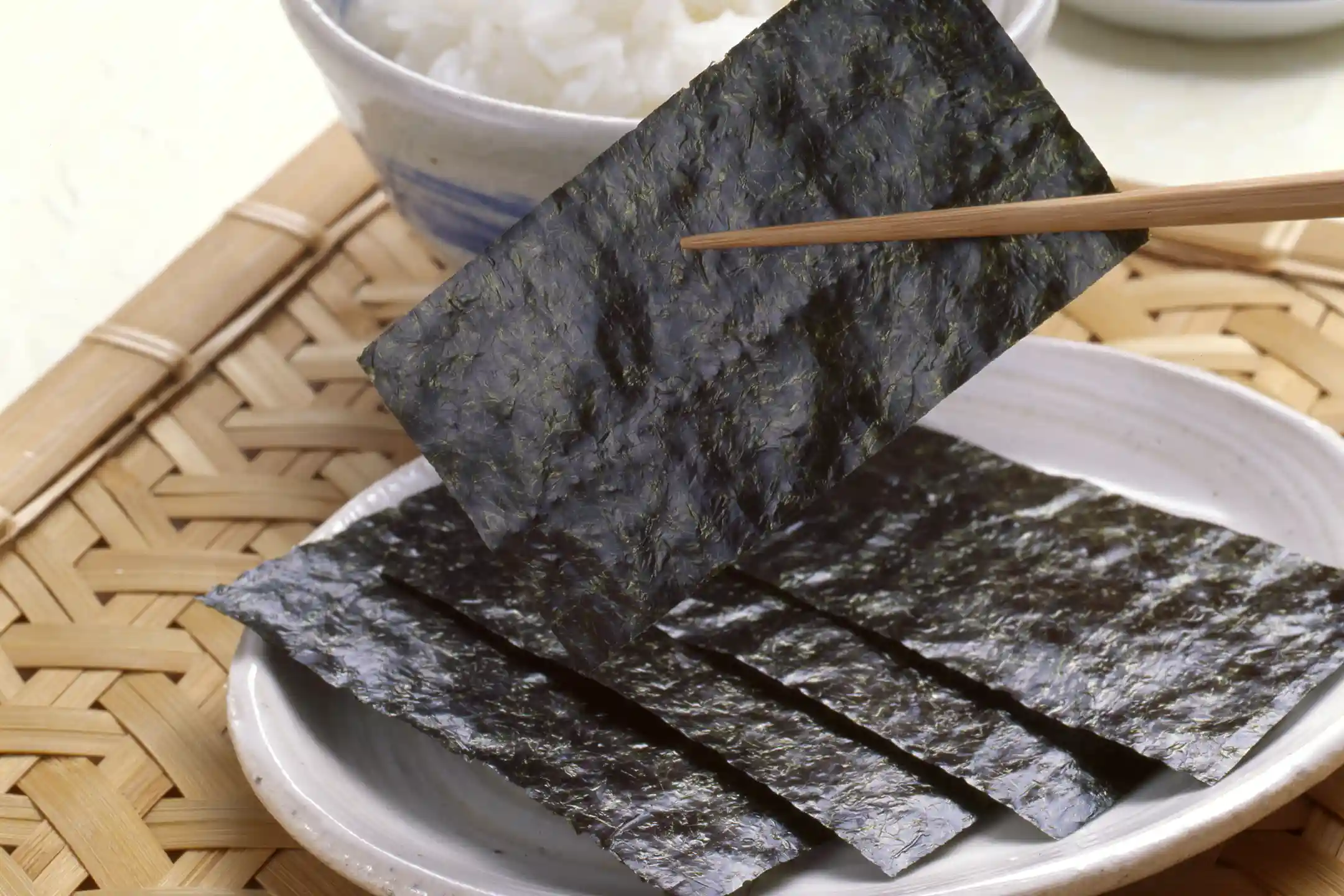
The type best suited to sushi is roasted nori, valued for its toasty aroma, clean bite, and crisp texture. In general, dried nori is roasted to bring out its texture, umami, aroma, and color (*2). By contrast, seasoned nori is roasted nori coated with a sweet-savory seasoning, so its flavor can easily become too dominant when paired with vinegared rice and sushi fillings (*3).
.webp?width=750&height=500&name=Fresh%20Raw%20Nori%20Seaweed%20(Nama-Nori).webp)
Meanwhile, raw nori refers to nori in a much less processed state. It is often used in foods such as tsukudani, where its soft texture is an advantage, but it is generally not suitable for rolling sushi (*3).
Aonori Is Something Else—A Common Point of Confusion for Beginners
One of the easiest mistakes for beginners is confusing sushi nori with aonori. Aonori belongs to a different category from the black sheet nori used for sushi and is typically sold as flakes or powder rather than as sheet nori (*4).
Fisheries materials also treat aonori separately as its own product category (*5). If your goal is sushi, narrowing both your search terms and the product label to “roasted nori,” “sheet nori,” or “sushi nori” helps you avoid mix-ups.
Types and Sizes of Nori for Sushi—How to Read Labels Like Sheet Nori, Half-Cut, and Hand-Roll Use
Much of the confusion in the nori aisle comes not from flavor, but from size and labeling. Once you understand the basic sheet sizes first, choosing seaweed sheets for sushi becomes much easier (*1).
The Difference Between Full Sheets, Half-Cuts, and Third-Cuts—and How to Use Each
A standard full sheet of nori is roughly 19 cm by 21 cm, and a stack of 10 sheets is called one jō. In distribution, 10 jō may also be called one bundle. If an online listing says “○ jō,” the simplest way to read it is to remember that 1 jō equals 10 full sheets (*1)..webp?width=750&height=500&name=The%20Appearance%20of%20High-Quality%20Nori%20Seaweed%20(Blackness%2c%20Gloss%2c%20and%20Uniformity).webp)
A half-cut sheet is simply a full sheet cut in half, making it an easy format for hand-rolled sushi. Third-cut sheets are practical for slim rolls or small onigiri, whenever you want to wrap a modest amount neatly. Industry materials on nori distribution also describe the basic unit as 10 full sheets equaling 1 jō (*2).
What Is the Difference Between Labels Like “Sushi Nori,” “For Hand Rolls,” and “For Maki Rolls”?
Labels such as “sushi nori,” “for hand rolls,” and “for maki rolls” are useful as rough guidance, but the wording itself does not guarantee quality. What actually affects how easy the nori is to roll are physical traits such as thickness, color, aroma, gloss, and the absence of chips or breakage (*3). When in doubt, check first whether the product is a full sheet or a half sheet and whether the storage method is clearly stated. Then make your final decision based on aroma and surface quality.
A Rough Guide to Quantity and Cutting—How Not to Run Short at Home
At home, the problem is often not that you bought too little nori, but that too much of it gets torn, softened, or wasted during serving. If you cut full sheets into halves in advance, keep them sealed with a desiccant, and bring out only what you need, you are much less likely to waste them.
As a rough guide, if hand rolls are the focus, plan for 6 to 8 half-sheets per person. If maki rolls are the center of the meal, work backward from 1 full sheet for one thick roll and 1/2 sheet for one slim roll. That makes it easier to avoid both shortages and excess. It is usually better to estimate a little generously and use leftovers for quick re-toasting or as garnish than to run out mid-meal.
.webp?width=750&height=500&name=Making%20Maki%20Sushi%20(Rolled%20Sushi).webp)
Quality and Grade in Nori for Sushi—What to Check in Appearance and Texture
With nori, the difference between a good choice and a disappointing one often shows up faster than it does with the topping itself. That is why it helps to turn “quality” into practical things you can actually check in a store.
.webp?width=750&height=500&name=Toasted%20Nori%20Seaweed%20(Yaki-Nori).webp)
What Color, Gloss, Holes, and Chips Tell You About Quality
Start with color. Reports suggest that sheets with deeper tones closer to black tend to rank higher in grade (*1). That said, “darker is always better” is too simple. It is better to judge color together with surface gloss, the number of tiny holes or broken edges, and whether the sheet looks evenly formed when held to the light. A basic translucency check is also used in quality control to confirm whether thickness is even across the sheet (*2).
Where the Difference in Aroma and Crisp Snap Comes From
A crisp snap is largely a moisture story. Heat treatment and roasting reduce moisture, which is one reason properly finished nori breaks more cleanly and releases a stronger aroma (*3).
Roasted nori is also generally described as dried nori that has been roasted to bring out texture, umami, aroma, and color (*4). In other words, attractive nori is not created by the raw material alone. It is the result of processing decisions layered on top of the raw material, and that way of thinking gives you a steadier eye when you buy.
How to Read the Label—Check the Origin, Processor, Best-Before Date, and Storage Instructions
Before you buy, the label items worth checking are the product name, ingredients, net quantity, best-before date, storage instructions, and manufacturer or processor. Administrative labeling examples organize the information in much the same way and commonly include storage guidance such as avoiding direct sunlight, heat, and humidity (*5).
In Japan, origin labeling for processed foods generally follows the ingredient with the largest weight share, although some categories have product-specific rules (*6). Nori also has specific examples in official guidance, including separate treatment when it is used for onigiri (*5)(*6).
Because origin claims matter, methods such as DNA analysis and isotope-based approaches have also been studied to improve the reliability of origin identification (*7). In that sense, the label is not just a legal formality. It is part of the product’s transparency.
How to Think About Origin and Brand—Choose by Tendency, Not by Better or Worse
The idea that “this place must be the right answer” often leads to disappointment. Because nori is influenced by both natural conditions and processing conditions, you will usually get better results if you think of origin less in terms of superiority and more in terms of tendency (*1).
What Changes Most by Place of Origin Is the Direction of Aroma, Thickness, and Melt-in-the-Mouth Texture
.webp?width=750&height=500&name=Sheets%20of%20Seasoned%20Seaweed%20(Ajitsuke%20Nori).webp)
At the distribution stage, nori is graded by factors such as thickness, color, aroma, gloss, and texture, and the place where it was grown is also treated as a point of evaluation (*1). In practical terms, it helps to think along three axes: aroma, thickness, and melt-in-the-mouth texture. That is often enough to help you discover the profile you personally prefer.
For example, if aroma matters most to you, that may naturally guide you toward hand-roll use. Thickness helps when you need the nori to hold the wall of a gunkan-maki. Melt-in-the-mouth texture matters more when you want the nori to blend smoothly into a slim roll. At the same time, reports note that the final quality of dried nori depends not only on the raw algae itself but also on drying conditions (*2), which means quality can vary even within the same production area.
Fisheries Agency materials also point to issues such as rising seawater temperatures, predation by birds and fish, and declining nutrient levels in farming areas (*3). That is one reason it is more realistic to choose with flexible expectations: one area may lean a little thicker, another may often show more lift in aroma, and the best fit still depends on how you want to use it.
Why Nori Is So Important in High-End Sushi
Nori matters so much in high-end sushi because it often sits on the outside of the bite. In rolled sushi, it is the first aroma you notice and the first texture you break through. Since roasted nori is generally produced to sharpen texture, umami, aroma, and color (*4), and roasting conditions can change the final quality (*5), it makes perfect sense that serious sushi shops pay close attention to the nori they use.
By Sushi Style—Recommended Directions for Choosing Nori for Sushi
Even within the single category of roasted nori, there is no single correct answer. If you decide in advance what you want the nori to do for the style of sushi you are making—whether that is crispness, bite, or structural strength—shopping becomes much less confusing (*1).
For Hand-Rolled Sushi, Prioritize Crisp Snap in Your Nori for Sushi
Hand-rolled sushi is built around immediacy. You roll it and eat it right away, so the stars are the aroma and the crisp sound of the nori. Because heat treatment and roasting are what sharpen that experience (*2), the quality of the roast matters a great deal. Open the package at the table, and keep the time the sheets spend in the air as short as possible. Nori with visible gloss also looks more elegant in the hand and photographs beautifully.
For Rolled Sushi (Slim Rolls and Thick Rolls), Prioritize Bite and Balance
The more fillings a maki roll contains, the harder it becomes to bite cleanly if the nori is either too dominant or too weak. Since grading takes thickness, texture, and mouthfeel into account (*1), choosing a middle-ground style is often the safest starting point. For slim rolls, lean slightly thinner. For thick rolls, choose something a bit sturdier. If you care about a clean cross-section, prioritize sheets with few holes or chips and with even thickness, because the cut surface is less likely to collapse (*3).
For Gunkan-Maki, the Keys Are Strength to Hold Shape and an Aroma That Rises Quickly
Gunkan-maki is a style in which the nori acts as a wall. To hold that shape well, you want sheets with few chips and a certain resilient body. Thickness and uniformity matter here, which fits the usual grading emphasis on thickness and texture (*1).
.webp?width=2048&height=1365&name=Gunkan%20Maki%20(Battleship%20Roll%20Sushi).webp)
At the same time, gunkan-maki is not only about preventing the topping from spilling out. It is also about the way the nori’s aroma wraps around the topping. Since dried nori is roasted to bring out aroma (*4), the quality of the roast matters here too.
When in doubt, remember three points: for hand rolls, prioritize aroma and crispness; for maki rolls, prioritize bite and uniformity; for gunkan-maki, prioritize structural body and minimal chipping. In the end, the best nori is the one that matches how you want the bite to feel.
How to Handle Nori for Sushi—Its Crispness Depends on Time and Humidity
Even excellent nori can be ruined by handling. Nori absorbs moisture easily, and manufacturing guidance warns that inadequate sealing can lead to defects caused by moisture uptake (*1). Some local guidance also notes that, after opening, home storage in the refrigerator or freezer can work well when the nori is kept well sealed with enough desiccant (*2).
How to Store It After Opening—Prevent Deterioration with Airtight Sealing, a Desiccant, and Smart Placement
After opening, the basic rule is simple: airtight sealing plus a desiccant. You want to protect the nori not only from humidity, but also from odor transfer, so move it into a zip bag or airtight container and keep the desiccant packet instead of throwing it away. Hygiene guidance for manufacturing also notes that poor sealing and moisture absorption can lead to product defects (*1).
In hot and humid seasons, some people prefer refrigeration or freezing, but condensation is the biggest risk. The safest rule is to take out only what you plan to use. That is especially helpful when you bought nori while traveling, because temperature changes during transport make moisture problems more likely.
How to Bring Softened Nori Back—A Safe Way to Re-Crisp It Without Ruining It
If nori has softened from moisture, lightly driving off that moisture can restore much of its texture. One practical home method is to preheat a toaster oven at a low setting, place the nori on foil, and toast it briefly on both sides (*3).
The key is short time and careful checking. Scorching will flatten the aroma and change the color almost instantly. In terms of safety and repeatability, a toaster oven or frying pan is easier to control than direct flame. After re-toasting, either eat it while it is still crisp or let it cool completely and seal it again right away.
The Timing of Contact with Vinegared Rice Changes the Taste—Optimize the Order in Which You Make It
Nori softens not only from moisture in the air, but also from moisture in sushi rice. If you translate the basic moisture problem into home cooking, three habits help immediately: do not let rolled sushi sit too long after assembly, bring the nori out last, and make sure the rice is no longer too hot or overly wet.
What matters most is remembering that nori’s best moment does not begin when you open the package, but when it meets humidity. Put only the portion you plan to eat on the table, and keep the rest sealed. That small extra step protects the texture all the way to the last bite.
Where to Buy Seaweed Sheets for Sushi—Comparing Specialty Shops, Department Stores, Airports, Supermarkets, and Online Stores
Where you buy nori is really an extension of how you want to enjoy it. Specialty shops offer conversation and guidance, supermarkets offer convenience, airports fit travel, and online stores offer range. Each has its own strengths, so it makes sense to choose the channel based on your purpose (*1).
Benefits and Cautions by Place of Purchase—Freshness, Storage, Selection, and Gift Support
Specialty shops are especially useful when you want to explain how you plan to eat the nori and get a recommendation that fits (*1). In supermarkets, airports, and online stores, what matters more is your own ability to check the seal, whether a desiccant is included, and whether the storage instructions are clearly shown.
Although nori is generally sold in moisture-resistant packaging (*2), the environment after purchase differs from one household or trip to another. That is why clear storage instructions on the label are so helpful at the moment you buy (*3).
How It Changes by Price Range—Higher-Priced Nori Is Not Always the Right Answer
It is true that as price rises, you are more likely to notice refinement in color, surface quality, and texture. Reports also suggest that darker color tends to correspond to higher grade and that price differences exist across grades (*4).
That said, your ideal may be thin and delicate, or it may be aromatic with more body. Preference and price do not always align. Since roasting conditions also affect the final quality (*5), even products in the same price range can feel quite different. The most reliable way to start is often to compare several solid mid-range options and identify the direction you actually enjoy.
How Not to Miss with Souvenirs and Gifts—Aroma, Gloss, Packaging, and Story
With gifts, value is not only about taste. It is also about story, appearance, and ease of appreciation. Fisheries Agency materials report that nori exports in 2024 were about 4.1 billion yen, up roughly 253% over the previous five years (*6).
In other words, nori travels well as a distinctly Japanese food gift with a clear cultural context. When choosing one, prioritize aroma, surface gloss, packaging that protects the sheets from breakage, and labeling that allows the recipient to understand the origin and processor. That makes it much more likely to be welcomed as something genuinely enjoyable with sushi (*3).