After a day spent wandering through museums and galleries, there is something deeply satisfying about quietly enjoying high-quality takeout sushi back at your hotel. It can be one of the best meals of a trip. But even when the toppings are cooked—grilled, simmered, steamed, tamago, and so on—sushi is still a delicate food, and both safety and flavor can deteriorate faster than many travelers expect.
If you are wondering, “how long is cooked sushi good for?” the practical answer depends on time, temperature, and handling. In this article, while treating the shop’s label as the top priority, we break public food safety guidance and food science into simple, practical terms so you can judge how long cooked sushi can last and how to store it at room temperature, in the refrigerator, or in the freezer with more confidence.
The Bottom Line: How Long Is Cooked Sushi Good For?
To give you the short answer first: even with cooked sushi, room temperature means no more than 2 hours (or 1 hour in hot conditions). If you refrigerate it promptly and keep it cold, general guidance for cooked leftovers is often up to 3 to 4 days, but sushi is usually best eaten the same day and is most worth finishing by the next day because quality falls quickly. Freezing is not so much a way to “kill bacteria” as a way to stop them from multiplying. If food stays continuously frozen at 0°F (-18°C) or below, it can remain safe much longer from a food-safety standpoint. Recommended freezer periods are mainly about quality, and the guideline varies by food (for example, leftovers are often given a range of 2 to 6 months).
Because sushi rice, nori, and sauces lose quality easily, the least misleading way to think about cooked sushi is this: the sooner you eat it, the better. For takeout sushi, the safest and most satisfying target is still as soon as possible—ideally the same day, and if refrigerated, usually by the next day unless the shop’s label gives a shorter limit (*1) (*2). That said, your top priority should always be the information provided by the shop: the use-by date, whether it must be refrigerated, the storage temperature, and any instructions from staff (*3). If you are unsure, choose the safer option.
How Long Can Cooked Sushi Sit at Room Temperature?
According to public food safety guidance, perishable foods that require refrigeration should be left at room temperature for no more than 2 hours, or 1 hour in hot conditions. The key is to avoid leaving food for long in the temperature range where bacteria grow easily. Even if everything seems like “room temperature,” the level of risk rises near a sunny window, in a heated room, or inside a car parked in the sun (*4).
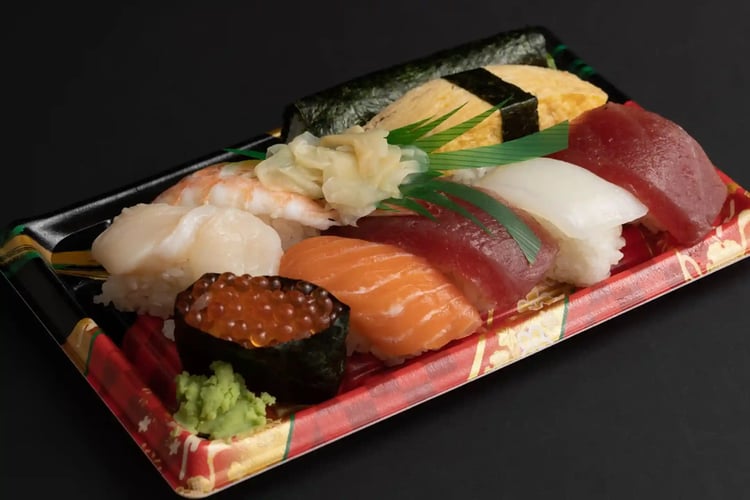
Takeout is also considered riskier than eating in the restaurant simply because the time from preparation to eating tends to be longer, so the safest advice is to eat it promptly after purchase or refrigerate it right away without making extra stops (*3).
A smart travel strategy is to make “purchase → transit → check-in → handwashing → opening the box → eating” happen within 2 hours (*1). If that seems unrealistic, it is wiser to buy less or switch to something you can eat on the spot (*3).
Refrigerating Cooked Sushi: Best Practices and Pitfalls
Refrigeration slows bacterial growth, and standard household food safety advice treats getting perishables into the fridge quickly as a basic rule (*5). At the same time, sushi is one of those foods in which quality often becomes the limiting factor before generic leftover timelines do. Food science research shows that rice starch retrogrades as it cools, which makes the texture firmer and less pleasant (*6). In other words, refrigeration helps with safety, but the softly airy texture of sushi rice is easily lost in a short time. If you do refrigerate it, pair that with two things: protect it from drying out by sealing it in a lidded container, and eat it as soon as you reasonably can (*1) (*7).
Freezing Cooked Sushi: What Works Well—and What Does Not
Freezing is less a way to “kill bacteria” than a way to put them into a state where they are far less able to multiply. Public guidance also explains that freezing food at -18°C or below helps keep it safe over the long term, while recommended storage periods are mainly about preserving quality (*2) (*8).
That said, sushi is not especially freezer-friendly. The combination of rice, nori, and sauce tends to suffer in the freezer. Sushi rice is prone to moisture migration during thawing, which can lead to stickiness or dryness, likely because of ice crystals and starch retrogradation (*7). Dried nori is also affected by moisture conditions (aw), and the more humidity it absorbs, the more its quality can shift (*9). The result is often “safe, but no longer delicious.”
If you do freeze sushi, your odds improve when three conditions are met: 1) the nori is packed separately or there is no nori at all, 2) the sauce is minimal, and 3) the topping has been thoroughly cooked all the way to the center. On the other hand, types topped with aburi, mayo, or chopped condiments are generally better treated as poor candidates for freezing.
%20and%20Plain%20Steamed%20Rice%20(Ginshari).webp?width=750&height=500&name=Vinegared%20Rice%20(Shari)%20and%20Plain%20Steamed%20Rice%20(Ginshari).webp)
What Counts as Cooked Sushi? How It Differs from Raw Sushi and Aburi Sushi
The biggest reason people get storage times wrong is the assumption that “cooked means safer than raw, so it should last much longer” (*1). Thorough cooking does reduce the risk from many pathogens, but sushi still goes through post-cooking steps such as shaping, cutting, saucing, and plating, and those stages leave room for recontamination (*2). On top of that, sushi rice itself deteriorates quickly in the refrigerator, so even if the topping is cooked, the “window of deliciousness” is still short (*3).
This distinction matters not only for safety, but also for how you plan storage time. Toppings that have been heated through to the center are generally lower-risk, while something like aburi—where only the surface is seared—may still be raw inside. For storage decisions, it is safer to treat aburi more like raw sushi and be equally strict about avoiding room-temperature holding and saving it for later (*4) (*6).
Common Examples of Cooked Sushi
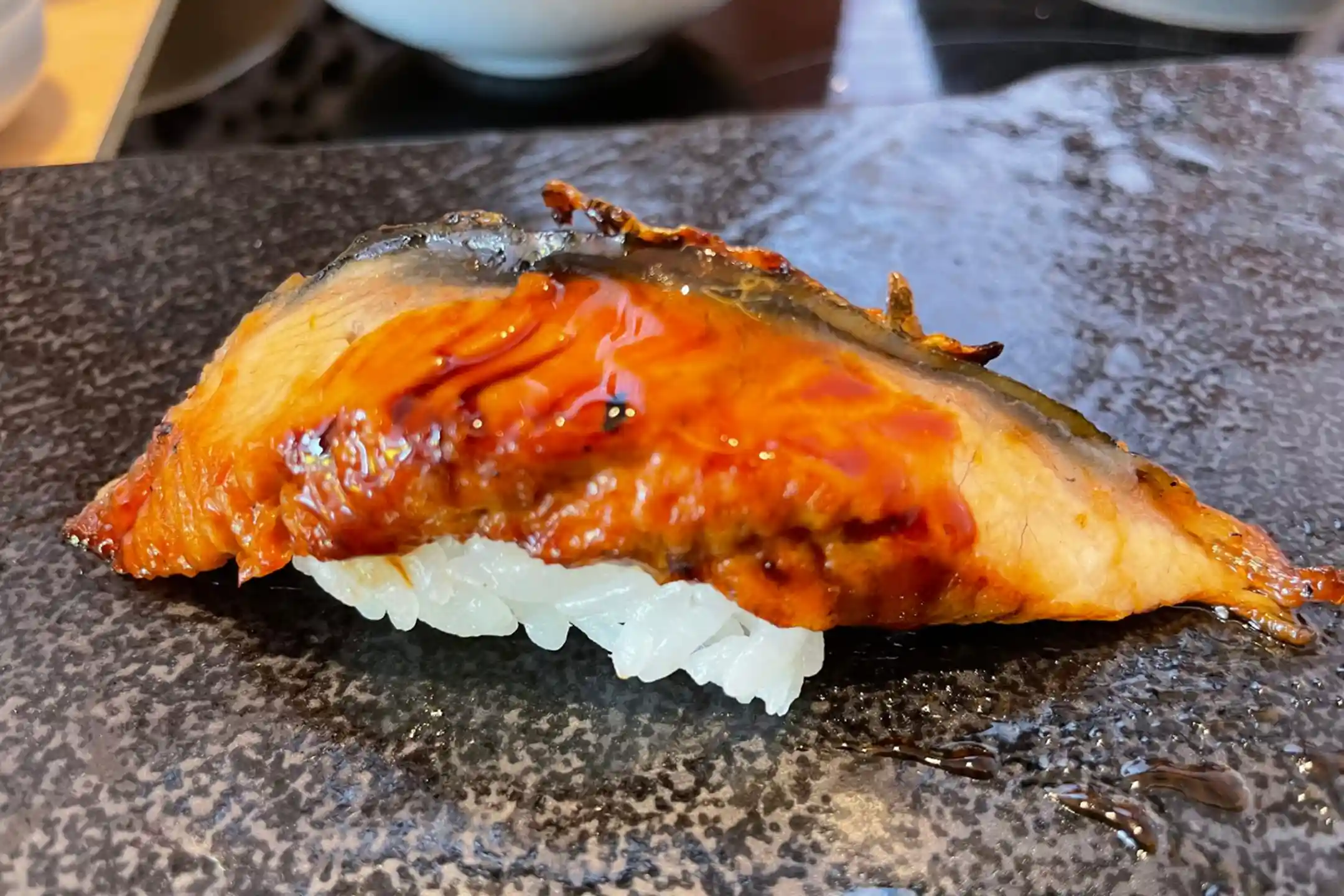
Cooked sushi generally refers to sushi in which the topping has been heated through to the center and cooking is the main preparation method. Easy examples for travelers to recognize include eel (kabayaki), conger eel (nimono-style anago), shrimp that has been boiled or steamed, and tamagoyaki-style egg omelet. For English-speaking readers who may be less familiar with anago, it is a long, slender fish similar to eel, and in Edomae sushi it is often finished with a sweet-savory simmered glaze (*5).
Aburi Sushi Is Not Always Fully Cooked
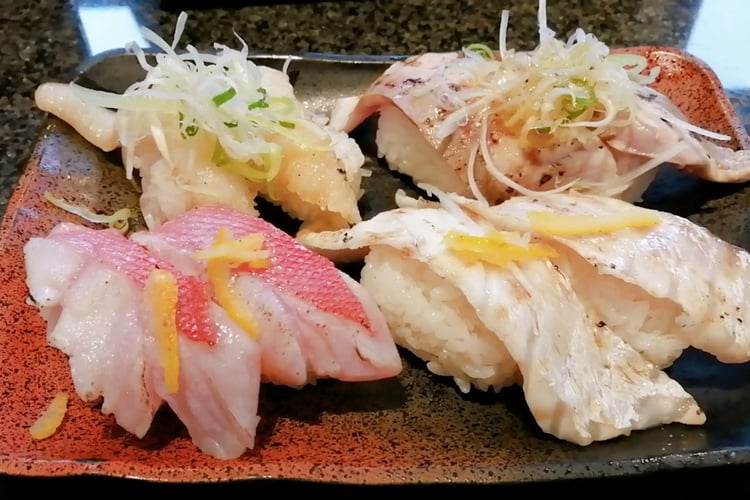
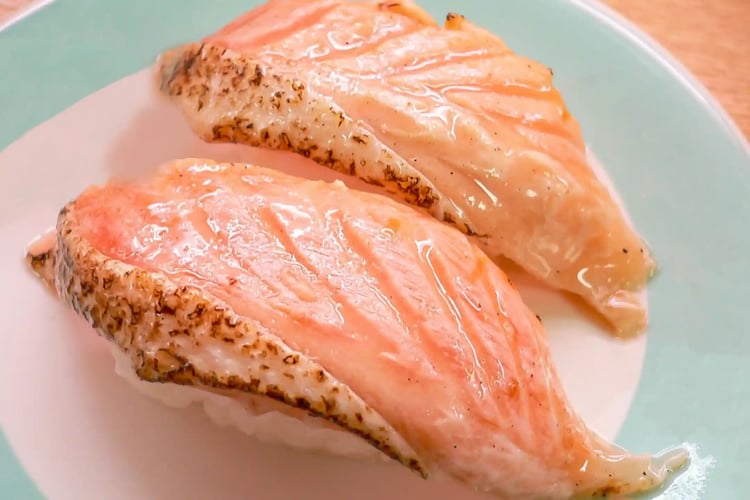
Aburi sushi uses surface searing to draw out aroma and the sweetness of the fat, but the center does not always reach a sufficient temperature. Public temperature guidelines generally set 145°F (63°C) as the benchmark internal temperature for fish, and only once the heat reaches the center can it truly be considered “cooked.” So if the sushi has been seared only on the surface, it is safest to treat it like raw sushi for storage purposes and avoid both room-temperature holding and saving it for later (*4) (*6).
Why Cooked Sushi Still Does Not Keep Well
First, even though sushi rice contains vinegar, that does not make modern takeout sushi a shelf-stable food. Food hygiene materials explain that acidified rice can help control risk when pH is properly managed, but it is important not to overestimate that protection because recontamination can still occur and spore-forming bacteria such as Bacillus cereus remain relevant concerns (*7) (*8).
Second, the basic principles of food poisoning prevention are “do not contaminate,” “do not allow growth,” and “destroy through heating.” Even with cooked sushi, once the “do not allow growth” part breaks down through poor temperature or time control, the risk returns. In other words, cooked sushi may give you a little more peace of mind, but it does not mean “you can leave it out for a long time” (*2) (*6).
What Determines How Long Cooked Sushi Keeps
Even if you memorize “2 hours at room temperature” or “X days refrigerated,” your travel route is never exactly the same twice. That is why it helps to have a set of principles you can use to make your own call when the conditions change (*1). Public-agency guidance consistently emphasizes temperature, time, and hygiene during handling. Once you understand that sushi is a food in which all three matter sharply, you are far less likely to make a bad call (*2).
Temperature and Time Matter Most
The real framework of risk is how long the food has remained in the temperature range where bacteria multiply easily—the so-called Danger Zone (*3). Because takeout tends to lengthen the time between preparation and eating, official guidance warns that extra care is needed, especially in summer. It is perfectly natural to want to make one more sightseeing stop, but sushi is one of those foods for which it is worth planning a day when you head straight back to your hotel first (*1).
.webp?width=750&height=500&name=Pressed%20Sushi%20(Oshizushi).webp)
Post-Cooking Handling Can Be the Risk Point
The principles of food poisoning prevention are simple: do not contaminate, do not allow growth, and destroy through heating. Even with cooked sushi, contamination can happen after cooking through steps like shaping, cutting, and plating, whether from hands or utensils. International hygiene education materials also place strong emphasis on keeping things clean and separating raw foods from cooked ones. In other words, even if the storage time is short, careless handling still raises the risk (*2) (*4).
Sauce, Mayo, and Condiments Speed Up Quality Loss
The issue is not just safety, but also how quickly appearance and aroma begin to slip. Research reports that fat-rich fish and sauces can continue to undergo lipid deterioration, including oxidation, during refrigeration, making aromas duller and that familiar “fishy” smell more noticeable (*5). Mayo-based toppings can separate into water and oil, while fresh condiments lose their fragrance quickly. The more elaborate the sushi, the more helpful it is to assume that the moment you buy it may be its peak.
A Note on Vinegared Rice and pH
The tradition of mixing vinegar into sushi rice is not only a matter of flavor and fragrance; it also has some meaning in terms of preservation (*6). In food-safety materials, pH 4.2 appears as an important benchmark when assessing acidified foods, which is one reason properly acidified rice is handled differently from plain cooked rice.
At the same time, applying that benchmark in practice assumes proper measurement, validated acidification, awareness of recontamination, and caution about spore-forming bacteria. So for takeout sushi at home or on the road, it is risky to think, “It has vinegar in it, so it should be fine” (*7) (*8). Traditional wisdom is powerful, but it is not a universal safeguard.
By Topping: Which Cooked Sushi Keeps Better, and What You Should Eat First
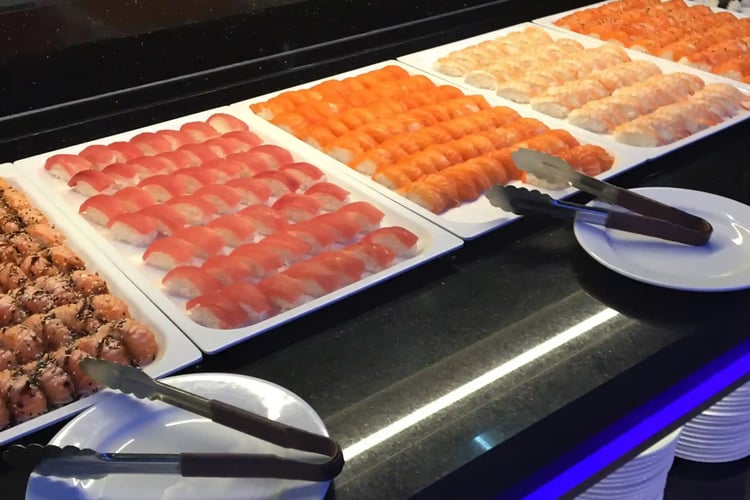
The higher-end the sushi, the more wasteful a temperature-management mistake feels. Here, rather than focusing only on safety, we will work backward from the peak of flavor and sort out what you should eat first (*1). The principle is simple: the more fat it contains, the more it relies on surface treatment, and the more sauce it carries, the sooner you should eat it (*2).
Toppings That Tend to Be Relatively Stable
The toppings that tend to be relatively stable are those cooked through thoroughly, such as tamago, shrimp boiled or steamed to the center, and anago or eel whose flavor is built through simmering and glaze (*1). But “stable” does not mean “hard to spoil.” Quality can still decline: sushi rice dries out and turns hard, and refrigerator odors can transfer to the food. That is exactly why, even with these more stable options, the ideal plan is still to finish them the same day (*3).
Toppings That Deteriorate Quickly
What deteriorates quickly includes fatty grilled items, aburi styles, and types where oil and moisture coexist in sauces like tare and mayo. Because lipids can continue oxidize during refrigeration, changes in aroma become more noticeable (*2). Rather than saying, “I’ll save this for tomorrow morning,” you will usually end up with a safer and more satisfying experience if you make it the first thing you eat once you get back to your room.
Combinations That Need Extra Caution
The combinations that deserve particular caution are mayo plus chopped green onion, semi-soft or runny elements such as onsen-egg-style toppings, and creative sushi with plenty of sauce. Mayo-based foods are widely treated as items that become more vulnerable once temperatures rise, so when they appear on sushi, it is safest to treat them as firmly within the “must be refrigerated” category and eat them within a short window.
These items are not only quick to lose their visual appeal; the risk also rises when they are left at room temperature for too long, so they are not a great match for carrying around while you wander. If you are going to buy them, save them for a day when you can eat them right away (*4).
The Best Eating Order So You Do Not Regret It While Traveling
A practical travel rule is to eat sushi in the order of what is hardest to manage safely by temperature. That means: 1) aburi, sauce-heavy, and mayo-based items, 2) fatty grilled items, 3) relatively stable options such as glaze-finished toppings and tamago (*2) (*3). And once you open the box, do not leave everything sitting out at room temperature—take out only what you are about to eat, then return the rest promptly. That alone improves your chances of finishing it while it still tastes good. If you are planning around putting it back in the refrigerator, it also helps to check that the refrigerator is actually cold enough—around 40°F/4°C is a useful benchmark—to reduce the risk further (*4) (*5).
How to Store and Carry It Without Regret: Takeout, Carryout, and Hotel Stays
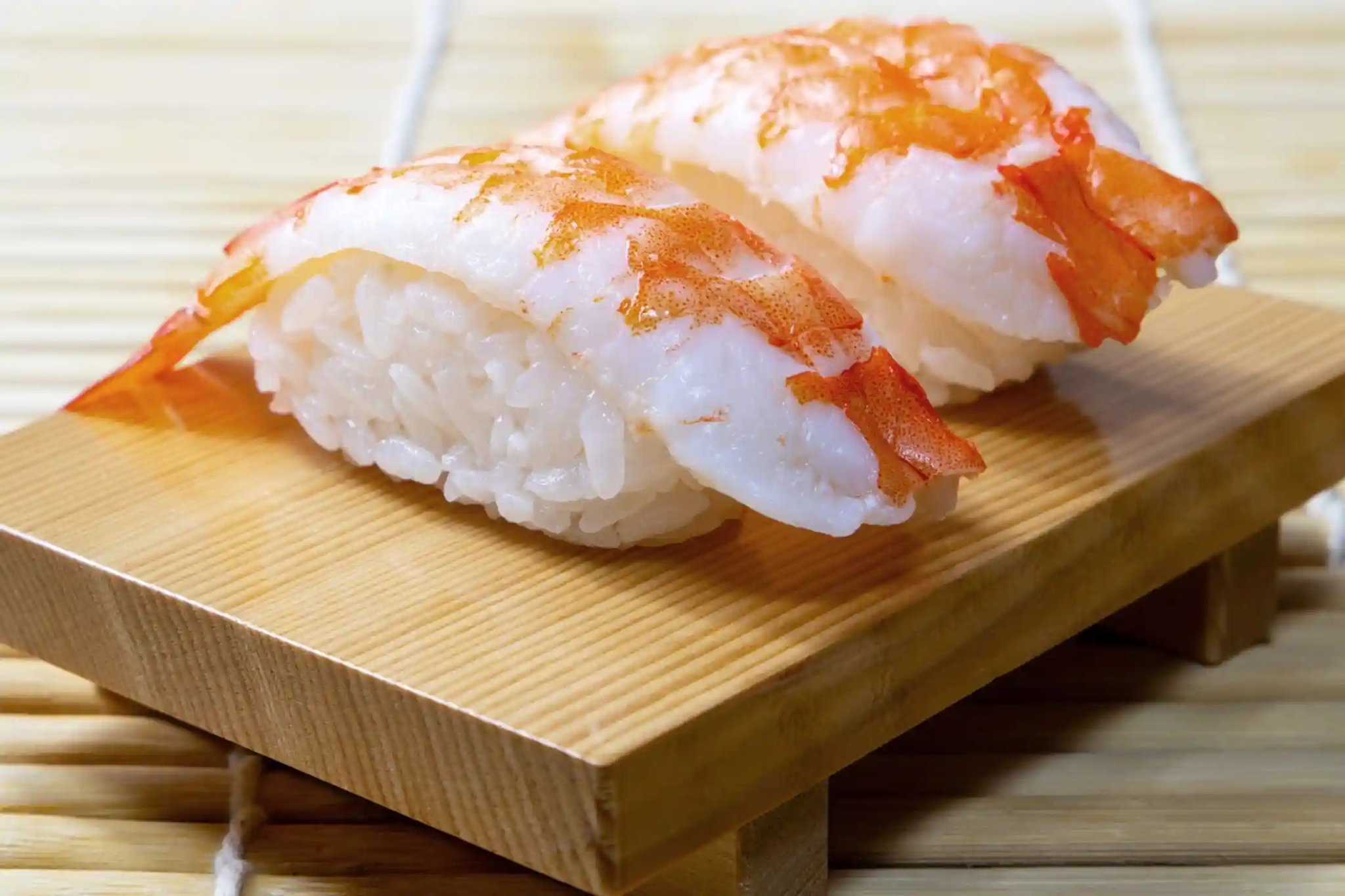
Whether sushi keeps well depends less on the power of the refrigerator and more on how you handle it from the moment you buy it to the moment you eat it. Consumer Affairs Agency guidance clearly notes that you should not carry it around for long after purchase, and that the key is to eat it promptly or refrigerate it right away. Here, we turn that into a process you can realistically follow while traveling.
What to Check at the Time of Purchase
There are four things worth asking at the shop: 1) the time it was made or prepared, 2) the recommended storage temperature and whether it must be refrigerated, 3) whether ice packs are included and how many, and 4) whether reheating is possible. Point 4 matters in particular because the way you handle it changes depending on whether it is a style of sushi designed to be warmed again, such as some kinds of pressed sushi. If there is a label, the label takes priority over everything else (*1).
Best Practices While You Are in Transit
Public agencies advise keeping cold foods at 40°F (4°C) or below and refrigerating them within 2 hours of purchase. In practical terms, a cooler bag with ice packs works best when the ice packs are placed to the side of or underneath the sushi, rather than directly on top of it, so the whole box cools more evenly. If you are traveling by car, keep it at your feet in an air-conditioned seat area rather than in the trunk. And keep it out of direct sunlight (*2).
Seasonal Rules
In summer, focus even more on shortening transit time and keeping it cold. In winter, pay more attention to preventing dryness and avoiding accidental warming from indoor heating. Even in winter, a heated car can become surprisingly warm, effectively creating the same conditions as leaving it out at room temperature. Whenever seasonal judgment starts to feel fuzzy, go back to the 2-hour / 1-hour rule—it is the most dependable guide (*3).
How to Make Refrigerated Sushi Taste Better
Sushi rice turns firm because refrigeration speeds up starch retrogradation (*4). The ideal is to plan in a way that avoids refrigeration altogether, but if you have no choice, take it out of the refrigerator shortly before eating and let the temperature come back up only briefly in a clean indoor setting—15 to 30 minutes at most.
That said, more time at room temperature does not mean more safety. The longer it sits out, the higher the risk, so keep the return-to-temperature period short. Microwaves can create uneven heating, so if you do use one, you need to prevent cold spots by stirring midway or using some comparable method. Also keep in mind that if toxins have already been produced by bacteria such as Bacillus cereus, reheating does not necessarily make the food safe again (*5).
How to Finish It Sustainably
Public information on reducing food waste introduces a few basic household practices: buy only what you need, prepare or order only what you can finish, and store food properly. Sushi is not an easy food to “save for tomorrow and be frugal with,” which is exactly why it helps to optimize how much you buy and, when you are unsure, plan to share it. That is one of the most direct ways to protect both your health and sustainability at the same time (*6).
Is It Still Okay to Eat? Or Should You Throw It Away? Warning Signs in Cooked Sushi and How to Spot Them
Even if you stay within the recommended time window, poor handling can still make the answer no. Public agencies consistently recommend throwing away food if there are unusual changes in color, smell, or texture, and they also advise you never to taste food just to check whether it is safe.
They further warn that food is not necessarily safe just because it looks or smells normal at first glance—in some cases, you simply cannot detect the danger. Because sushi feels delicate and easy on the palate, it is all too easy to dismiss a faint sense of discomfort as “probably nothing.”
When in doubt, throw it out. If you decide that from the beginning, your judgment becomes much steadier. This is especially true when room-temperature holding is part of the story, because even if the time seems to fall within the guideline, the actual temperature conditions are often unclear. If you suspect a problem, discarding it is the more rational choice (*1) (*3). Thinking in terms of “Do I have a solid reason to call this safe?” helps you decide more quickly (*2).
Visible Changes
Even without a photo, you can usually pick up warning signs by looking for the following: 1) discoloration in the topping (dullness, a grayish tone, or an unnaturally rainbow-like sheen), 2) sliminess on the surface, 3) stringiness, 4) mold, and 5) collapse inside the box with liquid leaking out. Stringiness and mold, in particular, are immediate deal-breakers. Even if the time is technically within the guideline, do not taste it in these cases—throw it away (*1).
On the other hand, things like sushi rice drying out and cracking, or the grains becoming a little firm, may simply reflect a loss of quality first and foremost. The key here is not to jump straight from “it is dry” to “it is definitely dangerous,” but to give greater weight to signs of microbial growth such as slime, stringiness, and liquid leakage (*1) (*3).
Changes in Smell and Taste
Your sense of smell is a strong sensor, but tasting is unnecessary. Public food safety guidance clearly states that you should never taste food to confirm whether it is safe, because harmful bacteria are invisible and may not be detectable by taste or smell. If it smells sour, sharp, ammonia-like, or like stale oil, the rational move is to throw it away without putting it in your mouth. That “just a tiny bite” impulse is exactly the kind of risk behavior you most want to avoid (*1) (*2).
Cases Where Risk Is Higher Because of Health Condition or Personal Factors
Public guidance warns that food poisoning is more likely to become severe during pregnancy, in older adults, in infants and young children, and when your immune system is weakened. On days when you are a little tired, your stomach feels off, or a long journey has left you short on sleep, it is especially worth choosing the safer option. When in doubt, discard it. That is not wasteful—it is a decision that protects both your health and your travel time (*4) (*1) (*2).
Column: Sushi and the Japanese Culture of Preservation
Sushi is strongly associated with the image of “raw fish on rice,” but if you trace its history, it is in fact a food culture that began with the wisdom of preservation and processing (*1). When you choose sushi on your travels, knowing something of the layers of time behind it can make even a single piece feel just a little richer and more delicious.
Edomae Sushi Evolved Through a Balance of “Preparation” and “Immediate Eating”
In the days before refrigeration, Edo—a major city of its time—developed sushi that was easier to handle through vinegared rice and techniques such as simmering, grilling, and marinating fish, then shaped it into something people could eat right away from street stalls (*2). Public explanations also note that mixing vinegar into the rice both enhanced flavor and helped reduce spoilage, and that akazu made from sake lees was used as well (*2). In other words, Edomae sushi was an elegant compromise between preservation and immediacy (*2).
From Fermented Sushi to Modern Sushi
An even older form is narezushi. Public explanations of traditional foods describe it as a preserved food in which fish was packed with salt and rice and allowed to undergo lactic acid fermentation, with categories such as namanare and hon-nare depending on the length of fermentation (*3).
Public materials also explain that narezushi was a culture in which rice was used for fermentation and the fish itself was eaten, and that sushi changed dramatically over time (*1). Modern nigiri sushi is built around freshness, but behind it lies the broader shift in Japanese food culture from a way of thinking centered on preservation to one centered on freshness (*1) (*3).
Once you know this background, it becomes easier to see that modern takeout sushi is not a preserved food, but an immediate delicacy supported by refrigerated infrastructure (*1) (*2). Put another way, sushi on your travels is a form of gastronomy that is highly sensitive to time and temperature (*2). Good storage technique is, in that sense, a new kind of wisdom for the modern traveler (*1) (*2).