%20is%20Gratitude.webp)
You are standing in front of a flower in Japan and you want to say something about it. English gives you one workhorse phrase, "beautiful flower," and leaves it there. Japanese makes you choose first, because the choice carries information: how close you feel to the flower, whether you are praising its form or its poise, whether you are speaking as a guest in a garden or as someone admiring the arrangement on a restaurant counter.
This guide answers the literal question in the first section, then keeps going into the part that phrasebooks skip: the sentence you actually say out loud, the grammatical trap inside the most common word for beautiful, and the five adjectives a Japanese speaker reaches for when "beautiful" is too blunt. It ends where the words become usable, at four places that admit visitors, with what each one costs.
Two things are worth knowing before you start. The word utsukushii, the one dictionaries hand you for "beautiful," did not begin as a word about looks at all. And hanakotoba, Japan's language of flowers, is younger than the Meiji-era railways and arrived in a book you can name.
How to say beautiful flower in Japanese
Two answers cover almost every situation:
美しい花 — utsukushii hana. The considered word. You use it when the beauty has some weight to it: a single camellia in a tea room alcove, a garden that has been composed rather than planted.
きれいな花 — kirei na hana. The everyday word. Clean, bright, well-formed, pleasing at a glance. This is the default in front of a flower shop.
The single most useful thing to know is that these are not two intensities of the same word. They come from different places, and the older one is stranger than its dictionary entry suggests.
Utsukushii or kirei: two ways to call a flower beautiful
The Japanese dictionary Kotobank's entry for 美しい lists harmony of color, form and sound as one sense of utsukushii — and then lists another: tender feeling toward a spouse, a child, a relative, or toward something small and dear. The entry notes that this affectionate sense came first. Utsukushii began as a word for love directed at something small, and widened into a word for beauty later.
That is a fact about the word's history rather than a rule about how it is used today — modern Japanese applies utsukushii to handwriting, to conduct, to a well-struck golf swing. But it explains why the word has never been a neutral report on appearance.
Kirei has no such history behind it. Its other main sense is "clean" — which is why travelers who look the word up for a flower keep meeting it again on a sign about tidy toilets. The overlap is not a coincidence and it is not a mistranslation: in Japanese, unblemished and lovely sit inside one word.
So the working rule is this. Kirei is the everyday word and it is always safe, if not always sufficient. Utsukushii is the considered one: you reach for it when you want the remark to sound like a judgment rather than a reaction — a composed garden, a single camellia in an alcove, an arrangement someone made on purpose. Both are correct in front of the same flower. What changes is how much weight you are putting behind the remark. Praising an ikebana arrangement in front of the person who made it, utsukushii is the one that lands as a compliment about their judgment rather than about the flowers they were handed.
The na that learners drop
Here is the grammatical trap. Utsukushii attaches to a noun directly: 美しい花, utsukushii hana. But kirei needs a linking な (na) first: きれいな花, kirei na hana. Saying "kirei hana" is the mistake English speakers make most often here.
The reason is easy to miss. Japanese adjectives split into two classes, and the class is normally visible from the ending: words written ending in -i attach to a noun directly, and everything else takes the linking na. Kirei is written ending in -i and belongs to the second class anyway, because that -i is part of the word's stem rather than an adjective ending. There is a test that settles this particular case without any grammar vocabulary: no adjective of the first class ends in -ei. Kirei ends in -ei, so it takes na, and so do yuumei (famous) and teinei (polite), which trip up learners the same way. The test only runs one way, so it will not save you from kirai (disliked), which ends in -ai and still takes na.
Now the sentence. To say the whole thought rather than the label:
きれいな花ですね — kirei na hana desu ne. "It's a beautiful flower, isn't it."
花がきれいですね — hana ga kirei desu ne. "The flower is beautiful, isn't it."
The two sentences are not interchangeable in feel. The first calls the thing a beautiful flower. The second says something about the flower in front of you both. That closing ね (ne) is the piece worth carrying home: it turns a statement into something shared, an invitation for the other person to agree. Dropped, the same sentence becomes a verdict delivered to nobody. Used, it is one of the shortest routes into a conversation with a stranger in a garden. Our collection of Japanese travel phrases covers the same ne ending in greetings and small talk.
Five words that say where the beauty sits
.webp?width=751&height=501&name=Cherry%20Blossoms%20and%20Japanese%20White-eye%20(or%20Mejiro).webp)
Utsukushii and kirei tell someone that you find a flower beautiful. The next five tell them which kind of beautiful you mean. This is where Japanese stops being a translation of English and starts being a different instrument.
可憐 — karen. Small, fine-limbed, slightly fragile; the beauty that makes you want to shelter it. Correct for a single stem of bellflower, wrong for a peony.
清楚 — seiso. Unadorned and composed. White camellia, white lily, anything whose dignity comes from restraint rather than display.
雅 — miyabi. Courtly refinement. Kotobank's entry for 雅 traces the word to 宮ぶ, "to behave in the manner of the court" — its original sense was simply "courtly." The entry describes it as an elegant, intellectually polished taste discovered by the refined sensibility of city people. It is the word for wisteria and iris, flowers that classical poetry made aristocratic.
優雅 — yuga. Grace with ease in it. Where miyabi points at a cultural pedigree, yuga points at how something moves: a wisteria raceme swinging, a long stem placed at an angle that looks unforced.
端正 — tansei. Well-proportioned, correctly ordered. The word you want for an arrangement whose balance is the point.
There is a detail inside miyabi that says something about the whole vocabulary. The character 雅 is also, as the same dictionary entry records, one of the six categories of the Chinese Book of Songs — the court poems performed at Zhou dynasty ceremonies. The Japanese word for the most distinctively Japanese kind of elegance is written with a character imported from the Chinese classics. Japan's aesthetic vocabulary was built out of borrowed material and then bent until it described something local. That pattern repeats in the next section.
The Japanese word for flower, and the season that picks your adjective
.webp?width=751&height=501&name=Hydrangea%20A%20SymbolFeature%20of%20the%20Rainy%20Season%20(Tsuyu).webp)
Which adjective fits is not only a matter of the flower's shape. It is a matter of when you are standing there.
Spring. Cherry blossom is the case where the season does the work for you. The Stanford Encyclopedia of Philosophy's entry on Japanese aesthetics calls the love of cherry blossoms the most frequently cited example of mono no aware in contemporary Japan, and is precise about why: the blossoms begin to fall within a week of appearing, and it is the evanescence of their beauty that produces the feeling. In front of falling petals, utsukushii is doing real work and kirei sounds like a shrug.
Wisteria belongs to the same weeks of spring and to a different word. The Japan National Tourism Organization describes wisteria tunnels running over 100 meters at Kawachi Fujien. Length and hang are the point, so yuga and miyabi fit and karen does not.
Summer. Hydrangea arrives in June with the rains, and the vocabulary follows the water: cool, washed, composed — seiso territory. At Meigetsu-in in Kamakura the effect has its own name. The Kamakura City Tourist Association says the temple's several thousand hydrangeas are called Meigetsu-in Blue, and gives the practical frame a visitor needs: gates open at 9:00 and close at 16:00, admission 500 yen for high school age and above, 300 yen for younger children, with June hours subject to change.
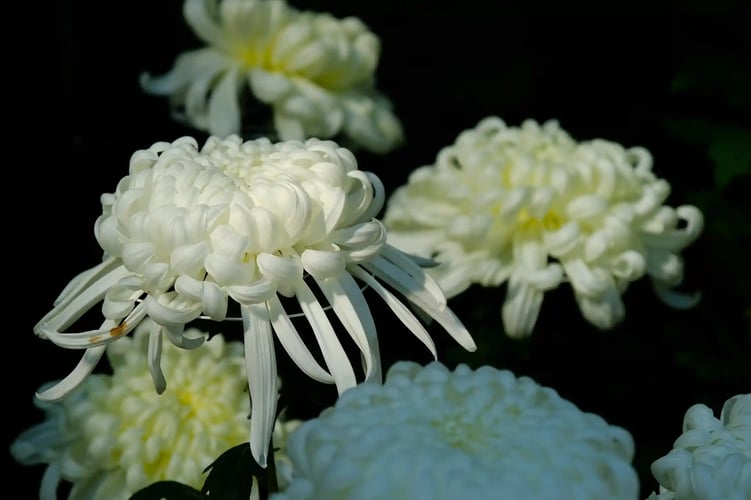
Autumn and winter. Chrysanthemum, kiku, is the flower Japan put on its highest emblems: JNTO, describing the chrysanthemum festival at Kameido Tenjin Shrine, notes that it serves both as the symbol of the Imperial House and as the flower on the cover of the Japanese passport. Camellia carries the cold months, and it is native to Japan: JNTO records that the Izu Oshima camellia festival brings more than three million pink camellia flowers into bloom across that island, and that Goto in Nagasaki is known for the same flower.
Hana, ka and hanami: the Japanese word for flower inside other words
The Japanese word for flower is 花, read hana on its own. Read ka in compounds, the same character builds much of the vocabulary above: hanami (花見), flower-viewing; hanakotoba (花言葉), flower-words; kacho-fugetsu (花鳥風月), literally flower-bird-wind-moon, the four-part shorthand for the natural subjects worth contemplating.
Knowing that one character is inside all of them is what turns a vocabulary list into a system. If you want the names of individual blossoms and the separate character 華 that also reads hana, our guide to the word for flower in Japanese works through the flower names and the 花 versus 華 distinction in detail.
Hanakotoba: the flower language Japan imported in 1910
Hanakotoba is regularly presented to visitors as ancient Japanese wisdom. It is not ancient, and its arrival is documented.
The National Diet Library's Reference Collaborative Database, answering a question about the earliest flower-language book published in Japan, identifies it as 『花』(Hana), a book of Western flower language published in 1910 by Seibunkan. Its authors were Enami Bunzo, a poet who took over the editorship of the magazine Subaru that same year, and Yosano Akiko. The same entry points to 『英文学に現はれたる花の研究』, Ishikawa Rinshiro's 1924 study of flowers in English literature, as carrying the first comprehensive comparison table of flower meanings.
So the sequence runs: a Western system of flower meanings, a book that carried it into Japanese in 1910, and a vocabulary that has been circulating here for a little over a century. Yosano Akiko, one of the most consequential poets of modern Japan, is on the cover of the first one.
This is the same pattern as 雅 borrowed from the Chinese classics. Japan took an imported system and naturalized it so thoroughly that visitors now read it as indigenous. Both arrived attached to poetry.
Why hanakotoba differs from one source to the next
Look up the hanakotoba for a single flower and you will find sources that disagree. There is a reason, and it follows from the history above: no institution ever standardized the list. It entered Japan through books rather than through a school with authority to fix meanings, and it has been recopied, extended and localized ever since.
The practical consequence for a traveler is worth stating plainly. A confident single-line answer about what a flower "means" in Japan is a claim about one source, not about a settled tradition — which is why this guide does not give you a table of meanings to memorize. When a florist in Kyoto tells you what a flower says, you are hearing a living version of a hundred-year-old import, and that is more interesting than a fixed list would be.
The philosophy behind a beautiful flower in Japanese
Two ideas sit underneath the vocabulary, and both have names.
Mono no aware is the one that explains why a Japanese speaker's warmest praise is often reserved for a flower that is on its way out. The Stanford Encyclopedia entry defines it as a pathos of things deriving from their transience, and credits the literary scholar Motoori Norinaga with bringing it to the front of literary theory through his study of The Tale of Genji. The entry also quotes the priest Yoshida Kenko: the most precious thing in life is its uncertainty. Under that reading, cherry blossom is not admired despite falling. It is admired because it falls.
Ichigo ichie is the second, and it comes from the tea room. Urasenke, one of the principal schools of Japanese tea, puts the phrase at the center of its own statement of purpose and explains it for beginners in its introduction to tea: this gathering will not come again, so host and guest give it their full attention. Our guide to the meaning of sado has a section devoted to ichigo ichie and where it sits within tea practice.
Put the two together and the grammar lesson from the first section stops being trivia. Kirei reports what you can see. Utsukushii commits you to an opinion about it. And adding ね hands the remark — either remark — to the person standing beside you for agreement. The vocabulary is built for a culture that treats looking at a flower as something done with someone, once.
Where to practice: two gardens and two ikebana rooms
%20at%20Ninna-ji%20Temple%2c%20Kyoto.webp?width=751&height=501&name=Autumn%20Leaves%20(or%20Autumn%20Foliage)%20at%20Ninna-ji%20Temple%2c%20Kyoto.webp)
Vocabulary settles when you have somewhere to attach it. Four places, with what each currently costs and asks of you. Confirm details against the official pages before you travel, since hours and application rules change.
Katsura Imperial Villa, Kyoto. The Imperial Household Agency's visit page for Katsura states that you can only enter on a tour led by its staff, with English-language tours starting at 9:20, 11:20, 13:20, 15:20 and 16:20, and that capacity is limited enough to require applying ahead — though walk-in registration also exists alongside the online application. The agency's visitor information page puts the tour at one hour, sets the minimum age at 12, and lists admission at 1,000 yen for visitors 18 and over, free for ages 12 to 17. That fee is worth noticing: of the five Imperial facilities open to visitors, Katsura is the one that charges. The villa is closed on Mondays and over the New Year period, from December 28 to January 4. An hour on foot is enough time to watch the same garden ask for a different word each time the path turns, which is the exercise.
Kenrokuen, Kanazawa. The name is itself a judgment about gardens. Ishikawa Prefecture's official page glosses Kenrokuen as a garden combining the six attributes of a perfect garden, and its history page records that the name was given in 1822 by Matsudaira Sadanobu, lord of the Shirakawa Domain. Someone decided this garden had all six, and said so in the name. The prefecture's guidance page lists admission at 320 yen for adults 18 and over and 100 yen for children aged 6 to 17, with the garden open 7:00 to 18:00 from March 1 to October 15 and 8:00 to 17:00 from October 16 to the end of February. The detail that changes a trip is further down the same page: before those official hours the garden opens early and admission is free — from 4:00 through April to August, from 5:00 in March and from September to October, from 6:00 in the winter months. Only the Renchi-mon and Zuishinzaka gates are open then, and you are asked to leave 15 minutes before the standard opening time. An hour in a garden of that rank, at first light, at no cost, is the strongest argument in this article for setting an alarm.
Ikenobo, Kyoto. The oldest school of ikebana runs a trial lesson for visitors. Its English lesson page gives the terms: Thursdays 13:30 to 15:30 excluding national holidays, 7,000 yen per person, two participants minimum and ten maximum, guiding available in English or Chinese, and booking by email. Read the equipment line carefully — vases, pin frogs and scissors are lent for use in the room only. The flowers go home with you; the tools do not. Cancellations must reach the school at least three days ahead, and canceling later than that, or not turning up, costs 3,000 yen per person.
Sogetsu, Tokyo. The contemporary counterweight. Sogetsu's International Class runs every Monday except national holidays, 10:30 to 12:30, in English, with a first-time trial lesson at 6,000 JPY including two bunches of material and tax, and booking required five working days ahead. Its experience page puts a trial session at 90 to 120 minutes covering an arrangement, a demonstration by the instructor and individual advice, and states that equipment is lent while the materials you use can be taken home.
The two schools sit on different days, which means a traveler with a week in Japan can attend both and feel the contrast directly: Ikenobo's line and rule against Sogetsu's freer dialogue with material and space. Our guide to ikebana in Japanese sets out the histories of both schools and where their aesthetics diverge.
One instruction for the lesson itself. When your arrangement is finished, write down the adjective you would use for it — karen, seiso, tansei — and why the other two do not fit. Choosing between them is what teaches the words. Reading a list does not.