/Kazunoko%20Matsumae-zuke%20(Herring%20Roe%20and%20Seafood%20Pickles).webp)
Ask what chinmi means and you will be told "rare delicacy," which is accurate and tells you nothing. The useful definition is narrower: these are small, intensely concentrated preserved foods, eaten in quantities of a teaspoon, that exist because somebody needed to keep something from spoiling and discovered that the process made it better than it had been fresh.
Some of them are among the most extreme foods produced anywhere. One is made from an organ that would kill you, by a method nobody can explain. Another was nearly legislated out of existence four years ago. This guide covers what chinmi are, the ones worth knowing, and what has been happening to the people who make them.
What Is Chinmi? The Definition and the Unstable List
/Simmered%20Kazunoko%20(Seasoned%20Herring%20Roe).webp?width=800&height=533&name=Simmered%20Kazunoko%20(Seasoned%20Herring%20Roe).webp)
Chinmi are what remains when you take the preservation techniques of a country with hot summers and no refrigeration — salting, drying, fermenting in rice bran, curing in the fish's own viscera — and apply them to the parts of an animal nobody would eat fresh. Roe. Intestines. Liver. Gonads. The results keep for months and taste of concentrated salt, umami and time.
There is a conventional list: the Three Great Delicacies of Japan — karasumi, salted sea urchin, and konowata. The Ministry of Agriculture sets out all three, giving Echizen in Fukui for the urchin, Nagasaki for the karasumi, and — this is the part usually flattened in English — Noto, Owari and Mikawa for the konowata. The single-province attributions you will see quoted are a later tidying-up. No authority ever issued the list; it is a convention that hardened.
What is documented is age. The ministry's konowata page traces it to the Engishiki, the tenth-century legal compendium, where it appears as tribute sent from Noto to the imperial court; Muromachi-period documents record it being presented to the nobility; and the roe version is said to have been indispensable on the celebratory table of Maeda Toshiie in Kaga. The same page also points at a source most guides never mention — the Nihon Sankai Meisan Zue of 1799, which illustrates the sea cucumber fishery of the day and sets out how konowata was judged for quality. Chinmi were what provinces sent to power when they wanted to be remembered.
That is the thread running through all of them. A province with a difficult coastline and a short season could not send volume, so it sent concentration — the one thing it made that nobody else could. The three-delicacy list is best read as a record of which provinces won that competition at the shogunal table, which is why the entries are place-and-product pairs rather than dishes.
Fugu Roe Nukazuke: The Chinmi Food Nobody Can Explain
/Fugu%20Roe%20Pickled%20in%20Rice%20Bran%20(Nukazuke).webp?width=800&height=533&name=Fugu%20Roe%20Pickled%20in%20Rice%20Bran%20(Nukazuke).webp)
Start with the one that should not exist. Pufferfish ovaries carry tetrodotoxin, for which there is no antidote. In Ishikawa Prefecture they are salted and then pickled in rice bran until they are safe to eat, and the finished thing is sold in shops.
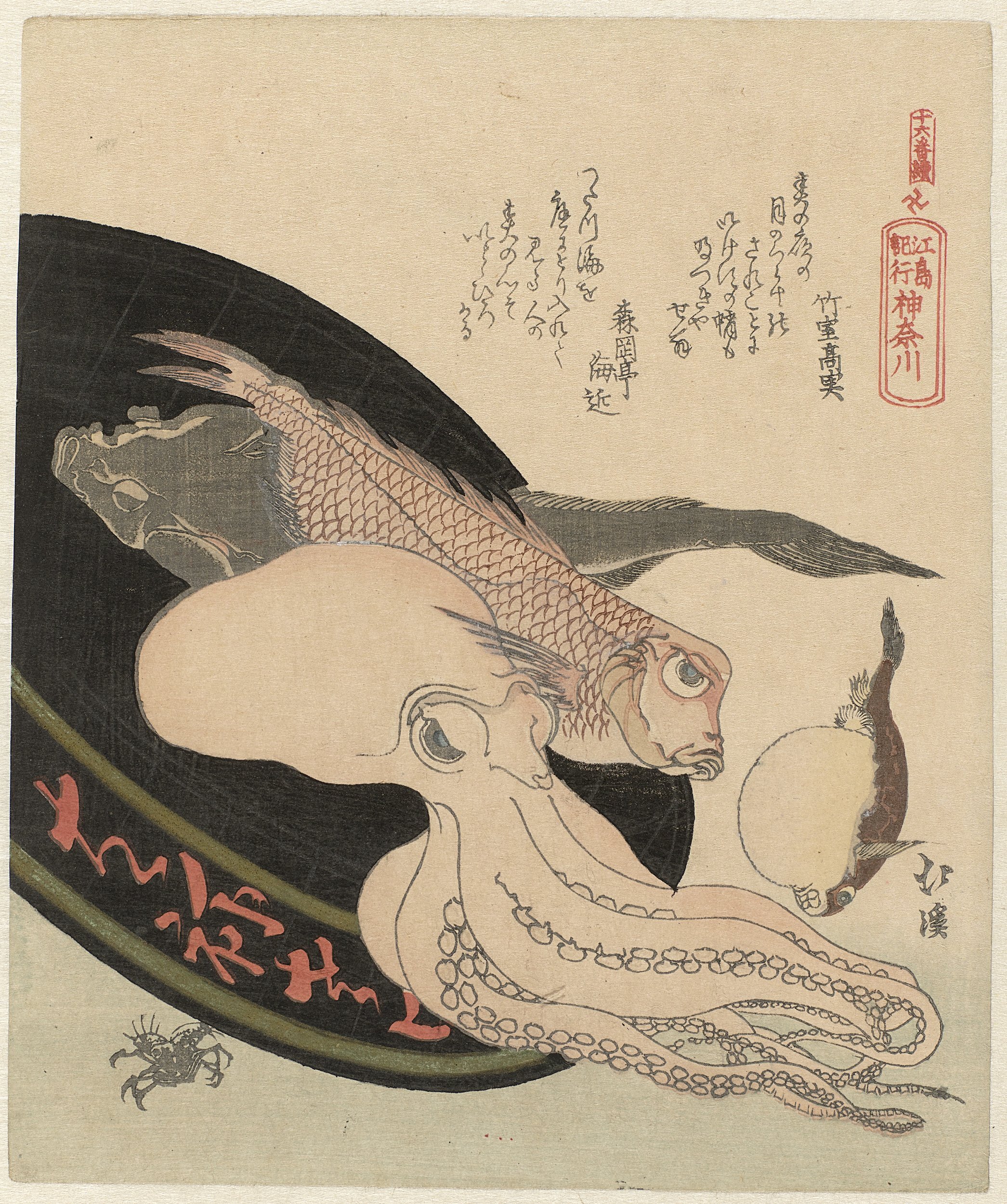
The method, as the Ministry of Agriculture describes it, is roughly this: the ovaries are salted for about six months to a year, rinsed, then packed with rice koji, rice bran, chili and ishiru — the local fish sauce — under weights.
Here is the part that stops people. The ministry states outright that the detoxification mechanism has not been explained. There are theories — that the toxin diffuses and equalizes into the brine and the bran, or that microbes break it down during fermentation — and neither has been established. A food is being made safe by a process whose operation is unknown, and it is being made safe reliably enough to sell.
Which is why the rules around it are what they are. Production is confined to a limited number of licensed makers in Ishikawa, concentrated in Kanaiwa and Ono in Kanazawa, the former town of Mikawa, and Wajima. The ministry's stated grounds for permitting it at all are worth quoting in substance: that it is a Kaga tradition running back to the Edo period, and that there has never been a single accident. Not that the science is settled. That the record is clean.
The Agency for Cultural Affairs has since registered Mikawa's fugu roe nukazuke in its Hundred-Year Food program, alongside three other Ishikawa entries. It is, in the most literal sense, a tradition preserved by regulation rather than by understanding. The method is fixed because the law fixes it, and the law fixes it because nobody can model what the method does.
The system around it is written into prefectural law. Ishikawa's ordinance on the handling of pufferfish requires that before any toxic part is sold or processed for sale, the operator must test its toxicity and confirm it meets a standard fixed by regulation. Producers must be qualified, the removal of toxicity must follow a prescribed method, and records must be kept. The counts you will see quoted for the trade — a little over twenty licensed makers, most of them individuals — are widely repeated but do not appear in the ordinance or on the ministry page, so treat them as figures in circulation.
The timings are worth holding together, because they come from two different sources and only make sense side by side. The ministry gives six months to a year for the salting. The producers' own association in Mikawa describes the bran stage as running about two years, with ishiru poured down the side of the barrel daily so the contents never meet the air. Three years, roughly, from a lethal organ to a shop shelf.
Konowata and Kuchiko: The Arithmetic of Scarcity
/Sea%20Cucumber%20Intestines.webp?width=800&height=533&name=Sea%20Cucumber%20Intestines.webp)
Most chinmi are expensive for a reason you can calculate. Konowata is made from the intestines of sea cucumbers, salted and matured. The ministry gives the yield plainly: about 100 grams of konowata from five kilograms of sea cucumber. Everything about the price follows from that ratio.
Kuchiko is scarcer still. It is made from the ovaries, which means it can only be made from the animals that happen to be carrying them, and those are a fraction of any catch. The result is dried into flat sheets that look like nothing else in Japanese food and are priced accordingly. Lightly toasted, which is how the ministry says it is usually eaten, the sheet is the single most concentrated thing on a Japanese table.
The Noto peninsula, where the ministry places this, is also where the fugu ovaries are cured. It is not a coincidence so much as a shared condition: a coastline with strong seasonal catches, long winters, and no historical way to move fresh fish inland fast. Preservation was not a craft tradition there. It was the only distribution system available.
/Fresh%20Box%20of%20Uni%20(Sea%20Urchin%20Roe).webp?width=800&height=533&name=Fresh%20Box%20of%20Uni%20(Sea%20Urchin%20Roe).webp)
Salted sea urchin from Echizen runs on the same logic, and its maker publishes the arithmetic. Tentatsu, in Fukui, uses bafun urchins two to three centimeters across, and states that a single urchin is concentrated down to one gram: a hundred grams of the finished cure takes more than a hundred urchins. Nothing goes in but salt, and the salted roe is turned one piece at a time with chopsticks while the moisture leaves and the color goes from orange to vermilion.
The recipe was commissioned. The third-generation head of the house, Tennōya Gobee, was asked by Matsudaira Harutoshi, lord of the Fukui domain, for a preserved food that could be carried on campaign. What came back was delivered to the domain in paulownia boxes, and it is still sold in them.
The point is not that these are luxuries. It is that the scarcity is structural rather than manufactured — it comes from the animal, not from the marketing. If you have read our guide to what expensive Japanese food is actually worth, this is the clearest case of the principle in the whole cuisine.
Karasumi and Kusaya: Two Japanese Delicacies, Two Directions
/Karasumi%20(Salted%20Cured%20Bottarga).webp?width=800&height=533&name=Karasumi%20(Salted%20Cured%20Bottarga).webp)
Karasumi is mullet roe, salted, desalted, and dried until it slices like a hard cheese. Its name comes from a resemblance to Chinese inksticks, and the technique is not originally Japanese at all — it belongs to a Mediterranean and Middle Eastern family of dried-roe products that includes bottarga, and it reached Nagasaki through the China trade. Nagasaki was the port where foreign things arrived, and karasumi is one of them that stayed.
How it stayed is documented by the house that did it. Takanoya, founded in Nagasaki in 1675, records that its first-generation head Takano Yūsuke began using mullet roe from Nomozaki, presented the result to the Nagasaki magistrate, and that the magistrate sent it on to the shogunate. The shogun's household liked it, and by order the house then supplied it every year for 156 years — from 1712 to 1867, across seven generations — alongside Nagasaki's other tawaramono marine exports. That is how a Mediterranean technique ended up on a domestic list of three.
Made properly it takes weeks: the roe sacs are salted, then desalted in stages so the salt leaves evenly, then pressed flat and dried in sun and wind, turned by hand, until the outside firms and the inside stays waxy. The best of it is eaten in translucent slices with daikon, or grilled for a moment so the surface blisters.
/Hachij%C5%8D-jima%20Island_s%20Kusaya%20(Salt-Dried%20and%20Fermented%20Fish).webp?width=800&height=533&name=Hachij%C5%8D-jima%20Island_s%20Kusaya%20(Salt-Dried%20and%20Fermented%20Fish).webp)
Kusaya goes the other way — nothing arrived, everything stayed. Fish are soaked in a fermented brine, the kusaya liquid, and then dried. The liquid is the point: it is not discarded and remade but topped up and carried forward, so that a producer's brine has a continuous history. It is the same principle as a sourdough starter applied to fish, and the smell is famous enough that the Izu Islands' most recognizable product is one many visitors decline.
Around these sit the ones you will meet more casually. Ankimo, monkfish liver steamed and sliced, is the winter one, and the comparison to foie gras is doing it no favours — it is lighter and cleaner than that. Shiokara is the broad family of things cured in their own salted viscera, of which squid is only the best known; abalone liver is the version that turns up on expensive counters. Matsumae-zuke from Hokkaido, dried squid and kelp and herring roe in soy, is the one most likely to appear on a New Year table. Konka-zuke, sardine or mackerel packed in rice bran on the Noto coast, is the same technique as the pufferfish without the danger.
Both karasumi and kusaya are worth trying in the same sitting, because they demonstrate the two directions preservation can take. Karasumi concentrates a flavor that was already there. Kusaya creates one that was not.
Iburigakko, and the Law That Nearly Ended It
Iburigakko is smoked daikon pickle from Akita, and its existence is a direct consequence of snow. Daikon for pickling has to be dried first, and in Akita the temperature drops below freezing before the radishes have dried in the sun. So they were hung above the irori, the sunken hearth, and dried in smoke instead. The Ministry of Agriculture's account says the origin is held to go back as far as the Muromachi period and describes the method: two to five days of smoke from hardwoods such as oak and cherry, then packing in rice bran, salt and sugar to ferment for two months or more.
It was a farmhouse food, made in farmhouses, and that is what nearly killed it.
In June 2021 a revision to Japan's Food Sanitation Act added pickle manufacturing to the list of businesses requiring a license. The requirement applied to the farmers who had always made iburigakko in their own kitchens and sold it at roadside direct-sales stands. A transition period ran to the end of May 2024; after that, no license meant no selling. Meeting the standard meant building a separate facility, at a cost the Akita Economic Research Institute put at one to two million yen.
The prefecture surveyed the people affected. In July and August 2021 it asked 636 pickle sellers at Akita's direct-sales outlets whether they intended to obtain a license. Of the 306 who answered, 175 said they would. 108 said they would not. The ones declining were concentrated in their sixties and seventies and above.
That is what the disappearance of a food actually looks like when it is written down: not a dramatic ban, but a hundred-odd people, most of them past sixty, deciding one by one that it is not worth rebuilding a kitchen for. Akita responded with money. For the 2022 financial year the prefecture budgeted fifty million yen to subsidize a third of the cost of the equipment and buildings the law now required, with a ten-million-yen ceiling per applicant, open to individual farmers as well as certified operators; by the end of that July nineteen applications worth eighteen million yen had been approved against forty-eight planned in April. Producers also improvised. Sankichi Nōen, a farm in the Obonai district of Semboku City that has grown daikon and made iburigakko since 2017, built a shared processing facility with crowdfunding — about 2.7 million yen for the build, of which some 920,000 came from the campaign and the rest from its own pocket. Iburigakko itself is in no danger — it was registered as a Geographical Indication in 2019 and is made commercially at scale. What thinned out was the version made by the household that grew the radishes.
Rare Japanese Food, and Why the State Started Cataloguing It
Something worth noticing about the sources above: almost all of them are government pages. The Ministry of Agriculture runs a database of local dishes and a separate one of traditional foods. The Agency for Cultural Affairs runs the Hundred-Year Food program. Iburigakko carries a Geographical Indication. None of these existed a generation ago.
Countries catalogue things when they are worried about losing them. The registers are not celebrations of a healthy tradition; they are inventories taken at the point where somebody realized the inventory was needed. The fugu roe entry and the iburigakko entry sit in the same programs for the same reason — one is made by a couple of dozen licensed households, the other by farmers in their seventies deciding whether to rebuild a kitchen.
It is a good reason to eat rare Japanese food of this kind attentively rather than as a novelty. The stall selling you a hundred grams of something may be the last part of a chain that has run since the Tokugawa.
How to Approach Japanese Chinmi as a Traveler
/Grilled%20Dried%20Sardines.webp?width=800&height=533&name=Grilled%20Dried%20Sardines.webp)
Chinmi reward a small amount of preparation, mostly because the failure mode is ordering too much and being defeated by it. A few practical things.
Order chinmi with sake, not with a meal. These are not dishes; they are punctuation. Japanese delicacies of this kind are priced and portioned as seasoning for drinking, not as courses. A restaurant serving them will bring a portion the size of a thumbnail, and that is the correct amount.
Fugu roe nukazuke is sold retail in Ishikawa, vacuum-packed and sliced thin. Look for the certification seal on the package — the licensed producers' output is tested before shipment, and the seal is the visible end of that system.
Ask what the shop's kusaya liquid is. It is a real question with a real answer, and it is the fastest way to be taken seriously in an Izu Islands shop.
Start with karasumi if you have not done this before. It is the most legible of them — salt, roe, drying, nothing challenging — and it calibrates your sense of how strong the others will be. Konowata and kuchiko are the ones to reach for once you know you like the register. Kusaya is the one to attempt last, and ideally where you can step outside.
Check your own country's rules before buying to carry home. They are less restrictive than travelers expect for seafood — the United States Department of Agriculture, for one, allows fish and other seafood for personal use, dried and cured included — but they vary, and meat products are a different matter. Iburigakko, being a vegetable, is the easy one.
For where to encounter these things in the course of an ordinary trip, our guides to Kyoto's Nishiki Market and the Tsukiji Outer Market cover the two places where the greatest range is on open display.